
For governance and compliance leads in England’s health and social care sectors, implementing the Accessible Information Standard is a critical component of providing safe, person-centred services. More than a procedural checklist, it represents a fundamental commitment to ensuring patients, service users, and their carers can understand and engage with their own care. The significant 2025 update to the standard brings new requirements and a renewed focus on strategic oversight, moving organisations from basic compliance towards a culture of proactive accessibility.
This guide provides a strategic framework for understanding and applying the standard, officially known as DAPB1605 Accessible Information. It outlines the updated six-stage process, explores the governance structures required for defensible decision-making, and addresses the complexities of meeting specialist communication needs. For organisations seeking to embed robust and sustainable systems, this is a roadmap to not only meeting regulatory expectations but also delivering genuinely equitable care.
The Six Stages of AIS Implementation
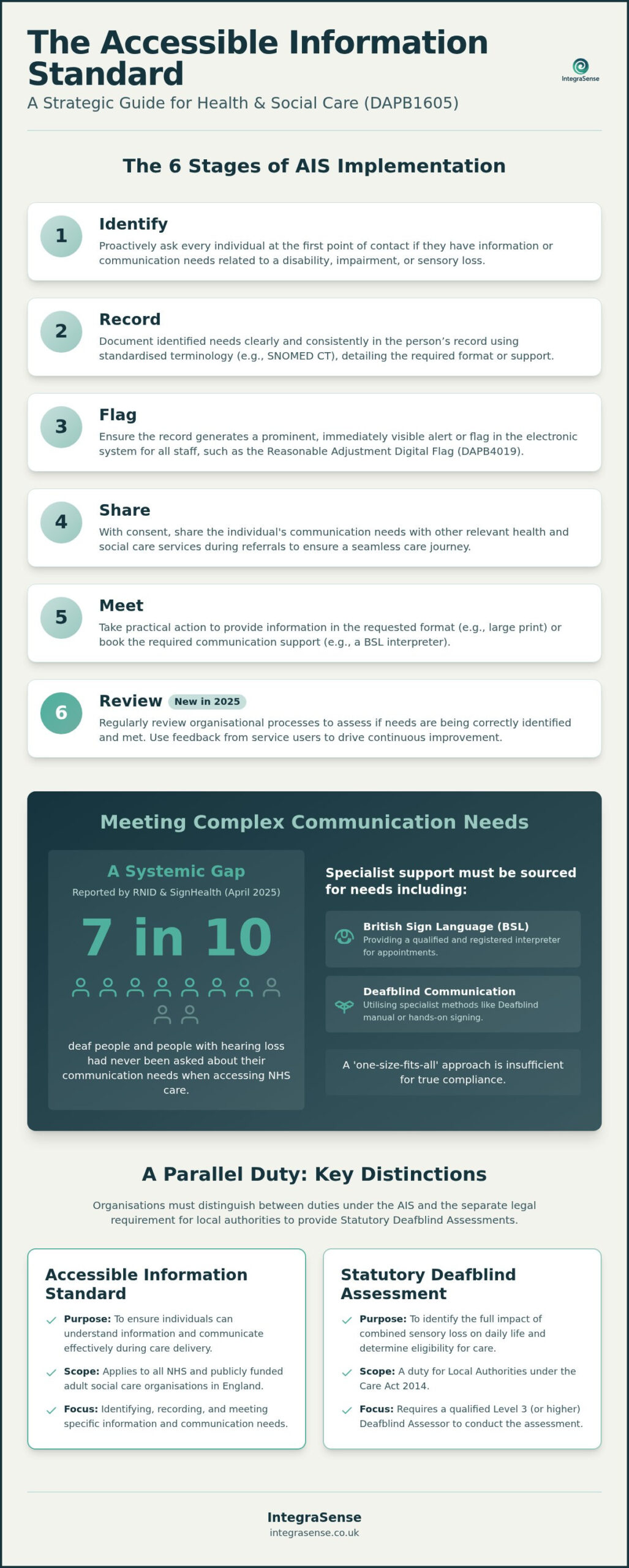
Following its update on 30 June 2025, the Accessible Information Standard (AIS) is structured around a clear, six-stage framework. All NHS and publicly funded adult social care services in England must have due regard to this standard. These stages create a continuous cycle designed to ensure communication needs are systematically identified, met, and reviewed.
- Identify: Proactively ask every individual at the first point of contact if they have any information or communication needs related to a disability, impairment, or sensory loss. This is not a passive duty; it requires services to initiate the conversation.
- Record: Document the identified needs clearly and consistently in the person’s record. This must be a specific, standardised entry detailing the format required (e.g., large print, email) or the support needed (e.g., a British Sign Language (BSL) interpreter).
- Flag: Ensure the recorded information generates a prominent alert or flag in the electronic record system. This flag must be immediately visible to all staff who interact with the individual, ensuring their needs are not overlooked at subsequent appointments or interactions.
- Share: With the individual’s consent, share their communication needs with other relevant health and social care services when a referral is made. This prevents the person from having to restate their needs at every new step of their care journey.
- Meet: Take action to provide the information in the way the person has requested. This involves producing documents in alternative formats or booking the required communication support for their appointments. It is the practical delivery of the accessible information.
- Review: This sixth stage, introduced in the 2025 update, requires organisations to regularly review the processes they have in place. This includes assessing whether needs are being correctly identified and met, and using feedback to drive improvement.
Recording and Flagging in Practice
The effectiveness of the entire AIS framework hinges on the accuracy and visibility of recorded data. The ‘Record’ and ‘Flag’ stages are not merely administrative tasks; they are the technical backbone of a safe and responsive system.
To ensure consistency, needs must be recorded using standardised clinical terminology. The required system is SNOMED CT, though Read v2 or CTV3 codes may still be in use in some legacy systems. Using these codes ensures that the data is interoperable and can be understood by different systems across the health and social care landscape.
The introduction of the Reasonable Adjustment Digital Flag (DAPB4019) is central to this process. When properly implemented, this digital flag ensures that a person’s needs, including those covered by the AIS, are shared electronically and automatically with other services. This is crucial for creating a seamless care pathway, particularly for individuals who move between primary care, secondary care, and social care providers. An effective flag removes the burden from the patient and reduces the clinical risk of vital information being missed during handovers.
Meeting Complex Communication Needs
While standard formats like large print or email address many common needs, some individuals require specialist support that demands a more nuanced approach. A striking finding from RNID and SignHealth’s April 2025 report, “Still Ignored: The Fight for Accessible Healthcare”, revealed that seven in ten deaf people and people with hearing loss had never been asked about their information and communication needs when accessing NHS care. This highlights a systemic gap in identifying and meeting needs, particularly for those with sensory loss.
For people who use BSL, meeting their needs means providing a qualified and registered interpreter for appointments. For individuals with combined sight and hearing loss, often described as Deafblind, the requirements can be even more specific. Support may involve Deafblind manual, hands-on signing, or other methods tailored to the person’s unique sensory profile. Implementing the Accessible Information Standard effectively means having pathways to source and fund this specialist support. You can learn more about the importance of Deafblind communication and why specialist practitioners are essential for safe and effective care.
Organisations must recognise that a one-size-fits-all approach is insufficient. True compliance lies in understanding the specific need and providing a solution that ensures the person can communicate effectively and receive information in a way that is genuinely accessible to them.
Statutory Deafblind Assessments: A Parallel Duty
It is important for social care organisations to distinguish between their duties under the AIS and the separate legal duty to provide a Statutory Deafblind Assessment. While AIS work and these assessments are complementary, they are not the same and are governed by different frameworks.
The duty to conduct a specialist assessment for anyone with combined sight and hearing loss falls to local authorities under the Care Act 2014 and associated statutory guidance. The purpose of this assessment is to identify the full impact of the person’s sensory loss on their daily life and determine their eligibility for care and support.
These assessments must be carried out by a suitably qualified professional holding a Level 3 qualification (or higher for complex cases) as a Deafblind assessor. This is a specialist role, and registration as a BSL interpreter does not qualify an individual to conduct these statutory assessments. The findings from a Statutory Deafblind Assessment will provide a detailed understanding of a person’s communication needs, which in turn informs and strengthens an organisation’s ability to meet its AIS duties.
Sustaining Compliance: Audit, Training, and Governance
The 2025 update to the AIS places a strong emphasis on governance and continuous improvement. The requirement for organisations to appoint a senior named role to oversee implementation signals a shift towards embedding the standard at a strategic level. Furthermore, organisations should be in a position to publish their compliance annually via a self-assessment framework by March 2027.
This is where the ‘Review’ stage becomes critical. Sustaining compliance requires a robust system of monitoring and quality assurance. This should include:
- Regular Audits: Conducting annual audits to test the effectiveness of the entire AIS pathway. Are needs being identified correctly? Are flags visible and acted upon? Are referrals successfully sharing the information? An accessibility audit can provide an objective analysis of systemic strengths and weaknesses.
- Targeted Staff Training: Moving beyond basic awareness to provide staff with the skills and confidence to ask about communication needs sensitively and record them accurately. Training should cover the lived experience of sensory loss to foster greater understanding.
- Professional Supervision: For staff involved in arranging or delivering complex communication support, professional supervision is essential. It provides a structured space to reflect on practice, manage challenging cases, and maintain high ethical standards.
- Patient Feedback: Actively seeking and analysing feedback from patients and service users about their experience. This provides invaluable insight into whether the implemented measures are truly effective.
By embedding these practices, an organisation can move beyond reactive adjustments and create a resilient, proactive system for meeting the communication needs of everyone it serves. How to implement the NHS Accessible Information Standard is not just a question of process, but of leadership and organisational culture.
At IntegraSense, we provide specialist consultancy, communication audits, and statutory assessments to help health and social care organisations build defensible and effective accessibility frameworks. To discuss how we can support your governance and compliance goals, book a specialist communication audit with our team.
Contact IntegraSense to strengthen your AIS implementation strategy.
Frequently Asked Questions
Is the Accessible Information Standard a legal requirement?
The standard itself is not legislation. However, all NHS and publicly funded adult social care services in England must have “due regard” to it under section 250 of the Health and Social Care Act 2012. Implementing the standard is a primary way for organisations to evidence how they are meeting their legal duties to make reasonable adjustments for disabled people under the Equality Act 2010.
Does it cover spoken language translation for people who do not speak English?
No. The Accessible Information Standard applies specifically to the needs of people with a disability, impairment, or sensory loss. The provision of interpreting and translation services for people whose first language is not English is a separate duty and is not covered by this standard. For organisations managing these broader requirements, partnering with an experienced provider like Aabévé Vertaalbureau can ensure high-quality communication across diverse language needs.
What changed in the 2025 update?
The 2025 update (version 1.1.0, reference DAPB1605) introduced several key changes. These include the addition of a sixth stage, ‘Review’, to promote continuous improvement; a new requirement for organisations to appoint a senior named role to oversee implementation; the introduction of a self-assessment framework for reporting on compliance; and clearer alignment with the CQC’s assessment framework. To navigate these evolving standards, CQC Consultancy offers expert guidance for healthcare providers on registration and compliance.
How are communication needs handled where a patient lacks mental capacity?
In cases where a person lacks the mental capacity to make their own decisions, organisations must still identify, record, and meet their communication needs. The standard also requires services to ask about and record the communication needs of any carers, parents, or legal representatives involved in their care. This ensures that those making best interests decisions on the person’s behalf receive information in a format they can understand.