
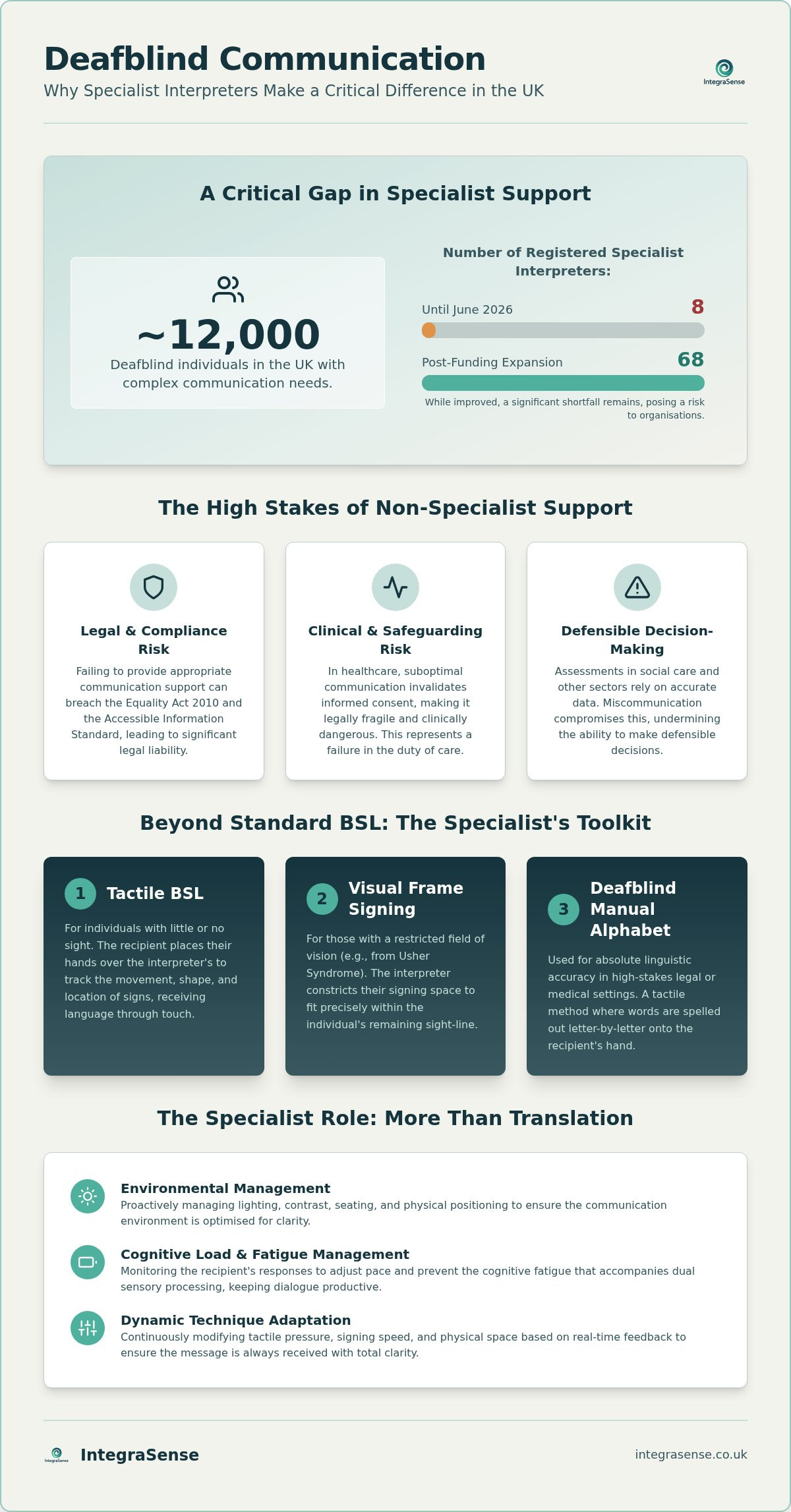
Until June 2026, the United Kingdom relied on just eight registered interpreters to support a population of approximately 12,000 Deafblind individuals with complex communication needs. While recent government funding has expanded this specialist pool to 68 professionals, the historical scarcity highlights a significant risk for organizations striving to meet their statutory obligations. You likely recognize the importance of accessibility, yet navigating the specific requirements of dual sensory loss often leads to operational uncertainty and potential liability. This article examines Deafblind Communication: Why Specialist Interpreters Make a Difference for healthcare providers, local authorities, and employers who require defensible decision-making frameworks. You will discover the technical nuances of tactile modalities and the critical role of specialist assessments in ensuring legal compliance and robust safeguarding. By moving away from generalist solutions, your organization can achieve the precision required for high-stakes professional environments.
Key Takeaways
- Distinguish modalities. Specialist support for dual sensory loss involves bespoke methods like tactile signing and adapted visual frames that go far beyond the scope of general BSL.
- Mitigate risk. Aligning your provision with the Equality Act 2010 and the Accessible Information Standard prevents the significant legal liability associated with miscommunication in professional settings.
- Source expertise. Discover why Deafblind Communication: Why Specialist Interpreters Make a Difference when navigating high-stakes legal or clinical environments that require absolute linguistic precision.
- Secure compliance. Utilising statutory deafblind assessments ensures your decision-making is defensible and your communication strategy is precisely tailored to the individual’s sensory requirements.
The Nuances of Dual Sensory Communication: Beyond Standard BSL
Deafblindness is often misunderstood as a simple additive impairment. In reality, it is a unique disability that fundamentally alters how an individual receives and interprets data from their environment. Standard British Sign Language (BSL) interpreting is designed for a visual field that assumes a certain level of ocular clarity and peripheral range. This is the primary reason Deafblind Communication: Why Specialist Interpreters Make a Difference is so critical; they possess the specific technical training to translate visual language into a format accessible to those with limited or no sight.
The selection of a communication modality is a highly individualized process determined by a person’s residual sensory input. A specialist professional continuously monitors the recipient’s responses to adjust speed, signing space, and tactile pressure. They manage the cognitive fatigue that often accompanies dual sensory processing, ensuring that the dialogue remains productive and the individual stays engaged in the decision-making process.
Specialist Modalities: Tactile, Manual, and Visual Frame
Precision in high-stakes environments requires a sophisticated understanding of diverse modalities. For individuals with no residual sight, tactile BSL involves the recipient placing their hands over the interpreter’s to track movement and shape. In contrast, visual frame signing involves constricting the signing space to match a narrow field of vision, such as that caused by Usher Syndrome. When absolute linguistic accuracy is required in legal or medical settings, the deafblind manual alphabet provides a tactile letter-by-letter method that eliminates ambiguity. Understanding Deafblind Communication: Why Specialist Interpreters Make a Difference involves recognizing their role as environmental consultants who manage lighting, contrast, and physical positioning to ensure every message is received with total clarity.
Mitigating Organisational Risk through Specialist Interpretation
Beyond the linguistic mechanics discussed previously, organizations must address the governance and legal implications of sensory accessibility. The Equality Act 2010 and the Accessible Information Standard mandate that information is provided in a format the individual can actually process. Relying on a non-specialist for a person with dual sensory loss creates a high-risk gap in service delivery that generalist BSL training cannot bridge. Deafblind Communication: Why Specialist Interpreters Make a Difference is most visible when an organization is called to justify its reasonable adjustments during a legal or clinical review, where a failure to provide the correct modality can be interpreted as a failure in duty of care.
High-pressure assignments require more than just technical skill; they require professional resilience. The physical and cognitive demands of tactile interpreting can lead to rapid professional fatigue, which increases the risk of critical errors in translation. This is why professional supervision for interpreters is a strategic necessity for any robust service framework. Supervision provides a reflective space for specialists to manage these complexities, ensuring that the standard of interpretation remains precise, ethical, and reliable throughout the duration of a complex engagement.
Defensible Decision-Making in Public and Health Services
In healthcare settings, the validity of informed consent hinges entirely on the patient’s full comprehension of a procedure or diagnosis. If the communication method is suboptimal, the consent is legally fragile and clinically dangerous. Deafblind Communication: Why Specialist Interpreters Make a Difference by providing the clarity needed to satisfy stringent safeguarding and risk management protocols. For local authorities and social care providers, this level of expertise ensures that assessments are based on accurate, unfiltered data. This facilitates “defensible decisions” that protect both the service user’s autonomy and the provider’s professional standing. IntegraSense supports these frameworks by delivering specialist communication support that aligns with your internal governance and statutory obligations.
Establishing a Framework for Sensory Accessibility and Compliance
Compliance begins with precise identification. A statutory deafblind assessment is the foundational step for any organization, moving beyond generic accessibility to pinpoint exact communication modalities. This is where Deafblind Communication: Why Specialist Interpreters Make a Difference becomes a practical reality. Sourcing NRCPD-registered specialists with specific deafblind competencies ensures that interaction is both functional and accurate. Finally, integrating these requirements into workplace adjustments or long-term care plans ensures sustainable, long-term viability for the individual and the organization. It’s about moving away from reactive fixes toward a structured, proactive system of support.
Consultancy and Quality Assurance for Complex Environments
Maintaining high standards requires ongoing oversight. An External Quality Assurer (EQA) provides the necessary scrutiny to monitor communication standards in complex settings, ensuring that providers meet their statutory obligations. For employers, the journey often involves utilizing Access to Work to fund specialist deafblind support. While the annual grant cap reached £69,260 in April 2026, the real challenge lies in professional practice execution. IntegraSense bridges the gap between initial assessment and delivery, providing the technical depth needed for systemic harmony. We help organizations transition from fragmented support to a cohesive, defensible framework of specialist communication that respects both the individual’s rights and the organization’s legal duties.
Securing the Future of Sensory Accessibility
Achieving linguistic precision in complex professional environments requires more than a generalist approach. It demands a structured framework that prioritizes statutory assessments and the expertise of NRCPD-registered specialists. We’ve explored Deafblind Communication: Why Specialist Interpreters Make a Difference by ensuring legal compliance and facilitating defensible decision-making in high-stakes settings. By integrating these specialist modalities into your organizational strategy, you mitigate risk while upholding the rights of service users. IntegraSense provides the multidisciplinary expertise and defensible frameworks needed to optimize your communication support services. Our specialists in BSL and deafblind communication are ready to help you transition from fragmented provision to a cohesive, compliant system. Contact IntegraSense for specialist communication consultancy and deafblind assessments to ensure your organization is prepared for the future. You can build a truly inclusive space where every interaction is clear and controlled.
Frequently Asked Questions
What is the difference between a BSL interpreter and a deafblind interpreter?
A deafblind interpreter uses tactile or modified visual techniques that go beyond the standard visual field of a BSL interpreter. While BSL interpreters work within a visual frame, deafblind specialists adapt to the user’s specific sensory needs, such as hands-on signing or the manual alphabet. This distinction is central to understanding Deafblind Communication: Why Specialist Interpreters Make a Difference in environments where linguistic precision is non-negotiable.
How do I know if a person requires a specialist deafblind interpreter?
You identify the need through a statutory deafblind assessment or a communication audit conducted by a qualified professional. These evaluations determine if the individual relies on tactile input, a restricted visual field, or specific environmental controls. Relying on a standard BSL professional for someone with dual sensory loss can lead to information gaps, making expert assessment the only defensible way to ensure compliance.
Is a deafblind interpreter covered under Access to Work grants?
Yes, Access to Work grants fund specialist communication support, including deafblind interpreters, for employees in the workplace. As of April 2026, the annual cap for these grants is £69,260 per person. This funding is vital for maintaining professional productivity and safety. Organizations should be aware of the 109-day average processing time recorded in late 2025 and plan their support frameworks accordingly to ensure continuous accessibility.
What are the legal consequences of failing to provide a specialist interpreter under the Care Act?
Failing to provide a specialist can result in a breach of statutory duties, leading to judicial reviews, financial penalties, or safeguarding failures. The Care Act requires local authorities to ensure that individuals with dual sensory loss can participate fully in their care planning. Without Deafblind Communication: Why Specialist Interpreters Make a Difference, organizations risk making indefensible decisions that compromise the safety and autonomy of the individual.