
Could the traditional model of the solitary freelance interpreter be the primary factor limiting the quality of British Sign Language provision across the UK? You likely recognize that the weight of high-stakes assignments, particularly in mental health or judicial settings, creates a compounding emotional toll that’s difficult to process alone. It’s a familiar tension; you balance the need for clinical excellence with the isolation of the freelance circuit, often while struggling to justify the cost of support to Access to Work. Many practitioners find themselves at a crossroads where the intensity of the work outpaces their existing support structures.
This guide explores how BSL interpreter professional supervision transitions your practice from a reactive struggle into an optimized, resilient career. We’ll show you how to build a defensible framework for ethical decision-making and vicarious trauma management. We’ll examine the strategic integration of reflective practice to ensure you meet the 2024 NRCPD professional standards while securing your long-term professional health. By the end of this article, you’ll possess a clear roadmap to turn professional oversight into your most valuable strategic asset.
Key Takeaways
- Define the evolution of interpreting from a solitary task into a collaborative, reflective framework that aligns with the latest UK professional standards.
- Learn to leverage BSL interpreter professional supervision as a strategic tool for making defensible, high-stakes decisions within complex health and legal environments.
- Safeguard your professional workforce by implementing structured debriefing protocols designed to mitigate vicarious trauma and ensure long-term practitioner resilience.
- Identify the most effective delivery model for your organisation by comparing the practical and technical nuances of individual, peer, and group supervision.
- Transition toward a more sustainable and resilient communication strategy by following our specialist guide to integrating professional oversight into your workflow.
Understanding the Framework of BSL Interpreter Professional Supervision
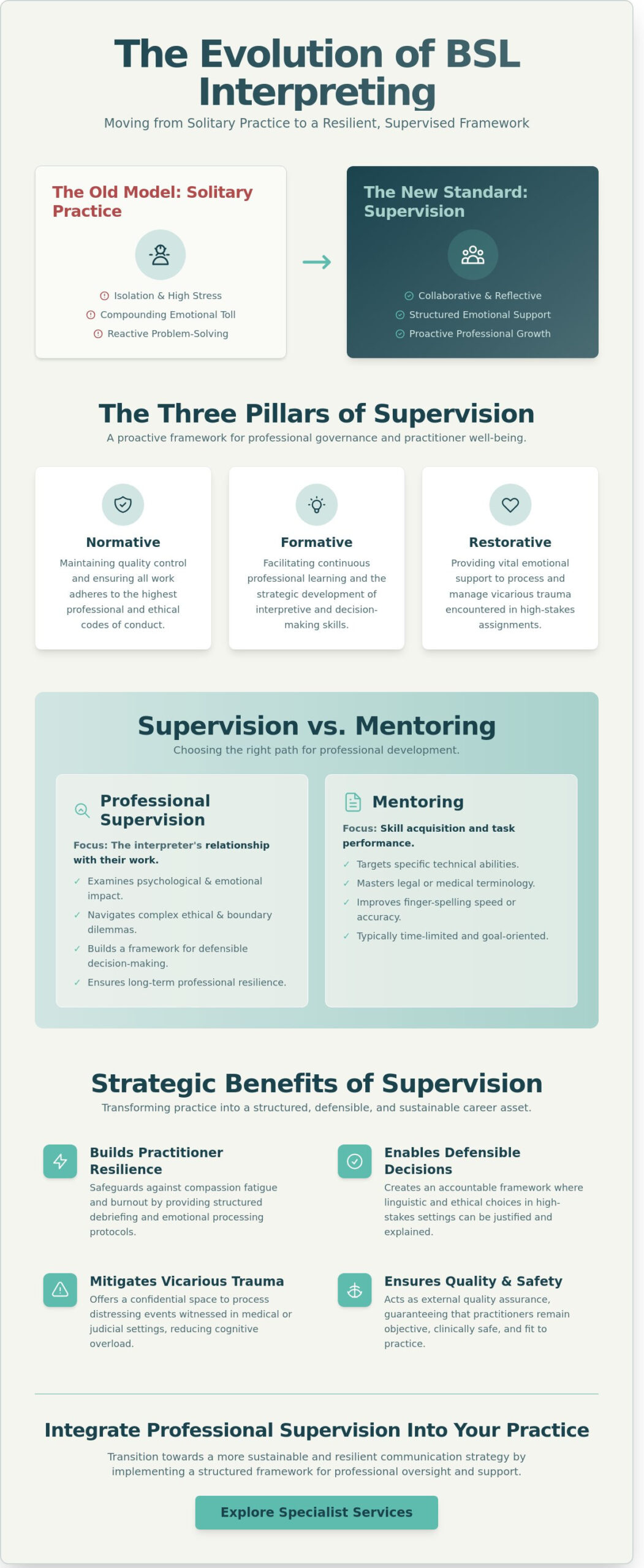
Professional practice for BSL interpreters in the UK is evolving beyond basic technical proficiency. BSL interpreter professional supervision represents a collaborative, reflective process that stands apart from standard line management or technical mentoring. It offers a structured environment where practitioners analyze their work through a critical lens; this ensures every interaction meets the highest ethical standards. This shift mirrors the framework of professional supervision used in healthcare, focusing on long-term sustainability and practitioner resilience.
The NRCPD now highlights supervision as a vital component of professional maintenance. It’s no longer a reactive measure taken when things go wrong. Instead, it’s a proactive tool for professional governance that safeguards both the practitioner and the service user. This approach relies on three distinct pillars:
- Normative: Maintaining quality control and adhering to professional codes of conduct.
- Formative: Facilitating continuous learning and the development of interpretive skills.
- Restorative: Providing the emotional support necessary to manage the secondary trauma often encountered in high-stakes communication.
Supervision vs. Mentoring: Choosing the Right Path
Distinguishing between these two disciplines is essential for career progression. Mentoring typically targets skill acquisition, such as mastering legal terminology or improving finger-spelling speed. It’s a performance-based relationship. Conversely, BSL interpreter professional supervision examines the interpreter’s relationship with their work. You need a supervisor when the challenge isn’t the language itself, but the psychological or ethical weight of the assignment.
The Role of Reflective Practice in Communication Support
Reflective practice creates what specialists call “the third space.” It’s a neutral zone where an interpreter can dissect complex interactions without the pressure of an active assignment. In high-pressure environments like Kent’s acute hospitals or legal settings, this reflection leads to more consistent outcomes. By analyzing past decisions, practitioners gain the clarity needed to handle future complexities with precision. Organizations seeking to optimize their communication support can explore specialist services to ensure their teams meet these rigorous standards.
The Strategic Benefits: From Resilience to Defensible Decision-Making
Professional supervision transforms the raw experience of interpreting into a structured asset for both the individual and the commissioning body. It offers a robust framework for making defensible decisions within high-stakes health and legal environments. When an interpreter justifies a specific linguistic choice or boundary setting, they rely on the reflective practice honed during BSL interpreter professional supervision sessions. This process aligns with the professional standards for BSL interpreters, ensuring that every action remains accountable, transparent, and ethically sound.
Regular, structured debriefing serves as a critical buffer against vicarious trauma and compassion fatigue. Interpreters often witness distressing events in medical or social care settings; without a dedicated space to process these experiences, the risk of cognitive overload increases. Supervision addresses the observer effect, helping practitioners recognize how their presence influences power dynamics while maintaining the neutral positioning essential for effective communication. For organisations, this acts as external quality assurance, guaranteeing that the practitioners they deploy remain objective and clinically safe. Commissioning bodies can further strengthen their governance by aligning procurement decisions with the NUBSLI fee guidance to ensure that supervised, high-quality practitioners are engaged at appropriate market rates.
Managing Ethical Dilemmas in Specialist Settings
Supervision provides a secure, non-judgmental environment to navigate complex ethical grey areas while maintaining absolute client confidentiality. This is particularly vital in deafblind assessments. The dual-sensory complexities in these cases significantly increase cognitive load, requiring a level of precision that only regular reflective practice can sustain. It allows practitioners to sense the subtle shifts in communication needs before they become barriers to service delivery. Legal professionals navigating these same complexities may also benefit from engaging an expert witness Kent to ensure that sensory impairment is accurately represented and assessed within legal proceedings.
Sustainability and Career Longevity for Freelancers
High rates of burnout affect the BSL community, with many practitioners leaving the field prematurely due to the emotional and physical demands of the role. BSL interpreter professional supervision acts as a vital protective factor, turning a demanding career into a sustainable vocation. It’s a long-term investment that reduces turnover and ensures a consistent standard of BSL interpreting in Kent and across the wider UK. Organisations looking to optimize their communication strategies can explore our specialist support services to ensure their teams are supported by resilient, supervised professionals.
Implementing Supervision: A Guide for Practitioners and Organisations
Effective practice demands more than technical fluency. It requires a structured framework for reflection and growth. Integrating BSL interpreter professional supervision into a workflow begins with identifying the right model for your specific environment. Individual supervision provides a private space for deep analysis of complex cases. Peer groups offer a collaborative environment where shared experiences foster collective intelligence. Group supervision, led by a qualified professional, brings a multidisciplinary lens to the challenges of the field. At IntegraSense, we view this as an optimization process that transforms a solitary practice into a resilient, intelligent career path.
Documentation is critical for maintaining professional standards and meeting registration requirements. Practitioners must maintain a detailed log of supervision hours, noting the date, duration, and key learning outcomes. This record serves as vital evidence for Continuing Professional Development (CPD) portfolios. Adherence to the RBSLI Code of Ethics remains the foundation of these sessions; it ensures that every reflective conversation aligns with established UK regulatory standards and professional boundaries. Organisations responsible for procuring BSL services should also reference the NUBSLI fee guidance 2026 to build procurement frameworks that reflect the true cost of professionally supervised, ethically grounded interpreting provision.
Securing Funding through Access to Work
The Department for Work and Pensions (DWP) recognizes the necessity of professional support. Access to Work (AtW) often covers the costs of supervision when it’s framed as a ‘specialist’ or ‘support worker’ requirement. To succeed in an application, your justification must be precise. Avoid vague terms. Instead, specify how supervision prevents burnout and ensures the safety of both the practitioner and the client. Referencing the 2023 AtW operational guidance can strengthen your case by highlighting the role of supervision in maintaining sustainable employment and mental health within the interpreting profession.
Selecting a Qualified Professional Supervisor
Choosing a supervisor is a decision that impacts the long-term health of your practice. Look for professionals who possess a deep sensing of the Deaf community’s cultural nuances and a robust grasp of interpreting ethics. A formal contract is essential for any BSL interpreter professional supervision arrangement. This document should clearly define boundaries, the frequency of meetings, and strict confidentiality protocols. It’s about creating a secure environment where professional challenges can be dissected with surgical precision. Explore our specialist communication and supervision services to see how we support professional excellence through our multidisciplinary consultancy approach.
Securing the Future of Professional Interpreting Standards
Professional excellence in communication support isn’t a static achievement. It’s a continuous process of refinement and strategic oversight. Implementing BSL interpreter professional supervision provides the necessary framework to transform individual practice into a robust organisational asset. This structured approach fosters long-term resilience and ensures that every interaction is grounded in defensible decision-making. By adhering to the NRCPD Code of Conduct and meeting UK Equality Act 2010 requirements, organisations mitigate the significant risks associated with communication breakdown in high-pressure environments. Organisations that embed supervision into their governance structures may also benefit from conducting accessibility audits to ensure their broader compliance framework under the Equality Act 2010 is equally robust and defensible.
IntegraSense offers a sophisticated blend of multidisciplinary consultancy and specialist knowledge in Deafblind and BSL communication. We prioritize precision in governance, helping you navigate the complexities of Access to Work and public sector compliance with quiet confidence. Our focus remains on creating optimized environments where communication flows with intelligence and purpose. We don’t just provide a service; we act as a visionary partner in your journey toward technical and professional sustainability.
Contact IntegraSense to discuss your professional supervision requirements and ensure your team has the clarity and control needed to excel.
Your commitment to professional standards today builds the foundation for a more inclusive and resilient tomorrow.
Frequently Asked Questions
Is professional supervision mandatory for BSL interpreters in the UK?
Professional supervision isn’t currently a mandatory requirement for maintaining NRCPD registration, though it’s recognized as a core pillar of ethical practice. The Association of Sign Language Interpreters (ASLI) and Visual Language Professionals (VLP) advocate for its use to maintain clinical safety. Practitioners who engage in BSL interpreter professional supervision mitigate the risk of vicarious trauma and ensure long-term resilience in high-pressure environments. It’s a strategic choice for those prioritizing excellence.
What actually happens during a typical supervision session?
A typical session functions as a structured space for reflective practice where you analyze complex assignments and navigate ethical dilemmas. You’ll work with a qualified supervisor to sense-make the emotional and cognitive demands of your recent work. This process involves deconstructing specific interactions to identify areas for optimization in your professional output. It’s a methodical approach to identifying patterns that might otherwise lead to burnout. This ensures your service delivery remains precise.
Can I use Access to Work to pay for my professional supervision?
You can use Access to Work grants to fund professional supervision if you’re a Deaf professional or an interpreter with specific support needs. The Department for Work and Pensions (DWP) recognizes supervision as a legitimate expense for maintaining sustainable employment. When applying, you must provide a clear business case that outlines how BSL interpreter professional supervision enables you to meet your workplace responsibilities. This ensures your practice remains efficient and compliant with the Equality Act 2010.
How often should a BSL interpreter attend supervision sessions?
Most practitioners find that attending one session every 4 to 6 weeks provides the necessary cadence for effective reflection. This frequency aligns with industry standards for high-intensity roles where emotional and cognitive loads are high. If you work more than 20 hours per week in complex settings, you might increase this frequency to maintain peak performance. IntegraSense recommends a consistent schedule to ensure your professional development remains proactive. It’s about maintaining a sustainable career path.