
Can your current assessment process survive a legal challenge under the Care Act 2014? For local authorities and healthcare providers, the risk of a non-compliant report isn’t just a procedural error; it’s a direct path to a judicial review. You likely recognize the difficulty in sourcing specialists who possess the precision to evaluate the complex intersection of sight and hearing loss. IntegraSense provides deafblind assessment services Kent that bridge this gap by integrating specialist intelligence with a deep understanding of statutory duties.
We promise to show you how to secure legally robust, specialist-led assessments that satisfy the Care Act 2014 while ensuring every decision is entirely defensible. It’s about moving away from fragmented care towards a model of optimized support that empowers individuals. This article outlines the essential framework for compliance, the importance of specialist qualifications, and the actionable steps to mitigate legal risk in Kent’s social care sector.
Key Takeaways
- Identify the specific statutory mandates of the Care Act 2014 and why generic assessments often fail to meet the legal threshold for specialist sensory loss.
- Access a practical decision-making tool to evaluate external providers against rigorous professional standards and specialist communication requirements.
- Secure legally robust deafblind assessment services Kent organisations can rely on for defensible outcomes and seamless integration into local care pathways.
- Discover the end-to-end journey of a specialist-led assessment, from initial referral to the delivery of expert witness-level reports for complex cases.
Statutory Deafblind Assessments in Kent: Understanding the Care Act Mandate
The Care Act 2014 establishes a clear, non-negotiable duty for local authorities to provide specialist assessments for individuals with combined sight and hearing loss. In Kent, this statutory mandate ensures that residents don’t fall through the gaps of generic social care. Standard assessments often overlook the complex interplay between two sensory impairments, leading to insufficient care packages that fail to address isolation or safety risks. Securing expert dual sensory loss support Kent is vital for maintaining an individual’s independence and dignity. When local authorities bypass these specialist requirements, they risk legal challenges and, more importantly, the wellbeing of vulnerable citizens.
The Legal Definition of Deafblindness and Your Obligations
Deafblindness doesn’t strictly mean a total absence of both sight and hearing. It encompasses varying degrees of dual sensory impairment where the combination of the two losses creates significant barriers to communication, information, and mobility. Understanding Deafblindness involves recognizing how even mild impairments in both senses can compound to create a unique disability. To deliver a Care Act compliant deafblind assessment, the professional must have specific training and expertise. DHSC guidance mandates that a specialist assessor must be a person who is specifically qualified to assess people who are deafblind to ensure their complex requirements are fully understood. This ensures that every deafblind assessment services Kent provider meets the high threshold of expertise necessary to identify nuanced needs.
Defensible Decision-Making in Sensory Social Care
Local authorities face significant litigation risks if their care decisions aren’t grounded in specialist evidence. Defensible decision-making relies on a robust, multidisciplinary approach that integrates clinical insight with social care expertise. By utilizing qualified sensory professionals, Kent-based public sector organisations build a resilient framework that withstands judicial review. This precision reduces service failure and optimizes resource allocation. It’s about moving from a reactive model to a proactive, intelligent system of care that prioritizes long-term sustainability for both the provider and the service user. IntegraSense provides the clarity needed to manage these complex environments with confidence and precision.
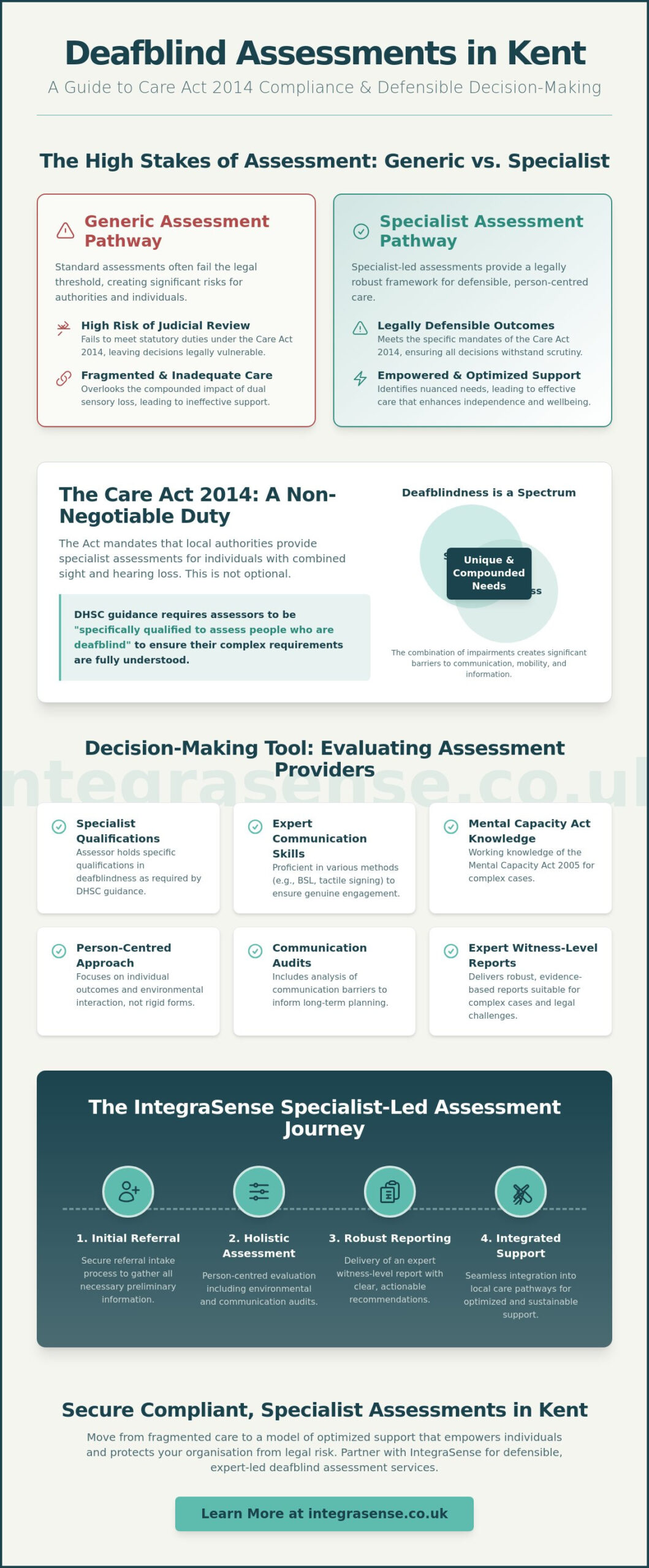
Evaluating Deafblind Assessment Services: A Decision-Making Tool for Kent Organisations
Selecting reliable deafblind assessment services Kent offers is a critical task for local authorities and healthcare providers. It’s not just about meeting a statutory mandate; it’s about ensuring the precision of the data collected to support vulnerable individuals. Commissioners should look for providers who integrate a Specialist Assessment Process that aligns with the Care Act 2014. Quality is maintained through consistent professional supervision. This oversight ensures that statutory reports meet the high threshold required for legal compliance and clinical accuracy, reducing the risk of costly appeals or service failures.
Key Criteria for Selecting a Specialist Assessor
A specialist assessor’s value lies in their ability to translate complex sensory data into actionable care plans. Essential qualifications include sensory-specific training and a working knowledge of the Mental Capacity Act 2005. Effective assessments prioritize person-centred outcomes. They don’t rely on rigid, standardized forms that often overlook the nuances of dual sensory loss. Instead, they focus on how an individual interacts with their environment. Specialist communication support for complex needs, such as BSL or tactile signing, must be integrated from the start. Without these tools, the assessment cannot capture the true needs of the individual, leading to inadequate support packages.
Communication Audits as a Component of Quality Assessments
A communication audit is a vital element of comprehensive specialist services. These audits go beyond identifying hearing or sight loss levels. They analyze the specific barriers an individual faces in their daily interactions and physical surroundings. This data informs long-term care planning and accessibility strategies for Kent organisations. By understanding these sensory dynamics, providers can implement optimized solutions that improve safety and independence. If you need to refine your approach to sensory compliance, you can speak with our specialist team to explore tailored assessment frameworks that ensure your organisation meets its legal obligations with confidence.
Commissioning Specialist Deafblind Assessments in Kent with IntegraSense
Precision in sensory evaluation is a statutory necessity. IntegraSense provides a structured, intelligence-led pathway for local authorities and healthcare providers to secure the high-quality deafblind assessment services Kent requires to meet Care Act 2014 obligations. Our approach moves beyond simple checklists, focusing on the nuanced reality of dual sensory loss to ensure that every individual receives the specific support they need to thrive.
Our Process: From Insight to Implementation
We manage the assessment journey with a focus on efficiency and clinical accuracy. This end-to-end service ensures that no detail is overlooked during the transition from initial referral to final implementation.
- Step 1: Strategic Screening. The process starts with a consultation and risk screening to define the assessment’s scope. This phase identifies the specific communication requirements and environmental factors that will shape the evaluation.
- Step 2: On-site Evaluation. Our specialists conduct face-to-face assessments throughout Kent. We utilise tailored communication methods, including British Sign Language (BSL) and tactile signing, ensuring the individual’s experiences are captured with absolute clarity.
- Step 3: Defensible Reporting. We produce a robust, evidence-based report that meets all professional standards. These documents serve as a reliable foundation for care planning and budget allocation, providing a clear audit trail for compliance purposes.
Why IntegraSense is the Trusted Partner for Kent Authorities
We bring a methodical approach to complex sensory challenges. Our multidisciplinary team includes BSL interpreters and specialists capable of providing expert witness services for high-stakes legal cases. This level of expertise is essential when navigating the complexities of the Mental Capacity Act or contested care packages.
By integrating External Quality Assurance (EQA) into our workflow, we maintain a standard of practice that remains consistently high. We understand the local Kent landscape, from the specific pressures on social care budgets to the geographical challenges of service delivery in rural areas. This local insight allows us to provide recommendations that are both ambitious and achievable. Organisations looking to enhance their sensory provision can contact IntegraSense to arrange a professional consultation.
Advancing Statutory Excellence in Sensory Care
Navigating the complexities of the Care Act 2014 requires more than a standard social care approach; it demands specialized intelligence. Since our founding in 2019, IntegraSense has bridged the gap between statutory requirements and professional practice. We ensure your organization meets its legal mandates through precise, multidisciplinary evaluations that stand up to scrutiny. By prioritizing qualified deafblind assessment services Kent, you mitigate the risk of judicial review while delivering life-changing support to individuals with dual sensory loss. It’s vital to recognize that specialized assessments aren’t just a regulatory hurdle. They’re a framework for sustainable, high-quality outcomes. Our Kent-based team leverages a national reputation for excellence to deliver assessments that are both legally defensible and deeply person-centered. We offer the clarity you need to manage complex sensory environments with absolute confidence. Let’s work together to ensure your services are as resilient and effective as the people they support.
Secure a defensible deafblind assessment in Kent today
Frequently Asked Questions
What qualifies as a ‘specialist’ deafblind assessment in Kent?
A specialist deafblind assessment must be conducted by a practitioner with a minimum Level 5 qualification in dual-sensory impairment. This ensures the assessor possesses the technical intelligence to evaluate complex communication and mobility needs accurately. Under the Care Act 2014, local authorities must ensure that assessors have specific training to identify the unique risks associated with combined sight and hearing loss.
How do I request a deafblind assessment for a resident in Kent?
You can request a specialist assessment by contacting Kent County Council’s adult social services or through a professional referral. It’s vital to explicitly state that the individual has combined sensory losses to ensure the request is handled by qualified specialists. IntegraSense offers professional deafblind assessment services Kent organisations rely on to meet statutory deadlines and maintain high standards of clinical governance.
What is the difference between a standard social care assessment and a deafblind assessment?
A standard social care assessment focuses on general daily tasks, but a deafblind assessment investigates the synergistic impact of losing two primary senses. This specialized evaluation covers communication methods, access to information, and safe navigation of the physical environment. The Department of Health LAC (2001)8 guidance requires this specific focus because standard assessments often overlook the isolation and safety risks inherent in dual-sensory loss.
Can IntegraSense provide expert witness reports for sensory impairment cases in Kent?
IntegraSense delivers expert witness reports for sensory impairment cases, providing authoritative evidence for legal proceedings and tribunals in Kent. Our specialists produce detailed documentation that articulates the precise support hours and technical equipment required for compliance. By integrating clinical insight with statutory frameworks, we help legal professionals and public bodies navigate the complexities of specialist communication support for complex needs in sensory disability law with clarity and precision.