Could a person’s perceived cognitive decline actually be an unaddressed sensory impairment masking the true nature of their condition? In the UK, where over 944,000 individuals currently live with a diagnosis, the distinction between Alzheimer’s disease and other forms of dementia is frequently misunderstood by the organisations responsible for their care. You’re likely aware that managing communication becomes exponentially harder when sensory loss enters the equation, yet the path to a precise diagnosis remains clouded by technical and clinical complexity.
This specialist guide provides the professional clarity required to differentiate between cognitive types and understand the critical intersection where sensory health meets mental function. You’ll gain a sophisticated perspective on the assessment process and the statutory requirements that UK healthcare providers must satisfy to ensure both compliance and long-term sustainability. We’ll explore how integrating specialist sensing expertise transforms a fragmented care environment into one defined by intelligence and optimized support. By the end of this article, you’ll have a clear roadmap for the professional assessment journey and the actionable steps needed to meet your legal obligations with precision.
Key Takeaways
- Distinguish between benign age-associated memory loss and the progressive neurological decline of dementia to ensure timely and precise intervention.
- Uncover the complexities of “diagnostic shadowing” and understand how undiagnosed sensory impairment can be misinterpreted as cognitive failure.
- Navigate the statutory requirements of the Care Act 2014 to ensure local authorities meet their legal obligations for specialist assessments.
- Establish a robust trail of defensible decision-making through professional specialist reporting that mitigates clinical and operational risk.
- Explore the critical link between sensory deprivation and the acceleration of symptoms, highlighting the need for holistic sensing and integrated support.
Defining Dementia: Symptoms, Types, and the Mechanics of Cognitive Decline
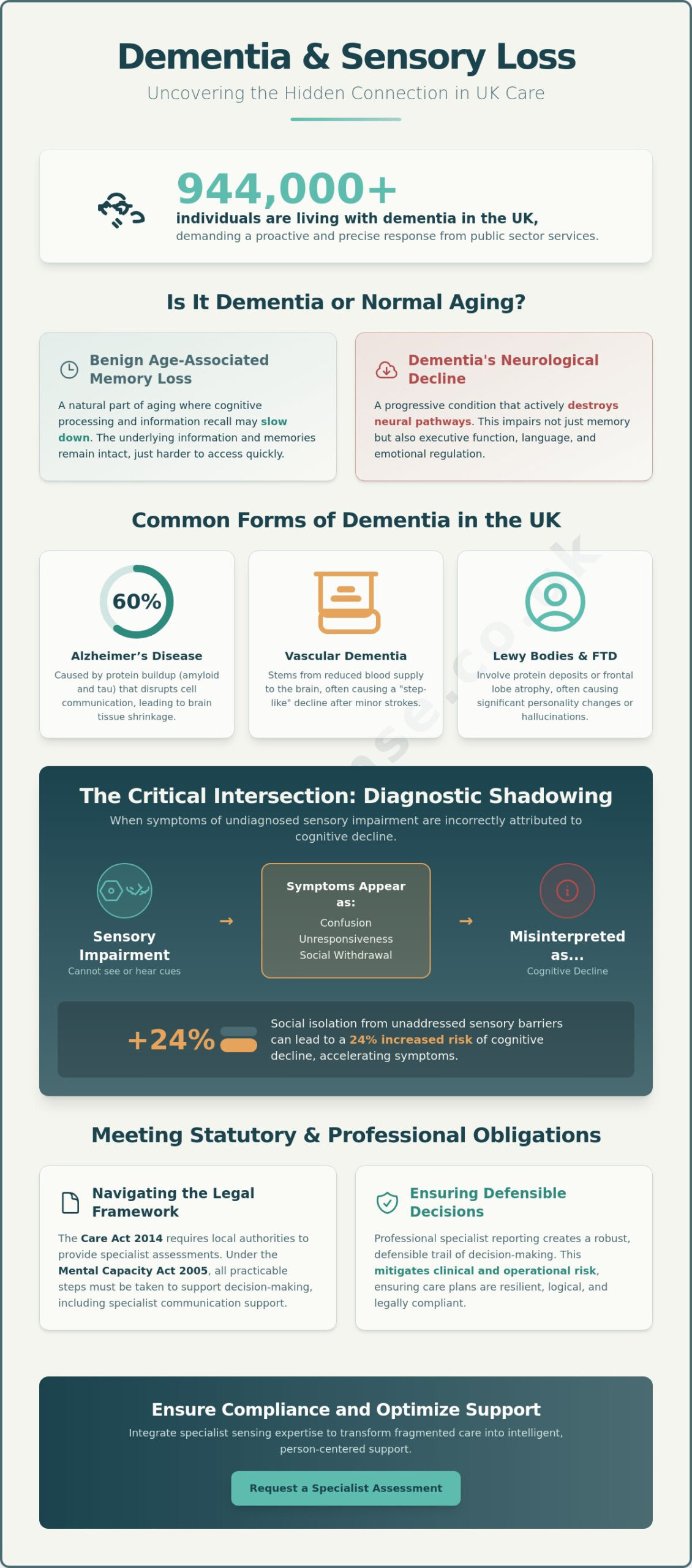
Dementia isn’t a single disease. It acts as a clinical umbrella term for a range of progressive neurological conditions that impair the brain’s ability to function. While many people mistake mild forgetfulness for natural aging, the “Not Normal” rule serves as a vital distinction for healthcare providers and UK employers. Aging might slow recall; Dementia actively destroys the neural pathways required to process information. In the UK, approximately 944,000 individuals are currently living with these conditions, a figure that demands a proactive response from public sector services.
The trajectory of decline involves far more than memory loss. It compromises executive function, language processing, and emotional regulation. A specialist approach recognizes that these shifts aren’t just medical hurdles; they’re significant communication barriers that impact safety and autonomy. Organizations must understand that early intervention isn’t just a compassionate choice. It’s a strategic necessity for maintaining operational compliance and ensuring that support systems remain optimized as the condition evolves.
Common Forms of Dementia in the UK
- Alzheimer’s Disease: This accounts for roughly 60% of UK cases. It’s characterized by the abnormal buildup of amyloid and tau proteins which disrupt cellular communication and lead to brain tissue shrinkage.
- Vascular Dementia: This type stems from reduced blood supply to the brain. It often results in a “step-like” progression where cognitive abilities drop suddenly following minor strokes or small vessel disease.
- Lewy Bodies and Frontotemporal Dementia: These complex forms involve protein deposits or frontal lobe atrophy. They often manifest as significant personality changes, loss of empathy, or visual hallucinations, requiring highly specialized mediation.
The Importance of Early and Accurate Diagnosis
A timely diagnosis serves as the foundation for defensible decision-making. It’s the mechanism that triggers statutory rights under the Equality Act 2010 and facilitates access to specialist support like Access to Work grants. For organisations, a formal diagnosis allows for the seamless integration of specialist services and environmental adjustments. Relying on unqualified assessments creates unnecessary legal and operational risk. Precision in diagnosis ensures that care planning remains resilient, logical, and tailored to the individual’s specific cognitive profile.
The Sensory Intersection: How Sight and Hearing Loss Complicate Dementia
Clinical assessments often fall into the trap of diagnostic shadowing. This occurs when the symptoms of undiagnosed hearing or sight loss are incorrectly attributed to cognitive decline. A person might appear confused or unresponsive simply because they cannot perceive the auditory or visual cues of their environment. Research indicates that sensory deprivation acts as a primary risk factor for the acceleration of symptoms. Social isolation resulting from these barriers can lead to a 24% increase in the risk of cognitive decline. Integrating sight and hearing loss with dementia care is not just a preference; it’s a clinical necessity for accuracy. Dual sensory impairment in the context of dementia refers to the concurrent loss of vision and hearing that creates a unique barrier to information, mobility, and social interaction, demanding a specialised approach to care and communication.
Supporting Communication in Complex Cases
Effective communication audits ensure that an individual’s sensory profile is fully understood before any mental capacity determination is made. Under the Mental Capacity Act 2005, practitioners must take all practicable steps to help a person make a decision. This often requires specialist support, such as British Sign Language (BSL) interpreting or the use of the deafblind manual. Environmental optimization also plays a critical role. Improving acoustic clarity and lighting levels can significantly reduce sundowning and evening confusion by providing clearer sensory anchors. Organisations that prioritise these specialist sensory services foster environments where residents feel secure and understood.
Deafblindness and Dementia: A Specialist Challenge
Individuals with pre-existing sensory loss face a heightened challenge when cognitive changes develop. Their established communication methods may fail as processing speeds alter, requiring a visionary approach to support. Understanding deafblindness in its full historical and professional context — from the advocacy of pioneers like Helen Keller to the statutory frameworks of today — is essential for practitioners navigating these complex cases. Local authorities have a legal obligation to provide Care Act compliant deafblind assessments for anyone suspected of having dual sensory loss. These assessments ensure that the technical and human elements of care are perfectly aligned. Precision in these evaluations prevents the misallocation of resources and ensures that every individual retains their dignity through tailored connectivity.
Statutory Frameworks and Defensible Decision-Making in Dementia Care
The Care Act 2014 establishes a clear legal duty for local authorities to facilitate specialist assessments for individuals presenting with complex needs. This isn’t a suggestion; it’s a statutory mandate. When dementia intersects with sensory impairment, standard assessment models often fail to capture the full scope of clinical risk. Defensible decision-making relies on a robust evidence trail. Professional reports provide this security, ensuring that clinicians and social workers can justify their interventions through a lens of precision and compliance. The Mental Capacity Act 2005 remains the primary safeguard for autonomy, requiring practitioners to support individuals in making their own decisions for as long as possible. IntegraSense acts as a strategic partner in these high-stakes environments, providing specialist consultancy and assessments that align with statutory requirements and mitigate institutional risk.
Professional Supervision for Dementia Practitioners
The emotional weight of managing cognitive decline often leads to vicarious trauma and burnout. Establishing professional supervision for practitioners is a resilience strategy, not a luxury. It provides a structured space to navigate the ethical dilemmas inherent in end-of-life care and complex communication. This support ensures that specialists maintain the clarity required for high-level practice. According to recent industry standards, regular supervision reduces staff turnover by up to 25 percent in high-stress healthcare environments.
Creating a Roadmap for Future Care
Proactive planning is essential before dementia causes cognitive capacity to decline significantly. Lasting Power of Attorney (LPA) and Advanced Decisions should be secured early to ensure the individual’s wishes remain central to their care. Building a multi-disciplinary team is the next logical step. This involves integrating BSL interpreters, specialist assessors, and healthcare providers into a cohesive unit. Maintaining consistent standards across these teams requires a structured approach to external quality assurance that ensures every decision remains defensible and compliant with evolving governance requirements. This collaborative approach transforms a fragmented care plan into a streamlined, resilient roadmap for the future. It’s about moving away from reactive crisis management and towards an optimized, person-centered strategy.
Advancing Precision in Cognitive and Sensory Integration
Effective management of dementia requires a shift from reactive care to an integrated, intelligent strategy. When sensory impairments like sight or hearing loss intersect with cognitive decline, the risk of misdiagnosis or inadequate support increases. It’s vital that local authorities navigate the Care Act 2014 with absolute precision to ensure every assessment remains legally robust and ethically sound. Our framework prioritizes defensible decision-making by embedding specialist communication and BSL interpreting directly into the assessment process. This holistic approach ensures seamless compliance while delivering clarity in high-stakes environments. IntegraSense provides the expertise needed to transform complex sensory data into actionable care pathways. By bridging the gap between statutory requirements and specialist communication needs, we help organisations mitigate risk and improve outcomes. Organisations seeking to strengthen their governance structures can benefit from implementing external quality assurance frameworks that provide independent oversight and reduce the likelihood of compliance gaps. Contact IntegraSense today for specialist consultancy and defensible assessment services to optimize your service delivery and protect vulnerable individuals. Navigating these challenges with the right partner ensures a future defined by precision and professional integrity.
Frequently Asked Questions
Is dementia a natural part of ageing?
Dementia isn’t a natural part of ageing. It represents a clinical syndrome resulting from diseases that physically damage the brain. Statistics indicate that 1 in 14 people over 65 live with the condition, yet it’s a pathological state rather than a standard milestone. Early identification allows for the optimization of support environments and clearer communication pathways for those affected.
What is the difference between Alzheimer’s and dementia?
Alzheimer’s is a specific disease, while dementia is a broader term used to describe a range of cognitive symptoms. Alzheimer’s constitutes 60% to 80% of all cases in the UK. Recognising this difference is essential for delivering precise care. IntegraSense provides the specialist insight needed to bridge the gap between clinical diagnosis and practical, day-to-day environmental intelligence.
How does hearing loss affect a dementia diagnosis?
Hearing loss directly impacts the accuracy of a dementia diagnosis by masking cognitive symptoms or accelerating decline. The Lancet Commission’s 2020 report identifies hearing loss as the primary modifiable risk factor, linked to 8% of cases globally. When sensory connectivity is lost, the brain’s cognitive load increases, which often results in heightened confusion and social withdrawal.
What are the legal rights of someone with dementia in the UK?
People with dementia have clear legal protections under the Equality Act 2010 and the Mental Capacity Act 2005. These frameworks mandate that UK organisations provide reasonable adjustments and support individual decision-making. Failure to comply with these regulations risks legal repercussions and compromises the quality of service delivery within healthcare and employment sectors.
When should I seek a specialist deafblind assessment for someone with dementia?
A specialist deafblind assessment is necessary when someone shows signs of both sight and hearing loss. The Care Act 2014 requires local authorities to ensure these evaluations are conducted by specialists with specific training in dual sensory impairment. This specialized sensing approach ensures that communication barriers don’t lead to an inaccurate assessment of a person’s cognitive capabilities.
Can dementia be prevented or delayed?
While certain risks are genetic, 40% of cases are linked to 12 modifiable lifestyle factors that can be managed. Improving cardiovascular health and maintaining social connectivity are proven methods to delay cognitive decline. By focusing on environmental stewardship, sensory health, and cognitive stimulation through language—a principle central to the curriculum at Meridian Private Primary School—individuals and organisations can build greater resilience against the progression of cognitive diseases.