
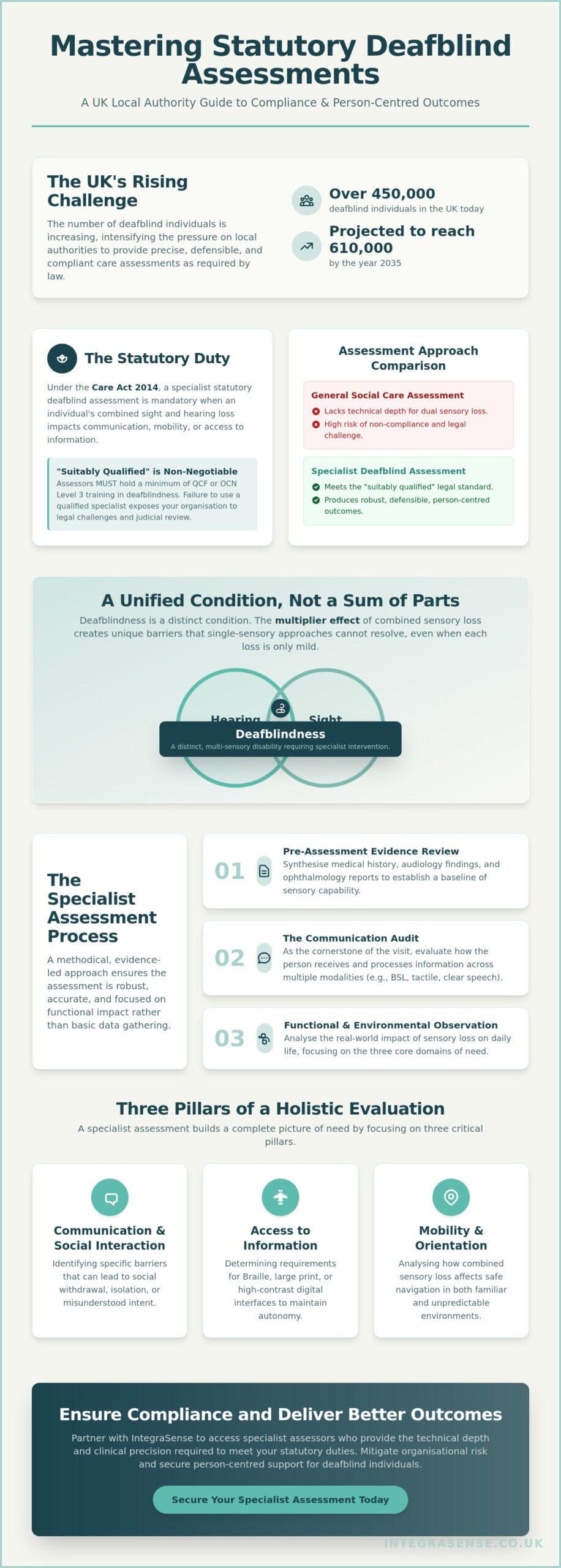
With over 450,000 deafblind individuals currently in the UK and that figure projected to climb toward 610,000 by 2035, the pressure on local authorities to deliver precise, defensible care has never been higher. You likely recognize that a standard social care check is insufficient for dual sensory loss, yet the struggle to secure a “suitably qualified” specialist often leaves organizations vulnerable to legal challenges. Conducting a statutory deafblind assessment is not merely a procedural box to tick; it is a specialist clinical intervention required to ensure 100 percent compliance with the Care Act 2014 and current regulatory standards.
This guide provides the clarity you need to master these complex legal requirements and professional procedures. You’ll understand the specific qualifications mandated for assessors and the specialist steps necessary to move from fragmented reporting to optimized, person-centred outcomes. We will examine how to mitigate organizational risk through robust, expert-led evaluations. By positioning IntegraSense as your strategic partner, you can ensure that technical depth and statutory duties are handled with the precision your service users deserve.
Key Takeaways
- Legal Precision. Understand the specific obligations under the Care Act 2014 to ensure every statutory deafblind assessment is conducted by a specialist who meets mandatory training standards.
- Unified Perception. Shift your organizational perspective to treat dual sensory impairment as a distinct, unified condition rather than a combination of separate hearing and vision losses.
- Communication Clarity. Implement a structured audit to identify precise interaction needs, ensuring support plans are grounded in the individual’s actual lived experience.
- Defensible Outcomes. Secure better results and minimize legal vulnerability by producing reports that bridge the gap between clinical findings and actionable social care.
Understanding the Statutory Requirement for Deafblind Assessments
Compliance is not optional. Under the Care Act 2014 for adults and the Children Act 1989 for children, local authorities carry a strict legal duty to identify and support individuals with dual sensory loss. A statutory deafblind assessment becomes a mandatory requirement the moment an individual’s combined sight and hearing impairment impacts their daily communication, mobility, or access to information. This trigger applies regardless of whether either sensory loss is total; it is the multiplier effect of the two impairments that defines the legal need.
General social care assessments are frequently insufficient in these cases because they lack the technical depth required by the “suitably qualified” mandate. This mandate, issued under section 78 of the Care Act, requires assessors to hold a minimum of QCF or OCN Level 3 training in deafblindness. Relying on non-specialist staff doesn’t just compromise the quality of care. It exposes organizations to successful legal challenges and judicial reviews by failing to address the unique complexities of the condition.
The Definition of Deafblindness in 2026
Official guidance clarifies that Deafblindness is not merely the sum of two separate disabilities. It’s a unique condition where the combination of impairments creates barriers that a single-sensory approach cannot resolve. Even mild losses in both hearing and sight can significantly impede a person’s ability to navigate their environment or participate in social settings. Deafblindness is a distinct, multi-sensory disability that necessitates specialist intervention to unlock effective communication and safe navigation.
Sensory Intersection: Deafblindness and Dementia
Assessing sensory loss becomes significantly more complex when cognitive decline is present. Without a specialist’s eye, it’s easy to misinterpret the symptoms of sensory deprivation as advanced dementia, leading to inappropriate care pathways and increased distress for the individual. Our specialist guide to dementia and sensory intersection explores how these conditions interact. A precise statutory deafblind assessment prevents misdiagnosis by isolating sensory barriers from cognitive symptoms. IntegraSense provides the expertise required to untangle these disparate challenges, ensuring that care environments are optimized for both sensory and cognitive needs.
The Mechanics of a Specialist Assessment: Beyond General Social Work
Executing a statutory deafblind assessment requires a methodical transition from desk-based review to active clinical observation. We don’t start with the interview; we start with the evidence. A specialist assessor must synthesize medical history, recent audiology findings, and ophthalmology reports to build a baseline of sensory capability before meeting the individual. This preparatory phase ensures that the face-to-face visit focuses on functional impact rather than basic data gathering.
The communication audit is the cornerstone of the visit. We evaluate not just what the person says, but how they receive and process information. This involves testing various modalities, from British Sign Language (BSL) and tactile signing to clear speech or the use of assistive listening devices. While the UK context is governed by the Care Act, looking at international standards like the legal definition of deaf-blindness in educational settings reveals how critical early, precise identification is for long-term outcomes.
Core Domains Evaluated During a Statutory Visit
We focus on three critical pillars to build a holistic picture of need:
- Communication and Social Interaction: Identifying the specific barriers that lead to social withdrawal or misunderstood intent.
- Access to Information: Determining if the individual requires Braille, large print, or high-contrast digital interfaces to maintain autonomy.
- Mobility and Orientation: Analyzing how the intersection of sight and hearing loss affects safe navigation in both familiar and unpredictable environments.
The Role of Specialist Communication Support
An assessment cannot be robust if the individual cannot fully participate. Utilizing a qualified BSL interpreter or a deafblind manual specialist ensures that the assessment captures the person’s true voice and intent. Following the visit, we often recommend comprehensive accessibility audits to translate our findings into tangible environmental changes. If your organization requires a defensible, expert-led approach to these complex cases, explore our specialist services to ensure full operational compliance and system harmony.
Securing Robust Outcomes: Professional Reporting and Risk Management
A completed statutory deafblind assessment must function as a legally defensible document that stands up to the scrutiny of ombudsman complaints or judicial reviews. It isn’t enough to list impairments; the reporting must articulate the precise relationship between sensory loss and social care outcomes. A robust report provides a clear audit trail that justifies resource allocation while mitigating the significant risks associated with non-compliance and safeguarding failures.
Non-compliant assessments often lead to fragmented care pathways that fail to meet the statutory threshold for specialist expertise. This negligence increases organizational vulnerability and frequently results in poor person-centred outcomes. IntegraSense acts as a strategic partner in this landscape, offering external quality assurance to ensure your internal processes meet the highest professional standards of governance.
From Assessment to Actionable Care Planning
Effective care planning translates sensory findings into specific, quantifiable interventions. This often includes the provision of specialist 1-to-1 support, such as intervenor services, which facilitate interaction and environmental access. When implementing these complex care plans, including those requiring overnight support, CQC-regulated providers like NeeryVille Care offer the professional domiciliary support necessary to maintain safety and independence. Because conditions like Usher Syndrome are degenerative, we emphasize the necessity of scheduled reviews. Regular re-evaluations ensure that support levels remain synchronized with the individual’s changing sensory profile and cognitive processing needs.
To ensure these intensive care packages are managed effectively at all times, Contesto provides the operational support and out-of-hours management that care providers need to maintain safety and compliance across the United Kingdom.
Organisational Governance and Defensible Decisions
Local authorities hold a statutory duty to identify, contact, and maintain an accurate record of deafblind individuals within their jurisdiction. Expert-led assessments provide the evidentiary basis for this record, ensuring that public sector spending is targeted and efficient. By utilizing specialists who understand the intricate mechanics of dual sensory loss, organizations can move away from reactive crisis management toward optimized, long-term care strategies. To ensure your assessments meet statutory excellence, contact IntegraSense today.
Optimizing Social Care Through Specialist Governance
The landscape of social care in 2026 demands a shift from generic evaluations to precise, specialist interventions. We’ve explored how a robust statutory deafblind assessment serves as the foundation for both legal compliance and meaningful person-centred outcomes. By identifying the unique intersection of sensory loss and implementing expert-led communication audits, organizations can mitigate the risks of ombudsman complaints and safeguarding failures.
IntegraSense provides the multidisciplinary expertise necessary to navigate these technical complexities. Our consultants deliver expert-led assessments grounded in Care Act 2014 compliance, ensuring that local authorities maintain defensible decision-making and rigorous risk management. With deep proficiency in BSL and dual sensory loss, we help you transform fragmented data into a cohesive, actionable support strategy that respects both statutory duties and individual dignity.
Explore our Specialist Assessment and Reporting Services to bring clarity and control to your sensory care provision. It’s time to move toward an optimized environment where specialist knowledge empowers every individual to connect with their world more effectively.
Frequently Asked Questions
Is a deafblind assessment different from a standard Care Act assessment?
Yes, a statutory deafblind assessment is a distinct legal requirement that goes beyond the parameters of a standard Care Act assessment. While general assessments focus on broad wellbeing, this specialist intervention analyzes how the combination of sight and hearing loss creates unique barriers. It’s specifically designed to identify technical requirements for communication and mobility that generalist evaluations frequently miss, ensuring the individual’s dual sensory needs are fully recognized.
Who is considered “suitably qualified” to carry out a deafblind assessment?
A “suitably qualified” assessor must hold a minimum qualification of QCF or OCN Level 3 in deafblindness. This professional standard ensures the assessor can interpret the complex intersection of sensory impairments and their impact on daily life. Relying on staff without these specific credentials leaves organizations vulnerable to legal challenges and fails to meet the statutory mandates established in current UK social care guidance.
What happens if a local authority refuses to provide a specialist assessment?
When an authority refuses to provide a specialist assessment, it’s often in breach of its duties under the Care Act 2014. Individuals or their advocates can challenge these decisions through formal internal complaints, the Local Government and Social Care Ombudsman, or judicial review. Ensuring that a specialist leads the process from the start prevents these costly legal disputes and secures more defensible outcomes for the organization.
How much does a private statutory deafblind assessment cost for an organisation?
Costs for private specialist assessments are determined by the complexity of the individual’s needs and the specific communication support required during the visit. Organizations should request a bespoke proposal that accounts for preparatory data review and the production of a defensible, expert-led report. Choosing a specialist provider ensures that the final assessment provides a robust audit trail for public spending and organizational governance.