
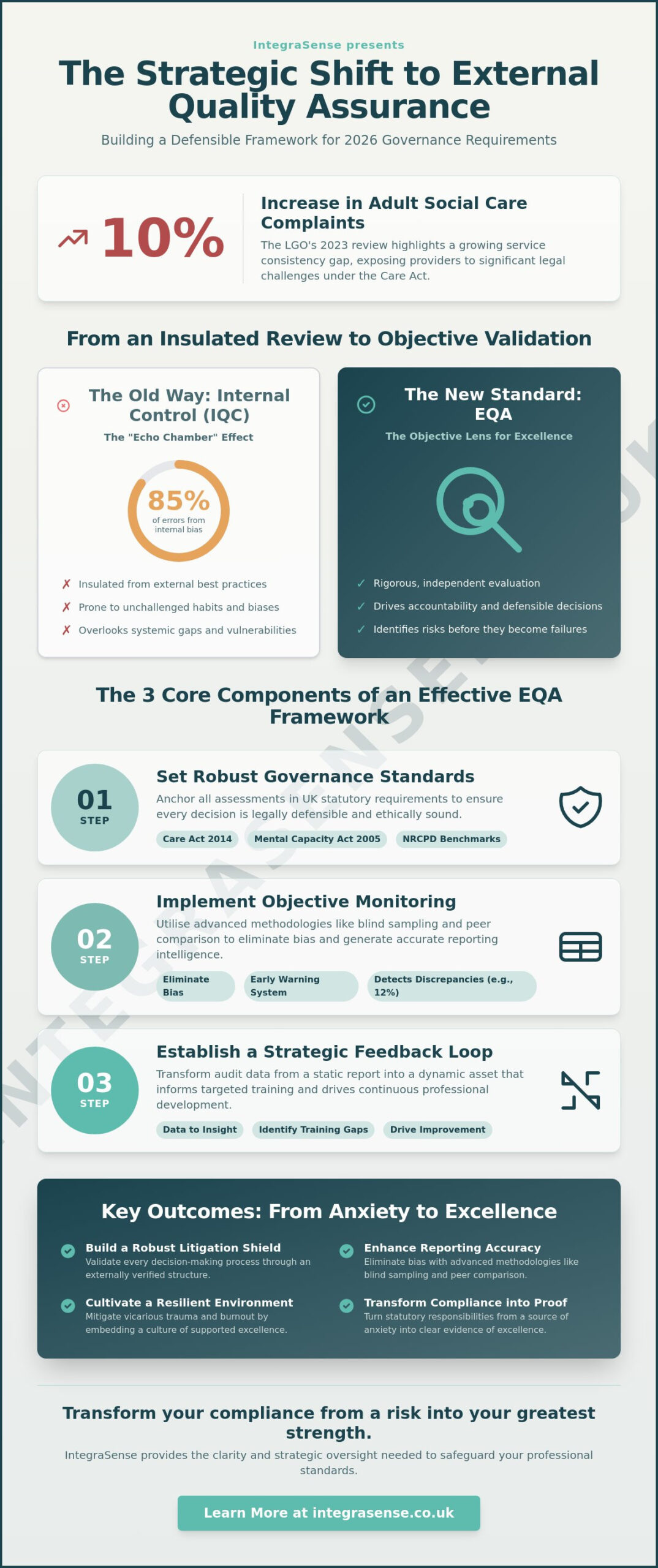
According to the Local Government and Social Care Ombudsman’s 2023 review, complaints regarding adult social care saw a 10% increase, highlighting a growing gap in service consistency. It’s a sobering reality for providers who manage complex communication and care environments where a single misstep under the Care Act can lead to significant legal challenges. You’re likely aware that maintaining uniform standards across multidisciplinary teams feels like a moving target as regulatory demands intensify. Relying on internal oversight alone often leaves gaps in compliance that only become visible during a formal audit. This guide shows how implementing external quality assurance creates a robust framework to safeguard professional standards and ensure every decision is defensible. We’ll examine the strategic shift toward 2026 governance requirements and how IntegraSense provides the clarity needed to reduce organisational risk while delivering person-centred outcomes. You’ll discover a methodical approach to service improvement that transforms your statutory responsibilities from a source of anxiety into evidence of excellence.
Key Takeaways
- Transition from internal oversight to a sophisticated external quality assurance framework that provides the objective lens necessary for true organisational accountability.
- Establish precise, measurable benchmarks aligned with UK statutory requirements to ensure your professional outputs consistently meet the highest industry standards.
- Build a robust shield against litigation by validating your decision-making processes through an externally verified structure that ensures every action is defensible.
- Implement advanced methodologies like blind sampling and peer comparison to eliminate bias and enhance the accuracy of your reporting intelligence.
- Cultivate a resilient professional environment that mitigates vicarious trauma and burnout by embedding a culture of excellence and structured support.
Understanding External Quality Assurance (EQA) in Complex Professional Settings
Effective governance relies on the ability to see beyond internal operational boundaries. External quality assurance represents a rigorous, independent evaluation of an organisation’s processes and professional outputs, ensuring that standards remain consistent and objective. Unlike internal reviews, which can become insulated, External Quality Assessment (EQA) introduces a necessary layer of accountability. It transforms quality from a static checkbox into a dynamic driver of professional excellence. This shift is vital for services where the stakes involve legal compliance and human rights.
EQA vs. IQC: Why Internal Checks Are Not Enough
Internal Quality Control (IQC) provides a basic baseline, yet it often suffers from an “echo chamber” effect. In small, specialised teams, up to 85% of procedural errors can stem from unconscious bias or established habits that go unchallenged by colleagues. These internal peer reviews frequently overlook systemic gaps because the reviewers are too close to the daily workflow. External perspectives identify these vulnerabilities before they escalate into service failures or regulatory breaches. EQA is the ultimate safeguard for professional integrity in 2026.
Specialist Application: Sensory Loss and Cognitive Decline
In high-stakes environments like British Sign Language (BSL) interpreting or statutory assessments, the margin for error doesn’t exist. Accuracy is a legal requirement under the Equality Act. Implementing robust external oversight ensures that Care Act compliant deafblind assessment standards are met with absolute precision. A thorough understanding of deafblindness — rooted in the social model of disability and the professional standards that have evolved from advocacy milestones — is essential for practitioners who must make legally defensible decisions in this specialist field. This proactive oversight directly correlates to improved outcomes when understanding dementia and its intersection with sensory loss. IntegraSense positions EQA as a strategic tool to optimise these complex interactions, moving away from reactive monitoring toward a model of continuous professional refinement. This approach ensures that specialists provide the clarity and control that vulnerable service users require.
- Objective validation of communication support and interpreting standards.
- Reduction of risk in statutory social care assessments.
- Alignment with 2026 regulatory frameworks and best practices.
The Core Components of an Effective EQA Framework
Precision in external quality assurance requires more than a standard checklist. It demands a structured architecture that senses vulnerabilities before they manifest as systemic failures. By 2026, the integration of data-driven insights with human expertise will define the most resilient frameworks. This approach moves beyond simple compliance, turning audit data into a strategic asset for organisational growth.
Step 1: Setting Robust Standards for Governance
Effective governance begins by anchoring all assessments in UK statutory requirements. Frameworks must align strictly with the Mental Capacity Act 2005 and the Care Act 2014 to protect both the provider and the service user. Defining “good” in specialist communication support involves measuring performance against NRCPD benchmarks and the European Union’s Quality Assurance Framework, which offers a sophisticated blueprint for maintaining high-level professional standards. This alignment ensures that BSL interpreting and specialist support services remain legally defensible and ethically sound.
Step 2: Monitoring, Reporting, and Risk Identification
Reliable reporting hinges on “blind sampling” and rigorous peer comparison. These methods eliminate internal bias, ensuring that the evidence gathered is an objective reflection of service delivery. Organisations seeking to validate their physical and digital environments often commission an accessibility audit Kent venues rely on for robust compliance. This level of scrutiny acts as an early warning system. For instance, if a 12% discrepancy is detected in reporting accuracy across different departments, the EQA process flags this as a systematic risk rather than an isolated incident.
The final stage of a mature framework is the feedback loop. Data shouldn’t sit dormant in a report; it must inform professional development. By identifying specific training gaps, such as a lack of fluency in updated legislative terminology, organisations can implement targeted CPD strategies. This creates a cycle of continuous improvement where audit findings directly translate into actionable service enhancements. If you’re ready to refine your internal processes, you can consult with our specialist team to build a bespoke quality framework.
- Measurable Benchmarks: Establish KPIs based on 2026 professional best practices.
- Blind Sampling: Use independent reviewers to verify the integrity of service reports.
- Actionable Insights: Convert audit data into specific training modules for staff.
- Risk Mitigation: Identify 100% of systematic errors through cross-departmental peer comparison.
Why External Quality Assurance is Essential for Defensible Decision-Making
External quality assurance provides a robust shield against litigation. It transforms subjective professional choices into evidence-based actions backed by an audited framework. When local authorities or healthcare trusts face scrutiny, the presence of an external validator ensures that every decision rests on a foundation of proven best practice. This transparency builds deep trust with stakeholders who rely on specialist support. Organisations that adopt these frameworks move beyond mere compliance; they demonstrate a commitment to high-level governance that positions them as specialist leaders.
Operational resilience depends on the wellbeing of the workforce. EQA reduces vicarious trauma and professional burnout by ensuring practitioners operate within a “best practice” environment where the burden of responsibility is shared with a validated system. This structured oversight provides the clarity needed to manage complex cases without the isolating pressure of unverified decision-making. By implementing rigorous external quality assurance schemes, providers can ensure their service delivery remains both ethical and sustainable.
The Intersection of EQA and Professional Supervision
EQA findings offer a vital data stream for BSL interpreter professional supervision. While supervision focuses on the individual practitioner’s growth, external quality assurance provides the objective benchmarks required for meaningful reflective practice. This synergy allows senior practitioners to align their personal development with organisational goals. It bridges the gap between individual performance and systemic excellence, ensuring that supervision isn’t just a supportive conversation but a strategic tool for quality control.
Managing Risk in Public Sector Contracts
Public sector procurement demands more than just basic certification. Meeting the rigorous requirements of Access to Work and NHS health sector contracts requires a demonstrable track record of third-party validation. EQA transforms raw data into strategic intelligence. This intelligence allows managers to identify risks before they escalate into service failures. Organisations using EQA are better equipped to navigate the 2026 regulatory environment, where data-driven governance is the expected standard for any specialist provider.
For professionals who value this level of strategic intelligence and are looking to apply it to their broader financial interests, you might check out BGS Capital for information on pre-IPO investment opportunities.
Securing Future Governance Through Strategic Oversight
Effective governance isn’t a static requirement. As we look toward 2026, the complexity of professional practice requires a shift from reactive monitoring to proactive, multidisciplinary oversight. This approach bridges critical gaps between health, education, and legal standards to ensure no detail is overlooked. Implementing a robust framework for external quality assurance ensures your organisation maintains defensible decision-making while meeting the rigorous demands of Care Act 2014 compliance. It’s about turning chaotic data into clear, actionable intelligence.
To ensure this intelligence remains secure, especially when operating in complex enterprise or tactical environments, Quantum Infinity provides specialized stealth tunneling solutions that safeguard the technical foundations of your governance.
Since its founding in 2019, IntegraSense has focused on specialist sensory and communication expertise to help UK providers navigate these intricate landscapes. Our multidisciplinary team integrates clinical insight with legal rigour to protect both the practitioner and the service user. By prioritising precision and long-term sustainability, you transform compliance from a burden into a strategic advantage. You’ll find that clear oversight leads to better outcomes for everyone involved. To begin refining your governance model, explore IntegraSense specialist EQA and consultancy services. Precision in governance today builds the resilience needed for tomorrow’s challenges.
Frequently Asked Questions
What is the difference between Internal and External Quality Assurance?
Internal quality assurance focuses on an organisation’s own monitoring processes to maintain standards from within. External quality assurance involves an independent body validating these processes against national benchmarks. This external lens provides the necessary distance to identify blind spots that internal teams might overlook. It ensures your governance frameworks remain resilient and aligned with the 2024 updates to professional standards.
How often should an organisation undergo External Quality Assurance?
Most UK organisations should schedule an external quality assurance audit every 12 to 24 months to maintain high levels of compliance. Sectors involving high-risk clinical or social care environments often require annual reviews to mitigate professional liability. Regular cycles prevent the degradation of standards and ensure your systems adapt to new legislative requirements. This proactive cadence transforms quality control from a reactive hurdle into a strategic asset for long-term sustainability.
Is External Quality Assurance mandatory for BSL interpreting agencies?
External quality assurance is a mandatory requirement for BSL interpreting agencies seeking to maintain registration with the NRCPD or to secure public sector contracts under the 2023 Crown Commercial Service frameworks. Agencies must demonstrate that their interpreters meet the rigorous standards necessary for high-stakes communication. Failing to implement these independent checks increases the risk of professional negligence. IntegraSense helps agencies navigate these requirements to ensure seamless service delivery across healthcare and legal settings.
How does EQA help in making defensible decisions in social care?
EQA provides a robust evidence trail that justifies professional judgements in social care settings, making them legally and ethically defensible. By documenting that decisions follow a validated, independent framework, practitioners can demonstrate compliance with the Care Act 2014. This process reduces the likelihood of successful legal challenges. It shifts the focus from subjective opinion to objective, data-driven reasoning. Having this external validation ensures every action is grounded in proven professional practice.