
Selecting the lowest tender for British Sign Language (BSL) provision isn’t a budget victory; it’s a strategic risk that often leads to statutory non-compliance and compromised service delivery. Most procurement leads understand the pressure to reduce overheads while meeting the mandatory requirements of the Equality Act 2010. However, unpredictable costs and regional price shifts often turn essential accessibility into a fiscal challenge. Aligning your strategy with the latest nubsli fee guidance provides the clarity needed to transform these complex variables into a predictable, optimized framework for the 2026 financial year.
IntegraSense offers the specialist intelligence required to master these complexities, ensuring your organisation makes defensible, high-quality procurement decisions that stand up to scrutiny. You’ll gain a clear understanding of current BSL market rates and learn how to build a robust framework that prioritizes both fiscal responsibility and professional standards. We provide a comprehensive overview of regional fee structures, the critical necessity of qualified interpreters, and actionable steps to secure seamless communication support for every service user. By the end of this guide, you’ll possess the tools to move away from chaotic spending toward a model of precision and long-term sustainability.
Key Takeaways
- Gain a sophisticated understanding of how market-reflective benchmarks establish a foundation for defensible and high-quality BSL procurement.
- Decode the 2026 regional weighting and booking structures to ensure your financial planning for interpreting services is both precise and sustainable.
- Protect your organisation from the operational risks of non-attendance and subpar quality by aligning your procurement strategy with the nubsli fee guidance.
- Transition from reactive cost-management to a proactive, quality-first approach that secures access to the UK’s most experienced and qualified practitioners.
- Leverage strategic insights to integrate professional communication standards into your broader accessibility and regulatory compliance frameworks.
What is NUBSLI Fee Guidance and Why Does it Matter?
The National Union of British Sign Language Interpreters (NUBSLI) serves as the primary professional body representing the interests of BSL/English interpreters across the United Kingdom. Their published nubsli fee guidance functions as a vital intelligence tool, allowing organisations to sense the current market climate and respond with precision. This guidance isn’t an arbitrary list of charges; it’s a data-driven benchmark established through rigorous surveys of the workforce to reflect actual market rates and the rising cost of professional practice.
Adopting these standards is essential for maintaining a sustainable and qualified workforce. When organisations ignore these benchmarks, they compromise the resilience of the local interpreting community, often leading to a shortage of specialists for critical assignments. The guidance distinguishes itself from mandatory tariffs by acting as a professional reference point. It empowers organisations to make informed decisions that balance budgetary constraints with the necessity for high-quality British Sign Language (BSL) access. For those seeking specialized support in navigating these requirements, our specialist services provide the necessary strategic oversight.
Understanding RSLI vs TSLI Fee Structures
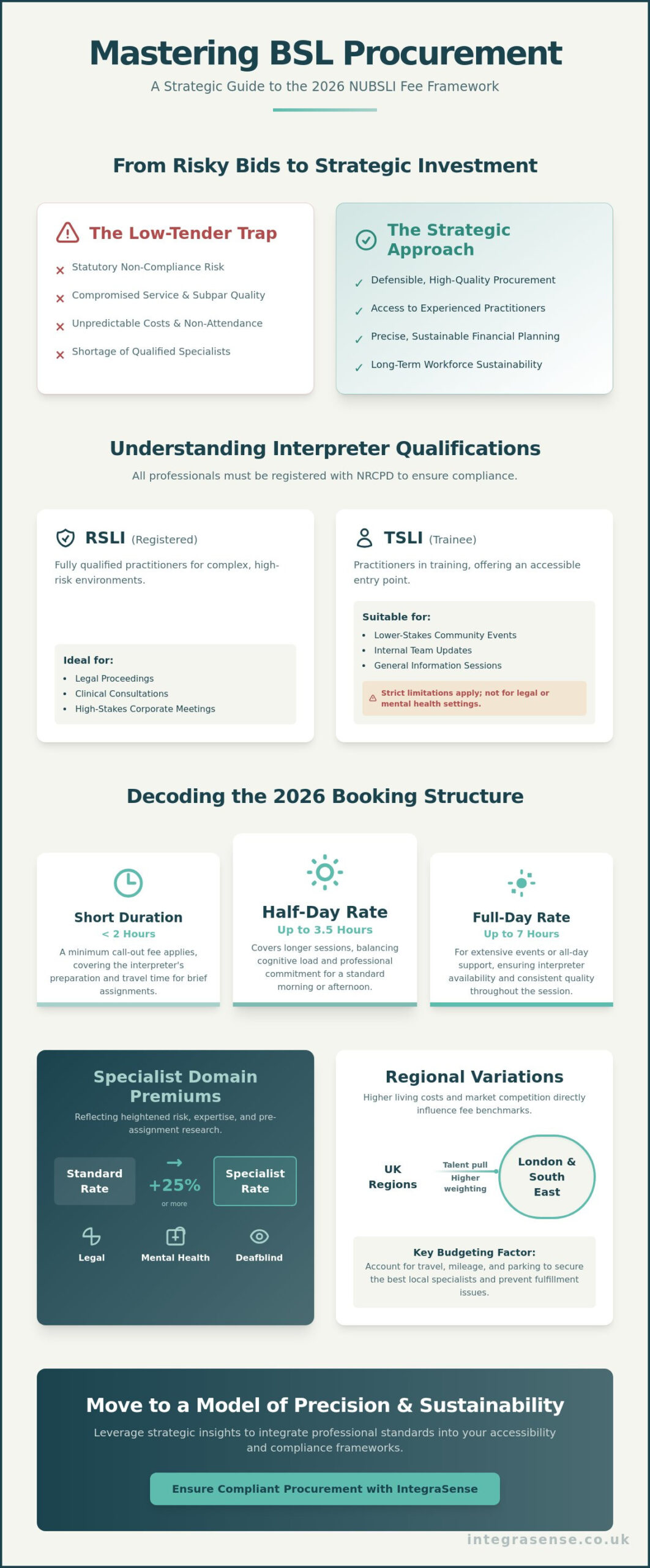
Effective BSL procurement requires a clear understanding of the professional hierarchy within the field. Registered Sign Language Interpreters (RSLI) are fully qualified practitioners capable of handling complex, high-risk environments such as legal proceedings or clinical consultations. In contrast, Trainee Sign Language Interpreters (TSLI) offer a more accessible entry point for lower-stakes interactions. While TSLI rates reflect their status as practitioners in training, they come with strict practice limitations; they shouldn’t be utilized in mental health or legal settings where advanced expertise is mandatory. To ensure full regulatory compliance, all BSL professionals must maintain active registration with the National Registers of Communication Professionals working with Deaf and Deafblind People (NRCPD). Organisations that invest in supervision for BSL interpreters as part of their governance framework are better positioned to maintain practitioner quality and reduce the risk of costly communication failures.
Decoding the 2026 Fee Structure: Rates, Regions, and Terms
The 2026 framework provides a necessary benchmark for transparency in procurement. It ensures that organisations pay for the specific expertise they require while maintaining a sustainable workforce. Standard booking units are divided into three distinct tiers to reflect the cognitive load and time commitment of the professional. Short duration assignments, typically under two hours, carry a minimum call-out fee. This covers the interpreter’s preparation and travel time. Half-day rates apply to bookings up to 3.5 hours, while full-day rates cover sessions up to seven hours. Following the nubsli fee guidance ensures that these rates remain fair and consistent across the industry.
Specialist domains require a more nuanced approach to budgeting. Legal proceedings, mental health assessments, and complex deafblind assignments demand advanced qualifications and significant pre-assignment research. These roles often command a premium of 25% or more above standard community rates. This isn’t an arbitrary increase. It reflects the heightened professional indemnity risks and the specialist expertise required to ensure accuracy in high-stakes environments. Legal professionals managing cases involving sensory impairment should also consider engaging an expert witness Kent to ensure communication barriers are properly identified and addressed before they compromise proceedings. When planning complex projects, referencing the Channel 4 guidance on BSL interpreters offers valuable context on why adhering to established benchmarks is vital for quality assurance.
The Impact of Regional Variations in the South East
Geography dictates professional availability. London and the South East operate as a distinct economic zone where higher living costs directly influence fee benchmarks. In Kent, the proximity to London creates a competitive market. Local specialists are frequently pulled towards city-based assignments that offer higher weighting. You should account for travel expenses, mileage, and parking when finding a BSL interpreter in Kent to secure the best local talent. Precision in budgeting for these variables prevents last-minute fulfillment issues.
Cancellation Policies and Terms of Engagement
Reliability requires mutual commitment. Most professionals utilise a 14-day sliding scale for cancellation fees. If an assignment is cancelled within 48 hours, the full fee is usually payable. Short-notice premiums also apply to bookings made within a 24 to 48-hour window. These terms protect the interpreter’s livelihood and ensure that your organisation has access to a dependable pool of experts. For tailored advice on navigating these requirements, you can explore our specialist consultancy services to optimise your accessibility strategy.
Strategic Procurement: Using Fee Guidance to Manage Risk
Choosing low-cost agencies that disregard the nubsli fee guidance often triggers a cascade of operational failures. Procurement data indicates that sub-benchmark rates correlate with higher non-attendance, leaving critical medical or legal appointments unfilled. When you invest in fair rates, you aren’t just buying time; you’re securing the expertise of practitioners who possess the nuance required for complex environments. This alignment with industry standards transforms fee transparency into a pillar of defensible decision making. It’s a proactive stance that prioritises clinical and legal safety. Integrating BSL interpreter professional supervision into your procurement model further reinforces this quality. It ensures that the professionals you hire maintain the psychological resilience and technical precision necessary for high-stakes interactions.
Mitigating Professional and Legal Risks
Inadequate communication support isn’t a minor oversight. It’s a breach of statutory duty. Failed assignments frequently result in formal complaints or litigation under the Equality Act 2010. In cases involving Deaf or Deafblind individuals, securing a qualified expert witness Kent specialist can provide the robust, defensible assessments needed to protect both the client and the organisation from the consequences of undetected communication barriers. To understand how public sector entities balance quality and cost, reviewing Bristol City Council BSL interpreter rates provides a clear benchmark for responsible booking. IntegraSense provides the clarity needed to avoid these pitfalls through our specialist consultancy services. We help you build a framework that stands up to scrutiny and protects your organisation from the reputational damage of failed accessibility.
Next Steps for Compliant BSL Provision
Effective procurement requires a methodical approach to verification. Use the following checklist to ensure your BSL provision meets the 2026 standards:
- Cross-reference all agency quotes against current nubsli fee guidance benchmarks to identify suspiciously low bids.
- Verify interpreter NRCPD registration numbers before confirming any bookings for sensitive assignments.
- Audit the provision of professional supervision within your contract terms to guarantee practitioner performance.
- Assess whether travel costs and minimum booking fees align with the 2026 regional variations.
Managing complex communication requirements demands specialist insight. For expert guidance on communication audits or to refine your procurement strategy, contact us today. We help you move away from chaotic, reactive booking and towards an optimised, resilient model of accessibility.
Securing Future-Ready BSL Provision
Navigating the complexities of language service procurement requires more than a surface-level understanding of costs. It demands a strategic alignment with industry benchmarks to ensure service continuity and ethical compliance. By integrating the latest nubsli fee guidance into your 2026 planning, you secure access to highly qualified professionals while mitigating the operational risks of underfunded provision. This proactive approach transforms procurement from a reactive administrative task into a robust framework for accessibility. It’s about creating a sustainable ecosystem where quality and value exist in equilibrium—a standard of professional care also exemplified by specialized technical firms like GTH – Getränke Technik Honesz.
IntegraSense provides the specialist insight needed for defensible decision-making in high-stakes environments. As an established consultancy for UK public sector bodies, we deliver expertise in BSL and deafblind communication audits that go beyond basic compliance. For organisations seeking independent assessment and verification of their global standards, International Associates Limited provides expert auditing and assurance services. We help you move away from fragmented systems toward an optimized, resilient model of communication support. Our focus remains on the end-to-end journey, ensuring your organisation meets its responsibilities with precision and clarity.
Contact IntegraSense for expert advice on compliant BSL procurement to refine your strategy. We look forward to helping you build a more inclusive and efficient future.
Frequently Asked Questions
Is NUBSLI fee guidance legally binding for local authorities?
The NUBSLI fee guidance isn’t a statutory legal requirement for local authorities, but it serves as the industry benchmark for sustainable procurement. While councils aren’t mandated by law to follow these specific rates, failing to align with them often leads to a shortage of qualified professionals. IntegraSense advises clients that adhering to these benchmarks ensures compliance with the Equality Act 2010. It secures reliable, high-quality communication support for Deaf citizens.
Why do BSL interpreters charge a minimum of two hours for short assignments?
Most BSL interpreters apply a two-hour minimum fee to account for the total time investment required beyond the face-to-face interaction. This professional practice covers essential preparation, travel time, and the opportunity cost of being unable to accept other bookings during that half-day window. It’s a standard business model across the UK that ensures the financial viability of the profession. IntegraSense integrates these logistical realities into strategic planning to provide transparent, end-to-end cost projections.
What should I do if an agency quote is significantly lower than the NUBSLI guidance?
You should conduct a rigorous due diligence check on the agency’s quality assurance processes if their quote sits 25% or more below the nubsli fee guidance. Sub-market rates often indicate that the provider is using trainees or unqualified staff instead of Registered Sign Language Interpreters (RSLI). This creates a significant risk of communication breakdown and legal non-compliance. IntegraSense prioritizes professional excellence, ensuring every specialist receives a fair fee that reflects their expert status.
How often is the NUBSLI fee guidance updated to reflect inflation?
NUBSLI typically reviews and updates its fee guidance every 12 to 24 months to reflect shifts in the UK’s cost of living and rising operational expenses. The 2026 iteration specifically addresses the cumulative inflation since the previous 2024 update, ensuring that interpreter earnings remain sustainable. By monitoring the nubsli fee guidance, IntegraSense helps organisations maintain long-term budgetary resilience. We help you uphold a commitment to social responsibility and accessible communication through precise financial planning. Embedding structured supervision for BSL interpreters alongside sound fee planning ensures that practitioners remain resilient and effective as financial pressures evolve.