
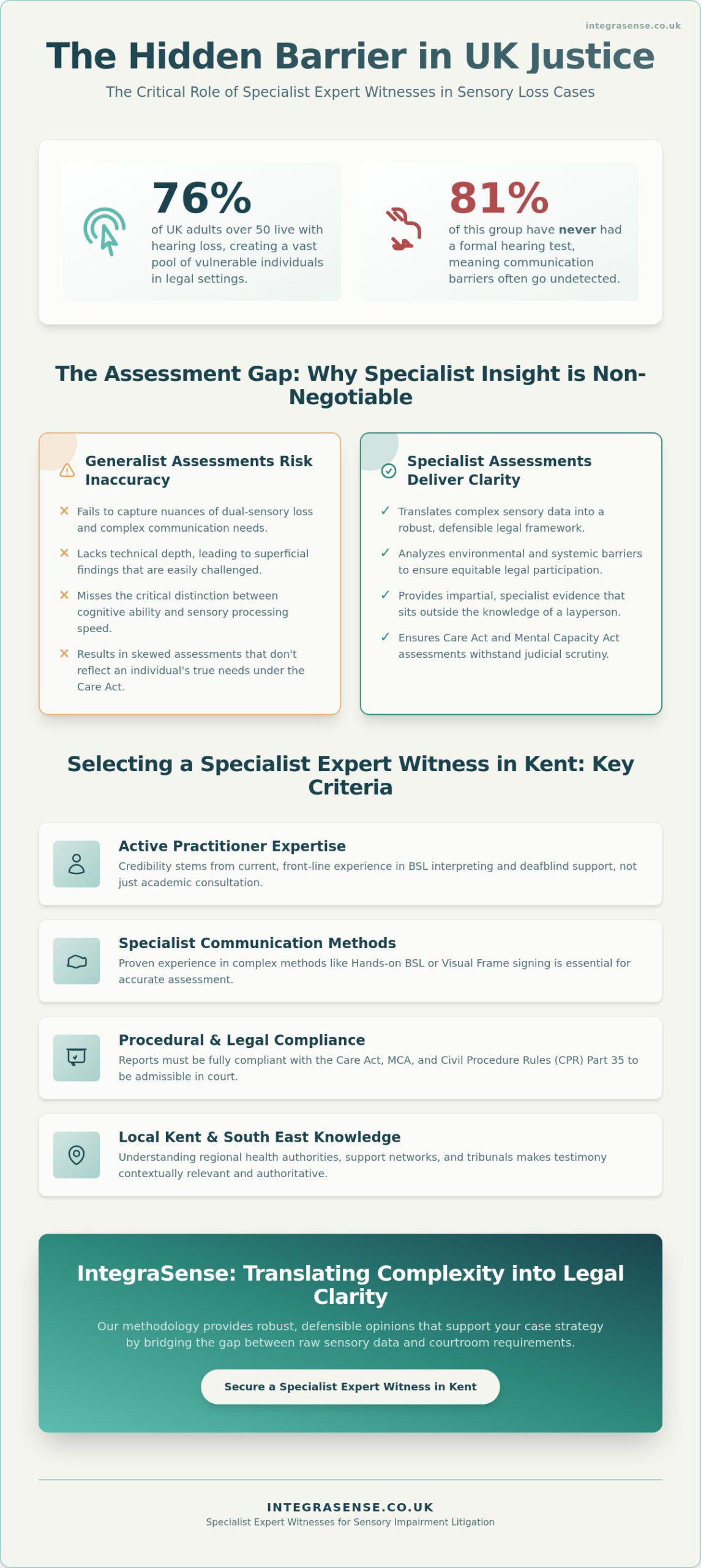
76% of UK adults over 50 live with hearing loss, but a staggering 81% have never undergone a formal hearing test according to the October 2025 UK National Eye Health and Hearing Study. This hidden prevalence creates a high-stakes environment in legal proceedings where communication barriers often remain undetected until they compromise the entire case. Finding a qualified expert witness Kent is no longer just about clinical data; it’s about securing a specialist who understands the profound intersection of sensory loss and the law.
You likely recognize that a standard medical assessment often fails to capture the nuanced impact of Deafblindness or complex communication needs under the Care Act. This guide offers a comprehensive roadmap for legal professionals and local authorities to manage these specialist requirements with precision. IntegraSense provides the expert insight needed to make sense of these complex environments, ensuring assessments are both robust and defensible. You’ll gain clarity on decision-making frameworks, current Legal Aid Agency rates for 2025/26, and the essential steps to ensure your expert reports remain beyond reproach in court.
Key Takeaways
- Understand why generalist assessments often fail to capture the critical nuances of dual-sensory loss and specialist communication in complex litigation.
- Identify the essential criteria for selecting an expert witness Kent, prioritizing practitioners with active expertise in BSL and deafblindness for credible testimony.
- Learn to mitigate the risk of legal challenges by ensuring assessments remain strictly compliant with the Care Act and Mental Capacity Act.
- Discover the IntegraSense methodology for translating raw sensory data into clear, defensible legal opinions that support your overall case strategy.
- Gain practical insights into the local Kent healthcare landscape to ensure your expert testimony is both contextually relevant and authoritative.
The Role of an Expert Witness in Sensory Impairment Litigation
In the high-stakes environment of sensory impairment litigation, the Role of an Expert Witness is to provide the court with impartial, specialist evidence that sits outside the knowledge of a layperson. For an expert witness Kent, this means translating the complex interplay of dual-sensory loss into a robust legal framework. Generalist social care experts often lack the technical depth to identify how specific communication barriers affect daily living or mental capacity. They might miss the subtle differences between a person’s cognitive ability and their sensory processing speed, leading to skewed assessments that don’t reflect the individual’s true needs.
This expertise is vital for producing Care Act compliant deafblind assessments that can withstand the scrutiny of a judicial review. In these cases, the expert doesn’t just report on what a person cannot do; they analyze the environmental and systemic failures that prevent access. A specialist expert witness in communication-access disputes serves as the essential bridge between clinical sensory data and the practical reality of equitable legal participation.
When is a Specialist Expert Witness Necessary?
Legal teams require specialist intervention when standard assessments fail to address the specific requirements of the deafblind community or BSL users. This is particularly relevant in:
- Professional negligence cases involving British Sign Language (BSL) interpreting standards.
- Disputes where the adequacy of a statutory deafblind assessment is questioned under the Care Act 2014.
- Complex Mental Capacity Act (MCA) assessments where communication barriers, rather than cognitive impairment, are the primary obstacle.
The Risk of Non-Specialist Testimony
Relying on generic assessments creates a significant litigation risk for local authorities in Kent. When an expert witness Kent lacks specific training in sensory loss, their findings are often superficial and easily challenged in court. This “interpreting gap” doesn’t just result in poor care planning; it can invalidate witness statements and compromise the integrity of the entire legal proceeding. Defensible decision-making requires a specialist who can sense the core barriers that others overlook, moving the case away from ambiguity and towards technical precision.
Selecting a Specialist Expert Witness in Kent: Key Criteria
Choosing an expert witness Kent demands a clear distinction between clinical diagnosis and practitioner-led functional assessment. While a medical report confirms a condition, a specialist practitioner explains how that condition disrupts a person’s ability to engage with the legal system. Credibility in court stems from active practice; a witness who still works on the front lines of BSL interpreting and deafblind support carries more weight than one who only consults. Professionals who utilize BSL interpreter professional supervision ensure their evidence remains objective and resilient under cross-examination. This adherence to high standards mirrors the Crown Prosecution Service guidance regarding the duties of those providing expert testimony.
Essential Qualifications for Kent Experts
Verify that your expert has proven experience with complex communication methods. This includes Hands-on BSL for those with profound dual-sensory loss or Visual Frame signing for individuals with restricted fields of vision. Every report must meet Civil Procedure Rules (CPR) Part 35 requirements to ensure admissibility. An expert familiar with NUBSLI fee guidance for 2025/26 provides essential data for accurate cost-recovery in civil litigation. You don’t want to risk a report being dismissed because the expert didn’t follow the correct procedural framework.
The Local Advantage: Why Kent Expertise Matters
A local expert witness Kent offers more than just geographical convenience. They possess a deep understanding of South East regional health authorities and the specific nuances of local education tribunals. Conducting face-to-face assessments in Maidstone, Canterbury, or Tunbridge Wells ensures a level of detail that remote sensing cannot replicate. By integrating local support networks into their care recommendations, they provide the court with a sustainable, long-term vision for the individual. You can learn more about our specialist services to understand how we bridge these gaps and provide clarity in complex cases.
Defensible Decision Making: How IntegraSense Delivers Legal Clarity
Legal clarity isn’t merely the absence of confusion; it’s the presence of technical precision. Our methodology moves beyond the static collection of clinical data to ‘sense’ the fundamental communication barriers that impede justice. By providing structured, defensible opinions, we support case strategy while maintaining the strict objectivity required by the Civil Procedure Rules for expert witnesses. This end-to-end support ensures that every stage, from the initial communication audit to the final cross-examination, is handled with the precision expected of an expert witness Kent. We position IntegraSense services as a holistic solution for managing the legal risks associated with sensory impairment and specialist communication needs.
Our Approach to Expert Witness Reporting
We conduct forensic analyses of communication breakdowns in both professional and legal settings. This process isn’t just about identifying a need; it’s about quantifying the solution. Our reports provide detailed costings for specialist equipment, BSL support, and long-term care needs to ensure full transparency for the court. We work collaboratively with legal teams to ensure that technical complexities are translated into clear, actionable insights. This level of detail is essential when an expert witness Kent must justify high-cost care packages or specialist interventions under the scrutiny of opposing counsel.
Ensuring Long-Term Resilience and Compliance
Defensible reporting is the cornerstone of long-term resilience. Our reports specifically mitigate the risk of future appeals or safeguarding failures by adhering to the rigorous standards of the Mental Capacity Act and the Care Act. We integrate external quality assurance into our practice to ensure every opinion is robust and evidence-based. Implementing structured supervision for BSL interpreters is one such quality assurance measure that protects both practitioners and the individuals they support from the consequences of communication failure. For practitioners managing demanding caseloads who need to maintain defensible decision-making, the ability to book professional supervision online offers a strategic pathway to structured, expert-led reflective practice. This methodical approach protects both the individual and the instructing authority from the fallout of indefensible decisions. If you require specialized support for a pending case, contact our Kent-based consultants for a confidential discussion.
Securing Legal Precision through Specialist Insight
Securing a robust legal outcome requires more than just clinical diagnosis. It demands a deep understanding of how sensory loss impacts communication, capacity, and statutory rights. By prioritizing practitioners who maintain active expertise in Deafblindness and BSL, legal teams move away from ambiguous assessments and toward technical certainty. This methodical approach ensures that every report is not only insightful but also strictly compliant with the Civil Procedure Rules (CPR) Part 35.
Since our founding in 2019, IntegraSense has focused on providing the defensible decision-making frameworks necessary for complex litigation. When you select an expert witness Kent from our consultancy, you’re choosing a partner dedicated to precision and long-term resilience. We translate intricate communication barriers into clear, objective evidence that stands up to judicial scrutiny. Instruct a specialist expert witness for your Kent case to ensure your legal strategy is built on a foundation of specialist expertise. We look forward to helping you achieve clarity and control in your next case.
Frequently Asked Questions
What is the role of an expert witness in a BSL interpreting dispute?
An expert witness evaluates whether a BSL interpreter met national professional standards or if a breach of duty occurred during legal or medical proceedings. They provide a forensic analysis of interpreting quality and its direct impact on the accuracy of the evidence. This objective insight is critical for resolving claims of professional negligence where communication access was compromised, ensuring that justice isn’t obstructed by linguistic barriers.
How much does an expert witness report cost in Kent?
Costs for an expert witness Kent are dictated by the funding structure of the case. For 2025/26, the Legal Aid Agency (LAA) national hourly rates for clinical psychologists are £107.64, while consultant psychiatrists are set at £132.00. In privately funded civil litigation, hourly rates generally range between £100 and £250. Highly specialized medical consultants often command fees between £250 and £450 per hour depending on the complexity of the sensory impairment.
What qualifications should a Deafblindness expert witness hold?
A specialist expert must hold a recognized deafblind assessor qualification and maintain active registration with the NRCPD. Credibility in court relies on their ability to demonstrate mastery of tactile communication methods and recent practitioner experience. This background ensures they can provide defensible opinions on the adequacy of statutory assessments under the Care Act 2014, moving beyond clinical data to provide a technical analysis of functional impact.
Can an expert witness help with Mental Capacity Act assessments?
An expert witness Kent assists in Mental Capacity Act (MCA) assessments by identifying and removing communication barriers that might otherwise lead to an incorrect finding of incapacity. They ensure that clinicians don’t confuse sensory processing delays with cognitive impairment. By establishing an optimized communication environment, the expert enables the individual to demonstrate their true ability to understand, retain, and weigh information relevant to the decision at hand.