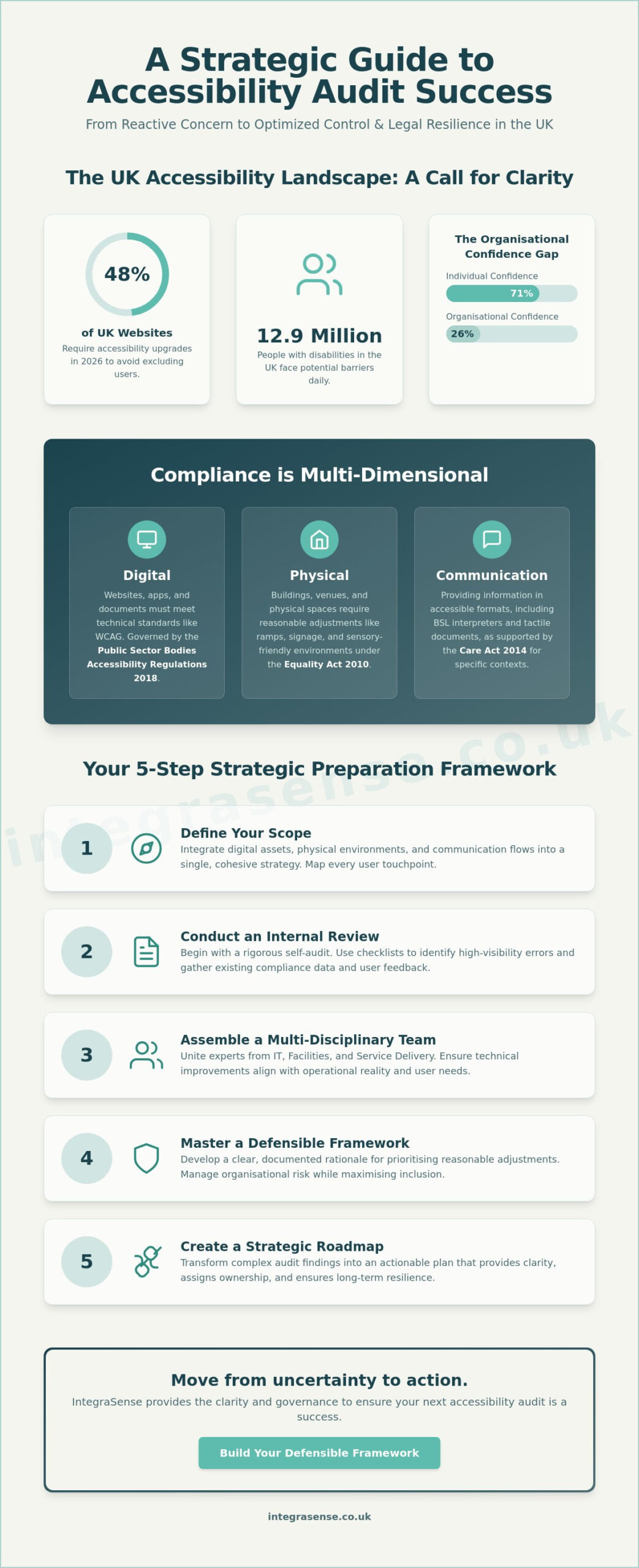
A 2025 report revealed that 48% of UK websites require accessibility upgrades in 2026 to avoid excluding users with disabilities. This data underscores a significant challenge for leaders who must balance complex regulatory demands with the lived experience of 12.9 million disabled people in the UK. You likely understand that meeting the Equality Act 2010 is essential, yet the path to prepare for accessibility audit requirements often feels fragmented. It’s common to feel a sense of uncertainty when distinguishing between digital, physical, and sensory barriers, especially when internal specialist knowledge regarding impairments is limited.
This strategic guide establishes a robust governance framework for your next assessment. At IntegraSense, we believe that clarity is the foundation of inclusion. We promise to move your organisation from a state of reactive concern to one of optimized control and legal resilience. You’ll gain a comprehensive preparation checklist and a defensible decision-making model that ensures your audit produces successful, actionable results for every service user.
Key Takeaways
- Define your compliance scope by integrating digital assets, physical environments, and communication flows into a single, cohesive strategy.
- Discover the essential steps to prepare for accessibility audit success, beginning with a rigorous internal review of your existing infrastructure.
- Assemble a multi-disciplinary team across IT, facilities, and service delivery to ensure technical improvements align with your operational reality.
- Master a defensible framework for prioritising reasonable adjustments, allowing you to manage organisational risk while maximising user inclusion.
- Learn how to transform complex audit findings into a strategic roadmap that provides clarity and long-term resilience for your organisation.
Understanding the Scope: Digital, Physical, and Communication Compliance
To prepare for accessibility audit success, an organisation must first recognise that compliance is multi-dimensional. The legal framework in the UK is anchored by the Equality Act 2010, which requires “reasonable adjustments” for all disabled people, and the Public Sector Bodies Accessibility Regulations 2018, which mandates technical standards for digital interfaces. A fragmented approach often fails because it ignores the intersection of digital, physical, and communication barriers. Compliance is not a static target; it’s a continuous process of optimization that requires you to synchronize your digital, physical, and communication workflows into a single, intelligent system.
High-risk areas frequently include inaccessible statutory reports or a lack of qualified communication professionals. These failures create legal vulnerabilities and operational friction for the 12.9 million disabled people living in the UK. The objective of any review is to establish defensible decision-making. This means having a clear, documented rationale for the adjustments you choose to implement or defer based on impact and resource. By shifting from a tick-box exercise to a strategic governance model, you ensure long-term resilience and genuine inclusion across all service touchpoints. Understanding how accessibility audits function as a strategic framework for UK organisational compliance is essential to building this kind of defensible, holistic approach.
The Role of Specialist Communication Audits
General audits often overlook the specific needs of users who rely on British Sign Language (BSL) or tactile communication. Specialist communication audits ensure that interpreting services and support systems meet professional standards. Quality assurance in this area is vital. A thorough communication access audit UK goes beyond surface-level checks to address the nuanced sensory and linguistic needs of BSL users and deafblind individuals, providing the defensible framework your organisation needs. For example, the role of BSL interpreter professional supervision is critical for maintaining the integrity and resilience of communication support in complex environments.
Sensory Impairment and the Care Act
In health and social care settings, the Care Act 2014 places specific duties on local authorities to identify and support complex needs. Accessibility isn’t just about ramps or screen readers; it’s about statutory excellence in identifying sensory loss. Integrating a Care Act compliant deafblind assessment into your broader accessibility framework ensures that individuals with dual sensory loss receive the specialist support they’re legally entitled to. This holistic approach transforms a technical requirement into a meaningful service improvement.
A Strategic Step-by-Step Guide to Prepare for Accessibility Audit Success
Success begins with a methodical inventory of your organisational landscape. You can’t optimize what you haven’t mapped. Start by identifying every digital portal, physical venue, and communication channel your organisation manages. This initial phase helps you isolate “known unknowns,” such as legacy software systems or unverified physical access routes in older buildings. A 2025 survey by AbilityNet revealed that while 71% of individuals feel confident in their own understanding of accessibility, only 26% believe their organisation shares that confidence. Bridging this gap requires a unified internal front.
Assemble a multi-disciplinary team that brings together IT, facilities management, and service delivery leads. This ensures that technical fixes don’t conflict with operational realities. You should also gather all existing accessibility statements and previous complaint data. These documents provide a historical context for your auditor, highlighting recurring pain points that require immediate sensing and resolution. Finally, establish a realistic budget that accounts for both the professional assessment and the subsequent remediation work. To effectively prepare for accessibility audit processes, you must view the investment as a long-term sustainability measure rather than a one-off cost.
Internal Pre-Audit Checklists
Before the specialists arrive, conducting an internal review can save significant time. Utilizing a website accessibility checklist allows your IT team to identify and resolve high-visibility errors in digital spaces. For organisations managing Kent-based health or education venues, this is also the time to review physical signage and sensory lighting. Small adjustments, such as ensuring high-contrast text on directional signs, can drastically improve the user journey for individuals with visual impairments.
Engaging Specialist Consultants
Self-audits are a useful starting point, but they rarely capture the technical depth required for full legal resilience. When internal resources reach their limit, it’s time to request a professional accessibility audit quote in Kent. Professional auditors bring a level of precision that internal teams often lack, particularly when vetting for specialist communication expertise. Ensure your chosen partner understands the nuances of sensory impairments and can provide a roadmap that integrates seamlessly with your broader digital transformation goals. If you’re unsure where to begin, exploring our specialist consulting services can provide the clarity you need to move forward with confidence.
From Audit Findings to Defensible Implementation and Risk Management
Receiving the final report is just the first step in a larger strategic journey. To truly prepare for accessibility audit results, you must translate raw data into a defensible implementation plan. This requires a strategic risk management lens where you document exactly why certain adjustments take priority. Under the Equality Act 2010, the concept of “reasonableness” is central. You must show a clear, logical audit trail of your decision-making to protect your organisation from legal challenges while ensuring the 12.9 million disabled people in the UK can access your services without friction. Organisations that treat accessibility audits as an ongoing strategic framework rather than a one-time exercise are far better positioned to demonstrate this kind of defensible compliance.
Prioritisation should always focus on high-impact areas that pose the greatest legal or operational risk. Critical communication failures or digital blockers that prevent statutory compliance are your first concern. Accessibility is not a static achievement; it is a continuous process of environmental stewardship and digital transformation. Maintaining these standards requires ongoing professional supervision and regular re-evaluations. This ensures that new technologies or service changes don’t introduce fresh barriers for your users. It’s about moving away from the chaotic and towards an optimized, resilient environment; to support this transition with a high-quality online presence, you can learn more about Gravitas Web Design and their bespoke branding solutions.
Managing Complex Communication Environments
Effective implementation requires more than technical fixes; it demands human-centric solutions. Integrating BSL interpreting and deafblind support into your long-term strategy ensures that communication flows remain inclusive and compliant. Staff training is equally vital. Your team must be equipped to implement the audit’s recommendations effectively, ensuring that adjustments like Access to Work provisions or sensory support are delivered with precision and professional authority. Commissioning a specialist communication access audit UK organisations can rely on will help you identify precisely where these human-centric gaps exist and build a robust, legally defensible remediation plan.
The IntegraSense Approach to Accessibility
We move beyond the surface level to provide the end-to-end intelligence needed to make sense of complex data. Our methodology treats accessibility as a holistic ecosystem where digital, physical, and communication systems are seamlessly integrated. By partnering with us, you gain access to specialist expertise that ensures your organisation remains resilient and compliant. Explore our specialist services to see how we can support your post-audit implementation and long-term optimization goals.
Securing Long-Term Resilience through Strategic Accessibility
Accessibility is not a static destination; it’s a dynamic process of environmental stewardship. By synchronizing your digital, physical, and communication assets, you replace fragmented efforts with a cohesive strategy. You now have the tools to prepare for accessibility audit cycles with confidence, using a defensible framework to prioritise adjustments that matter most. This proactive stance ensures your organisation remains compliant with the Equality Act 2010 while fostering genuine inclusion for 12.9 million disabled people in the UK.
IntegraSense provides the specialist intelligence needed to make sense of complex regulatory landscapes. Our team offers deep expertise in sensory impairment alongside a rigorous background in expert witness and legal compliance. Based in Kent but serving organisations nationwide, we deliver the precision and clarity required for long-term resilience. Contact IntegraSense today for specialist accessibility consultancy and begin your journey toward an optimized, inclusive future. We’re here to turn your technical challenges into sustainable solutions.
Frequently Asked Questions
How do I prepare for an accessibility audit in a healthcare setting?
Preparation in healthcare requires mapping the entire patient journey from digital booking portals to physical consultation rooms. You must ensure your data systems accurately flag communication needs as mandated by the Accessible Information Standard. This involves reviewing how frontline staff access BSL interpreters or tactile support during clinical appointments. Specialized providers, such as those offering a private pregnancy scan Mansfield, must prioritize these standards to ensure every patient receives clear and accessible care. Identifying these gaps early helps you prepare for accessibility audit requirements that satisfy both the Equality Act 2010 and CQC inspection standards.
What is the difference between a basic accessibility check and a specialist audit?
A basic check typically relies on automated tools to identify surface-level digital errors or obvious physical barriers. In contrast, a specialist audit involves human-led testing by experts who understand the nuances of sensory impairments and complex communication support. Specialist audits provide a defensible roadmap for compliance; they cover areas that software misses, such as the quality of interpreting services or the effectiveness of assistive hearing loops in complex acoustic environments.
Does my organisation need a deafblind-specific communication audit?
Your organisation requires a deafblind-specific audit if you provide statutory services or manage environments with high public interaction. Standard assessments frequently overlook the unique requirements of dual sensory loss, such as specific lighting thresholds or tactile signage. A targeted audit ensures you meet your legal duties under the Care Act 2014. It transforms your space into one that is truly navigable for the 450,000 people in the UK living with deafblindness.
Is an accessibility audit a one-off requirement for UK public bodies?
An accessibility audit is not a one-off task but a recurring element of your governance strategy. Public sector bodies must maintain an up-to-date accessibility statement and review their digital assets whenever significant updates occur. Continuous monitoring is essential as technology evolves and user needs change. Establishing a regular cycle to prepare for accessibility audit updates ensures long-term resilience and prevents your organisation from falling behind the WCAG 2.2 standards required by the 2018 Regulations.