
A single indefensible decision in a high-stakes environment can cost a UK organisation more than just its reputation. It often triggers a full-scale legal challenge under the Care Act 2014 or the Mental Capacity Act 2005, where the margin for error is non-existent. You’re likely aware that providing equitable access is a statutory necessity that grows significantly more complex when dual sensory loss or profound cognitive impairments are involved. Securing specialist communication support for complex needs shouldn’t feel like a gamble with compliance or an endless search for qualified expertise.
This guide provides the strategic clarity you need to implement defensible, person-centred communication strategies that stand up to the most rigorous scrutiny. At IntegraSense, we believe that making sense of complex sensory requirements is the foundation of effective advocacy and care. We’ll show you how to transition from fragmented support toward an optimized framework that ensures every interaction is precise, intelligent, and legally sound. You’ll gain a clear roadmap for securing qualified specialists and improving individual outcomes while maintaining total statutory resilience across your entire organisation.
Key Takeaways
- Understand the critical distinction between basic interpreting and the high-level expertise required to navigate non-verbal and dual sensory barriers.
- Secure your organisation’s reputation by aligning communication strategies with the Care Act 2014 and the Mental Capacity Act 2005.
- Learn to deploy specialist communication support for complex needs through a structured framework of audits and multi-disciplinary consultancy.
- Mitigate the high cost of non-compliance by moving toward defensible, person-centred decision-making that prioritises individual agency.
- Optimise your service environment by identifying and removing the cognitive and sensory barriers that hinder effective connectivity and engagement.
Understanding Specialist Communication Support for Complex Needs
Effective communication within UK public services requires more than a simple linguistic bridge. Specialist communication support for complex needs represents a shift from passive translation to active, strategic facilitation. While basic interpreting handles standard language conversion, specialist support addresses the intersection of sensory, cognitive, and physical barriers. It’s about creating an environment where information isn’t just delivered, but truly understood and processed; for instance, leveraging sensory-rich spaces from Immersive Experiences can significantly improve engagement for those with profound needs.
Generic British Sign Language (BSL) services often lack the nuance required for high-stakes health or legal environments. In 2023, reports from the UK healthcare sector highlighted that standard interpreting frequently fails when patients present with cognitive impairments or idiosyncratic communication styles. Organisations must distinguish between tactical support, which solves an immediate linguistic hurdle, and strategic consultancy, which optimizes the entire communication journey. This proactive approach ensures compliance with the Equality Act 2010 while mitigating the risks of misdiagnosis or legal negligence.
The Impact of Dual Sensory Loss
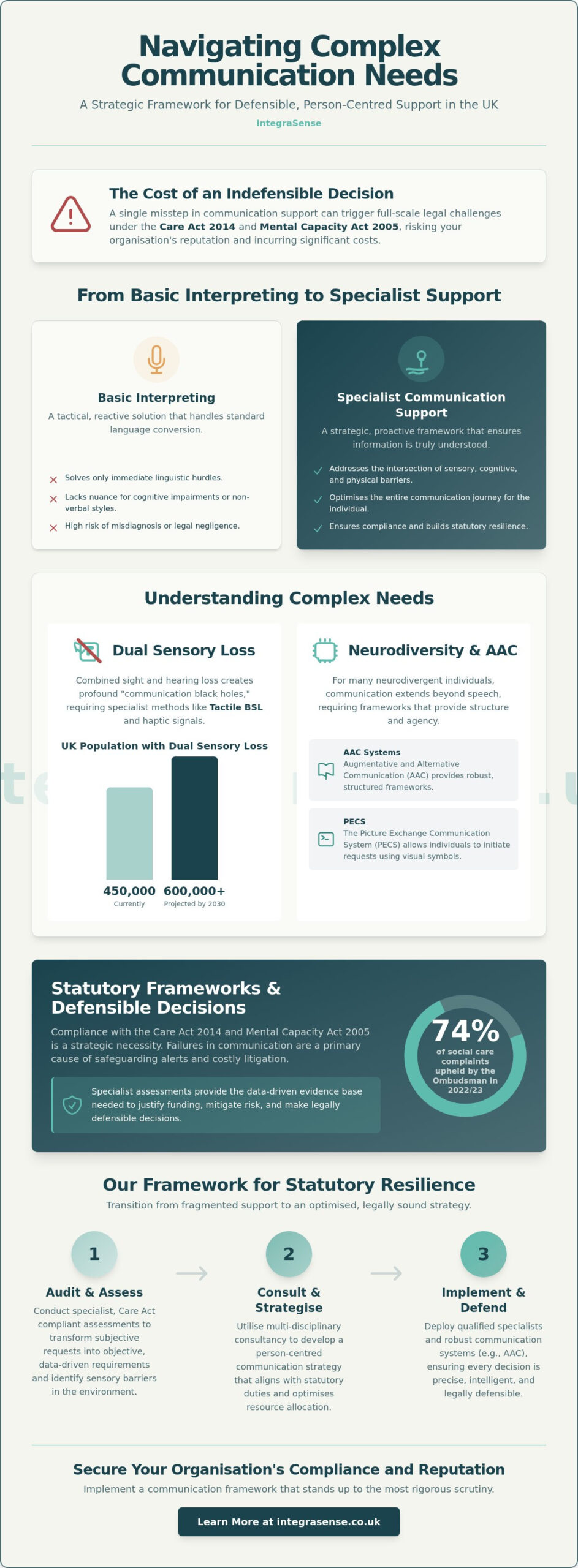
Combined sight and hearing loss creates profound isolation, often described as communication “black holes.” Over 450,000 people in the UK live with dual sensory impairment; a figure projected to rise to over 600,000 by 2030. Standard visual signing isn’t enough in these instances. Professionals must deploy tactile BSL or haptic signals to ensure clarity and safety. For organisations operating in the South East, accessing dual sensory loss support Kent is a critical step in bridging these sensory gaps and maintaining service resilience. Understanding what is a deafblind assessment and how it informs specialist provision is equally essential for organisations seeking to meet their statutory obligations under the Care Act 2014.
Beyond Speech: PECS and Alternative Systems
For neurodivergent individuals, communication often moves beyond verbal or signed language into the digital and physical space. Practitioners utilize Augmentative and Alternative Communication (AAC) frameworks to provide structure and agency. Implementing the Picture Exchange Communication System (PECS) allows individuals to initiate requests and express complex needs through visual symbols. Integrating these systems into educational and care settings transforms chaotic interactions into seamless, intelligent exchanges. As modern organizations seek to scale these capabilities, they may explore voice agents to enhance automated accessibility. This end-to-end focus on multi-sensory impairment (MSI) ensures that even the most complex technical challenges in human connectivity are handled with precision and care.
Statutory Frameworks and Defensible Decision-Making
Compliance isn’t a choice; it’s a strategic necessity. The Care Act 2014 and the Mental Capacity Act 2005 demand precise alignment between an individual’s unique needs and the support they receive. Failing to secure specialist communication support for complex needs creates significant legal exposure and increases the likelihood of safeguarding failures. These failures often stem from miscommunication, which can lead to costly litigation or Ombudsman investigations. In the 2022/23 period, the Local Government and Social Care Ombudsman upheld 74% of complaints within the education and children’s services category, frequently citing failures in specific provision for those with additional needs.
Defensible decision-making relies on a robust evidence base. Specialist assessments transform subjective requests into objective requirements. This data-driven approach justifies funding and ensures that resources are allocated where they’ll have the most impact. For professionals managing complex budgets, these assessments provide the intelligence required to mitigate risk and optimize outcomes. It’s about moving away from reactive measures and toward a model of proactive, sustainable support.
Ensuring Care Act Compliance
Local authorities have a specific duty to ensure that assessments for individuals with dual sensory loss are conducted by qualified professionals. Moving toward statutory excellence requires more than just meeting a minimum standard. It’s about precision. Our Care Act compliant deafblind assessment framework ensures that every report meets the high threshold required for statutory reporting. This process often involves evaluating the effectiveness of various AAC systems and strategies to ensure long-term communication resilience. Organisations that remain unclear on the foundational requirements should first explore what a deafblind assessment involves and the mandatory qualifications required of assessors to avoid costly compliance failures.
Managing Risk in High-Stakes Environments
Precision matters most in legal and tribunal settings. Expert witness services provide the clarity needed when complex communication is at the heart of a legal case. For employers, the Access to Work scheme offers a vital mechanism to fund professional support, ensuring that talent isn’t lost to avoidable barriers. Organizations should seek specialized consultancy services to integrate these frameworks into their operational DNA, ensuring every decision is both ethical and legally defensible.
Implementing a Robust Specialist Support Strategy
Moving from reactive fixes to a proactive framework requires a structured, four-step approach. UK organisations often find that generic accessibility policies fail when faced with the nuances of specialist communication support for complex needs. Precision in implementation ensures that statutory duties under the Equality Act 2010 are met while optimizing the experience for the individual.
- Step 1: Conduct a comprehensive communication audit. You can’t solve what you haven’t measured. A professional audit identifies specific linguistic, cognitive, and environmental barriers that prevent effective interaction.
- Step 2: Engage multi-disciplinary consultants. Effective person-centred planning involves bringing together speech and language therapists, specialist interpreters, and advocates. This collaborative intelligence ensures the support package is holistic rather than fragmented.
- Step 3: Integrate professional supervision. Supporting individuals with complex needs is emotionally demanding. Regular reflective practice prevents practitioner burnout and mitigates the risk of vicarious trauma.
- Step 4: Establish a feedback loop. Quality assurance isn’t a one-time event. Regular reporting and stakeholder feedback ensure the strategy evolves alongside the user’s changing requirements.
The Role of Professional Supervision
Resilience in the workforce is a strategic asset. Specialists navigating high-stakes environments, such as mental health tribunals or child protection cases, require a space to process the psychological impact of their work. We recommend integrating BSL interpreter professional supervision into your workflow. This practice doesn’t just protect the practitioner; it safeguards the quality of the communication itself, ensuring that personal stress doesn’t cloud professional judgment.
Partnering with IntegraSense for Specialist Consultancy
IntegraSense bridges the gap between high-level statutory duty and practical, on-the-ground implementation. Our expertise across Kent and the South East allows us to provide localized, high-impact support tailored to the specific demographics of the region. We transform chaotic communication environments into optimized, accessible spaces where every voice is heard. Whether you’re managing a complex healthcare setting or an inclusive workplace, our team provides the clarity you need to move forward with confidence.
Ready to enhance your organisation’s accessibility? Explore our specialist services to see how we deliver specialist communication support for complex needs, or contact our consultancy team today to schedule your comprehensive communication audit.
Securing Resilience through Communication Intelligence
Navigating the intricacies of statutory frameworks requires more than just awareness; it demands a proactive commitment to precision. Organisations that prioritise specialist communication support for complex needs ensure their decisions remain defensible while fostering an environment of genuine accessibility. By integrating qualified expertise into health, education, and legal workflows, you mitigate the risks of non-compliance and elevate the standard of service provided. Clarity is essential.
Since 2019, IntegraSense has delivered this clarity through a multidisciplinary team focused on high-stakes environments. Our expertise spans statutory deafblind assessments and BSL professional supervision, providing the rigorous oversight necessary to satisfy UK regulatory demands. We help you move beyond reactive measures toward a model of sustainable, intelligent communication management that protects both the individual and the organisation. It’s a strategic investment in clarity that yields long-term operational stability.
To refine your approach and secure expert oversight, contact IntegraSense for specialist communication consultancy. It’s time to transform your communication challenges into a foundation for excellence and inclusion.
Frequently Asked Questions
What qualifies as a “complex need” in communication support?
Complex needs represent a convergence of sensory, cognitive, and linguistic barriers that exceed the scope of standard interpreting. These requirements typically involve individuals with dual sensory loss, severe mental health conditions, or neurological diversities that disrupt traditional message processing. According to the NHS Accessible Information Standard updated in 2024, providers must identify these specific needs early to prevent service failures. It’s about recognizing when a person’s environment requires more than a simple translation to achieve true understanding.
How does specialist communication support differ from standard BSL interpreting?
Specialist communication support for complex needs functions as a strategic bridge rather than a direct linguistic mirror. While standard BSL interpreting focuses on fluid translation between two established languages, specialist consultants manage fragmented or non-linear communication styles. They provide a layer of environmental intelligence, adapting their methodology to the user’s cognitive pace and sensory profile. This proactive approach ensures clarity in high-stakes environments where a simple misunderstanding could lead to significant legal or medical risks.
Is an organisation legally required to provide specialist support under the Care Act?
The Care Act 2014 establishes a clear statutory mandate for specialist provision through its emphasis on individual well-being and involvement. Section 6 of the Act dictates that local authorities must provide independent advocacy and specialized communication if a person has “substantial difficulty” engaging with social care processes. Organizations that neglect these duties face increased litigation risks and fail to meet the “Triple Aim” of healthcare improvement. IntegraSense guides partners through these regulatory complexities, ensuring every touchpoint remains compliant and human-centric.
Can Access to Work funding be used for specialist communication consultants?
Access to Work serves as a vital financial mechanism for workforce optimization and inclusivity. This DWP-led scheme provides grants to cover specialized support that goes beyond the “reasonable adjustments” required by the Equality Act 2010. During the 2022/23 financial year, the DWP supported 49,820 individuals with such grants, enabling them to thrive in professional roles. By utilizing this funding, UK employers can integrate sophisticated support systems that enhance productivity without straining their primary operational budgets.