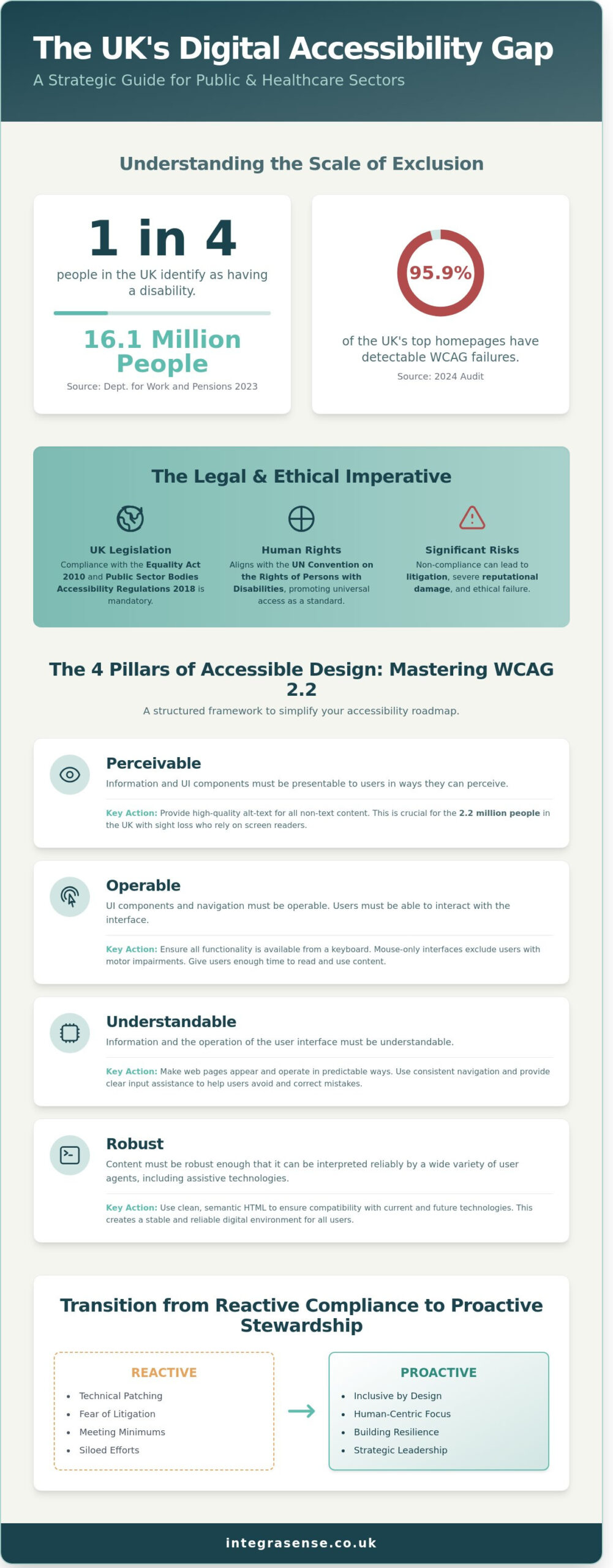
What if your digital infrastructure is inadvertently silencing 16.1 million people across the UK? According to the Department for Work and Pensions 2023 data, one in four people in the UK identifies as having a disability, yet many public sector and healthcare platforms remain functionally opaque to them. You likely recognize that website accessibility is a core pillar of the Equality Act 2010. It’s a commitment to equity that most organizations strive for; however, the technical intricacies of WCAG 2.2 can feel like a labyrinth of moving targets and shifting priorities.
IntegraSense understands that true digital transformation requires more than a reactive patch; it demands a structured, intelligent approach to inclusivity. This guide provides a comprehensive website accessibility checklist designed to help you master the essentials of inclusive design. You’ll gain a clear, prioritized roadmap that ensures your digital spaces are compliant, resilient, and human-centric. We’ll move beyond the fear of litigation to focus on how optimized connectivity empowers every user to navigate your services with confidence and clarity.
Key Takeaways
- Transition from reactive compliance to proactive digital stewardship, positioning your organisation as a leader in inclusive and resilient digital design.
- Master the WCAG 2.2 standards through the POUR framework to simplify and streamline your website accessibility roadmap.
- Identify and mitigate common barriers to digital interaction, with a specific focus on the unique communication requirements of the Deafblind community.
- Implement a defensible decision-making framework that leverages expert communication audits to manage risk and ensure high-quality professional practice.
- Learn how to bridge the gap between digital platforms and statutory obligations, ensuring your services align with UK healthcare and social care compliance.
Understanding Website Accessibility: More Than a Technical Requirement
True website accessibility involves the deliberate removal of barriers to communication and interaction. It’s a fundamental shift from reactive compliance to proactive digital stewardship. By 2026, universality has become the core principle of the modern web; it’s no longer an optional feature but a baseline for participation. When digital spaces exclude users, the human cost is high. In health and education, inaccessible interfaces prevent 16 million disabled people in the UK from accessing essential services independently. For a comprehensive overview of web accessibility and its foundational guidelines, understanding the intersection of technology and human rights is vital.
The Legal Landscape: Equality Act 2010 and Beyond
The Equality Act 2010 mandates that UK organisations make reasonable adjustments to ensure disabled people aren’t disadvantaged. This legal obligation extends to digital environments. Since the Public Sector Bodies Accessibility Regulations 2018 took effect, the standard for inclusive design has sharpened. Ignoring these requirements carries severe risks. Organisations face potential litigation, significant reputational damage, and the ethical failure of excluding a large portion of the population. IntegraSense provides the strategic oversight needed to transform these legal obligations into operational strengths.
Accessibility as a Human Right
Digital presence must align with the UN Convention on the Rights of Persons with Disabilities. This isn’t just about a specific demographic; it’s about the curb-cut effect. Features designed for accessibility, like high-contrast text or clear navigation, benefit the wider population in various environments. Accessible design is a marker of professional excellence and technical intelligence. It demonstrates that an organisation values precision and long-term sustainability. By prioritising inclusive design, specialists ensure that complex digital environments remain clear and optimised for every user.
The Four Pillars of Accessible Design: Making Sense of WCAG Standards
Website accessibility is no longer a peripheral concern; it’s a core requirement for digital resilience. The Web Content Accessibility Guidelines (WCAG 2.2), updated in October 2023, provide the technical foundation for this transformation. For non-technical leaders, these standards can appear dense, yet they rest on four logical pillars: Perceivable, Operable, Understandable, and Robust (POUR). These principles ensure that digital environments sense and respond to the needs of every user, regardless of their sensory or cognitive profile.
Perceivable and Operable: Ensuring Access for All
Information must be presentable in ways users can sense. For the 2.2 million people in the UK living with sight loss, this means providing high-quality alt-text for non-text content. Assistive technologies like screen readers and refreshable braille displays rely on this metadata to translate visual data into meaningful information. Without these descriptions, a significant portion of your audience is left in a data vacuum.
Operation requires flexibility. A 2024 audit of the UK’s top 1,000,000 homepages found that 95.9% of pages had detectable WCAG failures, often related to keyboard navigation. Mouse-only interfaces exclude users with motor impairments or those using switch devices. Organisations must also manage time-sensitive content, giving users sufficient time to process information without artificial pressure. While UK law is governed by the Equality Act 2010, many global organisations also monitor legal obligations under the ADA to maintain international compliance and avoid litigation.
Understandable and Robust: Building Trust and Reliability
Clarity builds trust. Interfaces must remain predictable, using consistent navigation patterns that reduce cognitive load. This is especially vital in healthcare and public sector settings where clear input assistance prevents user error. When a platform behaves as expected, it empowers the user, providing a sense of control over the digital environment.
Robustness is about longevity. Clean, semantic code ensures your platform remains compatible with both current tools and future innovations. It creates a stable environment that doesn’t break when a user updates their browser or assistive software. Investing in these specialist accessibility services ensures your digital infrastructure is built for long-term sustainability rather than temporary fixes. This technical precision is the difference between a platform that merely functions and one that excels in a competitive, inclusive market.
Essential Website Accessibility Checklist: Identifying Common Barriers
Effective website accessibility requires a methodical decomposition of digital barriers. A 2023 WebAIM Million report found that 96.3% of homepages had detectable WCAG 2 failures. This statistic underscores the need for a rigorous audit. Organizations must move beyond surface-level fixes to address the four pillars of inclusive design: visual, auditory, motor, and cognitive. For those operating within international frameworks or looking to adopt global best practices, understanding the Federal Digital Accessibility Requirements provides a robust technical baseline for compliance.
Visual and Auditory Checkpoints
Precision in visual hierarchy is non-negotiable. Text must maintain a minimum contrast ratio of 4.5:1 against its background to remain legible for users with low vision. For video content, captions are a legal baseline under the Equality Act 2010, but true inclusion involves BSL translations for the 87,000 Deaf people in the UK who use it as a first language. Screen reader compatibility hinges on semantic HTML. Developers should utilize ARIA labels and logical heading structures to ensure that non-visual users can navigate complex data arrays without friction.
Cognitive and Specialist Communication Barriers
Complexity acts as an invisible gatekeeper. Using “Plain English” and “Easy Read” formats reduces cognitive load for the 1.5 million people in the UK with a learning disability. For the estimated 450,000 individuals living with dual sensory loss, standard digital interfaces often fail entirely. Integrating specialist communication support into the digital journey ensures that Deafblind users aren’t excluded from essential services. Cluttered layouts and inconsistent navigation patterns create disorientation; a streamlined, predictable interface is a prerequisite for cognitive accessibility.
Downloadable documents often represent a major compliance blind spot. A PDF that isn’t tagged correctly is invisible to assistive technology. Every document must include alternative text for images, bookmarks for navigation, and a defined reading order. Failing to optimize these files for website accessibility creates a fractured experience that undermines the overall integrity of your digital environment.
Implementing Change: A Framework for Defensible Accessibility Decisions
Moving from an overwhelming to-do list to a strategic roadmap requires a shift in perspective. It’s not about fixing every line of code at once; it’s about managing risk through expert communication audits. The IntegraSense approach focuses on intelligence and sensing to identify where digital barriers create the highest legal and social friction. We prioritize remediation based on user impact. If a user can’t complete a primary transaction, that’s a critical failure. By focusing on these high-stakes journeys, you build a defensible position that satisfies both the Equality Act 2010 and the Public Sector Bodies Regulations 2018. Professional supervision ensures your team doesn’t just tick boxes but builds a sustainable culture of inclusion.
Conducting an Accessibility Audit
Automated testing tools are a useful baseline, but they typically only detect 40% of WCAG failures. They can’t sense the logical flow of a page or the nuance of complex data tables. To achieve true website accessibility, you must validate your progress with expert manual reviews. Seeking an accessibility audit quote in Kent ensures your platform is tested by specialists who understand the UK regulatory environment. Involving users with lived experience is the only way to transform technical compliance into a seamless user experience that works for everyone. Understanding how to prepare for an accessibility audit with a structured governance framework can help your organisation move from reactive concern to optimized legal resilience before the assessment begins.
Governance and Risk Management
Your Accessibility Statement shouldn’t be a static disclaimer. It’s a living document that outlines your commitment and current limitations. Documenting every “reasonable adjustment” provides a clear audit trail for regulators and helps manage expectations. This transparency is vital for public sector services and healthcare providers who face higher scrutiny. You should integrate website accessibility into your formal complaint handling process. This allows you to treat every user report as a data point for optimization rather than a legal threat. It’s about maintaining control over your digital environment while demonstrating proactive compliance to stakeholders and the Cabinet Office.
Ready to move beyond the checklist and implement a sustainable strategy? Explore our specialist accessibility services to secure your digital future.
Beyond the Checklist: Specialist Consultancy for Long-Term Resilience
True digital inclusion requires more than a technical audit. It demands a shift from reactive fixes to proactive professional practice. Website accessibility represents a live ecosystem that evolves alongside user needs and legislative updates. For organisations managing complex sensory requirements, this journey often intersects with statutory obligations, such as providing Care Act compliant deafblind assessments. Expert consultancy ensures that digital interfaces aren’t just technically compliant but functionally usable for those with dual sensory loss. Professional supervision acts as a critical safeguard, maintaining these inclusive standards through rigorous, independent oversight of communication protocols.
Specialist Communication and BSL Integration
Effective communication doesn’t stop at text. Integrating BSL interpreters into digital content is vital for the 151,000 BSL users in the UK. This goes beyond basic video subtitles. It involves structuring platforms to support Access to Work requirements for employees who rely on specialist support. While AI and sensing technologies offer new ways to bridge gaps, human expertise remains the benchmark for nuance and legal reliability. We balance these automated tools with specialist insight to manage high-stakes communication environments where precision is non-negotiable. This hybrid approach ensures your website accessibility strategy remains resilient against future technological shifts.
Your Next Steps with IntegraSense
IntegraSense provides the multidisciplinary framework needed to turn accessibility from a risk into a strategic asset. Our consultancy spans from initial communication audits to long-term strategic governance advice. We help your organisation move beyond the chaos of fragmented systems toward an optimized, resilient digital presence. We focus on the end-to-end journey, ensuring that your technical infrastructure empowers every user. You can reach out to us for a bespoke accessibility and communication review to align your digital infrastructure with the highest professional standards and statutory requirements.
Securing Digital Resilience Through Proactive Inclusion
True digital inclusion requires moving beyond a reactive mindset. By 2026, the landscape of website accessibility will demand more than simple compliance; it will require a robust framework for defensible decision-making that aligns with the Public Sector Bodies Accessibility Regulations 2018. Organizations that prioritize the four pillars of WCAG standards create environments where every user can engage seamlessly. It’s about turning technical barriers into strategic advantages that foster long-term sustainability and operational efficiency.
Managing these complex requirements doesn’t have to be a solitary challenge. IntegraSense provides multidisciplinary expertise in BSL and Deafblindness, ensuring your digital and communication strategies are grounded in professional practice. Registered in England and Wales, our team focuses on risk management and practical implementation for healthcare providers and public sector services. We help you navigate the nuances of communication support and workplace responsibilities with precision. Our approach ensures that every technical decision is backed by specialist insight and rigorous standards.
Take the next step toward a more inclusive and legally sound digital presence. Enquire about our Accessibility Consultancy and Communication Audits to optimize your organization’s impact. Together, we’ll build a future where accessibility is an integrated standard rather than an afterthought.
Frequently Asked Questions
Is website accessibility a legal requirement for private businesses in the UK?
Yes, the Equality Act 2010 requires UK private businesses to make reasonable adjustments for disabled users. This mandate ensures that 16 million disabled people in the UK, as reported in the Family Resources Survey 2022/23, can access digital services without discrimination. Failing to provide an inclusive experience exposes your organisation to litigation and excludes 24% of the potential domestic market.
What is the difference between WCAG 2.1 and WCAG 2.2?
WCAG 2.2, released in October 2023, adds nine new criteria to the existing 2.1 framework. These updates focus on improving experiences for users with cognitive disabilities and those using mobile devices. For example, it introduces a minimum target size of 24×24 pixels for interactive elements. This evolution ensures that digital spaces remain functional as hardware and user habits change through 2026.
How do I provide BSL interpreting for my website content?
Embed high-quality video translations produced by NRCPD-registered professionals to ensure authentic communication for the 151,000 BSL users identified in the 2021 Census. Don’t rely on automated avatars, as they lack the linguistic nuance required for complex information. IntegraSense facilitates these specialist translations, helping you meet your responsibilities in healthcare and public service settings where accuracy is vital for website accessibility.
Can I use automated overlays to make my website accessible?
No, automated overlays are not a valid substitute for native coding and structural integrity. Over 700 accessibility advocates signed the Fact Sheet on Overlays to highlight how these tools often interfere with screen readers. They don’t fix underlying code issues and can’t guarantee compliance with the Equality Act 2010. True inclusion requires a methodical approach to your site’s core architecture.
What are the most common accessibility barriers for Deafblind users?
Incompatible heading structures and a lack of braille display support are the most significant barriers for the 450,000 people in the UK with dual sensory loss. According to Sense (2024), non-descriptive links and time-limited sessions also prevent these users from navigating effectively. Ensuring your platform supports refreshable braille displays is a critical technical requirement for achieving deep, end-to-end digital inclusion.
How often should I conduct a website accessibility audit?
You should conduct a comprehensive audit annually or whenever you implement a major system update. Regular website accessibility monitoring is essential because 96% of homepages failed basic WCAG checks in 2023. IntegraSense recommends a quarterly review cycle to catch errors introduced by new content. This proactive schedule maintains your compliance and ensures your digital environment remains optimized for all users.
Do I need an accessibility statement if I am not a public sector body?
Yes, publishing an accessibility statement is a strategic move for transparency and risk management. While the Public Sector Bodies Accessibility Regulations 2018 mandate this for government entities, private firms use it to outline their roadmap and contact details. It provides a clear channel for user feedback, demonstrating that your organisation takes its legal and social responsibilities seriously.
What should I do if a user makes a complaint about my website accessibility?
Acknowledge the complaint within 48 hours and provide an immediate alternative way to access the requested information. You must then document a clear timeline for a permanent technical fix to avoid claims under the Equality Act 2010. IntegraSense offers specialist mediation and consultancy to resolve these issues, turning a potential legal risk into an opportunity for system-wide optimization.