
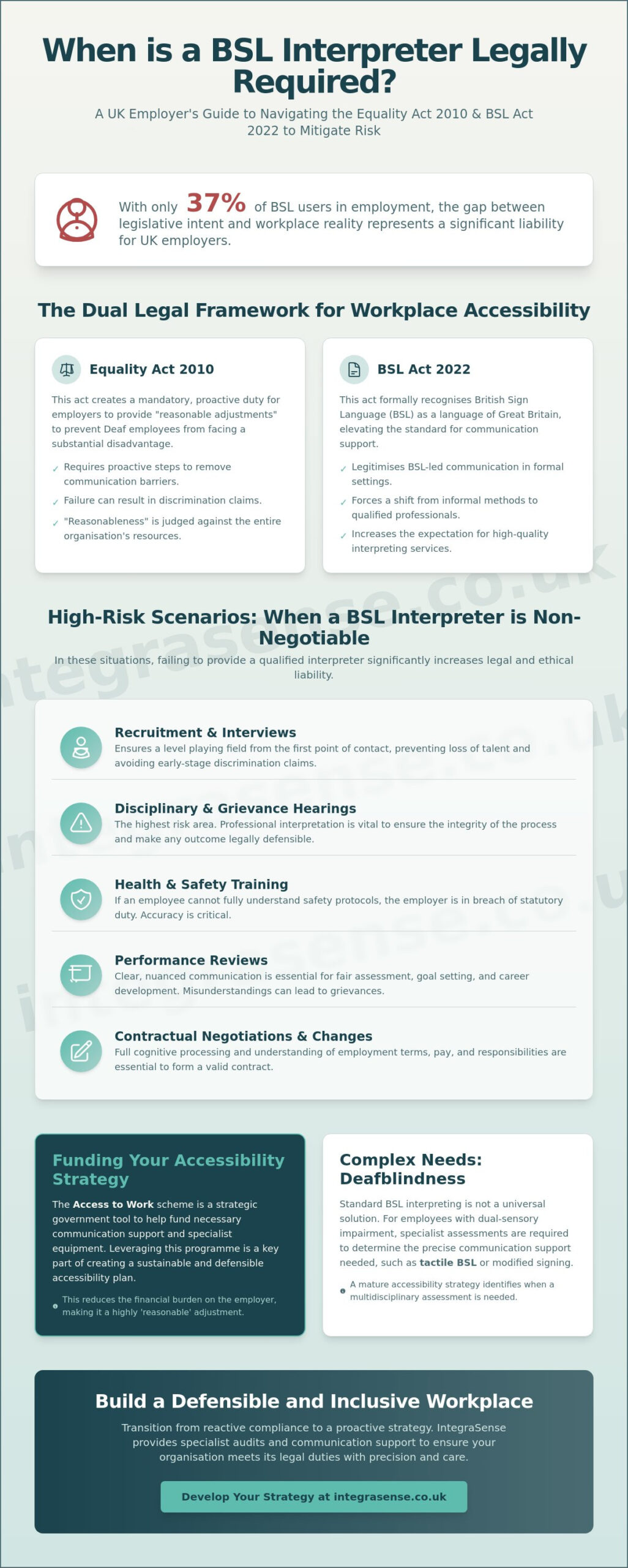
With only 37% of BSL users currently in employment, the gap between legislative intent and workplace reality represents a significant liability for UK employers. You likely recognize that accessibility is a moral imperative, yet the technical question of when is a BSL interpreter legally required in the workplace often creates more confusion than clarity. Under the Equality Act 2010, your duty to provide reasonable adjustments is proactive. It requires a methodical approach to identifying communication barriers before they result in avoidable discrimination claims.
We understand the desire for a workplace where every system functions with precision and every employee can contribute fully. This guide helps you navigate your legal obligations while implementing defensible communication strategies that protect both your staff and your reputation. We will examine high-risk scenarios like disciplinary hearings and performance reviews where professional support is essential. You’ll also find clarity on Access to Work funding to ensure your accessibility journey is both sustainable and optimized. At IntegraSense, we specialize in bringing harmony to complex environments, ensuring your organization remains a leader in modern inclusion.
Key Takeaways
- Understand how the Equality Act 2010 and the BSL Act 2022 create a dual framework for workplace accessibility and formal language recognition.
- Identify high-risk scenarios, such as recruitment and disciplinary hearings, to determine exactly when is a BSL interpreter legally required in the workplace.
- Mitigate legal and ethical liabilities by replacing informal communication methods with qualified professional interpreters to ensure accuracy and neutrality.
- Leverage the Access to Work scheme as a strategic tool to fund necessary communication support and specialist equipment effectively.
- Transition from reactive compliance to an optimized, defensible strategy that empowers Deaf employees while protecting your organizational integrity.
The Legal Framework: Equality Act 2010 and the BSL Act 2022
The legal landscape for workplace accessibility in 2026 is defined by a shift from simple accommodation to systemic inclusion. Under the Equality Act 2010, employers have a mandatory obligation to implement reasonable adjustments that prevent Deaf employees from facing a substantial disadvantage. In the context of BSL interpreting, a reasonable adjustment is a statutory duty where an employer must take proactive steps to remove or reduce communication obstacles, ensuring parity with hearing colleagues. Failing to meet this standard doesn’t just hinder productivity; it exposes an organization to claims of direct discrimination, indirect discrimination, and the specific legal breach of failing to make reasonable adjustments.
The British Sign Language Act 2022 has further matured the regulatory environment by formally recognizing BSL as a language of Great Britain. This recognition, coupled with the 2026 reporting requirements for government departments, places significant weight on BSL-led communication during formal interactions. It forces a move away from informal solutions toward professional-grade interpreting. Determining exactly when is a BSL interpreter legally required in the workplace depends on the impact of the interaction, but the baseline for compliance has never been higher.
Understanding the Duty of Care in 2026
Modern compliance requires a proactive stance. Organizations can no longer wait for a request to be made; they must anticipate needs to maintain a defensible position. Utilizing accessibility audits allows leadership to establish a robust baseline for communication support before issues arise. It’s vital to remember that reasonableness is assessed against the resources of the entire organization. A large public sector body or a global firm cannot justify the absence of an interpreter by pointing to a specific team’s quarterly budget. IntegraSense helps partners align their operational capacity with these evolving legal standards, ensuring that technical compliance feels like a natural extension of organizational excellence.
High-Risk Scenarios: When a BSL Interpreter is Non-Negotiable
Critical information delivery also mandates professional support. Health and safety training is a primary example; if an employee cannot fully process safety protocols, the employer is in breach of statutory duty. This extends to performance reviews and contractual negotiations where full cognitive processing of employment terms is essential. Implementing Defensible Communication Strategies means moving beyond “good enough” support. It involves ensuring that the level of interpretation matches the situational risk, protecting both the employee’s rights and the organization’s liability.
When communication failures in high-risk settings lead to physical harm, the legal ramifications for an organization are significant. To understand the legal protections available to those injured in such circumstances, you can visit Scotland Claims Injury Lawyers for specialized advice on personal injury law and statutory liability.
Complex Communication: Deafblindness in the Workplace
Standard BSL interpreting is not a universal solution. For employees with dual-sensory impairment, BSL alone may be insufficient to bridge the communication gap. In these instances, statutory deafblind assessments are necessary to determine the precise specialist communication support required. This might include tactile BSL or modified signing. Identifying when a multidisciplinary assessment is needed is a hallmark of a mature accessibility strategy. If you’re navigating a scenario involving complex needs, our specialist communication support services offer the technical expertise required to maintain system harmony and legal safety.
Implementing Defensible Communication Strategies
Establishing a robust framework for accessibility requires more than just an awareness of the law. It demands a strategic approach to resource allocation and quality assurance. The Access to Work scheme serves as a primary financial bridge for UK employers, providing funding for BSL interpreting and specialist equipment. By leveraging this government support, organizations can ensure that the cost of compliance remains sustainable, even when long-term support is necessary. Determining when is a BSL interpreter legally required in the workplace is only the first step; securing the right funding ensures that these adjustments are implemented without compromising departmental budgets.
One of the most significant risks to organizational integrity is the use of ‘informal support’. Utilizing colleagues or family members to facilitate communication in professional settings creates severe legal and ethical liabilities. These individuals lack the neutrality and technical expertise of a qualified professional, which can lead to critical inaccuracies or breaches of confidentiality. To maintain a defensible position, always verify that your interpreters hold NRCPD registration and carry professional indemnity insurance. This ensures that the communication process is governed by a strict code of conduct and professional standards.
Sustainable support also involves caring for the professionals within your system. Integrating BSL interpreter professional supervision into your organization’s support structure enhances the quality of service. Supervision provides interpreters with the cognitive space to process complex assignments, ensuring they maintain the resilience required for high-stakes workplace environments.
Managing Risk Through Specialist Consultancy
IntegraSense provides the expert advisory needed to conduct complex workplace communication audits, transforming chaotic environments into optimized spaces of inclusion. When communication breakdowns occur despite your best efforts, our specialists in mediation and conflict resolution can step in to manage risk and restore system harmony. We help you move beyond reactive measures toward a proactive, holistic journey of accessibility. To formalize your workplace accessibility framework and ensure you meet every statutory duty, contact IntegraSense today for a specialist consultation.
Securing Your Organizational Future through Proactive Accessibility
Mastering workplace compliance in 2026 requires a shift from viewing accessibility as a series of isolated tasks to seeing it as a cohesive, high-performance system. You have seen how the dual framework of the Equality Act 2010 and the BSL Act 2022 mandates a proactive approach to communication. By identifying high-risk scenarios and securing government funding through Access to Work, you protect your organization from significant legal and ethical liabilities. Understanding exactly when is a BSL interpreter legally required in the workplace is the foundation of a risk-averse corporate strategy that values both precision and human potential.
IntegraSense acts as a visionary partner, providing specialist consultancy across the health, education, and public sectors to ensure your communication infrastructure is both fluid and robust. Our team of registered NRCPD professionals delivers a defensible decision-making framework that transforms complex technical challenges into optimized operational strengths. Taking the next step toward systemic inclusion ensures that your organization remains a leader in environmental and social stewardship. Book a Specialist Communication Audit with IntegraSense to refine your accessibility journey. Together, we can build a workplace where clarity and control define every interaction.
Frequently Asked Questions
Is an employer legally responsible for the cost of a BSL interpreter?
Employers bear the legal responsibility for the costs associated with BSL interpreting as part of their duty to provide reasonable adjustments. While the Access to Work scheme often provides significant financial support, the statutory obligation remains with the organization. You shouldn’t pass these costs on to the employee or use a lack of funding as an automatic defense for failing to provide necessary support.
Can we use Video Relay Services (VRS) instead of an in-person BSL interpreter?
Video Relay Services are appropriate for short, transactional interactions or remote meetings where technical fluidity is maintained. However, identifying when is a BSL interpreter legally required in the workplace often reveals that high-stakes scenarios, such as disciplinary hearings or complex training, demand in-person support. Physical presence ensures that the interpreter can capture nuances and environmental cues that digital platforms might obscure.
What should I do if an employee refuses a specific BSL interpreter?
You should first establish the specific reason for the refusal, as it often stems from concerns regarding neutrality or previous negative experiences. If the refusal is based on a legitimate conflict of interest or a specific communication need, you must seek an alternative professional to maintain compliance. IntegraSense provides conflict resolution and mediation services to help organizations navigate these interpersonal complexities so they don’t compromise their accessibility goals.
How do I know if an interpreter is sufficiently qualified for a legal workplace meeting?
Verification of NRCPD registration is the industry standard for ensuring an interpreter possesses the necessary qualifications and professional indemnity insurance. For high-stakes meetings, you should specifically confirm that the professional is a Registered Sign Language Interpreter rather than a trainee. This level of due diligence is vital when determining when is a BSL interpreter legally required in the workplace to ensure the accuracy and defensibility of the communication process.