
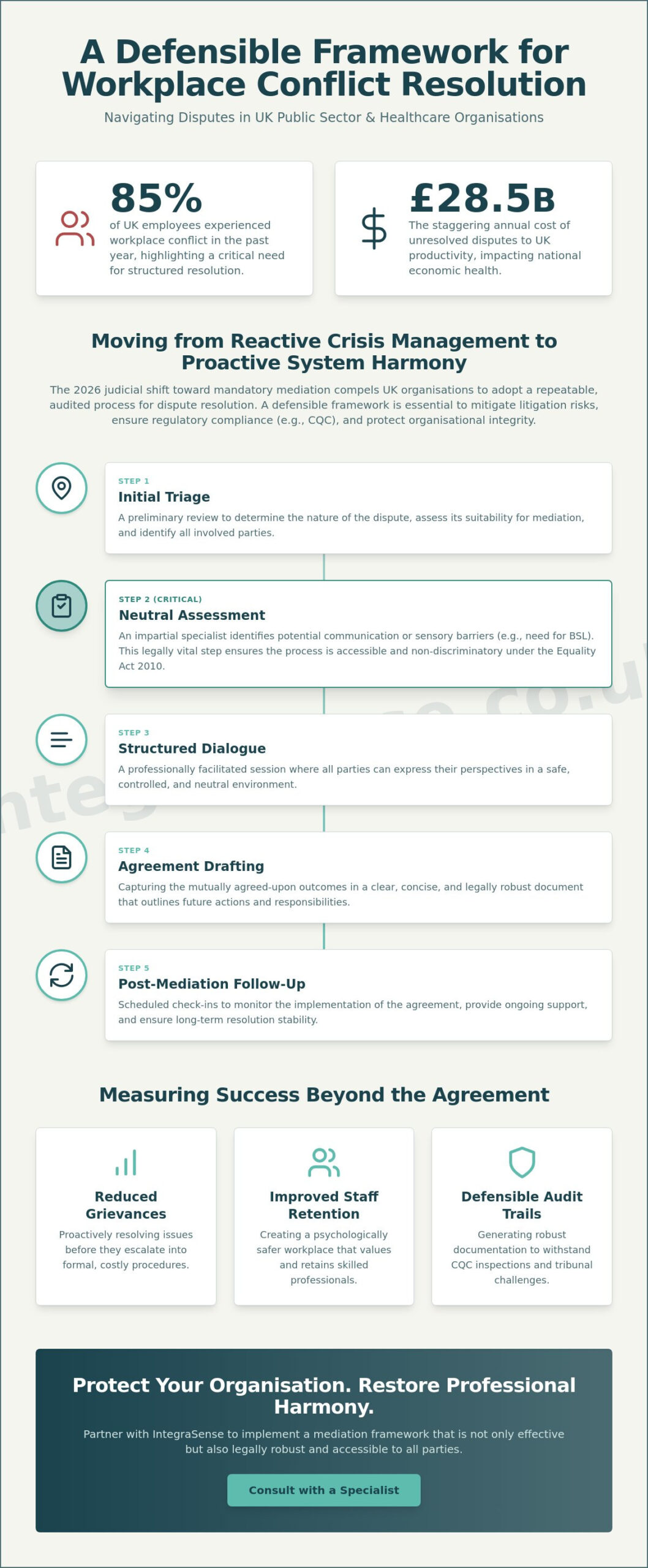
Recent data reveals that 85% of UK employees experienced workplace conflict over the past year, contributing to a staggering £28.5 billion annual loss in national productivity. For many leaders, these aren’t just statistics; they represent the escalating costs and emotional exhaustion of managing disputes that threaten to derail essential services. Finding a reliable path toward conflict resolution Kent organizations can trust has become a matter of both operational survival and legal necessity. You likely recognize that leaving these tensions unaddressed risks non-compliance with the Equality Act and compromises the well-being of teams working in high-pressure environments.
This article provides a definitive roadmap for navigating complex disputes using defensible, person-centered mediation frameworks. We’ll examine how the 2026 shift toward mandatory mediation, reinforced by the Churchill v Merthyr Tydfil CBC ruling, changes your obligations as an employer or service provider. By integrating the specialist expertise of IntegraSense, you can move from reactive crisis management to a proactive state of system harmony. We’ll outline actionable steps to reduce organizational risk and restore the professional relationships that define your success.
Key Takeaways
- Mitigate organizational risk. Learn to identify the specific triggers for litigation and regulatory failure that arise from unresolved workplace disputes.
- Adopt a defensible framework. Use a structured 5-step process for conflict resolution Kent organizations can implement to ensure neutral and legally robust outcomes.
- Ensure sensory accessibility. Prioritize neutral assessments to identify communication barriers that often complicate mediation in healthcare and public sector settings.
- Leverage specialist expertise. Discover how integrating BSL interpreting and professional supervision transforms mediation from a generic process into a visionary solution.
The Strategic Need for Professional Conflict Resolution in Kent
Professional conflict resolution is a structured, neutral intervention designed to reach defensible outcomes that withstand legal and regulatory scrutiny. While understanding conflict resolution through an academic lens provides a theoretical foundation, Kent organizations require a more pragmatic application. Generic “peace studies” often fail to address the immediate, high-stakes realities of the UK public sector. In these environments, unresolved friction isn’t just a cultural issue; it’s a financial and legal liability. For local providers, the risks of ignoring internal disputes include expensive litigation, high staff turnover, and catastrophic regulatory failure. Utilizing mediation in social care has transitioned from an optional soft skill to a critical tool for statutory compliance.
Risk Management and Defensible Decision-Making
Unresolved conflict creates indefensible positions during CQC inspections or tribunal challenges. When organizations react to disputes with “fire-fighting” tactics, they often bypass the rigorous documentation required to justify their actions. A defensible decision is one that is evidence-based, person-centred, and legally robust. Proactive professional consultancy ensures that every step of the resolution process is recorded and aligned with national standards. This methodical approach transforms a chaotic dispute into a managed process that protects the organization’s reputation and its budget.
Just as professional mediation provides a roadmap for organizational health, specialized educational consultancy can guide your personal career trajectory. For those considering advanced studies abroad, Ideal Study Abroad offers comprehensive admission assistance; you can find out more about their specialized services.
The Local Landscape: Kent Social Care and Healthcare
Kent-based providers face a unique set of pressures. Local authority budget constraints frequently collide with the intensive requirements of complex sensory loss cases, creating natural points of tension between families, staff, and funders. Effective conflict resolution Kent specialists must look beyond the surface of the argument. They must understand the person-centred planning framework to ensure that the individual’s needs remain at the heart of the resolution. This expertise is vital for navigating the specific workplace responsibilities and healthcare settings found across the county, ensuring that professional harmony is restored without compromising on quality of care.
Implementing a Defensible Framework for Dispute Resolution
Establishing a standard for conflict resolution Kent organisations can trust requires a shift from informal negotiation to a repeatable, audited process. Following the 2026 judicial shift toward mandatory mediation in civil disputes, a defensible framework for dispute resolution follows five distinct phases: initial triage, neutral assessment, structured dialogue, agreement drafting, and post-mediation follow-up. This sequence ensures that every intervention is grounded in evidence and objective reality rather than emotional conjecture.
The neutral assessment phase is particularly critical. This is where specialists identify sensory or communication barriers that might otherwise be overlooked. Without this step, any subsequent dialogue is inherently flawed and potentially discriminatory. Integrating workplace mediation into your organisational resilience strategy for 2026 ensures that disputes are resolved before they escalate into formal grievances or tribunal claims. You can consult with IntegraSense to ensure your mediation process remains legally robust and accessible to all parties.
Specialist Communication in Mediation
True equity in mediation is impossible if participants can’t fully engage. When disputes involve individuals with sensory impairments, the inclusion of BSL or Deafblind interpreting isn’t just a best practice; it’s a legal requirement under the Equality Act 2010. Failing to provide these supports renders the mediation process and its outcomes indefensible. Organisations should also look for External Quality Assurance (EQA) to verify that the mediation remains impartial and accessible to all parties, regardless of their specific communication needs.
Measuring Success Beyond the Agreement
The goal of professional mediation isn’t just a signed document. Success is measured through specific KPIs like reduced grievance rates, improved staff retention, and the creation of defensible audit trails for regulatory bodies. To maintain long-term stability, organisations should encourage professional supervision and leverage the team coaching expertise of Intact Academy to manage organizational change. This holistic approach ensures that the resolution sticks and the professional culture remains healthy.
Why Kent Organisations Partner with IntegraSense for Mediation
Selecting a partner for conflict resolution Kent requires moving beyond basic negotiation toward a multidisciplinary framework that accounts for every participant’s sensory and cognitive needs. IntegraSense positions itself as a visionary consultant for organisations that demand more than generic mediation. While University of Kent research on conflict resolution highlights the strategic impact of effective frameworks, we provide the specialist practitioners needed to execute them. Our team integrates BSL interpreting, expert witness services, and statutory Deafblind assessments directly into the mediation process. This ensures that every dialogue is inclusive and every outcome is legally robust.
Our focus remains on defensible decision-making. This approach protects the organisation’s interests while empowering the individual through precise communication support. It’s not just about reaching an agreement; it’s about building a durable resolution that survives scrutiny. For specific details regarding our mediation and consultancy fees, please refer to the IntegraSense services page.
A Holistic Approach to Organisational Harmony
System harmony doesn’t end when the mediation session concludes. We combine structured resolution with professional supervision to foster long-term stability. This allows staff to process complex interactions in a safe, guided environment. We also offer STILL method anxiety coaching for employees returning from high-conflict situations. These tools empower your workforce to manage their professional spaces more effectively and responsibly. It’s a comprehensive journey from initial dispute to final resolution.
Securing Your Professional Practice in Kent
We invite HR leads, commissioners, and public sector managers to a confidential discussion about their specific needs. It’s time to move away from chaotic disputes toward an optimized professional environment. Contact IntegraSense today to discuss your requirements and secure the specialist support your organisation deserves.
Advancing Toward Organisational Resilience and System Harmony
Managing the complexities of workplace disputes requires more than just conversation. It demands a rigorous, evidence-based approach that prioritizes both legal compliance and human dignity. By moving away from informal negotiation toward a structured framework, your organisation can mitigate the risks of litigation and regulatory failure. Effective conflict resolution Kent depends on identifying communication barriers early and ensuring that every party has the support they need to engage fully.
Since 2019, IntegraSense has operated as a specialist consultancy dedicated to these precise challenges. Our expertise in Care Act compliant assessments and BSL interpreting ensures that mediation remains accessible to those with complex sensory needs. We don’t just facilitate agreements; we provide professional supervision for practitioners to ensure long-term resilience and system harmony. This holistic focus transforms a point of friction into an opportunity for organisational optimization. Embedding robust safeguarding compliance and professional protection standards alongside your mediation framework ensures that your governance remains defensible against the 2026 statutory updates.
Secure a defensible solution with IntegraSense mediation services and restore clarity to your professional environment. You have the tools to turn complex disputes into sustainable foundations for future growth.
Frequently Asked Questions
What is the difference between mediation and formal grievance procedures in Kent?
Mediation operates as a voluntary and confidential process focused on restoring professional relationships, whereas formal grievance procedures follow a rigid, adversarial structure to determine fault. In Kent, public sector organisations often encourage mediation as an early intervention to prevent disputes from escalating into costly tribunals. While a grievance results in a binary decision, professional mediation allows parties to co-create a sustainable path forward that prioritizes future cooperation.
Can conflict resolution services in Kent support BSL users and the Deafblind?
Specialist conflict resolution Kent providers like IntegraSense integrate British Sign Language (BSL) and Deafblind interpreting directly into the mediation framework. This ensures that sensory barriers don’t compromise the neutrality or legal defensibility of the process. Failing to provide these specialist communication supports can lead to non-compliance with the Equality Act 2010 and create an inequitable environment that risks further litigation and regulatory failure.
Is professional mediation in Kent legally binding?
Mediation remains a non-binding process until a formal settlement agreement is signed by all parties involved. Once an agreement is reached and documented, it functions as a legally enforceable contract under UK law. This provides organisations with the certainty that the resolutions achieved are durable and defensible. UK courts now strongly encourage this route to avoid the protracted nature and high costs of traditional litigation.
How much does professional conflict resolution cost for an organisation in the South East?
The investment for professional conflict resolution varies according to the dispute’s complexity and any required specialist support. Factors such as the inclusion of BSL interpreting, Deafblind assessments, or professional supervision for returning staff will influence the final fee structure. Organisations should view these costs as a strategic investment to avoid the £28.5 billion annual productivity loss associated with unresolved workplace conflict in the UK economy. Aligning your conflict resolution strategy with current safeguarding obligations under the 2026 statutory framework can also help organisations avoid the additional costs of regulatory non-compliance.