For UK health and social care providers, compliance with the Accessible Information Standard (AIS), officially known as DAPB1605, has moved far beyond a ‘best practice’ recommendation. The updated 2025 framework solidifies its importance, yet many organisations struggle to translate policy into effective frontline practice. The core challenge lies in moving staff training from a passive, tick-box exercise to an active culture of defensible decision-making.
The legal imperative for this is clear. Compliance with the Accessible Information Standard is mandated for all NHS and adult social care providers under section 250 of the Health and Social Care Act 2012. While this provides the direct legal duty, failure to comply also exposes organisations to significant risk under the Equality Act 2010, which requires proactive, reasonable adjustments for disabled people. Effective staff training is therefore not just a matter of compliance, but a critical component of organisational risk management.
This guide provides a strategic framework for training staff on the Accessible Information Standard in 2026, focusing on the new six-stage process, the limitations of generic e-learning, and the principles of robust governance that protect both patients and providers.
Implementing the 6-Stage Framework: A Training Blueprint for AIS Compliance
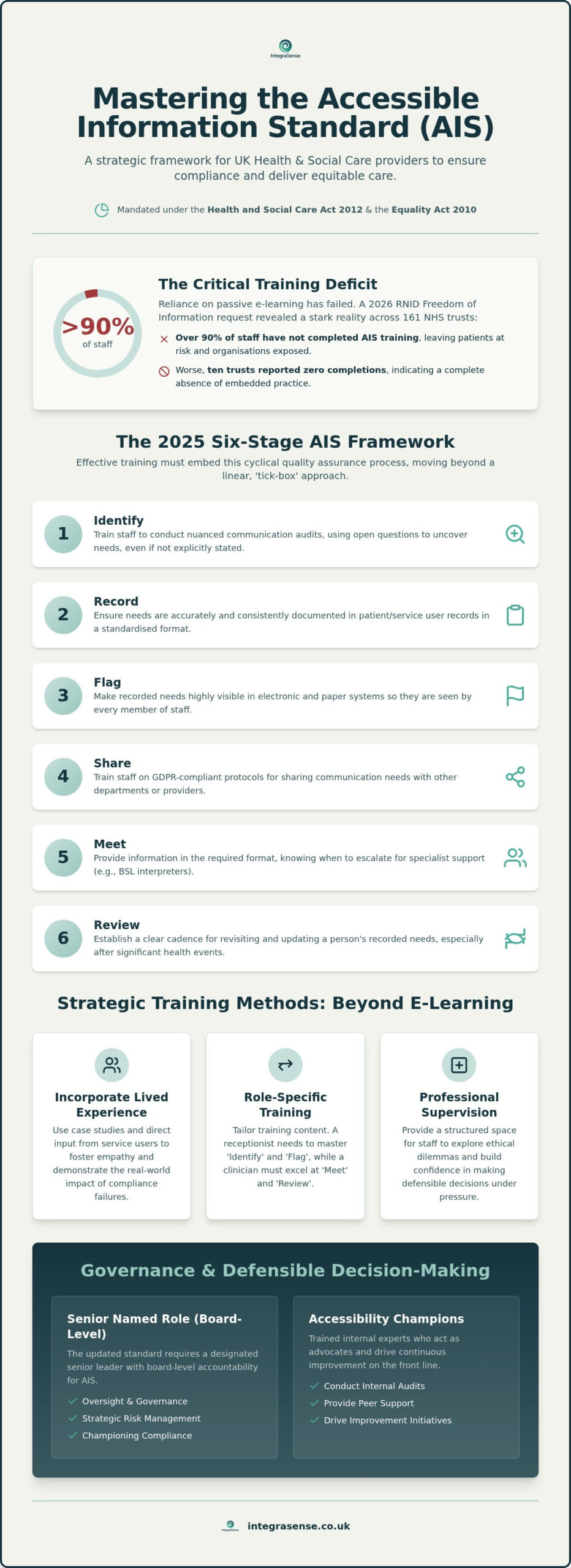
The 2025 update to the Accessible Information Standard evolves the original five-stage process into a more robust six-stage framework. Effective training must equip staff with the skills to navigate this entire cycle, ensuring a continuous and responsive approach to meeting communication needs.
- The evolution to the 2025 six-stage framework: Staff must be trained on the complete process: Identify, Record, Flag, Share, Meet, and Review. This represents a shift from a linear task to a cyclical quality assurance process.
- Beyond ‘tick-box’ identification: Training should coach staff to move beyond asking “Do you have any communication needs?” to conducting nuanced communication audits. This involves understanding how to ask open questions and listen for cues that indicate a need, even if not explicitly stated.
- Sharing information with diligence: The ‘Share’ stage requires careful training on how to transfer communication needs data between departments or organisations while remaining fully compliant with GDPR and data protection standards. This is a critical governance point.
- Establishing a cadence for review: The new ‘Review’ stage is crucial. Training must establish a clear cadence for revisiting a person’s recorded needs, ensuring they remain accurate and relevant over time, particularly after significant health events.
Mastering the ‘Meet’ Stage for Complex Communication Needs
The ‘Meet’ stage is where policy becomes practice, and it is the area with the highest risk of failure, especially for individuals with complex needs. Training must go beyond basic adjustments.
- Differentiating needs: Frontline staff must be trained to differentiate between basic needs (e.g., large print) and specialist requirements. This includes knowing when to escalate a request for professional support, such as for a specialist deafblind assessment, which is a statutory duty under the Care Act.
- The role of specialist support: Staff need to understand the critical function of specialist communication support in high-stakes environments. This includes knowing when and how to book qualified BSL interpreters for clinical appointments or legal discussions to ensure information is conveyed accurately and equitably.
Strategic Training Methods: Moving Beyond Mandatory E-Learning
While e-learning has its place for foundational knowledge, relying on it exclusively for AIS compliance is a flawed strategy. True behavioural change requires a more dynamic and reflective approach.
- The limitations of static e-learning: The ineffectiveness of a purely digital approach is stark. A January 2026 Freedom of Information request by RNID found that across 161 responding NHS trusts, over 90% of staff had not completed AIS training, with ten trusts reporting zero completions. This data proves that passive digital modules often fail to change staff behaviour or embed an accessible culture.
- Incorporating ‘lived experience’: Training workshops become far more impactful when they include case study analysis and, where possible, direct input from individuals with lived experience of communication barriers. This fosters empathy and a deeper understanding of the consequences of non-compliance.
- Utilising professional supervision: For practitioners handling complex cases, professional supervision provides a structured space to explore ethical dilemmas in accessibility. It allows staff to reflect on challenging situations and develop strategies for making sound, defensible decisions under pressure.
- Role-specific training: A one-size-fits-all module is inefficient. Training should be tailored to different roles. A receptionist’s training should focus on ‘Identify’ and ‘Flag’, a clinician’s on ‘Meet’ and ‘Review’, and an IT administrator’s on the technical aspects of ‘Record’ and ‘Share’.
Empowering Accessibility Champions and Senior Leadership
A compliant culture is driven from the top down and championed from the ground up. The 2025 update formalises this by requiring clear lines of accountability.
- Defining leadership responsibilities: The updated guidance requires organisations to identify a senior named role with board-level accountability for the Standard. Training for this individual should focus on governance, risk management, and strategic oversight, ensuring they can champion AIS at the highest level. This role works in tandem with a designated ‘AIS lead’ responsible for day-to-day implementation.
- Training ‘Accessibility Champions’: These champions act as internal experts and advocates. They require specialist training to conduct internal accessibility audits, provide peer support, and drive continuous improvement initiatives within their teams.
Governance and Defensible Decision-Making in Accessible Information
Robust AIS training is fundamentally about risk management. It equips your organisation and your staff to make, and document, defensible decisions regarding communication support.
- What is ‘Defensible Decision-Making’? In the context of the AIS, it means having a clear, evidence-based rationale for the communication support provided. It is the ability to demonstrate that you have followed a logical and compliant process to meet an individual’s needs.
- Documenting the ‘why’: A critical training component is teaching staff to document why certain communication adjustments were or were not provided. A simple record of a decision is insufficient; it must be accompanied by a clear rationale that links back to the individual’s assessed needs and the organisation’s legal duties.
- The legal intersection: Training must provide a primer on the intersection of the AIS (mandated by the Health and Social Care Act 2012), the Care Act 2014 (which includes duties around wellbeing and assessment), and the Equality Act 2010 (which covers the duty to make reasonable adjustments). Staff must understand how these legal frameworks interact to protect service users.
- Managing risk through training: Ultimately, robust training is the most effective way to prevent formal complaints and litigation. When staff are confident in their knowledge and processes, they are better equipped to meet needs correctly the first time, reducing the likelihood of service failures.
Handling Non-Compliance and Formal Complaints
Even with the best training, disputes can arise. How your organisation handles them is a key test of your commitment to the AIS.
- Training managers in conflict resolution: When disputes related to AIS do occur, managers must be equipped with the skills to de-escalate and resolve them effectively. Training in structured conflict resolution can prevent complaints from escalating into formal, costly processes.
- The role of External Quality Assurance (EQA): To validate the effectiveness of your training programme, consider using EQA. An external specialist can review your training materials, observe practice, and audit outcomes to provide independent verification that your processes are robust and fit for purpose.
By shifting the focus from passive learning to active, role-specific training grounded in defensible decision-making, health and social care providers can build a resilient and genuinely accessible service. This not only ensures compliance with the 2025 AIS updates but also fosters a culture of safety and respect for every individual’s communication needs.
Contact IntegraSense today for specialist accessibility consultancy and bespoke staff training designed to embed defensible practice within your organisation.
Frequently Asked Questions
Is training on the Accessible Information Standard mandatory for all staff?
Yes, for applicable organisations. The legal duty to comply with the Accessible Information Standard (DAPB1605) for all NHS bodies and publicly funded adult social care providers comes from section 250 of the Health and Social Care Act 2012. Therefore, organisations must ensure their staff are sufficiently trained to meet this legal obligation. Furthermore, a failure to meet needs under the AIS creates significant legal risk under the Equality Act 2010, which mandates a proactive duty to make reasonable adjustments for disabled people.
What are the key changes in the 2025 Accessible Information Standard update?
The most significant change is the expansion from a five-stage to a six-stage framework: Identify, Record, Flag, Share, Meet, and Review. The addition of the ‘Review’ stage formalises the need for organisations to periodically check that a person’s recorded needs are still accurate. The update also places a stronger emphasis on organisational accountability, requiring a senior named role with board-level responsibility.
How often should staff receive refresher training on AIS compliance?
There is no single mandated frequency, but best practice suggests a regular cadence. A common approach is an annual refresher via e-learning for all staff to maintain baseline knowledge, supplemented by more intensive, role-specific workshops or supervision every 2-3 years, or whenever significant changes to the Standard or internal processes occur.
What is a ‘senior named role’ under the new AIS guidelines?
This is not a formal job title but a designated function. NHS England guidance requires organisations to identify a senior leader, typically at or near board level, who has ultimate accountability for the organisation’s compliance with the Accessible Information Standard. This role is strategic, focusing on governance and oversight, and is distinct from the ‘AIS lead’ who manages day-to-day operational implementation.