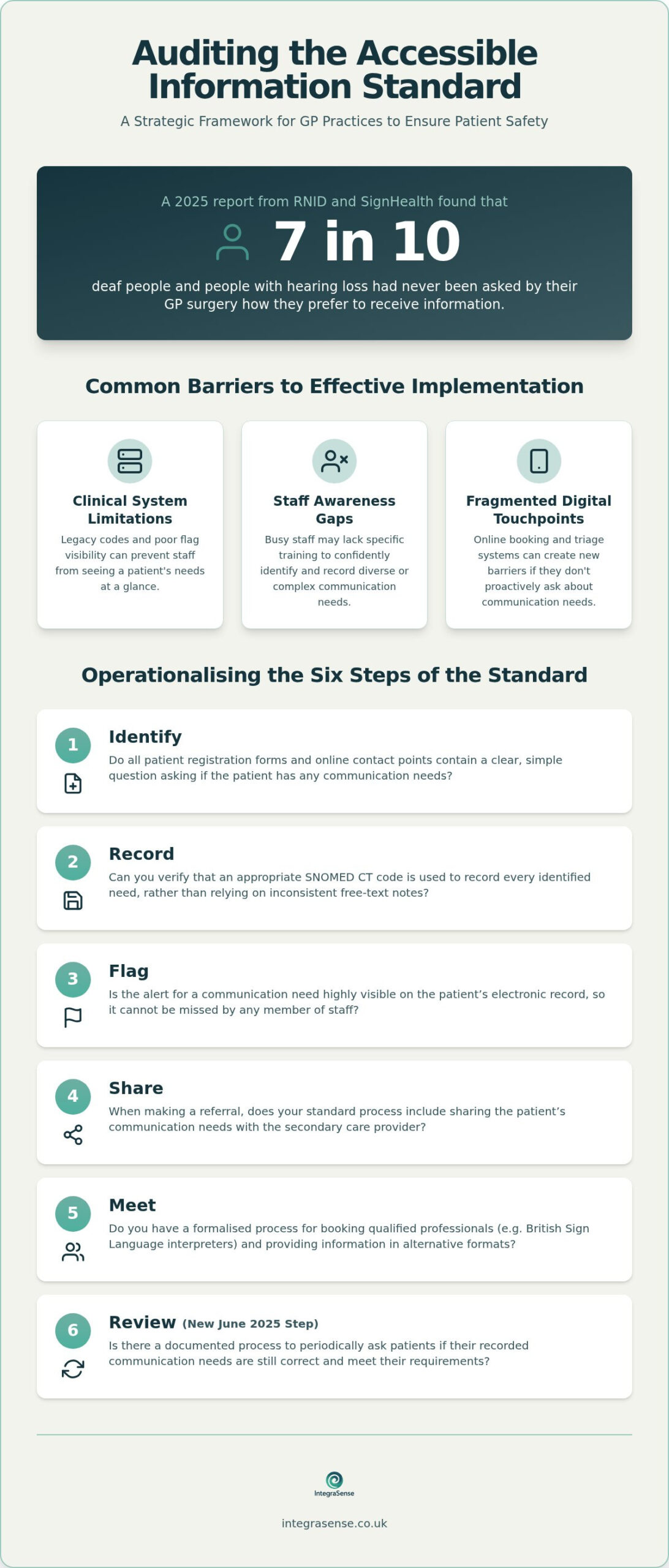
Most GP practice managers are aware of the Accessible Information Standard. Yet, a significant gap persists between acknowledging its principles and delivering them consistently in primary care. The standard exists to support patients who have a disability, impairment or sensory loss, but its aims are not always met on the ground. A 2025 report from RNID and SignHealth found that seven in ten deaf people and people with hearing loss had never been asked by their GP surgery how they prefer to receive information. This highlights a systemic challenge that goes beyond simple awareness. A structured approach is needed to move from policy to practice, ensuring every patient interaction is safe, effective and person-centred.
Key Takeaways from This Article
- The Accessible Information Standard is a strategic tool for patient safety and governance, not just an administrative task. It supports compliance with the Equality Act 2010.
- A systematic audit involves reviewing the entire patient journey, from initial registration and digital contact points to the consistent use of clinical system flags.
- The June 2025 update to the standard introduced a sixth step, ‘Review’, formalising the need for continuous evaluation of your practice’s communication processes.
- A specialist, external audit provides objective evidence for CQC inspections and helps identify organisational risks that internal self-assessments may overlook.
Strategic Framework for a GP Accessible Information Audit
The Accessible Information Standard, formally known as DAPB1605, was published under section 250 of the Health and Social Care Act 2012. Rather than viewing it as a paperwork exercise, it is best understood as a framework for improving patient safety and strengthening clinical governance. Its purpose is to support organisations in meeting their duties to make reasonable adjustments for patients under the Equality Act 2010. For a GP surgery, this means having robust systems to ensure that a patient’s communication needs do not become a barrier to receiving high-quality care.
However, several common barriers can hinder effective implementation in a primary care environment. These often include:
- Clinical System Limitations: Older patient record systems may rely on legacy codes like Read v2 or CTV3, making it difficult to flag and share information effectively compared to modern SNOMED CT codes. Flags may not be sufficiently visible to all staff, from receptionists to clinicians.
- Staff Awareness Gaps: Busy practice staff may lack the specific training to confidently identify and record a diverse range of communication needs, particularly for patients with complex requirements such as those who are Deafblind.
- Fragmented Digital Touchpoints: The rise of online appointment booking and digital triage systems creates new potential points of failure. If these platforms do not proactively ask about communication needs, patients can be left unable to access care equitably.
Identifying Organisational Gaps in Primary Care Communication
A thorough communication needs audit begins by examining the first points of contact. Your patient registration process, both paper and digital, should be the first line of defence in identifying needs. It is crucial to evaluate whether your practice protocols actively ask every new patient about their preferred information formats and communication support.
The audit should also review how your organisation manages risk when specialist support, such as a British Sign Language (BSL) interpreter, is not immediately available for an urgent appointment. Having a clear, documented procedure for these scenarios is essential for defensible decision-making. Finally, establishing a baseline for staff competency is vital. This means assessing whether your team can confidently recognise the different requirements of a patient who uses BSL and a Deafblind patient who uses hands-on signing, and knows the correct internal process for each.
Operationalising the Six Steps of the Standard
The June 2025 update to the standard formalised a six-step process that every provider should have regard to. An effective audit uses these steps as a practical checklist to verify that processes are not just documented but are working in practice. The six steps are: Identify, Record, Flag, Share, Meet and Review.
Use this checklist to assess your current systems:
- Identify: Do all patient registration forms and online contact points contain a clear, simple question asking if the patient has any communication needs?
- Record: Can you verify that an appropriate SNOMED CT code (or legacy equivalent) is used to record every identified need, rather than relying on inconsistent free-text notes?
- Flag: Is the alert or flag for a communication need highly visible on the front screen of the patient’s electronic record, so it cannot be missed by any member of staff?
- Share: When making a referral, does your standard process include sharing the patient’s communication needs with the secondary care provider or other service?
- Meet: Do you have a formalised process for booking qualified professionals, such as BSL interpreters, and a clear policy on providing information in alternative formats like large print or email? You can learn more about how to book BSL interpreters for medical appointments here.
- Review: Is there a documented process to periodically ask patients if their recorded communication needs are still correct and meet their requirements?
Specialist Consultancy for Defensible Decision-Making in Primary Care
While NHS England has an expectation that organisations will complete their first self-assessment by March 2027, an internal review can sometimes miss underlying issues. Staff may be accustomed to inefficient workarounds, or lack the specialist knowledge to identify risks associated with complex communication needs. This is where an external, specialist Accessible Information Standard audit for a GP surgery provides significant value.
An objective audit brings a fresh perspective, free from internal biases. A specialist consultant can benchmark your practice’s processes against established best practice, providing evidence that supports your position during a CQC inspection. The CQC considers how well services meet the standard under its responsive key question. A detailed audit report from a third party demonstrates a proactive approach to governance and risk management; for broader support with health, safety, and quality compliance, you can learn more about Quantum Leap Safety Services.
Furthermore, specialist consultancy can include professional supervision for staff. This provides a structured, confidential space for your team to discuss challenging cases and refine their practice. It helps build resilience and competence, ensuring staff feel supported in managing the ethical and practical complexities of accessible communication.
Optimising Primary Care Accessibility
Conducting a thorough accessibility audit is not about achieving a one-time pass. It is about embedding a culture of continuous improvement that prioritises patient-centred communication. By moving beyond a simple self-assessment, your practice can develop a long-term accessibility strategy that supports both patients and practitioners, reducing clinical risk and fostering trust. This holistic approach to safety and governance often includes wider property compliance, such as maintaining up-to-date Asbestos Management Surveys UK to ensure the physical environment remains safe for everyone.
A specialist review helps you build a robust and defensible framework for decision-making. It provides the assurance that your systems are not only documented but are truly effective in meeting the diverse needs of your patient community, including those who are Deafblind or use BSL.
IntegraSense provides expert consultancy to support primary care providers. Our services include specialist Deafblind assessments, BSL interpreting consultancy, and professional supervision for practitioners. Contact IntegraSense today to arrange a specialist Accessible Information Standard audit for your GP surgery and strengthen your approach to accessible healthcare.
Frequently Asked Questions
How often should a GP surgery conduct an Accessible Information Standard audit?
There is no compulsory schedule for a formal audit. However, NHS England’s June 2025 update introduced an expectation that organisations perform a self-assessment using its framework, with the first expected by March 2027. Many organisations choose to conduct more in-depth specialist audits periodically as part of their quality improvement and governance cycles, particularly when preparing for CQC inspections or implementing new clinical systems.
What are the consequences of not meeting the standard?
Providers and commissioners must have due regard to the standard. While it is not yet a mandatory requirement in full, the CQC considers how well services are applying its principles when assessing if a service is responsive. Failure to meet a patient’s needs can also be a factor in patient complaints and may relate to an organisation’s duty to provide reasonable adjustments under the Equality Act 2010.
Does the Accessible Information Standard cover spoken language translation services?
No. The standard’s scope is specifically focused on the needs of people who have a disability, impairment or sensory loss. It does not cover the provision of interpreting or translation services for patients whose first language is not English. This is managed through separate NHS England guidance.
How does the standard apply to Deafblind patients who use hands-on signing?
The standard fully applies to Deafblind patients. It requires practices to identify, record, and meet their specific communication needs. For a patient who uses hands-on signing, this would involve sourcing a specialist Deafblind interpreter, which is a distinct specialism from BSL interpreting. An audit would check if the practice has a clear process to identify this need and access the correct professional support.