
For adult social care commissioners and managers in Kent, ensuring statutory duties are met is a foundational responsibility. When it comes to assessing the needs of Deafblind individuals, the legal framework is highly specific, creating a practical capacity question for many local authorities. The duty, set out in Regulation 6 of the Care and Support (Assessment) Regulations 2014, demands a level of specialism that may not always be available within internal teams.
This creates a need for a clear strategy on how to secure assessments that are not only compliant but also genuinely person-centred and robust. Utilising an independent Deafblind assessor provides a practical solution for Kent-based authorities to meet this specific regulatory duty, manage complex caseloads, and ensure the resulting care and support plan is built on a foundation of specialist expertise. This article explores the precise requirements of the regulations and clarifies the role an independent specialist plays in fulfilling them.
What Regulation 6 Actually Requires
While often discussed in the context of the Care Act 2014, the specific duty relating to Deafblind assessments is detailed in the secondary legislation that sits beneath it. Understanding these details is crucial for commissioning and decision-making.
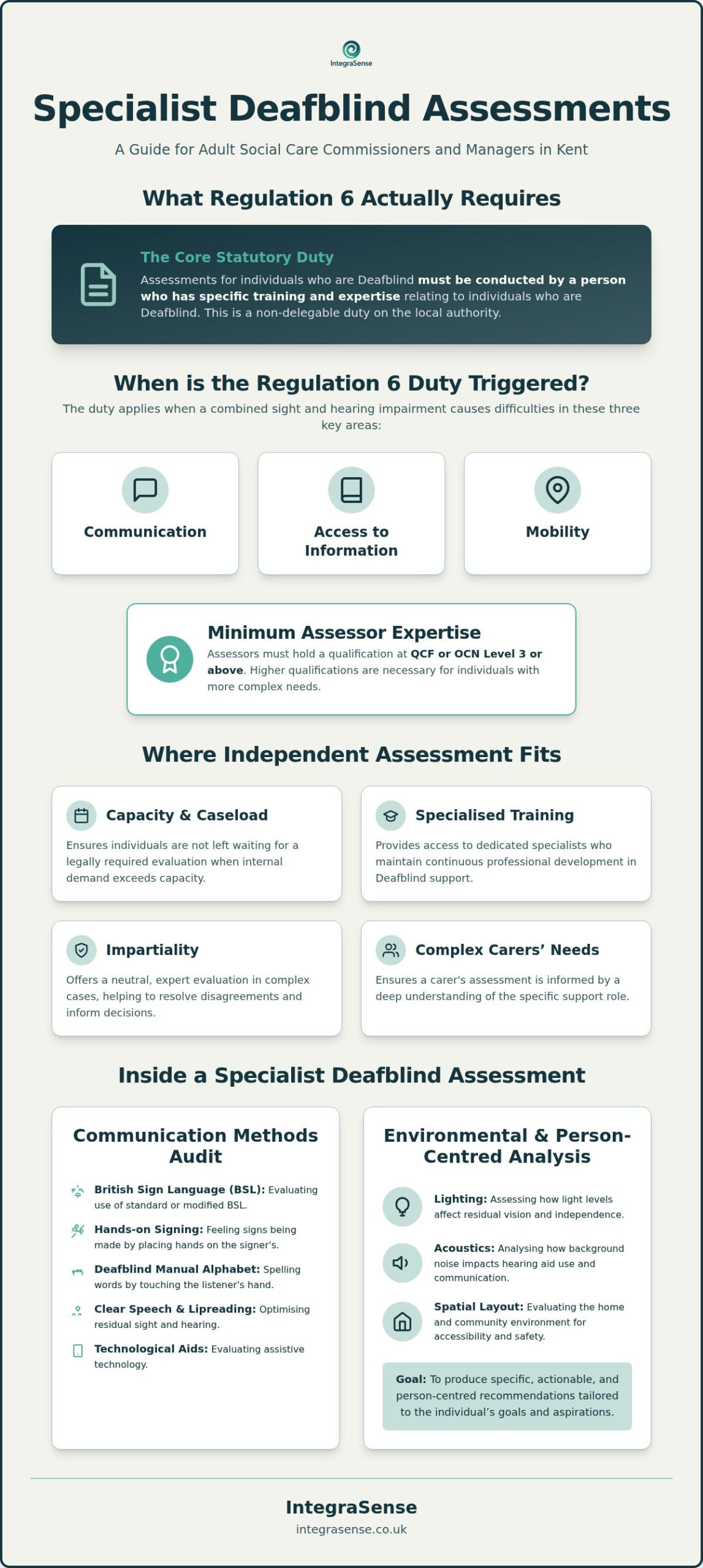
Regulation 6 of the Care and Support (Assessment) Regulations 2014 stipulates that any assessment carried out for an individual who is Deafblind **must be conducted by a person who has specific training and expertise relating to individuals who are Deafblind. **This duty sits with the local authority. Assessment functions may be carried out by a commissioned specialist under section 79 of the Care Act 2014, but accountability for how the duty is discharged always remains with the authority.
The regulations also provide a clear definition of who is considered Deafblind for the purposes of the Act. A person is defined as Deafblind if they have a combined sight and hearing impairment that causes difficulties with three specific areas of life:
- Communication
- Access to information
- Mobility
It is the combination of the sensory impairment and the impact on these three functional areas that triggers the Regulation 6 duty. A standard sensory assessment that does not engage with this specific triad of needs is insufficient to meet the statutory requirement.
To clarify the level of expertise required, the Care and Support for Deafblind Children and Adults Policy Guidance (December 2014) sets a minimum standard. It states that assessors should hold a qualification at QCF or OCN Level 3 or above. For individuals with higher or more complex needs, the guidance indicates that a higher level of qualification and experience is necessary to properly synthesise the person’s needs and produce a meaningful assessment.
Where Independent Assessment Fits
It is important to state plainly that the duty outlined in Regulation 6 is about the assessor’s training and expertise, not their employment status. An appropriately trained and qualified in-house assessor fully satisfies the regulation. However, many local authorities face practical challenges in maintaining this specialist capacity internally.
An independent Deafblind assessor offers a practical and effective route to compliance in several common scenarios:
- Capacity and Caseload Management: Specialist in-house staff often carry significant caseloads. When demand exceeds capacity, commissioning an independent specialist assessment ensures that individuals are not left waiting for a legally required evaluation.
- Access to Specialised Training: The field of Deafblind communication and support is highly specialised. It can be difficult for organisations to fund and maintain up-to-date training for a small number of staff. An independent assessor, by definition, is dedicated to this specialism and maintains their continuous professional development in this area.
- Impartiality and Second Opinions: In complex cases, particularly where there may be differing views between the individual, their family, and the local authority, an independent assessment provides a valuable, impartial perspective. This can help in resolving disagreements and ensuring the final decision is based on a neutral, expert evaluation.
- Complex Carers’ Assessments: When a carer is supporting a Deafblind individual, their own needs assessment must be informed by a deep understanding of the specific caring role. An independent specialist can conduct or contribute to the carer’s assessment, ensuring their support needs are accurately identified in the context of the Deafblind person’s life.
In these situations, engaging an independent deafblind assessor in Kent is not about replacing internal teams, but about augmenting them with specialist resources precisely when and where they are needed.
Inside a Specialist Deafblind Assessment
A specialist Deafblind assessment is fundamentally different from a general social care or standard sensory assessment. It is a holistic process that places the individual’s unique method of communication and interaction with their environment at the very centre of the evaluation.
Communication Methods and Audits
The core of the assessment involves identifying the person’s preferred and most effective communication methods. This goes far beyond noting a hearing or sight impairment. A specialist will assess proficiency and preference across a range of methods, which may include:
- British Sign Language (BSL): Evaluating the individual’s use of standard or modified BSL, including visual frame and presentation.
- Hands-on Signing: A method where the Deafblind person places their hands on the hands of the signer to feel the signs being made.
- Deafblind Manual Alphabet: A system of spelling out words by touching different parts of the listener’s hand.
- Clear Speech and Lipreading: Assessing the extent to which residual sight and hearing can be optimised.
- Technological Aids: Evaluating the use of assistive technology, from hearing aids and screen readers to specialised communication devices.
The assessor synthesises this information to understand how the individual receives information, expresses their choices, and engages in social interaction. This forms the basis for all further recommendations.
Environmental Factors and Person-Centred Recommendations
The assessment must also consider the person’s interaction with their environment. A specialist will analyse how factors like lighting, acoustics, and the spatial layout of their home and community impact their independence and wellbeing. For example, poor lighting can render residual vision useless, while background noise can overwhelm a hearing aid user.
The final report translates these detailed findings into specific, actionable, and person-centred recommendations. Rather than generic suggestions, the outcomes will be tailored to the individual’s goals and aspirations, ensuring that any proposed support directly contributes to their quality of life and ability to participate in their community.
Choosing a Specialist Assessor in Kent
When commissioning an independent Deafblind assessor in Kent, local authority and healthcare leads should look for a provider who offers more than just the assessment itself. A truly specialist consultancy provides a breadth of expertise that ensures a robust and comprehensive service.
Assessor qualifications and local knowledge
The first step is to verify the assessor’s qualifications. There is no professional register for Deafblind assessors in the UK, so registration cannot be used as a shortcut for checking competency. What matters is that the individual holds the Deafblind assessors qualification at level 3 or above, with a higher level of qualification and experience where the person’s needs are more complex.
It is worth being clear that this is a distinct credential. Registration as a Deafblind interpreter, or as a British Sign Language interpreter, is a separate qualification and does not in itself qualify someone to carry out a statutory Deafblind assessment. The roles draw on related knowledge, but they are not interchangeable. Commissioners should ask for evidence of the assessors qualification specifically, rather than treating interpreter registration as equivalent.
Furthermore, an assessor with specific knowledge of Kent’s local services, referral pathways, and third-sector organisations can produce more effective and practical recommendations. They understand the local context in which their support plan will be implemented, making for a smoother transition from assessment to provision.
A Multidisciplinary Approach
Complex cases rarely exist in a vacuum. A consultancy that offers a multidisciplinary skill set can provide more holistic support. This includes access to services such as:
- Professional Supervision: Providing reflective practice and support for the in-house teams who will be implementing the care plan.
- Mediation: In situations of conflict, an independent mediator can help resolve disputes between families, individuals, and service providers, ensuring a person-centred outcome.
- Expert Witness Services: Where a case may proceed to a tribunal or court, an assessor with expert witness experience can provide clear, impartial evidence on the individual’s needs.
This integrated approach ensures that the assessment is not an isolated event but part of a strategic framework for delivering high-quality, sustainable support for Deafblind individuals in the region.
IntegraSense provides specialist, independent Deafblind assessments across Kent and the South East, delivered by appropriately qualified specialist assessors.
Our work is grounded in a deep understanding of the statutory framework and a commitment to producing clear, comprehensive, and person-centred reports. To discuss a specific case or learn more about our assessment process, we invite you to arrange a consultation.
Book a Specialist Deafblind Assessment Consultation
Frequently Asked Questions
What does Regulation 6 require of a Deafblind assessment?
Regulation 6 of the Care and Support (Assessment) Regulations 2014 requires that an assessment for a person who is Deafblind must be carried out by someone with specific training and expertise in supporting Deafblind individuals. The regulation defines a person as Deafblind if their combined sight and hearing loss causes difficulties with communication, access to information, and mobility.
Who counts as having specific training and expertise?
According to the 2014 statutory guidance, the minimum qualification for a Deafblind assessor is a QCF or OCN Level 3 award in this specialism. For individuals with more complex needs, a higher level of qualification and experience is expected. Expertise also involves practical experience in a range of communication methods and environmental assessment. Registration as an interpreter is a separate credential and does not qualify a person to carry out the assessment.
Can an in-house assessor carry out a Deafblind assessment?
Yes. The regulation is focused on the assessor’s qualifications and expertise, not their employment status. An in-house social worker or sensory specialist who holds the required training and expertise can legally carry out the assessment. Independent assessors are typically commissioned when an authority lacks this specific in-house capacity or when an impartial, external view is required.
What is the difference between a general sensory assessment and a specialist Deafblind assessment?
A general sensory assessment may focus on sight loss or hearing loss individually. A specialist Deafblind assessment addresses the combined and compounding impact of both sensory impairments. It specifically evaluates the person’s difficulties across communication, access to information, and mobility, and requires a deep understanding of specialist communication methods like hands-on signing and the Deafblind manual alphabet.