
In mental health services, effective communication is the foundation of safe and ethical clinical practice. For Deaf patients, this foundation depends on access to skilled communication support. Securing a professional BSL interpreter for mental health appointments is not merely an administrative task; it is a critical component of clinical governance, risk management, and the delivery of person-centred care. Misinterpretation can jeopardise a patient’s diagnosis, treatment, and liberty, making the selection of an appropriately experienced interpreter a matter of professional and organisational responsibility.
This guide explores the specific demands of psychiatric and therapeutic settings, outlining how healthcare commissioners and service managers can ensure their communication support framework is robust, compliant, and conducive to positive clinical outcomes. It moves beyond the basic principle of access to address the nuances of defensible decision-making when working with Deaf individuals in complex care environments.
Why Linguistic Precision Matters in Psychiatric Assessment
Mental health assessments are profoundly reliant on the subtleties of language. Clinicians evaluate not just what a patient says, but how they say it—exploring tone, metaphor, abstract concepts, and the structure of their narrative. British Sign Language (BSL), a rich and complex visual language, conveys this nuance with the same depth as spoken English. However, conveying these subtleties accurately requires more than basic linguistic fluency.
An interpreter without specific mental health experience may struggle to convey the precise meaning behind a patient’s expressions of their internal world. This can lead to significant clinical consequences:
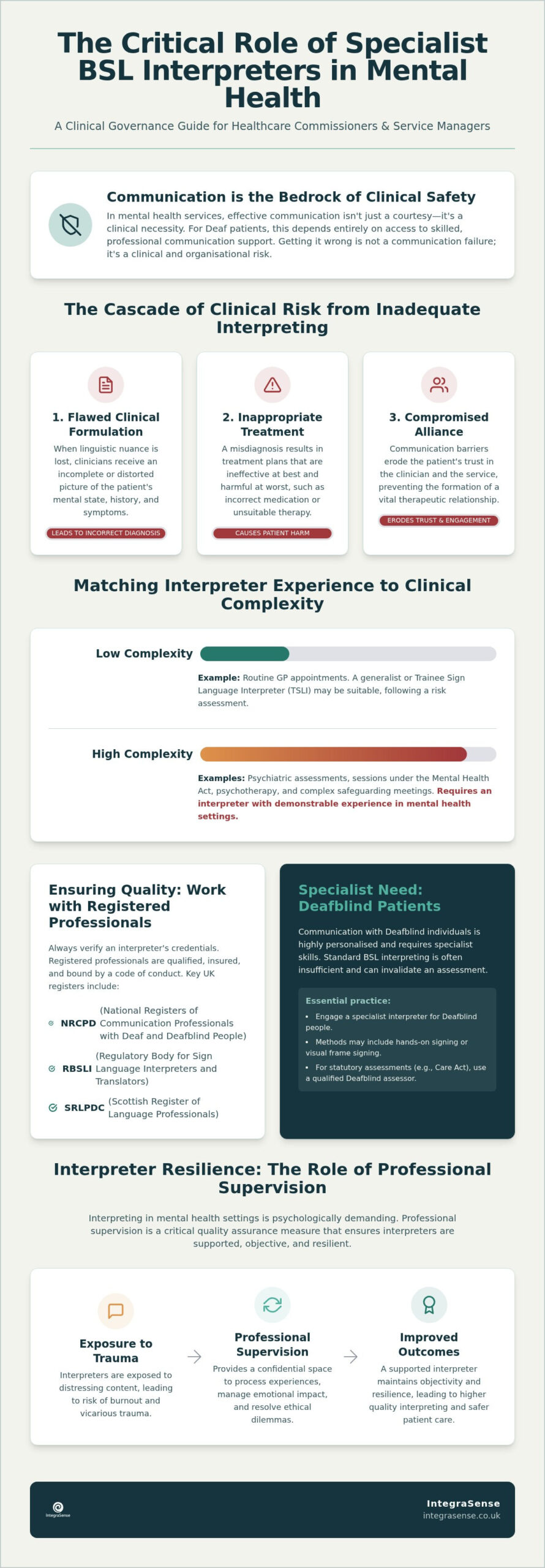
- Flawed Clinical Formulations: A clinician’s understanding of a patient’s history, symptoms, and mental state is built upon the information relayed by the interpreter. If nuance is lost, the resulting clinical formulation may be inaccurate, leading to an incorrect diagnosis.
- Inappropriate Treatment Plans: A misdiagnosis can result in treatment plans that are ineffective at best and harmful at worst. For example, medication may be prescribed inappropriately, or therapeutic interventions may fail to address the patient’s actual needs.
- Compromised Therapeutic Alliance: The relationship between a patient and clinician is central to successful treatment. Communication barriers created by inaccurate interpreting can erode trust and prevent the development of a strong therapeutic alliance.
The role of the interpreter is to facilitate accurate understanding, allowing the clinician to perform their assessment and documentation duties reliably. This requires a professional who can navigate the complex dynamics of a clinical consultation with precision and impartiality.
Matching Interpreter Experience to Psychiatric and Therapeutic Settings
Not all interpreting assignments carry the same level of complexity or risk. While a generalist interpreter may be perfectly suitable for a routine GP appointment, mental health settings demand a specific skill set and level of experience. Commissioners and managers should prioritise matching the interpreter’s background to the demands of the clinical environment.
In the UK, communication professionals are typically registered with a professional body. These registers ensure practitioners hold relevant qualifications, carry professional indemnity insurance, and adhere to a code of conduct. Key registers include:
- The National Registers of Communication Professionals with Deaf and Deafblind People (NRCPD)
- The Regulatory Body for Sign Language Interpreters and Translators (RBSLI)
- The Scottish Register of Language Professionals with the Deaf Community (SRLPDC)
When booking an interpreter, it is good practice to work with registered and regulated professionals. For therapeutic appointments, assessments under the Mental Health Act, or other complex consultations, it is vital to verify that the interpreter has demonstrable experience in these specific domains. Trainee interpreters (TSLIs), while still completing their qualifications, may be considered for less complex appointments, but a thorough risk assessment should always be conducted to determine their suitability for the specific context.
Deafblind Patients and Complex Sensory Profiles
The communication needs of Deafblind individuals introduce further complexity. A Deafblind person’s communication methods are often highly personalised and may include hands-on signing, visual frame signing, or other adapted techniques. Standard BSL interpreting is often insufficient for this patient group, and using an unqualified professional can completely obstruct communication, rendering an assessment invalid.
Specialist interpreters for Deafblind people possess the skills to adapt their methods to the individual’s specific sensory and communication profile. Organisations like Deafblind Enablement maintain a specialist register for professionals qualified in this area. For statutory assessments, such as those conducted under the Care Act, engaging a qualified Deafblind assessor is crucial for compliance and for ensuring the patient’s needs are accurately identified and met.
Failing to provide this specialist support not only compromises patient safety but also prevents the organisation from fulfilling its legal duties to provide accessible information and make reasonable adjustments.
Professional Supervision and Interpreter Resilience
Interpreting in mental health settings is emotionally and psychologically demanding work. Interpreters are regularly exposed to distressing and traumatic content, which can lead to burnout and vicarious trauma if not properly managed. This, in turn, can affect their performance and the quality of care the patient receives.
Professional supervision is a formal process that allows interpreters to reflect on their practice in a structured and supportive environment. It provides a confidential space to discuss ethical dilemmas, manage the emotional impact of their work, and maintain clear professional boundaries. For organisations, prioritising service providers who invest in professional supervision for their interpreters is a critical quality assurance measure.
An interpreter who is well-supported is better equipped to manage the pressures of the role, maintain objectivity, and deliver a consistently high standard of service. This commitment to practitioner wellbeing is a hallmark of a mature and resilient communication support service.
Governance, Risk, and Defensible Decision-Making
Using a qualified and appropriately experienced professional BSL interpreter for mental health appointments is a fundamental aspect of good clinical governance. It creates a clear and defensible audit trail, demonstrating that the organisation has taken reasonable and proportionate steps to ensure effective communication.
This practice is underpinned by several key legal and policy frameworks in England:
- The Equality Act 2010: This Act creates a legal duty for service providers to make reasonable adjustments for disabled people. For Deaf patients, this includes providing a BSL interpreter. The cost of this provision must be borne by the service provider, never the patient.
- The Accessible Information Standard (AIS): NHS services and publicly funded adult social care providers must have “due regard” to the AIS. The Standard requires organisations to identify, record, flag, share, and meet the communication needs of their patients. An updated version, DAPB1605, effective from 30 June 2025, introduces a sixth “review” stage, an annual self-assessment framework, and the expectation that services appoint an AIS lead.
- The Mental Capacity Act 2005: This Act requires that all practicable steps be taken to help a person make their own decision. Effective communication, facilitated by a professional interpreter, is an essential “practicable step” in supporting a Deaf person’s decision-making capacity.
By investing in a high-quality BSL interpreting service, organisations not only comply with their legal obligations but also significantly reduce the risk of misdiagnosis, formal complaints, and legal challenges. It is a strategic investment in patient safety and organisational integrity, mitigating the significant legal, financial, and professional risks associated with communication failure.
Frequently Asked Questions
Can a family member act as a BSL interpreter in a mental health appointment?
Using a family member or friend to interpret is not recommended in clinical settings. They lack the impartiality, professional training, and adherence to confidentiality required. This can compromise the accuracy of the information conveyed and place the family member in a difficult and inappropriate position, potentially damaging their relationship with the patient.
What is the difference between a registered and a trainee interpreter?
A registered interpreter has completed their qualifications and is registered with a professional body, binding them to a code of conduct. A Trainee Sign Language Interpreter (TSLI) is still in the process of qualifying. While trainees can be suitable for some appointments, a risk assessment should always be conducted to ensure their level of experience is appropriate for the complexity of a mental health setting.
Who is responsible for paying for a BSL interpreter in a healthcare setting?
Under the Equality Act 2010, the responsibility for arranging and paying for an interpreter lies with the healthcare provider. It is considered a reasonable adjustment to ensure the service is accessible. A patient must never be asked to pay for their own communication support.
Does the Mental Capacity Act 2005 affect how I work with a BSL interpreter?
Yes. The Act requires that you take all practicable steps to help a person make a decision. For a Deaf person, using a professional interpreter is a critical step to ensure they understand the information being presented, can weigh their options, and can communicate their decision effectively. This is fundamental to upholding their autonomy.
How do I find a professional BSL interpreter for mental health appointments?
The most effective method is to work with specialist agencies or providers who understand the specific demands of clinical environments. They can ensure the interpreter assigned has the relevant experience, registration, and support structures, such as professional supervision, in place. IntegraSense provides expert communication support tailored to health and social care settings, focusing on risk management and defensible practice. Contact our team to discuss your organisation’s requirements.