
An unresolved dispute is more than a momentary friction; it’s a systemic vulnerability that threatens your operational continuity and professional reputation. You’ve likely felt the weight of a fractured team or the looming shadow of an employment tribunal, especially when disputes involve sensory impairments or communication barriers. Securing expert workplace mediation in Canterbury is no longer just an HR option. It’s a strategic necessity for leaders who value precision, compliance, and the long-term viability of their workforce.
At IntegraSense, we recognize that complex environments require a more sophisticated approach than standard negotiation. This guide explores how specialist intervention ensures your resolutions are both defensible and person-centred. You’ll discover how to align your conflict resolution processes with the Equality Act 2010 and UK employment law while restoring a sense of system harmony. We’ll examine the technical depth of professional mediation and provide actionable steps to transform chaotic friction into an optimised, collaborative environment where every voice is heard and every risk is mitigated.
Key Takeaways
- Understand the economic advantages of shifting from formal grievances to structured mediation to mitigate the rising costs of UK employment tribunals.
- Learn why generalist approaches often fail in complex disputes and how specialist workplace mediation Canterbury services address critical communication nuances.
- Discover how to identify and manage disputes involving sensory impairments or communication barriers through technical, multidisciplinary expertise.
- Explore the framework for defensible decision-making that ensures person-centred outcomes while maintaining compliance with the Equality Act 2010.
- Gain practical insights into restoring team morale and system harmony by choosing neutral, third-party interventions designed for long-term viability.
Navigating Workplace Conflict in Canterbury: The Strategic Case for Mediation
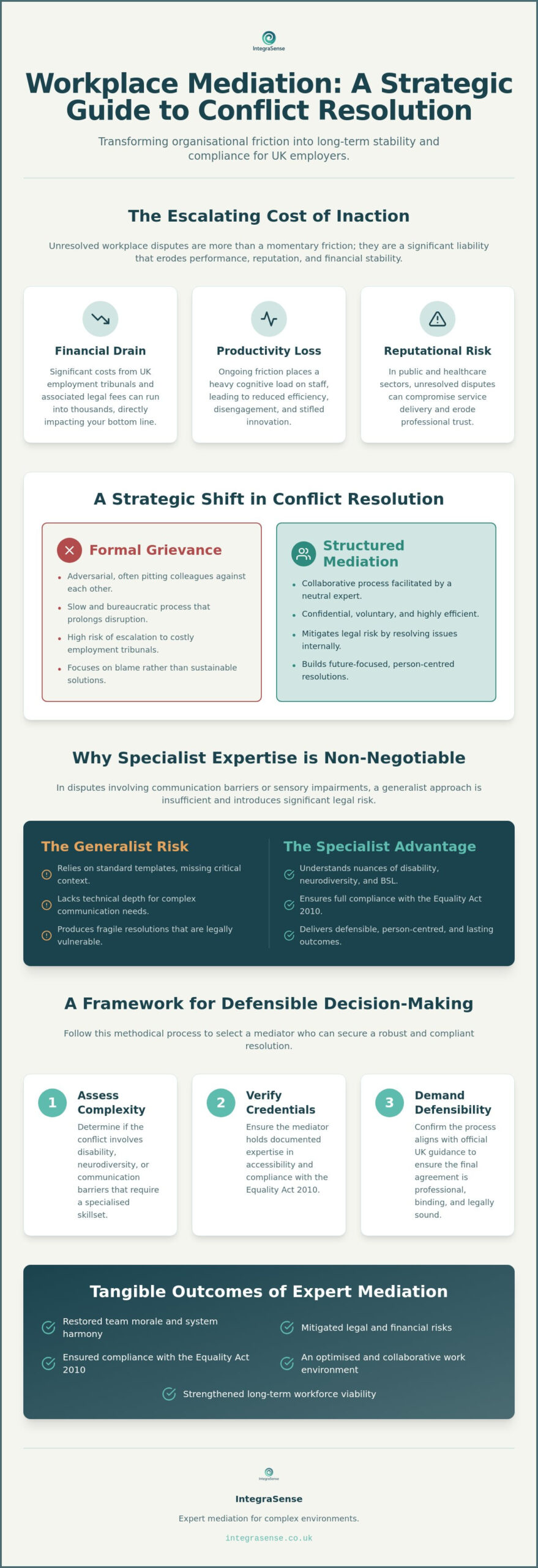
Unresolved conflict in the workplace is rarely static; it either resolves through intentional intervention or hardens into a systemic liability. For organisations in Kent, the financial implications of allowing disputes to escalate are significant. Beyond the immediate threat of UK employment tribunal fees, which can reach thousands of pounds in legal costs alone, the hidden drain on productivity often proves more damaging. When team friction goes unaddressed, the resulting cognitive load on employees reduces efficiency and stifles innovation.
Forward-thinking leaders are moving away from traditional, adversarial grievance processes. They’re opting for structured dialogue instead. This shift is rooted in a clear understanding of what is mediation: a confidential and voluntary process where a neutral specialist facilitates a resolution. By choosing workplace mediation Canterbury, organisations can address the “sticky situations” where team dynamics begin to seize up. Identifying these points of friction before they become formal legal disputes is a hallmark of proactive governance.
Beyond the Grievance: Protecting Your Organisation’s Reputation
In the public and healthcare sectors, the stakes are exceptionally high. Unresolved disputes don’t just affect internal morale; they can lead to systemic risks that compromise service delivery. Mediation plays a critical role in fulfilling employer obligations under the Equality Act 2010. It provides a defensible framework for resolving issues involving communication barriers or perceived discrimination, ensuring that the organisation remains compliant while fostering a culture of mutual respect.
Maintaining this culture often involves a multi-layered approach to safety; for organizations that need to complement mediation with professional risk assessment, Indemnity Security & Investigations, Inc. offers specialized investigative and security services to safeguard the workplace.
Canterbury Business Landscape: Local Risks and Opportunities
Canterbury’s unique economic mix of higher education, tourism, and professional services creates specific workplace pressures. Academic hierarchies and high-pressure seasonal environments often require a nuanced approach to dispute resolution. Managing these complexities locally ensures that interventions are timely and relevant to the specific cultural context of the city. For those operating across the wider region, it’s helpful to understand the broader context of Conflict Resolution in Kent to ensure consistent risk management across multiple sites.
Selecting a Workplace Mediator: Specialist Expertise vs. Generalist Resolution
Selecting a mediator is a strategic decision that impacts your organisation’s long-term stability. While many generalist mediators rely on standard templates, this approach often fails when disputes involve technical communication needs or sensory impairments. For effective workplace mediation Canterbury, you need a specialist who can interpret the subtle nuances that generalists often miss. Without this technical depth, resolutions remain fragile and legally vulnerable.
To secure a robust resolution, follow a methodical selection process:
- Assess Complexity: Determine if the conflict involves disability, neurodiversity, or specific communication barriers that require a specialized skillset.
- Verify Credentials: Ensure the mediator has documented expertise in accessibility and compliance with the Equality Act 2010.
- Demand Defensibility: The process must align with official government guidance on mediation to ensure the final agreement is professional and binding.
The Role of Specialist Communication in Mediation
When disputes involve BSL users or employees with sensory loss, the mediator must be more than a facilitator. They must understand the linguistic and cultural dynamics at play. Integrating principles from BSL Interpreter Professional Supervision ensures that the communication environment is managed with precision. This expertise prevents misunderstandings from escalating and helps restore genuine team harmony.
Accessibility Audits as a Pre-Mediation Tool
Sometimes, the conflict isn’t just between people; it’s between a person and an inaccessible environment. Conducting Accessibility Audits before mediation begins can reveal systemic barriers that contribute to team friction. This proactive step ensures the mediation venue and process are fully inclusive, creating a level playing field for all parties. If you’re managing a complex dispute, engaging a partner who understands these nuances is essential for workplace mediation Canterbury. You can view our full range of specialist support services to see how we bridge these gaps.
The IntegraSense Approach: Person-Centred Mediation and Defensible Outcomes
IntegraSense operates at the intersection of technical communication and strategic conflict resolution. Our methodology for workplace mediation Canterbury prioritises clarity over chaos. While purely legalistic approaches focus solely on compliance, we ensure that every resolution is grounded in a person-centred framework. This dual focus allows organisations to achieve what we term “defensible decision-making.” It’s a process that respects individual needs while providing a robust, documented rationale that withstands external scrutiny.
Standard mediation often stalls on the question of fault. We shift the focus. Instead of determining “who is right,” our facilitators guide parties toward the practical question of “how do we move forward?” This transition is essential for restoring system harmony. According to Acas guidance on workplace mediation, the goal is to find a way for people to work together again. We extend this by offering post-mediation professional supervision and mentoring. These services ensure that the resolution isn’t just a temporary truce but a foundation for long-term viability.
Structured Dialogue for Complex Environments
In health and education settings, statutory compliance is non-negotiable. Disputes in these sectors are rarely simple. They often involve intricate layers of professional responsibility and legislative requirements. Our expertise in high-stakes compliance, such as conducting a Statutory Deafblind Assessment, informs our mediation practice. We understand the regulatory environment, allowing us to facilitate dialogues that are both empathetic and legally sound.
Next Steps for Your Organisation
Strategic resolution begins with a clear, confidential assessment of your current challenges. Whether you’re managing team friction or navigating a complex communication-based dispute, early intervention is key. We invite you to contact our Canterbury-based specialists to discuss your conflict resolution requirements. A neutral, specialist perspective can transform your workplace from a space of conflict into one of optimised professional performance.
Securing Organisational Resilience Through Strategic Dialogue
Conflict doesn’t have to be a permanent drain on your resources or a threat to your reputation. By shifting from adversarial grievances to structured mediation, you protect your organisation from the volatility of employment tribunals while preserving critical professional relationships. Specialist workplace mediation Canterbury ensures that even the most complex disputes, particularly those involving sensory loss or specialist communication needs, are resolved with technical precision. This proactive approach moves your team away from the chaotic and towards an optimised, functional environment.
Our Kent-based consultancy brings a unique multidisciplinary expertise to every intervention. We don’t just facilitate conversations; we build defensible decision-making frameworks that align with your statutory obligations and the Equality Act 2010. This ensures that every resolution is robust, person-centred, and sustainable. It’s about establishing a foundation for long-term viability and professional harmony within your workspace. Take the first step toward a more cohesive team dynamic today; for those interested in extending this sense of harmony to their personal vocal expression, Vocal Basics provides specialized coaching to help you find your voice.
Contact IntegraSense for Specialist Workplace Mediation in Canterbury and discover how our expert-led approach can restore clarity to your organisation.
Frequently Asked Questions
What is the difference between workplace mediation and a formal grievance process?
Mediation is a voluntary and confidential process designed to facilitate a mutual agreement, whereas a formal grievance is an adversarial procedure where the employer makes a final determination. While a grievance often focuses on identifying past faults, mediation looks toward future operational viability. It allows parties to maintain control over the outcome, reducing the systemic risk associated with imposed decisions. This collaborative approach helps restore team morale more effectively than a rigid, top-down investigation.
How long does workplace mediation typically take in Canterbury?
Most sessions for workplace mediation Canterbury are completed within a single day, although complex disputes may require additional structured dialogue. The entire process, from initial individual assessments to the final joint meeting, typically spans two to four weeks. This efficiency stands in stark contrast to formal internal investigations or employment tribunals, which often consume months of organisational time and resources. It provides a rapid, efficient path back to productivity.
Is workplace mediation legally binding in the UK?
A mediation agreement is not automatically legally binding like a court order, but it becomes a binding contract once signed by both parties. This written record provides a defensible outcome that demonstrates an organisation’s commitment to resolving issues reasonably. If a case eventually reaches an employment tribunal, evidence of a good-faith attempt at mediation is often viewed favourably by the panel as it shows compliance with Acas standards and a proactive approach to resolution.
Can mediation help if an employee has a sensory impairment or uses BSL?
Specialist mediation is essential when a dispute involves employees with sensory impairments or those who communicate via British Sign Language (BSL). When seeking workplace mediation Canterbury, it’s vital to ensure the facilitator understands these specific barriers to ensure a fair and equitable process. IntegraSense integrates specialist communication support into the resolution, ensuring full compliance with the Equality Act 2010 and providing an inclusive, accessible environment for all participants.