
The true cost of British Sign Language (BSL) provision isn’t found on a monthly invoice. It’s hidden within the legal and operational risks of failing to secure qualified professionals. Understanding the trajectory of freelance BSL interpreter rates 2026 is no longer just a procurement task; it’s a core component of organizational resilience and statutory compliance. You’re likely aware that unpredictable costs and the nuances of the Equality Act 2010 can turn accessibility planning into a source of organizational friction.
This guide provides the clarity you need to move from reactive spending to strategic investment. We’ll break down the latest fee benchmarks across the UK, from London to Scotland, and clarify the vital differences between Registered (RSLI) and Trainee (TSLI) levels. You’ll gain a clear framework for defensible decision-making, ensuring your budget aligns with professional standards while leveraging support like Access to Work. At IntegraSense, we prioritize this system harmony. We help you transform technical accessibility challenges into optimized, inclusive environments where communication flows without interruption.
Key Takeaways
- Understand the critical distinction between Registered (RSLI) and Trainee (TSLI) professionals to ensure your organization meets its statutory obligations under the Equality Act 2010.
- Access a clear breakdown of freelance BSL interpreter rates 2026 across different UK regions, allowing for more precise financial forecasting and defensible procurement decisions.
- Master the nuances of fee structures, such as short-duration minimums and travel expenses, to eliminate budget unpredictability in healthcare and public sector settings.
- Implement a strategic framework for leveraging Access to Work grants, reducing the direct financial impact of providing high-quality communication support for your employees.
Navigating the BSL Interpreting Market in 2026: Standards and Statutory Requirements
Professional BSL interpreting is a regulated technical field. It requires more than just linguistic fluency; it demands a deep understanding of cognitive processing and cultural nuance. A Registered Sign Language Interpreter (RSLI) is a specialist who has met rigorous national standards. For an organization, hiring an RSLI isn’t just about communication. It’s about establishing a defensible position in an increasingly litigious environment. By adhering to a strict ethical framework and maintaining mandatory professional indemnity insurance, these practitioners provide the level of accountability required for public sector compliance. This ensures your service remains aligned with the Equality Act 2010. You can find more foundational details in this British Sign Language overview.
The Impact of Professional Registration (NRCPD)
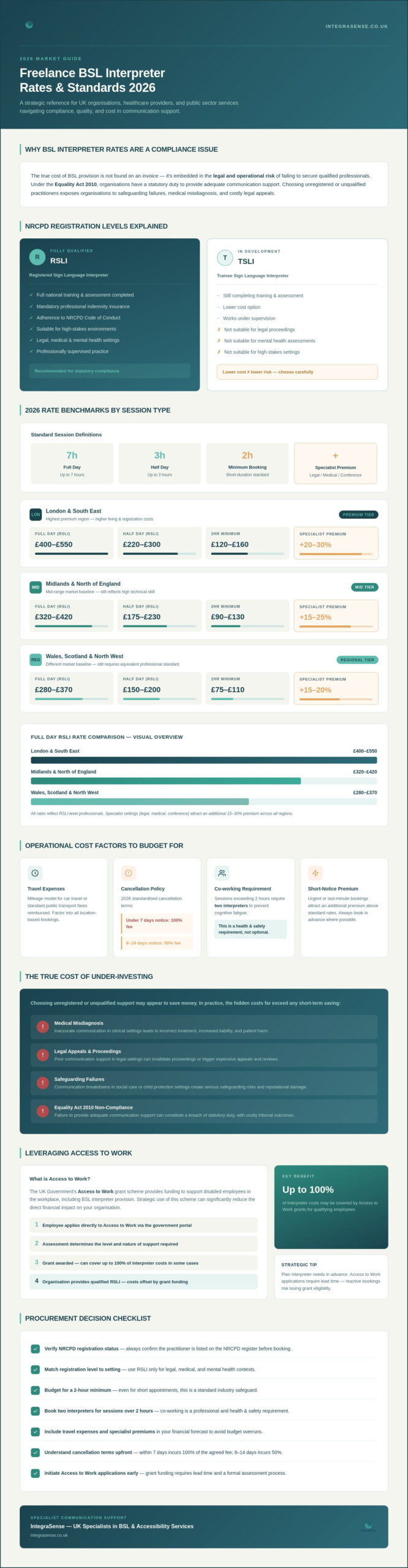
Registration levels directly impact freelance BSL interpreter rates 2026. An RSLI has completed full training and assessment, whereas a Trainee Sign Language Interpreter (TSLI) is still under development. While TSLIs offer a lower price point, they aren’t suitable for high-stakes environments like mental health assessments or legal proceedings. Following the NRCPD Code of Conduct is a non-negotiable requirement for these specialists. It provides a layer of risk management that protects both the service provider and the service user from the fallout of miscommunication.
Why “Lowest Cost” Often Means Highest Risk
The temptation to prioritize immediate savings can lead to catastrophic long-term expenses. Unqualified or unregistered support lacks the oversight necessary to guarantee accuracy in complex settings. The hidden costs of poor communication often manifest as medical misdiagnosis, expensive legal appeals, or safeguarding failures that damage organizational reputation. One primary marker of a high-quality practitioner is their commitment to BSL interpreter professional supervision. This practice ensures that interpreters remain resilient and ethically sound when handling the emotional and technical weight of high-stakes assignments. At IntegraSense, we believe that quality assurance isn’t an optional extra; it’s the only way to maintain system harmony and fulfill your statutory duties effectively.
Benchmarking Freelance BSL Interpreter Fees: 2026 Rate Structures
Budgeting for communication support requires a granular understanding of market benchmarks. The freelance BSL interpreter rates 2026 data reflects a market responding to both a national shortage and rising professional overheads. Most practitioners operate on a tiered structure that includes full-day, half-day, and short-duration sessions. A full-day booking typically covers up to seven hours of work, while a half-day session is capped at three. This distinction is vital for HR departments when planning for long-form conferences or brief clinical appointments.
Short-duration rates, often set as a two-hour minimum, are a standard industry safeguard. They ensure that the extensive preparation and travel time required for even a brief meeting remain viable for the professional. You’ll notice regional variances across the UK, with London and the South East commanding the highest premiums due to higher living costs and registration overheads. In contrast, rates in regions like Wales or the North West often reflect a different market baseline but still account for the high level of technical skill required.
Standard Day Rates vs. Specialist Legal and Medical Fees
Specialist environments like legal proceedings, mental health assessments, or international conferences require a higher tier of expertise. These assignments often attract a premium above standard community rates to reflect the increased professional risk and specialized vocabulary. It’s also vital to account for co-working. In sessions exceeding two hours, two interpreters are usually necessary to maintain accuracy and prevent cognitive fatigue. This isn’t a luxury; it’s a health and safety requirement that ensures the integrity of the communication for all parties involved.
Understanding Travel, Cancellation, and Short-Notice Premiums
Operational costs go beyond the base fee. Standard travel expenses often follow a mileage model for car travel or the reimbursement of standard public transport fares. Cancellation policies have also standardized in 2026 to provide practitioners with income security. Expect to pay 100% of the agreed fee if a booking is cancelled within seven days, and 50% if the notice is between eight and fourteen days. These structures are influenced by NRCPD professional registration fees and the necessity of maintaining practice resilience. If you’re looking to optimize your communication budget without compromising on quality, exploring our specialist communication support services can provide the clarity your organization needs.
Strategic Budgeting for Communication Support: Compliance and Quality Assurance
Organizations often struggle with the fragmented nature of accessibility costs. To forecast effectively, HR departments should analyze historical booking data and project future recruitment needs. This proactive approach ensures that freelance BSL interpreter rates 2026 are accounted for within annual financial cycles rather than being treated as emergency expenditures. Conducting accessibility audits provides the necessary data to identify long-term communication requirements across all service touchpoints. It transforms your approach from reactive spending to a structured investment in organizational fluidity.
Leveraging Access to Work and Statutory Funding
For employees who are Deaf or have hearing loss, Access to Work (AtW) grants are a vital resource. These government-funded grants can significantly offset the cost of BSL support, covering the gap between standard workplace adjustments and the specific needs of the individual. Employers should actively assist staff with these applications to ensure seamless integration. In social care settings, statutory duties under the Care Act 2014 mandate specific provisions. This includes the requirement for statutory deafblind assessments, which must be factored into local authority and healthcare budgets to ensure legal compliance and service user safety.
The IntegraSense Approach: Defensible Decision-Making
Choosing the right level of support is about managing professional risk. At IntegraSense, we act as a strategic partner, helping you navigate the complexities of the interpreting market with quiet confidence. We don’t just provide a service; we offer a framework for defensible decision-making. By matching the specific technical demands of your environment with the appropriate level of specialist communication support, we safeguard your organization against the consequences of poor communication outcomes. Whether you’re managing a complex health setting or an inclusive workplace, our expertise ensures your budget is utilized with precision. For bespoke guidance on freelance BSL interpreter rates 2026, we invite you to begin your journey toward optimized accessibility by contacting the team today.
Future-Proofing Your Communication Strategy
Mastering the complexities of the interpreting market ensures your organization remains both compliant and inclusive. By understanding the regional variances and specialist premiums that define freelance BSL interpreter rates 2026, you can transition from reactive spending to a model of long-term financial sustainability. Secure communication isn’t just a statutory requirement under the Equality Act; it’s a foundation for operational excellence and service user safety. Integrating professional standards with strategic funding like Access to Work creates a resilient environment where communication flows without interruption.
IntegraSense brings multidisciplinary expertise to these technical challenges, providing the clarity needed for compliance-focused decision making. As specialists serving South East England and beyond, we help you navigate complex health and education settings with precision. We invite you to contact IntegraSense for expert BSL interpreting and communication consultancy to refine your approach. We’re ready to help you transform your accessibility goals into a cohesive, high-performance reality.
Frequently Asked Questions
How much does a BSL interpreter cost per hour in 2026?
BSL interpreters usually charge a short-duration minimum rather than a single hourly fee. This model accounts for the significant preparation and travel required for every assignment. In 2026, these rates remain influenced by regional demand, with London and the South East representing the market’s upper tier. Budgeting for a two-hour minimum is the most accurate way to forecast costs for brief meetings or clinical appointments.
Do I need to pay for two BSL interpreters for a full-day meeting?
Co-working is essential for any assignment lasting longer than two hours or involving complex technical content. Two interpreters switch roles frequently to manage the high cognitive load and maintain accuracy. This isn’t a luxury; it’s a professional standard that protects the quality of communication. If your meeting is scheduled for a full day, budgeting for two professionals is a non-negotiable requirement for both safety and statutory compliance.
What is the difference between a Registered and a Trainee Sign Language Interpreter in terms of cost?
Registered Sign Language Interpreters (RSLI) carry full qualifications and professional indemnity, justifying their higher fee structure. They’re the only choice for high-risk environments like healthcare or legal proceedings. Trainee Sign Language Interpreters (TSLI) offer a more budget-friendly option for low-stakes community work. However, the cost difference reflects the level of risk management and expertise provided. Choosing an RSLI ensures your organization adheres to the highest professional and ethical standards.
Can I use Access to Work to pay for freelance BSL interpreter rates?
Access to Work grants are a primary mechanism for funding freelance BSL interpreter rates 2026 within the workplace. This scheme allows Deaf employees to secure the support they need while removing the direct financial burden from the employer. It’s a tripartite arrangement where the interpreter provides the service, the employer manages the booking, and the government reimburses the costs. Using this funding effectively is key to maintaining a diverse and accessible workforce.
Are travel expenses normally included in the BSL interpreter daily rate?
Travel expenses are typically billed as a separate line item rather than being bundled into the daily rate. These charges usually follow standard mileage rates or actual public transport costs. In some cases, you might also see a charge for travel time if the professional is coming from a significant distance. Clarifying these terms during the procurement phase prevents budget overruns and ensures a transparent relationship between your organization and the specialist.
What happens if I need to cancel a BSL interpreter at short notice?
Standard industry contracts include a sliding scale for cancellation fees to ensure practice resilience. If you cancel a booking with less than seven days’ notice, expect to pay 100% of the agreed fee. For cancellations made between eight and fourteen days, a 50% charge is standard. This policy accounts for the fact that freelancers often turn down other work to secure your date. Managing freelance BSL interpreter rates 2026 requires careful schedule coordination to avoid these costs.