A standard care assessment is often a liability when applied to the complexities of dual sensory loss. For organizations in Kent, securing a specialist deafblind assessment Ashford requires more than a generalist approach; it demands a precise alignment of statutory compliance and expert communication strategy. You likely recognize the pressure of meeting the Care Act 2014’s strict “suitably qualified” requirement while managing the risks of non-compliant reporting.
We’ll provide the clarity you need to navigate these statutory duties with confidence. This guide outlines the essential qualifications for assessors, such as the Level 3 RQF in Deafblind studies, and explains how to coordinate specialist support within the Ashford area. By focusing on defensible decision-making and system harmony, you can ensure that every individual receives a robust communication plan that meets both legal standards and practical needs. IntegraSense positions this technical depth as a bridge to better outcomes, transforming a complex regulatory hurdle into an optimized pathway for care.
Key Takeaways
- Recognise the specific legal triggers under the Care Act 2014 that necessitate a specialist assessment for individuals with combined sight and hearing loss.
- Learn how to secure a legally robust deafblind assessment Ashford by ensuring your chosen provider meets the “suitably qualified” criteria for defensible decision-making.
- Identify the operational risks of non-compliant statutory reports and the value of integrating specialist communication support into the assessment framework.
- Gain practical insights into commissioning specialist services and coordinating background documentation to facilitate a thorough and efficient evaluation for Ashford residents.
Identifying the Need for a Specialist Deafblind Assessment in Ashford
Identifying dual sensory impairment isn’t always a linear process. It’s more than the sum of its parts. When both hearing and sight are compromised, the individual loses their primary methods of compensation, leading to a unique state of isolation. A foundational understanding of Deafblindness is essential for any professional in Kent tasked with commissioning care. For local authorities and healthcare providers, recognizing when to trigger a deafblind assessment Ashford is the first step toward legal compliance and person-centered care.
Statutory Triggers and the Care Act 2014
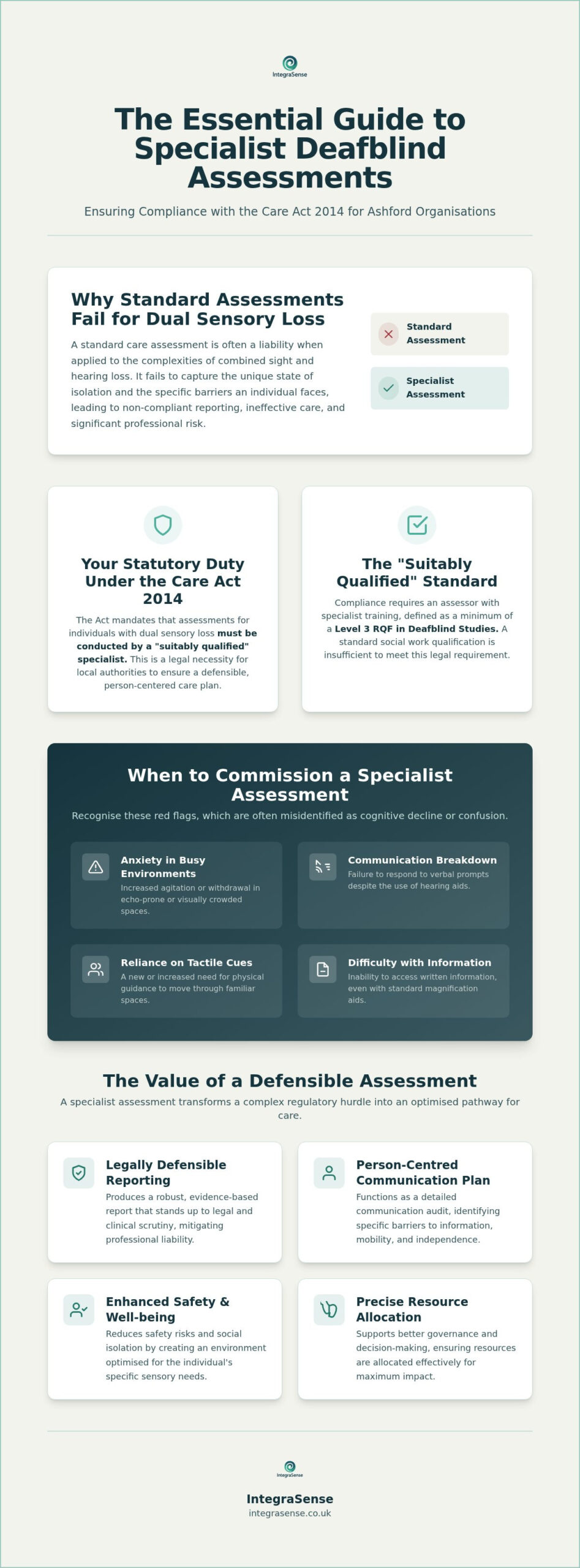
The Care Act 2014 mandates that assessments for those with dual sensory loss must be conducted by a specialist. Specifically, the Section 7 guidance, reissued in December 2014, requires assessors to be “suitably qualified” with specific training, typically a minimum of a Level 3 RQF in Deafblind studies. This ensures that the evaluation captures how the combination of sensory losses creates barriers that a single-sensory approach would overlook. A specialist assessment becomes a legal necessity for a local authority when an individual is identified as having a dual sensory impairment that impacts their ability to communicate, access information, or maintain mobility independently.
Recognising Dual Sensory Loss in Complex Environments
In residential care or hospital settings across Ashford, dual sensory loss often masquerades as cognitive decline, confusion, or social withdrawal. These challenges directly impact mental capacity assessments; without specialist communication support, an individual’s true wishes may remain obscured. Professionals should look for specific red flags that indicate a standard sensory check is insufficient:
- Increased anxiety or agitation in busy, echo-prone environments.
- A sudden reliance on tactile cues or physical guidance to move through spaces.
- Failure to respond to verbal prompts despite the use of hearing aids.
- Difficulty accessing written information, even with standard magnification.
IntegraSense provides the specialist communication audit required to untangle these complexities. By focusing on system harmony and cognitive processing, we ensure that every deafblind assessment Ashford is built on a foundation of professional precision rather than guesswork.
Ensuring Compliance: What Makes an Ashford Assessment “Defensible”?
Defensible decision-making serves as the bedrock of professional social care. It is a logical, evidence-based framework where every recommendation stands up to legal and clinical scrutiny. Within the sensory field, a report is only defensible if it aligns strictly with the official government guidance and demonstrates a profound understanding of the individual’s unique communication profile. Securing a deafblind assessment Ashford that meets these high standards is vital for organizations looking to mitigate risk and ensure long-term viability for their care strategies.
The Role of Suitably Qualified Assessors
The requirement for a “suitably qualified” assessor is a specific mandate, not a suggestion. A standard social work qualification lacks the technical depth needed to interpret the nuanced interplay between hearing and sight loss. Compliance requires an assessor with specialist training, typically at Level 3 RQF or above, who can identify how environmental factors impede a person’s autonomy. Relying on non-specialist staff for a statutory deafblind assessment invites significant professional liability and risks the delivery of an ineffective, non-compliant care plan.
Integrating Risk Management and Communication Audits
A robust assessment functions as a detailed communication audit. It identifies specific barriers to information and mobility that, if left unaddressed, lead to increased safety risks and social isolation. By breaking down complex sensory data into actionable technical applications, the resulting report supports better governance and more precise resource allocation. This structured approach moves the individual away from a chaotic environment and toward one that is optimized for their specific needs.
To maintain the highest levels of objectivity and precision, IntegraSense integrates Professional Supervision into the reporting process. This ensures that every deafblind assessment Ashford we facilitate is not only Care Act compliant but also serves as a reliable, long-term roadmap for high-stakes care planning.
How to Commission a Specialist Deafblind Assessment in Ashford
Commissioning a deafblind assessment Ashford is a proactive step toward organizational compliance and person-centered excellence. It isn’t enough to simply request a visit; professionals must establish a clear referral pathway that prioritizes data integrity and specialist insight. By following specialist assessment guidance from Sense, commissioners can ensure they’re asking the right questions from the outset. This structured approach moves the process from a generic referral to a precise, technical evaluation.
Step-by-Step Commissioning for Organisations
Efficiency in commissioning starts with thorough preparation. Gathering preliminary evidence is vital for a thorough evaluation and helps the assessor focus on the most complex aspects of the case. We recommend utilizing the following checklist before the assessment begins:
- Current medical reports from audiology and ophthalmology services.
- A detailed history of the individual’s preferred communication methods.
- Documentation of recent changes in behavior, social withdrawal, or mobility.
- Evidence of previous sensory support interventions and their specific outcomes.
The timeline typically spans several weeks. It moves from the initial enquiry and data gathering to the assessment itself, followed by the drafting and delivery of the final defensible report. During this period, it’s essential to coordinate with BSL interpreting or other specialist communication support to ensure the individual’s voice is accurately captured and represented.
Utilising the Assessment for Care Planning and Legal Compliance
Once the report is delivered, the focus shifts to implementation. A specialist report provides more than just a diagnosis; it offers a roadmap for care interventions that reduce risk and improve quality of life. Findings should be integrated directly into the individual’s care plan, ensuring that staffing levels and communication strategies are optimized for their specific needs.
This level of detail is particularly critical in expert witness Kent scenarios. In these cases, the deafblind assessment Ashford may serve as primary evidence in legal proceedings or high-stakes social care tribunals. IntegraSense ensures that these findings are translated into actionable steps, bridging the gap between technical assessment and day-to-day care delivery. This ensures that technical challenges are handled by specialists who value precision and long-term viability.
Establishing a Framework for Defensible Sensory Care
Securing a robust deafblind assessment Ashford is an essential requirement for any organization navigating the complexities of the Care Act 2014. We’ve explored how identifying dual sensory loss triggers and utilizing suitably qualified assessors ensures that statutory reporting remains legally sound. By prioritizing multidisciplinary expertise and structured communication audits, providers move away from fragmented care toward a model of optimized, long-term viability. This technical depth transforms a standard report into a defensible roadmap for complex care planning.
IntegraSense provides the specialist expertise needed to interpret these challenges with professional precision. Our defensible decision-making frameworks ensure that every report is Care Act 2014 compliant, offering clarity for both the individual and the commissioning body. If you’re ready to refine your sensory care strategy and ensure professional compliance, you can Contact IntegraSense for Specialist Deafblind Assessments in Ashford. Taking these proactive steps today ensures that the individuals you support benefit from a clear, cohesive communication strategy that respects their autonomy and enhances their safety.
Frequently Asked Questions
What is the legal definition of deafblindness for an assessment in the UK?
UK law defines deafblindness as a condition where the combined effect of hearing and sight loss creates significant barriers to communication, information access, and mobility. It’s not limited to the total loss of both senses; it describes the unique impact of dual impairment that cannot be addressed by single-sensory interventions alone. The Care Act 2014 recognizes this as a distinct disability requiring specialized statutory support.
Who is considered a “suitably qualified” person to carry out a deafblind assessment?
A “suitably qualified” assessor must possess specific training that goes beyond general social work or healthcare qualifications. Statutory guidance reissued in December 2014 recommends a minimum of a Level 3 RQF in Deafblind studies or an equivalent qualification. This ensures the professional has the technical depth to interpret the nuanced interplay of sensory losses during a deafblind assessment Ashford.
How much does a private deafblind assessment cost for an organisation in Ashford?
Statutory assessments are provided free of charge by Kent County Council for eligible individuals under their legal duty of care. For organizations or legal teams seeking independent evaluations, fees vary depending on the complexity of the case and the multidisciplinary expertise required. You should contact a specialist consultancy like IntegraSense directly to discuss specific reporting requirements and receive a professional quote.
Can I request a specialist assessment if the local authority has already done a standard one?
You can request a specialist evaluation if a previous generalist assessment failed to involve a professional with the mandatory qualifications. The Care Act 2014 is clear that dual sensory impairment necessitates an assessor with specific expertise. If a standard check overlooked the unique barriers of deafblindness, a new deafblind assessment Ashford is often necessary to ensure the resulting care plan is legally defensible.
What is the difference between a sensory check and a full communication audit?
A sensory check focuses on the physical thresholds of hearing and vision, whereas a communication audit evaluates how those senses function together in real-world environments. The audit identifies specific barriers to information and mobility while proposing technical interventions to optimize the individual’s autonomy. It’s a holistic approach that moves beyond clinical data to create a functional strategy for cognitive processing and daily interaction.
How long does a specialist deafblind assessment report take to complete?
The timeline for a specialist report typically spans several weeks to ensure professional precision and technical accuracy. This period allows for comprehensive data gathering, direct consultation, and the synthesis of multidisciplinary findings into a robust, defensible document. High-stakes care planning requires a methodical approach that prioritizes long-term viability and compliance over rapid, surface-level reporting.