
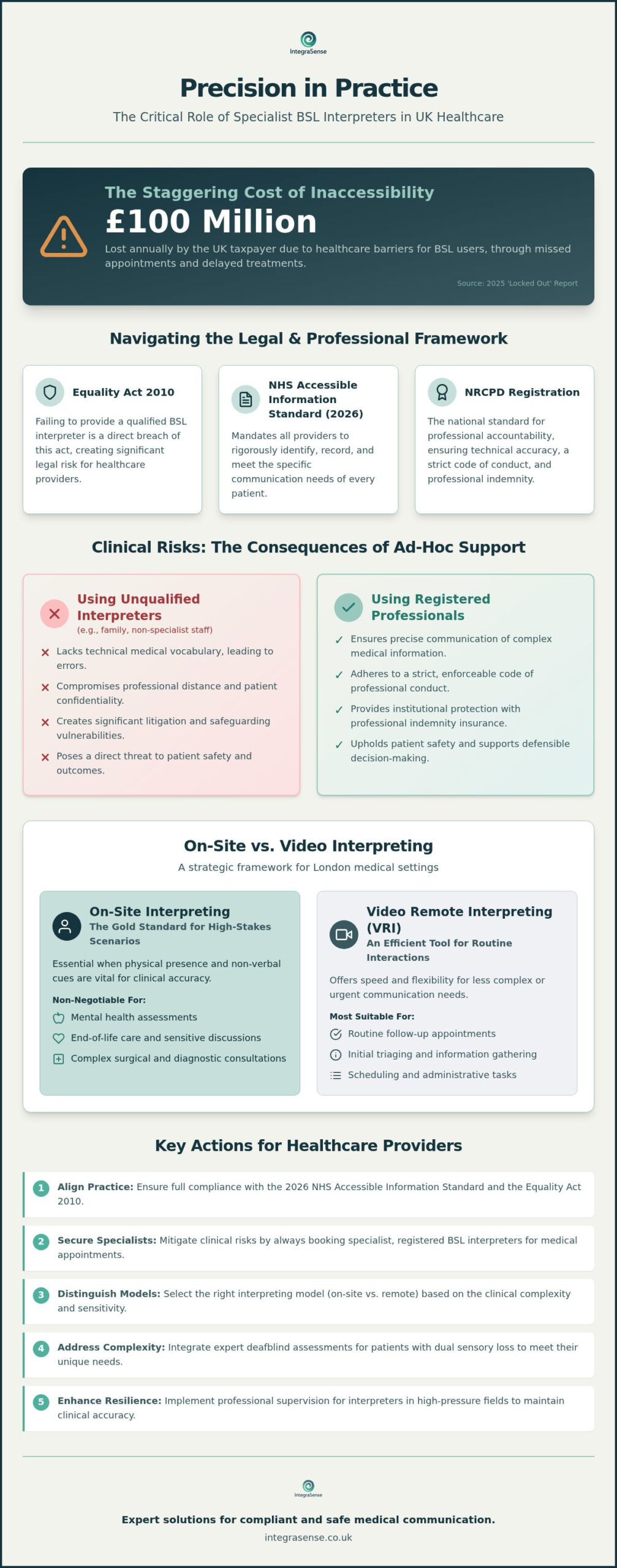
Did you know that barriers to healthcare for BSL users cost the UK taxpayer up to £100 million every year through missed appointments and delayed treatments? This staggering figure from the 2025 ‘Locked Out’ report underscores the critical need for precision when booking a BSL interpreter for medical appointment London services. Precision saves lives. In high-stakes clinical environments, communication isn’t just a courtesy; it’s a fundamental pillar of patient safety and legal compliance. A breakdown in dialogue within a medical setting isn’t just a logistical hurdle, it’s a significant risk to patient outcomes and institutional integrity.
Trust is built on clarity. We understand the pressure of meeting the Accessible Information Standard while managing complex, multidisciplinary cases. It’s often difficult to find the right balance between rapid service delivery and the rigorous standards required for defensible decision-making. This guide provides the expert framework you need to handle these technical challenges with confidence. We’ll explore the latest 2026 NRCPD requirements, DHSC policy updates, and the specific ways IntegraSense facilitates seamless communication in sensitive medical environments to ensure full regulatory compliance.
Key Takeaways
- Align your practice with the 2026 updates to the NHS Accessible Information Standard and the Equality Act 2010 to ensure full legal compliance.
- Secure a specialist BSL interpreter for medical appointment London environments to mitigate clinical risks and support defensible decision-making in patient care.
- Distinguish between on-site and remote interpreting models to select the most appropriate support for complex or sensitive clinical scenarios.
- Address the unique requirements of patients with dual sensory loss by integrating expert deafblind assessments and specialist communication support into your service.
- Enhance clinical accuracy and practitioner resilience through the implementation of professional supervision for interpreters working in high-pressure medical fields.
Legal Mandates and Clinical Risks: The Necessity of Qualified BSL Interpreters in London
The legal landscape for healthcare providers in London has evolved significantly. By 2026, the intersection of patient rights and clinical safety demands a more rigorous approach to communication than ever before. Failure to provide a qualified British Sign Language (BSL) interpreter isn’t just a service gap; it’s a breach of the Equality Act 2010 and a direct threat to patient safety. Organizations must move beyond ad-hoc arrangements and embrace a framework of defensible decision-making. This means ensuring that every BSL interpreter for medical appointment London settings is NRCPD registered to guarantee professional accountability and technical accuracy.
Using unqualified family members or non-specialist staff introduces unacceptable clinical risks. Family members often lack the technical vocabulary or the professional distance required to convey complex medical information accurately. This practice creates significant litigation and safeguarding vulnerabilities that can compromise both the patient and the healthcare provider. Registered professionals adhere to a strict code of conduct and maintain professional indemnity insurance, providing a layer of institutional protection that informal arrangements can’t match. In the fast-paced environment of a London clinic, these safeguards are essential for risk mitigation.
The Accessible Information Standard in 2026
The NHS Accessible Information Standard (AIS) now mandates that all providers must identify, record, and meet the communication needs of patients with disabilities. This statutory requirement applies with equal force to London-based NHS trusts and private clinics. Non-compliance risks not only legal challenges but also systemic failures in care delivery. Precision in communication is a non-negotiable standard for modern healthcare, ensuring that every patient interaction is documented and understood within a compliant framework.
Clinical Safety and Accurate Interpretation
Clinical miscommunication is a primary risk factor in patient safety. When dealing with complex diagnoses or consent procedures, the loss of linguistic nuance can lead to catastrophic errors. A registered professional ensures that the patient’s voice is heard and the clinician’s instructions are understood without ambiguity. IntegraSense supports this through specialist interpreting services designed for high-stakes medical environments, ensuring that communication remains fluid and accurate throughout the patient journey.
Selecting the Right Communication Support for London Medical Settings
Selecting appropriate support is a strategic decision that directly impacts patient safety and operational efficiency. When you secure a BSL interpreter for medical appointment London services, you must evaluate the clinical environment against the available delivery models. While digital solutions offer speed, they can’t always replicate the presence required for sensitive clinical interactions. Success depends on a methodical match between the patient’s linguistic needs and the interpreter’s technical expertise.
On-site vs. Video: A Decision Framework
On-site interpreting remains the gold standard for high-stakes medical interventions. It’s often non-negotiable in specific scenarios where physical presence and non-verbal cues are vital for clinical accuracy:
- Mental health assessments: Where subtle shifts in affect and body language are diagnostic indicators.
- End-of-life care: To ensure the highest level of empathy and clarity during sensitive family discussions.
- Complex surgical consultations: Where detailed anatomical explanations require tactile or spatial references.
Conversely, Video Remote Interpreting (VRI) serves as an efficient tool for routine follow-ups or initial triaging. Organizations should consult the RNID guidance on accessible healthcare to align their choices with patient expectations and statutory obligations.
Logistical considerations in London add another layer of complexity. High demand for registered professionals means that peak times are often booked weeks in advance. Healthcare providers must account for minimum call-out fees and travel times within the capital to ensure a seamless experience. Matching the interpreter to the patient’s specific communication method, whether that’s BSL, Sign Supported English (SSE), or a tactile method, is essential for a BSL interpreter for medical appointment London to be truly effective.
Specialist vs. Generalist Interpreters
Complex medical terminology requires more than just language fluency; it demands clinical literacy. A generalist may struggle with the nuances of oncology or neurosurgery, leading to potential miscommunication. Before the appointment, it’s prudent to conduct accessibility audits to ensure your London venue is fully optimized for specialist communication support. This proactive step ensures that the physical environment doesn’t hinder the clarity of the interpreted dialogue.
Precision in healthcare communication is an investment in long-term viability. If you’re managing complex cases that require a high degree of technical expertise, exploring specialist communication support can help you maintain the highest standards of patient care and regulatory compliance.
IntegraSense: Specialist Support for Complex Communication and Deafblindness
Medical environments often present challenges that transcend standard linguistic translation. When a patient presents with dual sensory impairment, a standard BSL interpreter for medical appointment London may find themselves operating outside their clinical scope. IntegraSense addresses this complexity by providing specialists trained in the nuances of deafblind communication. By integrating statutory deafblind assessments into medical care pathways, we ensure that every communication barrier is identified and mitigated with technical precision.
Resilience is a critical component of clinical accuracy. High-stakes medical environments place significant cognitive and emotional loads on practitioners. We provide professional supervision to our interpreters, a strategic practice that maintains high standards of performance while preventing burnout. This oversight ensures that the communication support provided to London organisations remains robust, ethical, and consistently accurate.
Specialist Deafblind Interpreting in London
Medical appointments for deafblind individuals require specific adaptations, such as tactile or close-proximity sign language. These aren’t just preferences; they’re essential requirements for informed consent and diagnostic clarity. Securing a specialist BSL interpreter for medical appointment London settings who also understands tactile communication is a prerequisite for patient safety. We help providers meet their obligations under the Care Act through specialist communication audits that transform clinical spaces into environments where information flows seamlessly.
A Partnership Approach to Communication
IntegraSense operates as a visionary consultant for London’s leading healthcare providers. We don’t just supply a service; we build frameworks for long-term accessibility and compliance. Our multidisciplinary approach combines technical expertise with a deep understanding of the UK’s regulatory landscape. For organisations seeking to optimise their patient interactions, you can contact our team for specialist communication services tailored to high-stakes environments. We provide the clarity and control necessary to manage even the most complex communication challenges.
Strategic Communication: Protecting Clinical Integrity in 2026
Ensuring patient safety in London’s healthcare sector requires a transition from reactive booking to proactive risk management. By prioritizing NRCPD-registered professionals, providers don’t just meet the Accessible Information Standard; they build a foundation for defensible decision-making that protects both staff and patients. The complexity of modern clinical environments demands a partner who understands the intersection of linguistic accuracy and statutory compliance. Whether you’re managing routine care or complex multidisciplinary cases involving dual sensory loss, the right BSL interpreter for medical appointment London services acts as a vital safeguard against clinical miscommunication.
IntegraSense brings a unique depth of expertise to this field. As specialist providers of statutory deafblind assessments and NRCPD-registered professional supervision, we ensure that every interaction is handled with precision. Our focus on long-term viability and system harmony helps organisations move away from chaotic, ad-hoc arrangements toward an optimized, compliant framework. Secure specialist BSL interpreting and consultancy for your London medical facility today. We look forward to helping you create a more accessible and resilient healthcare environment for everyone.
Frequently Asked Questions
Who is responsible for paying for a BSL interpreter in a medical appointment?
The healthcare provider holds the legal responsibility for funding communication support. This duty is established by the Equality Act 2010 and the NHS Accessible Information Standard. Whether it’s an NHS Trust, a GP surgery, or a private London clinic, the organisation must provide the service at no cost to the patient. This ensures equitable access to care and removes financial barriers for the Deaf community.
Can I use a family member to interpret for a deaf patient in a London hospital?
Using a family member to interpret is a significant clinical risk and should be avoided in all professional settings. Professional interpreting requires impartiality and a technical vocabulary that family members rarely possess. Securing a registered BSL interpreter for medical appointment London environments ensures that the patient receives unbiased information. This approach protects the clinician by establishing a clear, professional record of informed consent and technical dialogue.
How far in advance should I book a BSL interpreter for a medical appointment in London?
We recommend booking a BSL interpreter for medical appointment London settings at least two weeks in advance. The capital has a high concentration of healthcare providers, creating intense competition for the most experienced NRCPD registered professionals. Early booking allows time for the interpreter to prepare for specific clinical terminology. It also ensures that the provider can fulfil their statutory obligations without last-minute logistical failures.
What is the difference between a BSL interpreter and a Deafblind manual interpreter?
A BSL interpreter uses visual signs and facial expressions, whereas a Deafblind manual interpreter uses tactile communication by signing into the patient’s hand. This specialised method is essential for individuals with dual sensory loss who cannot rely on visual cues. IntegraSense provides the expertise required to navigate these complex requirements, ensuring that patients with deafblindness receive the same level of clarity and control as any other service user.