
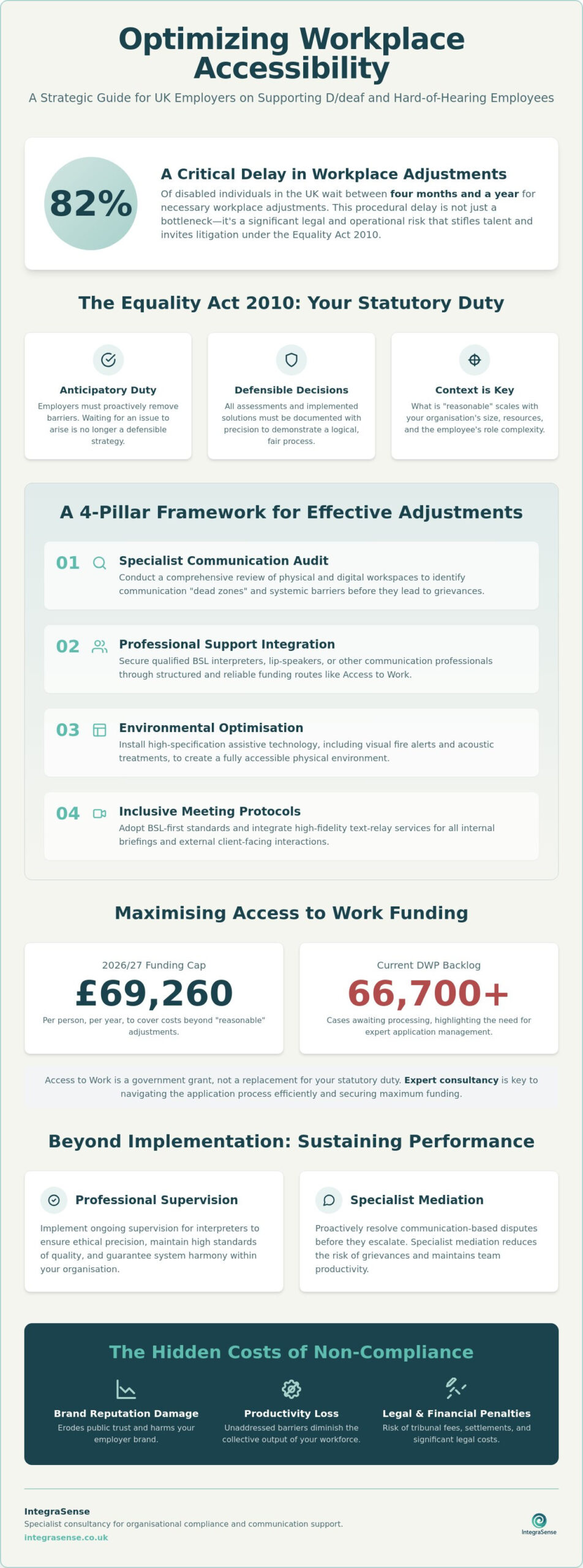
Did you know that 82% of disabled individuals in the UK wait between four months and a year for workplace adjustments to be implemented? For modern employers, this delay represents more than just a procedural bottleneck; it is a significant legal and operational risk that stifles talent and invites litigation. You likely recognize that providing reasonable adjustments for deaf employees UK is a mandatory requirement under the Equality Act 2010, yet the “reasonable” threshold often remains frustratingly vague amidst shifting regulations and a mounting Access to Work backlog.
This guide provides the clarity you need to move from uncertainty to optimized compliance. You’ll master the practical implementation of specialist communication support while navigating the 2026/27 Access to Work funding cap of £69,260. We will examine the strategic shift toward faster response times, including the recent recommendation for a two-week legal deadline, and outline how proactive audits protect your organisation from grievances. By the end of this article, you’ll have a clear roadmap to ensure your D/deaf and hard-of-hearing staff reach their full professional potential through robust, system-led inclusion.
Key Takeaways
- Define your statutory duties under the Equality Act 2010 by understanding how organisational resources and role complexity influence the “reasonable” threshold.
- Identify and dismantle physical and digital barriers by conducting a specialist communication audit as the foundation for reasonable adjustments for deaf employees UK.
- Maximise operational efficiency by leveraging Access to Work funding for qualified BSL interpreters and high-performance specialist communication support.
- Protect your organisation’s long-term viability by implementing professional supervision for interpreters to ensure ethical precision and system harmony.
- Resolve communication-based disputes proactively through specialist mediation, reducing the risk of workplace grievances and maintaining staff productivity.
The Legal Framework: Ensuring Defensible Decisions in 2026
The legal architecture surrounding reasonable adjustments for deaf employees UK has evolved from simple compliance into a critical pillar of organisational governance. At its core, the Equality Act 2010 mandates that employers take proactive steps to remove barriers that place D/deaf or hard-of-hearing staff at a substantial disadvantage. This duty is anticipatory; waiting for a crisis to occur before acting is no longer a defensible strategy in the 2026 regulatory environment. Organisations must move beyond reactive fixes toward a system-wide approach that integrates accessibility into the very fabric of the workplace.
Determining what is “reasonable” requires a nuanced analysis of your organisation’s specific context. A large public sector body possesses different financial and administrative resources than a small enterprise, meaning the threshold for adjustments will naturally scale. Factors such as the complexity of the role, the potential impact on service delivery, and the availability of external funding via Access to Work all shape the legal definition of reasonableness. To ensure decisions are defensible, every assessment must be documented with precision, demonstrating a logical pathway from identifying a barrier to implementing a specific communication solution.
The Interplay of the Equality Act and Workplace Policy
Generic policies often collapse when applied to high-stakes environments like healthcare or legal services. Effective frameworks must establish clear, confidential pathways for disability disclosure that empower employees rather than burdening them with bureaucratic hurdles. When your internal policies align with statutory requirements, you create a system where reasonable adjustments for deaf employees UK are handled with consistency and technical accuracy, reducing the risk of internal grievances.
Risk Management and Accessibility Compliance
Non-compliance carries hidden costs that extend far beyond potential tribunal fees or legal settlements. It erodes your brand’s reputation and diminishes the collective productivity of your workforce. Integrating Accessibility Audits into your strategic planning ensures that your infrastructure supports all staff, transforming compliance into a driver of long-term operational excellence. IntegraSense provides the specialist insight needed to navigate these complexities, ensuring your organisation remains both compliant and competitive.
Implementing Specialist Communication Audits and Adjustments
Transitioning from statutory theory to operational reality requires a structured, multi-step approach. Implementing reasonable adjustments for deaf employees UK begins with a Specialist Communication Audit. This diagnostic process evaluates how information travels through your organisation, pinpointing where physical acoustics or digital interfaces create communication silos. By identifying these barriers before they escalate into grievances, you ensure that your infrastructure supports peak performance for every team member.
Once barriers are identified, the next phase involves securing the necessary resources and environmental upgrades. Effective implementation typically involves four key pillars:
- Specialist Communication Audit: A comprehensive review of the physical and digital workspace to identify “dead zones” where communication breaks down.
- Professional Support Integration: Securing BSL interpreters or lip-speakers through structured funding routes.
- Environmental Optimisation: Installing high-spec assistive technology, such as visual fire alerts and acoustic treatments that reduce background interference, while ensuring facility resilience through remote monitoring of critical systems like HVAC or sump pumps with inTouch R&B.
- Inclusive Meeting Protocols: Adopting BSL-first standards or high-fidelity text-relay services for both internal briefings and client-facing interactions.
For organisations looking to further enhance their physical environment through specialized acoustic insulation or protective coatings, you can learn more about BIS Group and their range of industrial service solutions.
These reasonable adjustments for deaf employees UK transform the workplace from a series of obstacles into a fluid, accessible environment. Proactive planning is essential, especially given that 82% of disabled staff currently wait up to a year for adjustments to be finalised.
The Role of Access to Work Consultancy
Securing the maximum available funding, currently capped at £69,260 for the 2026/27 period, requires precise documentation. Access to Work is a government grant that covers costs beyond “reasonable” business expenditure. Expert consultancy streamlines the DWP application process, helping organisations manage the current 66,700-case backlog effectively while ensuring staff receive the support they need without delay.
Specialist Support for Complex Environments
High-risk sectors like healthcare or legal services demand a higher tier of linguistic precision. The choice between BSL interpreting and specialist communication support must be informed by a technical understanding of the role’s communication load. You can explore a full range of expert-led solutions through IntegraSense Services to ensure your adjustments are both effective and compliant with UK Government Guidance on Reasonable Adjustments.
Sustaining Performance: Supervision and Mediation
Implementation is merely the first phase of a broader strategic commitment. To ensure that reasonable adjustments for deaf employees UK remain effective, organisations must adopt a model of continuous evaluation. This involves regular review cycles that account for technological shifts and internal role transitions. Without this iterative approach, even the most sophisticated communication tools can become obsolete or misaligned with the employee’s evolving responsibilities. Effective governance requires that these adjustments are treated as living components of the workplace ecosystem.
A culture of system harmony is achieved when accessibility tools empower the entire workforce. This means moving beyond the concept of “accommodation” toward a unified environment where communication flows without friction. Achieving this state requires more than just hardware; it demands a focus on the human elements of communication support, ensuring that every practitioner and team member is positioned for success.
Professional Supervision for Interpreters
The quality of communication support is inextricably linked to the resilience of the practitioner. Professional supervision provides BSL interpreters with a structured space to process complex linguistic challenges and mitigate the risk of vicarious trauma. When an interpreter is supported through BSL Interpreter Professional Supervision, the accuracy and ethical integrity of the communication remain high. This investment protects the employee’s access to information while maintaining the organisation’s operational precision.
Conflict Resolution and Mediation
Friction occasionally arises when team dynamics shift or when there are misconceptions about accessibility protocols. Rather than allowing these tensions to escalate into formal grievances, proactive mediation offers a path toward resolution. Neutral, third-party intervention helps clarify expectations and recalibrate workplace relationships. For organisations seeking specialist support, Conflict Resolution in Kent provides a framework for managing risk while preserving team cohesion. IntegraSense ensures that these disputes are handled with the specialist insight necessary for complex, communication-sensitive environments.
Strategic Implementation: Securing Future-Proof Compliance
Mastering the nuances of the Equality Act and Access to Work is not merely a legal checkbox; it’s a strategic investment in your organisation’s human capital. By moving from reactive adjustments to a governance model built on specialist communication audits and professional supervision, you ensure that your workforce remains productive and your decisions remain defensible. This proactive approach transforms potential barriers into streamlined systems of inclusion, moving your environment away from the chaotic and towards the optimized.
Integrating reasonable adjustments for deaf employees UK requires a partner who understands the intersection of linguistic expertise and regulatory duty. IntegraSense provides this clarity through specialist BSL interpreting, statutory Deafblind Assessments, and Expert Witness services. Our commitment to professional supervision ensures that communication support remains resilient and accurate, even in high-pressure healthcare or legal settings. We help you navigate the complexities of 2026 compliance with quiet confidence and technical precision.
Contact IntegraSense for specialist accessibility consultancy and defensible decision-making support. We’re ready to help you build a workplace where system harmony and professional excellence go hand in hand.
Frequently Asked Questions
What is the definition of a “reasonable” adjustment for a deaf employee in the UK?
A “reasonable” adjustment is any modification that effectively removes a substantial disadvantage for a D/deaf employee while remaining proportionate to the employer’s resources. Factors such as organisational size, financial capacity, and the potential impact on service delivery determine this threshold. There isn’t a fixed list because reasonableness is relative to the specific context and complexity of the workplace environment.
Can an employer refuse a request for a BSL interpreter due to cost?
Employers rarely have grounds to refuse a BSL interpreter based on cost alone, particularly given the availability of government funding. The Equality Act expects organisations to explore all avenues, including the Access to Work grant, before claiming an adjustment is unreasonable. Refusal without a rigorous, documented assessment of all funding options often leads to successful discrimination claims and significant legal repercussions.
How does the Access to Work scheme help UK employers with deaf staff?
The Access to Work scheme provides a government grant that covers the costs of support beyond what is considered a standard business expense. For reasonable adjustments for deaf employees UK, this can include funding for BSL interpreters, lip-speakers, or specialized assistive technology. In the 2026/27 period, the individual funding cap stands at £69,260, offering significant scope for high-level communication support.
What happens if an organisation fails to make reasonable adjustments?
Failure to implement necessary adjustments exposes an organisation to employment tribunals and uncapped financial penalties for disability discrimination. Beyond these legal repercussions, it often results in significant productivity losses and long-term reputational damage. Proactive compliance through specialist consultancy helps mitigate these risks by ensuring that all statutory duties are met with technical precision and documented evidence.
How often should workplace reasonable adjustments be reviewed?
Workplace adjustments should be reviewed at least annually or whenever there is a change in the employee’s role or the physical work environment. Technological advancements in 2026 move quickly; what was effective last year might no longer be the optimal solution today. Regular review cycles ensure that communication remains fluid and that the organisation’s accessibility strategy continues to deliver operational excellence.
Is a specialist communication audit required for all deaf employees?
While not a universal legal requirement, a specialist communication audit is essential for D/deaf staff in complex or high-risk environments. These audits provide a defensible evidence base for reasonable adjustments for deaf employees UK by identifying specific barriers that general assessments overlook. Relying on generic checklists in healthcare or legal settings often fails to meet the threshold of a thorough, proactive adjustment process.