
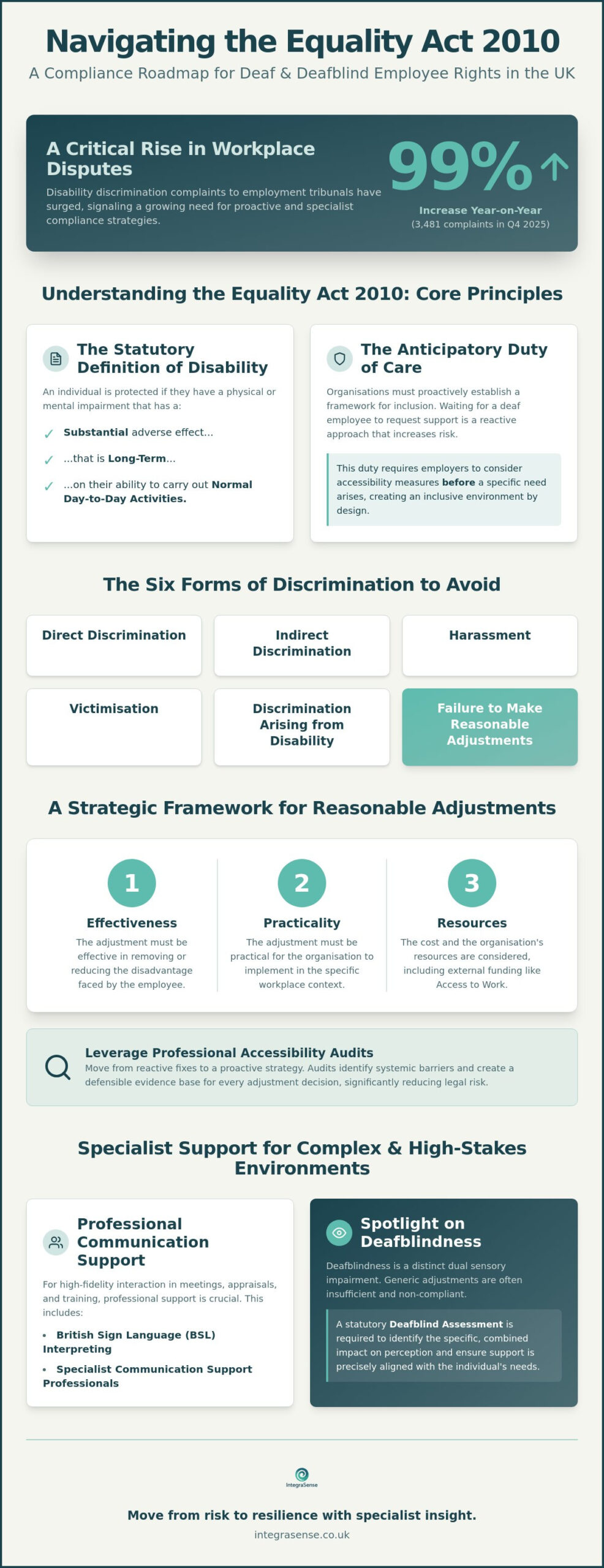
Disability discrimination complaints to employment tribunals reached 3,481 in the final quarter of 2025, a staggering 99% increase compared to the previous year. This surge reflects a growing tension between statutory obligations and the practical realities of the modern workplace. It’s natural to feel concerned about the complexities of Equality Act 2010 deaf employee rights, particularly as the UK government moves toward mandatory disability pay gap reporting for larger organisations. You understand that maintaining a legally defensible environment requires more than just good intentions; it demands precision, specialist insight, and a proactive approach to communication barriers.
This guide offers a clear compliance roadmap to help you regain control over complex technical and legal environments. We’ll examine the specific impact of the Worker Protection Act and provide actionable strategies for managing the current 106-day Access to Work processing backlog. You’ll learn how to identify truly reasonable adjustments and when to engage specialist communication support to ensure long-term viability. By positioning IntegraSense as your strategic partner, you can move away from the risk of litigation and toward an optimised workplace where every deaf and deafblind employee can perform at their peak.
Key Takeaways
- Master the statutory definitions of disability and the six specific forms of discrimination to build a robust compliance foundation.
- Implement a strategic framework for identifying reasonable adjustments that balances employee effectiveness with practical organisational resources.
- Leverage professional accessibility audits to uncover systemic barriers and establish a defensible evidence base for every adjustment decision.
- Reduce the risk of costly Employment Tribunals by integrating specialist conflict resolution and mediation into your accessibility protocols.
- Secure a clear roadmap for upholding Equality Act 2010 deaf employee rights while optimising workplace productivity for staff with complex communication needs.
The Equality Act 2010: Defining Deafness and Disability in the Workplace
The Equality Act 2010 provides the essential legal architecture for ensuring workplace equity. To effectively manage Equality Act 2010 deaf employee rights, organisations must first grasp the statutory definition of disability. An individual is protected if they have a physical or mental impairment that has a “substantial” and “long-term” adverse effect on their ability to carry out normal day-to-day activities. In the context of 2026, deafness and hearing loss almost always meet this threshold due to their persistent impact on communication and professional interaction.
Compliance requires understanding the six distinct types of discrimination. These include direct and indirect discrimination, harassment, victimisation, and discrimination arising from disability. Perhaps most critical for employers is the failure to make reasonable adjustments. For deafblind employees, the legal landscape becomes even more nuanced. Deafblindness is recognized as a distinct dual sensory impairment, requiring specialized Deafblind Assessments to identify the specific, combined impact on perception that single-sensory evaluations might overlook.
Protected Characteristics and the Duty of Care
The duty of care is often anticipatory. This means organisations shouldn’t wait for a deaf employee to join before considering accessibility; the framework for inclusion must be established proactively. It’s vital to distinguish between direct discrimination and “discrimination arising from disability.” The latter occurs when an employee is treated unfavourably because of something connected to their deafness, such as missing an instruction delivered via an inaccessible intercom system, rather than the deafness itself.
The Legal Threshold for Substantial Adverse Effect
The term “normal day-to-day activities” is broad, encompassing workplace communication, telephone use, and collaborative professional interaction. The law protects employees based on how their deafness would affect them without the use of hearing aids or cochlear implants, ensuring that medical interventions don’t disqualify them from legal protection. If a deaf employee’s rights under the Equality Act 2010 are ignored, the risk of litigation increases significantly, especially given the current 99% rise in tribunal claims. By partnering with specialists like IntegraSense for Deafblind Assessments, organisations can ensure they meet these complex statutory requirements with precision.
Reasonable Adjustments: A Strategic Framework for Compliance
The concept of “reasonableness” isn’t a static checkbox. It’s a dynamic evaluation based on the effectiveness of an adjustment, its practicality, and the resources available to the organisation. To protect Equality Act 2010 deaf employee rights, HR departments must move beyond generic solutions. A defensible decision-making process relies on evidence rather than assumptions. By conducting accessibility audits, you can identify systemic barriers that hinder performance before they escalate into legal liabilities.
This strategic approach transitions the organisation from reactive fixes to person-centred, specialist-led communication plans. Relying on the Official Equality Act 2010 Guidance helps clarify that an adjustment is only reasonable if it actually removes the disadvantage. If a proposed change doesn’t facilitate clear communication, it fails the statutory test. Precision here is vital; vague adjustments often lead to the 99% year-on-year increase in tribunal claims we’re currently seeing in the UK.
Implementing Professional Communication Support
Meetings, appraisals, and training sessions require high-fidelity interaction. For many, this necessitates British Sign Language (BSL) interpreting or specialist communication support. When supporting deafblind staff, generic adjustments are often insufficient. You must align workplace support with a statutory deafblind assessment to ensure every sensory need is addressed with precision. Failing to provide qualified professionals in these high-stakes environments creates significant risk for both the employee and the employer.
Access to Work: Leveraging Government Support
The Access to Work grant is a vital tool for fulfilling your obligations without bearing the full financial weight of specialist equipment or ongoing interpreting costs. With the current maximum grant capped at £69,260 per person per year, the scope for support is significant. However, the 106-day average processing backlog requires foresight. Engaging an accessibility consultant early in the recruitment or retention process ensures applications are accurate and handled with technical expertise. For tailored support in building a compliant framework, you can contact our specialist team to discuss your specific requirements.
Mitigating Risk through Specialist Assessments and Mediation
A specialist communication audit transforms subjective workplace assessments into a rigorous, evidence-based framework. To uphold Equality Act 2010 deaf employee rights, organisations must move beyond guesswork and establish a clear audit trail. These audits provide a primary shield against litigation by documenting exactly why specific adjustments were chosen. When disputes arise, utilising professional conflict resolution and mediation allows for a neutral, expert-led path to settlement. This proactive approach often resolves complex accessibility friction before it ever reaches an Employment Tribunal.
Compliance also extends to the quality of the support provided. Professional supervision for interpreters and the implementation of External Quality Assurance (EQA) act as silent but critical components of a compliant ecosystem. These services ensure that communication remains fluid and accurate, particularly in high-stakes healthcare or legal settings. IntegraSense provides the technical oversight necessary to maintain these standards, ensuring that your organisation’s accessibility infrastructure remains durable and effective over the long term.
The Importance of Defensible Decision-Making
A decision is “defensible” when it’s backed by specialist insight rather than administrative convenience. Tribunals look for a logical sequence of assessment and implementation. By commissioning reports from a multidisciplinary consultancy, you demonstrate a proactive commitment to statutory duties. This professional documentation is often the deciding factor in proving that an organisation has taken all “reasonable steps” to prevent discrimination or harassment.
Supporting the Whole Employee: Mental Health and Supervision
Deaf and deafblind employees often face significant “concentration fatigue” due to the intense cognitive load of navigating inaccessible environments. This exhaustion isn’t just a productivity issue; it’s a retention risk. Specialist mentoring and professional supervision foster a resilient workforce by addressing the isolation that can stem from dual sensory loss. By focusing on the human element of technical compliance, you create a workplace that isn’t just legally sound, but truly optimised for performance.
Securing a Future of Workplace Equity
Upholding Equality Act 2010 deaf employee rights requires a shift from reactive problem-solving to a durable, specialist-led strategy. We’ve established that true “reasonableness” is defined by the effectiveness of an adjustment and that specialist communication audits provide the necessary evidence base for every decision. By integrating professional mediation and expert assessments, you can navigate the complexities of the 2026 legal landscape with absolute precision. It’s about moving away from the risk of litigation and toward a workplace that’s truly optimised for all.
To ensure your organisation stays ahead of regulatory changes, you need a partner who understands the technical depth of sensory loss. IntegraSense provides multidisciplinary expertise in BSL and deafblindness; we focus on creating defensible decision-making frameworks that stand up to legal scrutiny. Our team also includes Registered Expert Witness services to support you in high-stakes environments. Ensure your organisation is fully compliant; contact IntegraSense for a specialist accessibility audit today. Taking these proactive steps now protects your workforce and your reputation for years to come.
Frequently Asked Questions
What is considered a “reasonable adjustment” for a deaf employee under the Equality Act 2010?
A reasonable adjustment is any modification to a workplace process or environment that effectively removes a disadvantage for a disabled staff member. Common examples include installing visual fire alarms, providing captioned telephony, or ensuring BSL interpreters are present for high-stakes meetings. The focus is always on the effectiveness of the adjustment in facilitating parity of communication and professional interaction.
Can an employer refuse to provide a BSL interpreter due to cost?
Cost is rarely a successful legal defense for refusing an interpreter, particularly for larger organisations with significant resources. While the law considers an employer’s budget, the availability of government grants often negates the argument that such support is an “undue burden.” Employers should seek specialist consultancy to explore how external funding can offset these costs before making a final decision that could lead to a discrimination claim.
Does the Equality Act 2010 cover employees with dual sensory loss (deafblindness)?
Yes, the legislation provides comprehensive protection for individuals with dual sensory loss. Managing Equality Act 2010 deaf employee rights for deafblind staff requires a more nuanced, specialist-led approach because adjustments must address both visual and auditory barriers simultaneously. This often necessitates bespoke assessments to identify specific communication needs, such as haptic support or modified digital interfaces, that single-sensory evaluations might overlook.
To ensure these digital platforms and interfaces are fully compliant with WCAG and ADA standards, you can discover 216digital for expert technical support and auditing.
What happens if an organisation fails to meet its obligations under the Equality Act?
Failure to comply with statutory duties can result in unlimited financial penalties at an Employment Tribunal and lasting damage to an organisation’s reputation. Beyond the legal risks, a lack of accessibility leads to the loss of skilled talent and increased staff turnover. Implementing professional mediation and specialist communication audits helps resolve these issues internally, ensuring that the organisation remains a leader in workplace equity.
How does Access to Work interact with an employer’s legal duties?
Access to Work is a grant scheme that supplements an employer’s legal duty rather than replacing it. The employer is responsible for making and funding “reasonable” changes, while the grant covers the additional costs of specialist support like BSL interpreting or technical equipment. IntegraSense can provide the technical consultancy required to manage these applications, ensuring that the support provided is both compliant and sustainable.
Is a deaf employee required to disclose their hearing loss during an interview?
Applicants aren’t legally required to disclose deafness or any other disability during the recruitment process. Employers are generally prohibited from asking health-related questions before a job offer is made, except to determine if specific adjustments are needed for the interview itself. This underscores the need for an anticipatory duty, where organisations proactively build accessible systems that don’t depend on an individual’s disclosure to be inclusive.