
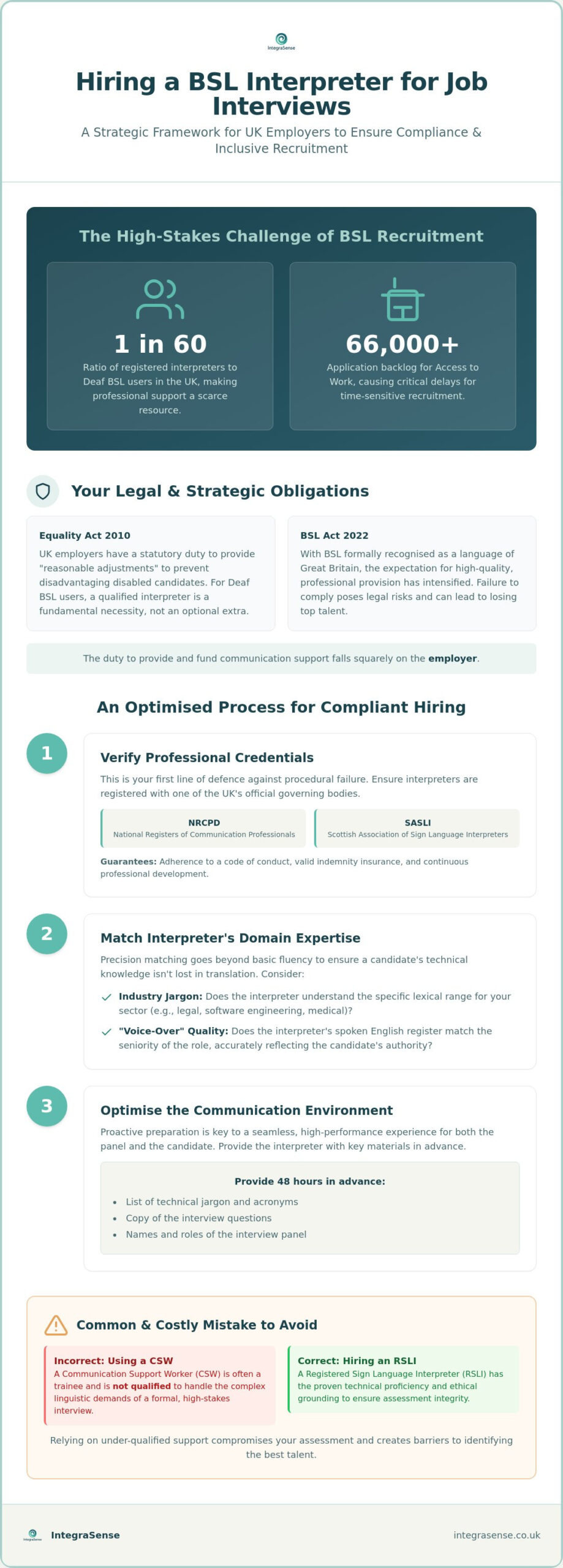
With roughly one registered interpreter for every 60 Deaf BSL users in the UK, securing professional communication support is a high-stakes procurement task that directly impacts your recruitment integrity. You likely recognise that hiring a BSL interpreter for a job interview is essential for legal compliance, yet the logistical friction of funding delays and quality assurance can stall even the most inclusive hiring strategies. It’s a common frustration to face a 66,000-application backlog at Access to Work when you need to move quickly to secure top-tier talent.
This guide offers a strategic framework to master the interpreting process, allowing you to mitigate legal risk and facilitate a truly equitable interview. We’ll explore the nuances of the updated 2026 Equality Act Code of Practice and provide actionable steps to ensure your communication environment is fluid and professional. By the end of this article, you’ll have the technical insight to move away from recruitment chaos and toward an optimised, compliant, and inclusive system that reflects the sophisticated standards of your organisation.
Key Takeaways
- Understand your legal obligations under the Equality Act 2010 to provide reasonable adjustments. This proactive approach mitigates the risk of litigation while maintaining high professional standards during recruitment.
- Verify professional credentials to ensure quality and accountability. Hiring a BSL interpreter for a job interview requires checking NRCPD or SASLI registration to guarantee ethical practice and technical proficiency.
- Match the interpreter’s specific domain expertise to your industry. Selecting a professional who understands your sector’s technical jargon facilitates a more fluid and accurate exchange of information.
- Utilise the Access to Work grant to manage costs effectively. Early engagement with the 2026 funding landscape helps you secure “Communication Support at Interview” grants and avoid timeline delays.
- Optimise the environment for system harmony. Providing jargon lists and interview questions 48 hours in advance allows the interpreter to deliver a seamless, high-performance experience for both the panel and the candidate.
Table of Contents
-
The Legal and Strategic Framework for BSL Interpreting in Recruitment
-
Criteria for Selecting and Matching the Right BSL Interpreter
-
Practical Implementation: Funding, Logistics, and Best Practices
The Legal and Strategic Framework for BSL Interpreting in Recruitment
Professional recruitment relies on a frictionless exchange of information. When an organisation overlooks the technical requirements of accessibility, it introduces systemic risk. Under the Equality Act 2010, UK employers must implement "reasonable adjustments" to prevent disabled candidates from being at a substantial disadvantage. This isn’t merely a box-ticking exercise; it’s a commitment to recruitment integrity. Since the British Sign Language Act 2022 formally recognised BSL as a language of Great Britain, the expectation for professional, high-quality provision has intensified. Organisations that fail to meet these standards risk losing exceptional talent to more accessible competitors.
Poor communication isn’t just an inconvenience. It’s a strategic failure. If interpreting is inaccurate or unpolished, you aren’t just missing out on a candidate’s potential; you’re creating a legal vulnerability. Defensible decision-making requires that every candidate has an equal platform to demonstrate their expertise. IntegraSense specialises in these complex environments, ensuring that the process of hiring a BSL interpreter for a job interview moves from a chaotic logistical hurdle to a precise, professional standard. High-quality communication access fosters a truly inclusive environment where diversity is supported by robust systems rather than just good intentions.
Understanding Reasonable Adjustments for Deaf Candidates
The duty to provide and fund communication support falls squarely on the employer. It’s a statutory requirement, not an optional benefit. Distinguishing between adjustments that are "preferable" and those that are "necessary" is vital for compliance. For a Deaf BSL user, a qualified interpreter is a fundamental necessity for a fair assessment. Without this support, the recruitment process lacks the fluidity needed to identify the best candidate. When hiring a BSL interpreter for a job interview, you must ensure the adjustment is effective, allowing the candidate to perform on a level playing field with their hearing peers.
Criteria for Selecting and Matching the Right BSL Interpreter
Effective recruitment hinges on the fidelity of the communication channel. When hiring a BSL interpreter for a job interview, verifying credentials is your first line of defence against procedural failure. In the UK, registration with the National Registers of Communication Professionals working with Deaf and Deafblind People (NRCPD) or the Scottish Association of Sign Language Interpreters (SASLI) is a non-negotiable standard. These bodies ensure that the professional is bound by a code of conduct, holds valid indemnity insurance, and maintains their skills through continuous development. While the Access to Work scheme provides the financial framework for support, the responsibility for quality control remains with the employer.
Precision matching goes beyond basic fluency. An interpreter who excels in a medical ward may lack the specific lexical range required for a high-level software engineering or legal interview. In high-stakes recruitment scenarios, such as those facilitated by the specialist headhunting firm HIA Legal, you need a specialist who understands the nuances of the legal industry. This expertise ensures that the candidate’s technical knowledge isn’t lost in translation. Equally critical is the "voice-over" quality. The interpreter acts as a linguistic mirror, reflecting the candidate’s expertise into spoken English. If the interpreter lacks the register appropriate for the role’s seniority, the candidate’s authority may be inadvertently diminished during the assessment.
The Risks of Unqualified Communication Support
Using a Communication Support Worker (CSW) instead of a Registered Sign Language Interpreter (RSLI) is a common but costly mistake. CSWs are often trainees or assistants. They aren’t qualified to handle the complex, high-stakes linguistic shifts of a formal interview. This mismatch compromises the integrity of your assessment and creates a barrier to identifying the best talent. Relying on under-qualified support introduces unnecessary friction into a system that requires total clarity.
Professional Supervision and Quality Assurance
Systemic resilience is maintained through professional supervision for interpreters. This practice ensures that specialists remain ethically grounded and linguistically sharp, even in high-pressure environments. At IntegraSense, we advocate for this level of rigour to ensure every recruitment journey is supported by a reliable, high-performance communication system. If you require guidance on establishing these standards, our accessibility consultancy services can help you build a more robust framework.
Practical Implementation: Funding, Logistics, and Best Practices
Securing the right talent requires a recruitment infrastructure that operates without friction. In a landscape where demand for the Access to Work Grant has reached record levels and processing backlogs persist, proactive planning is essential. While the "Communication Support at Interview" element is designed to be more responsive than standard claims, organisations shouldn’t leave funding to chance. If government timelines don’t align with your hiring schedule, your internal accessibility budget must be ready to bridge the gap. This ensures that the process of hiring a BSL interpreter for a job interview remains a priority rather than a logistical hurdle.
Logistical precision transforms a standard interview into a high-performance assessment. You must provide preparation materials to the interpreter at least 48 hours in advance. This pack should include technical jargon lists, the names of panel members, and the specific interview questions. Such transparency allows the specialist to internalise the linguistic nuances of your sector, ensuring the exchange remains fluid and accurate. Whether you opt for a remote or in-person format, the medium must support system harmony. Remote platforms require high-definition video and low-latency audio to prevent unnecessary cognitive load on the candidate.
Evaluation shouldn’t end when the candidate leaves the room. A post-interview review of the communication support allows you to refine your recruitment cycles and ensure long-term viability. Assessing how well the interpreter matched the role’s technical demands provides the data needed for future defensible decision-making and continuous improvement of your inclusive practices.
A Step-by-Step Procurement Checklist
-
Identify the candidate’s preferred communication method and any specific requirements for the interpreting team.
-
Check for NRCPD or RBSLI registration and professional indemnity insurance to ensure ethical and professional accountability.
-
Secure funding through the Access to Work scheme or confirm internal budget availability to maintain recruitment momentum.
Partnering with Specialist Consultants
Complex recruitment environments often require more than just a booking service; they require a strategic partner. IntegraSense provides specialist communication support and accessibility consultancy to ensure your hiring process is both compliant and equitable. By leveraging professional insight, you manage organisational risk and guarantee a fair platform for all talent. Contact us for specialist advice to optimise your recruitment infrastructure and secure the best professionals for your team.
Optimising Recruitment Through Strategic Accessibility
Building a truly inclusive organisation requires more than just meeting statutory obligations. It demands a commitment to system fluidity and professional precision. By verifying credentials through bodies like the NRCPD or RBSLI and ensuring domain-specific matching, you transform a potential legal risk into a competitive advantage. Mastering the process of hiring a BSL interpreter for a job interview ensures that your organisation identifies the best talent without the interference of communication barriers.
To complement your inclusive hiring practices with a strong market presence, you can discover GBS Worldwide and their comprehensive approach to employer brand strategy and recruitment media management.
IntegraSense operates as a specialist multidisciplinary consultancy, providing the expertise needed for defensible decision-making in complex recruitment environments. Our registered professional practitioners deliver the clarity and control required to manage your accessibility responsibilities effectively. When you move away from reactive logistics and toward an optimised recruitment strategy, you build a more resilient and inclusive workforce.
Consult with IntegraSense for expert BSL interpreting and accessibility guidance to ensure your next hiring cycle is seamless and compliant. We’re ready to help you build a future where professional communication is a standard, not an afterthought.
Frequently Asked Questions
Who is responsible for paying for a BSL interpreter at a job interview?
The employer holds the ultimate legal and financial responsibility for providing communication support under the Equality Act 2010. While the Access to Work scheme often covers these costs through a specific grant, the duty to ensure an equitable process remains with your organisation. You shouldn’t delay the interview process waiting for external funding confirmation; the priority is maintaining recruitment integrity and legal compliance regardless of the funding source.
How far in advance do I need to book a BSL interpreter for an interview?
You should aim to book a professional at least two to three weeks in advance to ensure the best match for your specific sector. With approximately 1,500 registered interpreters in the UK as of 2026, availability for hiring a BSL interpreter for a job interview is often limited. Early engagement allows for better domain-specific matching, which is particularly vital for roles requiring technical or senior-level expertise.
Can we use a staff member who knows basic sign language instead of a professional?
Using a staff member with basic signing skills is not a viable or legally defensible adjustment for a formal assessment. Professional interpreting requires a Registered Sign Language Interpreter (RSLI) who is bound by ethical codes and holds professional indemnity insurance. Internal staff lack the impartial distance and linguistic depth needed to facilitate a fair assessment, which significantly increases the risk of a successful discrimination claim.
What information should I provide to the interpreter before the interview starts?
Provide the interpreter with a technical briefing pack including industry-specific jargon, panel names, and the interview questions at least 48 hours before the start. This preparation ensures the specialist can accurately reflect the candidate’s professional persona and technical knowledge. Clear communication regarding the interview format, such as whether it is remote or in-person, is also essential for maintaining logistical system fluidity.
What happens if the Access to Work grant isn’t approved in time for the interview?
If government funding isn’t approved in time, the employer must cover the costs through their internal accessibility or recruitment budgets. The legal obligation to provide reasonable adjustments is not contingent on receiving an Access to Work grant. Failing to proceed with hiring a BSL interpreter for a job interview due to funding delays could be viewed as a failure to meet your statutory duties, potentially leading to costly legal challenges.