
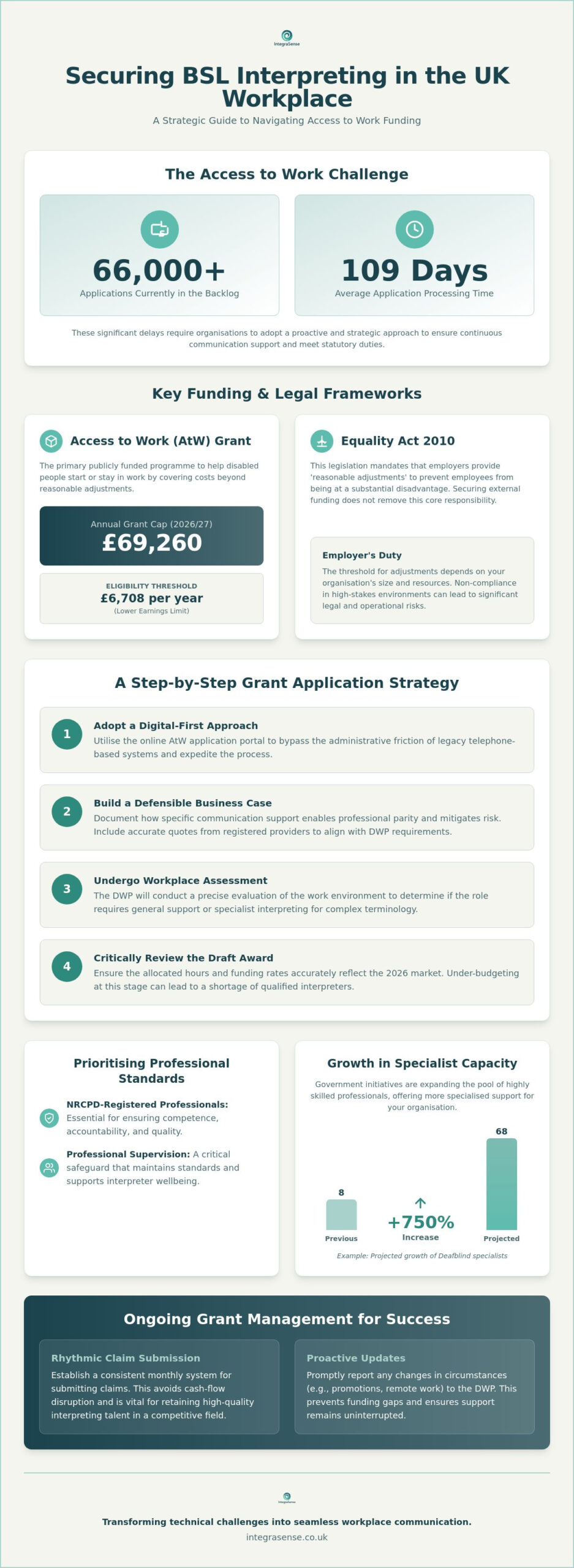
With over 66,000 applications currently caught in the Access to Work backlog and an average processing time of 109 days, the path to securing funding for BSL interpreters at work UK has never felt more congested. It’s understandable if your organization feels the weight of these delays, especially when trying to balance the Equality Act 2010 requirements with the immediate need for specialist communication support. You shouldn’t have to choose between administrative exhaustion and operational risk; your focus should remain on the fluidity of your professional environment.
This guide will show you how to navigate the £69,260 annual grant cap and statutory funding streams to secure high-quality BSL interpreting for your workplace. Accessibility is a strategic asset. A methodical approach ensures that your team remains connected while your organization stays protected from the risks of non-compliance. We’ll provide a clear roadmap for securing grants and demonstrate how IntegraSense transforms these technical challenges into a foundation for seamless workplace communication. By moving away from chaotic administrative processes toward an optimized strategy, you can maintain professional standards and foster an environment where every employee has the tools to succeed.
Key Takeaways
- Master the evolving regulatory landscape by aligning your organizational strategy with the latest DWP and BSL Advisory Board standards.
- Develop a defensible business case to successfully secure funding for BSL interpreters at work UK while meeting all statutory requirements.
- Implement proactive administrative strategies to navigate the current application backlog and ensure continuous communication support for your team.
- Secure long-term operational success by prioritizing NRCPD-registered professionals and the essential safeguard of professional supervision.
The Landscape of Workplace BSL Funding in 2026
The Department for Work and Pensions (DWP) remains the central authority for facilitating workplace communication through its financial frameworks. By 2026, the influence of the BSL Advisory Board has matured, creating a more structured environment for how British Sign Language (BSL) support is prioritized and delivered. This evolution reflects a broader commitment to system harmony, ensuring that funding isn’t just distributed but is effectively mapped to the specific linguistic needs of the user. A significant shift this year is the government initiative to increase specialist interpreter capacity, such as the drive to expand the pool of Deafblind specialists from 8 to 68. This surge in competency means your organization has access to a more diverse range of highly skilled professionals, though it necessitates a more rigorous selection process to ensure quality.
Access to Work (AtW): The Primary Funding Stream
Access to Work is a publicly funded employment support programme that aims to help more disabled people start or stay in work. For many, it’s the most viable route for securing funding for BSL interpreters at work UK, covering costs that exceed what is considered a reasonable adjustment. Eligibility extends to employees, self-employed individuals, and business owners, provided they meet the lower earnings limit of £6,708 per year. With the annual grant cap now set at £69,260 for the 2026/27 period, the scheme provides a robust financial foundation for long-term communication support. However, the current backlog of 66,000 applications requires a proactive approach. Organizations shouldn’t wait for a crisis to begin the application process.
The Equality Act 2010 and Employer Responsibilities
Securing external funding doesn’t absolve an employer of their initial duties under the Equality Act 2010. You’re required to provide reasonable adjustments to ensure that employees aren’t at a substantial disadvantage. The threshold for these adjustments often depends on the size and resources of your organization. In high-stakes professional environments, the risk of non-compliance can lead to legal complications and operational friction. IntegraSense provides the expertise needed to determine when a situation mandates specialist intervention. To understand how these requirements fit into your broader organizational goals, you can explore our guide on Accessibility Audits. This strategic clarity helps you manage your space effectively while meeting every statutory obligation.
Navigating the Access to Work Application Strategy
Parliamentary evidence highlights significant administrative friction within the DWP’s traditional telephone-based systems, which can stall progress before it begins. To bypass these barriers, your organization must adopt a digital-first strategy. Securing funding for BSL interpreters at work UK requires a business case that is both robust and defensible. This documentation shouldn’t just list needs; it must articulate how specific communication support enables professional parity and risk mitigation. Accurate quotes from registered providers are essential here, as the DWP requires evidence that the requested support aligns with current market rates and professional standards.
Step-by-Step: Securing Your BSL Grant
The journey begins with the digital application for an Access to Work grant. This pathway significantly reduces the friction often associated with legacy contact methods. Once the application is live, a workplace assessment follows. This is a precise evaluation of the environment to determine whether the role requires general support or specialist interpreting for complex legal or medical terminology. Always review the draft award with a critical eye. Ensure the allocated hours and rates reflect the reality of the 2026 market, as under-budgeting at this stage can lead to a shortage of qualified interpreters later.
Managing the Ongoing Funding Relationship
Approval is only the midpoint of the journey. You must establish a rhythmic system for submitting monthly claims to avoid cash-flow disruptions for both the employee and the provider. Effective claim management ensures that interpreters are paid promptly, which is vital for retaining high-quality talent in a competitive field. Renewals and changes in circumstances, such as a promotion or a shift to remote work, require timely updates to the DWP to prevent funding gaps and ensure your funding for BSL interpreters at work UK remains uninterrupted. Many organizations find that Access to Work Consultancy provides the necessary oversight to handle these technical transitions seamlessly. By treating the grant as a dynamic asset rather than a static award, you maintain system harmony and operational continuity.
Beyond the Grant: Ensuring Quality and Professional Standards
Securing the budget is a logistical victory, but it doesn’t guarantee linguistic accuracy. High-quality workplace communication depends entirely on the caliber of the practitioners you hire. Utilizing NRCPD-registered professionals ensures that your funding for BSL interpreters at work UK is invested in qualified experts who adhere to a strict code of conduct and professional ethics. This is particularly vital in complex environments where nuances in International Sign or the specific requirements of Deafblind interpreting can determine the success of high-stakes negotiations. By integrating these standards into your wider organizational strategy, you move from mere compliance toward genuine system harmony.
Risk Management and Professional Supervision
Accurate communication is a fragile system that requires constant maintenance through professional supervision. Without this safeguard, interpreters risk vicarious trauma, which directly impacts their long-term resilience and the precision of their work. You can explore our detailed framework for BSL Interpreter Professional Supervision to understand how practitioner support protects your organization. This isn’t just a benefit for the interpreter; it’s a strategic risk management tool for the employer. It ensures that the communication channel remains clear and that your investment in accessibility continues to deliver value over the long term.
Partnering with IntegraSense for Specialist Support
IntegraSense acts as the visionary bridge between the Access to Work grant scheme and the practical execution of high-standard communication. We don’t just provide a service; we deliver a comprehensive journey from initial assessment to final execution. For employers in South East England, we offer bespoke reporting and communication audits that ensure your accessibility goals align with your operational reality. Our methodical approach guarantees that technical depth never overwhelms human connection. If you’re ready to optimize your workplace fluidity, you should Contact our Kent-based specialists to discuss your BSL requirements. We help you manage your space effectively while upholding the highest professional standards.
Optimising Your Strategic Path to Workplace Accessibility
Securing the necessary resources for inclusive communication is an ongoing commitment to organizational excellence. It’s about more than just a grant. By mastering the digital application process and understanding the nuances of the 2026 landscape, you ensure that your funding for BSL interpreters at work UK remains a stable pillar of your operations. True success lies in the selection of registered practitioners and the implementation of professional supervision to maintain linguistic precision and practitioner resilience. These elements combine to move your organization away from administrative friction and toward a state of optimized system harmony.
IntegraSense provides the specialized insight required to navigate these technical complexities with quiet confidence. Based in Kent and serving the South East, our consultancy offers deep expertise in BSL interpreting and Deafblind assessments. We focus on delivering defensible decision-making that aligns with your statutory obligations and long-term viability. You don’t have to manage these administrative hurdles in isolation. Consult with IntegraSense for specialised BSL and Access to Work support to refine your workplace environment today. Taking these methodical steps creates a more resilient and connected future for your entire team.
Frequently Asked Questions
How much funding can I get for a BSL interpreter through Access to Work?
The maximum annual grant for Access to Work is £69,260 for the period between April 1, 2026, and March 31, 2027. This cap represents the total financial assistance available per person to cover all workplace adjustments, including British Sign Language support. It’s a comprehensive limit that resets every fiscal year. If your communication requirements are extensive, you must manage this budget strategically to ensure funding for BSL interpreters at work UK remains available for every essential meeting.
Can I use Access to Work funding for freelance or self-employed BSL interpreters?
You can certainly use Access to Work funding to hire freelance BSL interpreters or to support your own requirements if you’re self-employed. For self-employed individuals to remain eligible, they must meet the lower earnings limit of £6,708 per year or £559 per month. This flexibility allows you to select specialists who possess the specific technical vocabulary required for your field. It ensures that your support is as specialized and fluid as your professional environment requires.
What happens if the Access to Work grant does not cover the full cost of the interpreter?
If the grant doesn’t cover the full cost, the employer is responsible for meeting the remaining balance as a reasonable adjustment under the Equality Act 2010. This often occurs when highly specialized interpreters are required for complex technical or legal environments where rates may exceed standard DWP allocations. Organizations should view this as a necessary investment in operational risk management. Bridging this financial gap ensures that communication remains accurate and that the organization stays compliant with UK disability legislation.
Is there specific funding available for Deafblind interpreting in the workplace?
Specific initiatives exist to address the critical shortage of specialist interpreters for the Deafblind community within the UK. In June 2026, the government allocated £15,000 in new funding specifically to increase the number of qualified specialist interpreters from 8 to 68. Access to Work also provides funding for BSL interpreters at work UK that accounts for the higher costs and additional complexities associated with Deafblind communication support. IntegraSense can assist your organization in navigating these specialized funding streams to ensure your team has access to the most competent professionals.