
Effective healthcare relies on precise communication, yet many patients still face the anxiety of attending medical consultations without the necessary linguistic support. Securing a qualified BSL interpreter for NHS appointment Kent services is a legal requirement under the Equality Act 2010 and the BSL Act 2022, ensuring that every patient has equal access to vital health information. When communication breaks down in a clinical setting, the risks to patient safety and personal dignity are simply too high to ignore.
It’s understandable to feel frustrated when past interpreters haven’t arrived or when there’s confusion about who’s responsible for the booking. We’re here to ensure those barriers are removed. This guide provides the clarity you need to navigate the NHS booking system with confidence, ensuring your right to a professional NRCPD-registered interpreter is met every time. You’ll learn how the updated 2025 Accessible Information Standard protects your rights, what specific steps to take when booking your next appointment in Kent, and how IntegraSense supports healthcare providers in maintaining these critical standards of clinical excellence.
Key Takeaways
- Understand your statutory rights under the 2025 Accessible Information Standard, which mandates that NHS providers proactively identify and meet your specific communication needs.
- Learn how to initiate the booking process at the point of referral by ensuring your GP explicitly includes your BSL requirements in their clinical correspondence.
- Master the protocol for securing a BSL interpreter for NHS appointment Kent services, including direct verification with hospital departments or the Patient Advice and Liaison Service.
- Discover why healthcare providers prioritize External Quality Assurance and professional supervision to maintain high standards of safety and clinical accuracy.
Navigating the Accessible Information Standard for NHS Appointments in Kent
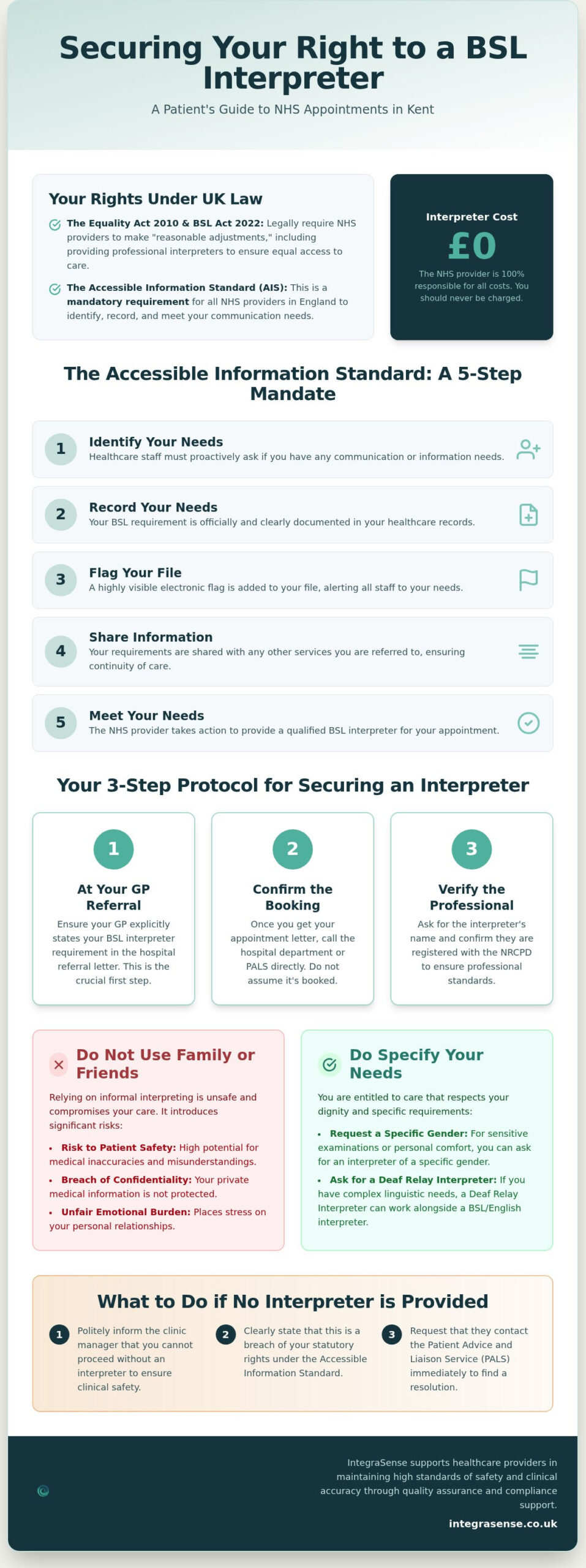
The Accessible Information Standard (AIS) is the statutory framework ensuring Deaf patients receive information in their required format. It isn’t just a guideline; it’s a mandatory requirement for every NHS provider across England. This standard creates a clear roadmap for healthcare services to follow, ensuring that communication barriers don’t compromise clinical outcomes. To comply, providers must follow a five-step protocol: they identify your needs, record them in a standardized way, flag your file so staff see the requirement, share this information across services, and ultimately meet those needs.
When you require a BSL interpreter for NHS appointment Kent services, the financial responsibility rests entirely with the healthcare provider. Patients are never charged for this essential accessibility bridge. Securing a British Sign Language (BSL) interpreter for NHS appointment Kent medical reviews ensures that clinical decisions are based on clear, unhindered dialogue rather than guesswork. This system fluidity is vital for maintaining patient safety and ensuring that every individual has full control over their healthcare journey.
Your Legal Rights Under the Equality Act 2010
The Equality Act 2010 mandates “reasonable adjustments” to prevent discrimination against disabled people. In a medical context, a professional interpreter is a clinical necessity, not a luxury. Relying on “informal” interpreting, such as using family members or friends, introduces significant risks to patient safety. It compromises confidentiality, risks medical inaccuracies, and places an unfair emotional burden on your personal network. Professional interpreting services provide the precision and neutrality required for complex medical discussions.
Specific NHS Trusts in Kent and Their Obligations
Major providers, including East Kent Hospitals University NHS Foundation Trust (EKHUFT) and Maidstone and Tunbridge Wells NHS Trust, have specific obligations to facilitate communication. These organizations are measured against accessibility compliance through Care Quality Commission (CQC) inspections and internal audits. If a Trust fails to provide an interpreter, they aren’t just failing you; they’re failing their legal and regulatory duties. Organizations often partner with specialists like IntegraSense to audit their processes, ensuring their communication systems are both durable and compliant with modern standards.
How to Secure a Qualified BSL Interpreter: A Step-by-Step Protocol
Securing a BSL interpreter for NHS appointment Kent services requires a structured approach to prevent communication gaps. It begins with your GP. When they refer you to a specialist, ensure they explicitly state your communication needs in the referral letter. This initial notification sets the expectation for the receiving Trust. Once your appointment letter arrives, don’t assume the booking is complete. Contact the specific hospital department or the Patient Advice and Liaison Service (PALS) to confirm that a professional has been secured.
Verification is the next critical phase. Ask the department to confirm the interpreter’s name and their registration status with the National Registers of Communication Professionals working with Deaf and Deafblind People (NRCPD). This ensures they meet the professional standards required for clinical settings. In emergency or out-of-hours situations at Kent hospitals, such as A&E visits, the process remains the same. While some departments may suggest Video Relay Services as a temporary measure, you have the right to request an in-person professional for complex or sensitive discussions.
Communicating Your Specific Needs
Precision in your request matters. If you’re attending a sensitive examination, you’re entitled to request an interpreter of a specific gender. Similarly, if you have complex linguistic needs, you may require a Deaf Relay Interpreter to work alongside the hearing professional. For organizations or patients seeking guidance on managing these requirements, the IntegraSense contact page offers a direct route to expert advice on communication audits and support structures.
What to Do if No Interpreter is Provided
If you arrive and no interpreter is present, or if the department refuses to book one, you must act decisively. Inform the clinic manager that this is a breach of your statutory rights. Navigating the Accessible Information Standard provides you with the legal leverage needed to insist on a resolution. You can request to see the PALS officer immediately to lodge a formal complaint. In many cases, referencing the AIS and the Trust’s legal obligations under the Equality Act triggers an immediate escalation. If you find your local provider is consistently struggling with compliance, our specialist services can assist organizations in refining their accessibility protocols.
Ensuring Quality and Compliance: Professional Support for Healthcare Providers
Maintaining high standards in clinical communication requires more than just filling a booking. It demands a robust framework of External Quality Assurance (EQA) to verify that every BSL interpreter for NHS appointment Kent services meets rigorous professional benchmarks. For NHS Trusts, this oversight is essential for risk management and governance. It transforms a reactive booking process into a proactive, defensible strategy that prioritizes patient safety. Specialist consultancy plays a pivotal role here, helping providers move away from fragmented systems toward optimized, holistic accessibility models. Organizations looking to refine their governance should explore our comprehensive IntegraSense services to ensure long-term compliance.
The Role of Professional Supervision in Clinical Interpreting
Medical interpreting involves navigating high-pressure environments where technical accuracy and emotional resilience are equally vital. It’s not enough to simply be a Qualified BSL Interpreter; practitioners must also engage in reflective practice to maintain professional boundaries and mental well-being. This is where professional supervision becomes a critical safeguard for both the interpreter and the patient. It ensures that the practitioner remains effective and resilient even in the most challenging clinical scenarios. For a deeper analysis of these requirements, our BSL interpreter professional supervision guide offers a strategic look at resilience-building in the field.
Deafblindness and Complex Communication in Kent
Standard BSL provision may not suffice for patients with dual sensory impairments. These complex cases require a more nuanced approach to communication, often involving tactile signing or specialist support professionals. In Kent, healthcare providers must recognize when a patient’s needs exceed standard protocols to avoid clinical errors. Planning for these individuals starts with statutory deafblind assessments, which provide the necessary data to build a truly accessible care pathway. By integrating these assessments into the patient journey, Trusts can ensure that communication support is precisely calibrated to the individual’s unique sensory profile.
Advancing Healthcare Accessibility in Kent
Achieving equitable healthcare requires a proactive commitment to communication standards. By understanding the Accessible Information Standard and following a rigorous verification protocol, you ensure that every consultation is safe, clear, and legally compliant. The transition from fragmented communication to system harmony is essential for patient dignity and clinical precision. It’s about moving toward an optimized environment where rights are respected and risks are mitigated through professional diligence.
IntegraSense supports this journey through specialist consultancy for NHS and public sector governance, ensuring that accessibility isn’t just a goal but a measurable reality. Our expertise in Care Act and AIS compliance provides the necessary framework for defensible decision-making. We also offer NRCPD-aligned professional supervision to maintain the resilience of practitioners in high-stakes environments. If you’re looking to optimize your organization’s communication strategy or need guidance on securing a BSL interpreter for NHS appointment Kent, we’re here to help.
Contact IntegraSense for expert advice on accessibility and professional BSL support. Taking these steps today creates a more inclusive and effective healthcare environment for everyone.
Frequently Asked Questions
Is the NHS responsible for paying for a BSL interpreter in Kent?
Yes, the NHS Trust is legally obligated to cover all costs for communication support. Under the Equality Act 2010, providing an interpreter is a “reasonable adjustment” to ensure equal access to healthcare. You shouldn’t be asked to pay or provide your own funding through personal budgets. This mandate applies to all NHS settings across Kent, including GP surgeries, hospitals, and community clinics.
Can I use a family member to interpret for me at the hospital?
No, using family members is strongly discouraged and often prohibited due to clinical safety and confidentiality risks. Family members lack the impartial professional distance and specialized medical vocabulary required for accurate interpretation. Relying on relatives can lead to misunderstandings or the omission of sensitive information. Hospitals must provide a neutral, qualified professional to ensure your privacy and the accuracy of the medical dialogue.
How much notice does an NHS hospital in Kent need to book an interpreter?
You should notify the hospital as soon as you receive your appointment date, ideally providing at least two weeks’ notice. While Trusts have emergency protocols for urgent cases, booking early increases the likelihood of securing your preferred interpreter. Specialist requirements, such as a specific gender or a Deafblind interpreter, often require more lead time to coordinate within the local Kent provider networks.
What should I do if my BSL interpreter doesn’t show up for my appointment?
Inform the clinic staff immediately and ask them to contact their interpreting lead or the contracted agency to find an urgent replacement. If a physical interpreter isn’t available, the hospital may offer a Video Relay Service as a temporary measure. Don’t feel pressured to proceed with the consultation if you can’t communicate effectively. You have the right to reschedule the appointment without penalty if the Trust fails to meet its accessibility obligations.
How do I check if my BSL interpreter is fully qualified?
You can verify an interpreter’s credentials by asking to see their NRCPD photo ID card upon arrival. A fully qualified BSL interpreter for NHS appointment Kent services will be registered with the National Registers of Communication Professionals working with Deaf and Deafblind People. This registration confirms they’ve met strict training standards and adhere to a professional code of conduct, which is vital for maintaining clinical safety and accountability.
What is the Accessible Information Standard and how does it help me?
The Accessible Information Standard is a legal requirement that directs NHS and social care providers to support the communication needs of patients with disabilities. It ensures that your needs are identified, recorded, and met consistently across all health services. By mandating that providers flag your file, the standard reduces the need for you to repeatedly request a BSL interpreter for NHS appointment Kent every time you access a different department.