
The Critical Role of Communication Accuracy in Legal Settings
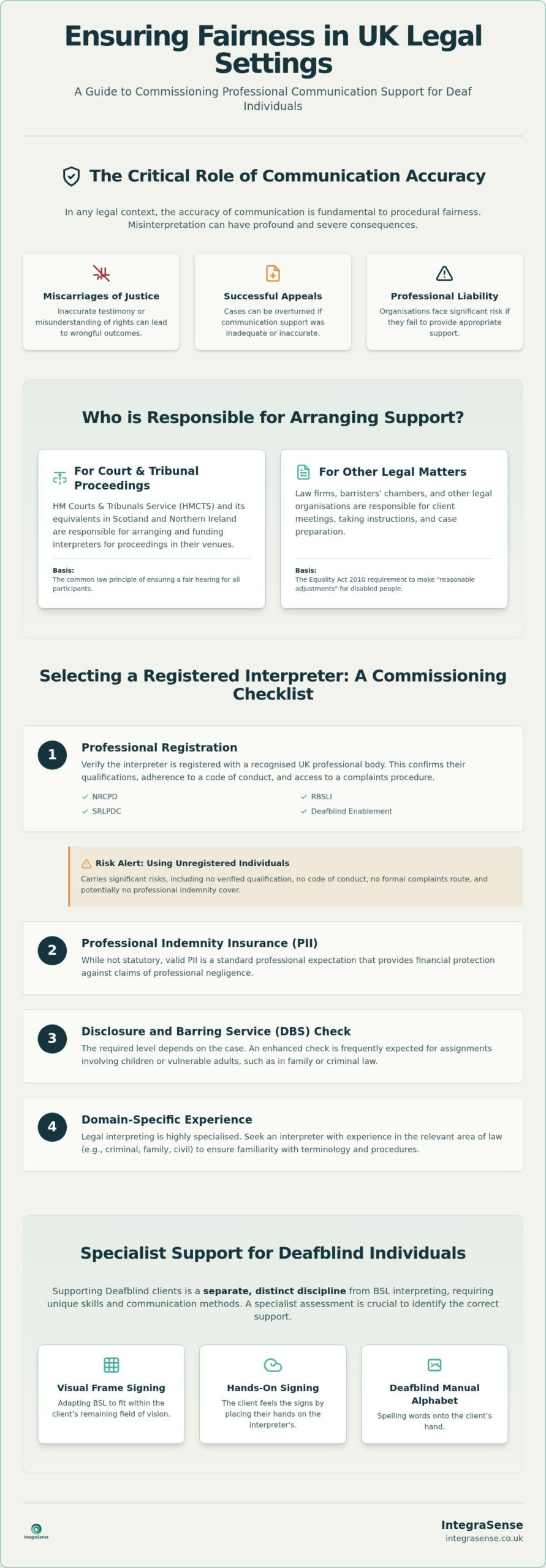
In any legal context, from initial client consultation to a high-stakes court hearing, the accuracy of communication is fundamental to procedural fairness. When a participant is Deaf, ensuring precise and impartial interpretation is not merely a matter of good practice; it is essential for upholding the principles of justice. Misinterpretation of legal terminology, client testimony, or judicial instruction can have profound consequences, potentially leading to miscarriages of justice, successful appeals, or significant professional liability.
Effective communication support ensures that Deaf individuals can participate fully and equitably in legal processes. It allows them to understand their rights, provide clear instructions, give evidence accurately, and comprehend the proceedings. This article provides guidance for legal professionals, court administrators, and public bodies on commissioning professional communication support to ensure fair outcomes and manage organisational risk.
Who is Responsible for Arranging Communication Support?
The responsibility for arranging a British Sign Language (BSL) interpreter depends on the specific legal context. It is crucial to distinguish between duties within court proceedings and obligations during other legal interactions.
- For Court and Tribunal Proceedings: In England and Wales, HM Courts and Tribunals Service (HMCTS) is responsible for arranging and funding interpreters for proceedings within its own venues. The Scottish Courts and Tribunals Service (SCTS) and the Northern Ireland Courts and Tribunals Service (NICTS) hold equivalent responsibilities in their respective jurisdictions. This duty stems from the common law principle of ensuring a fair hearing for all participants.
- For Other Legal Matters: Law firms, barristers’ chambers, and other organisations are responsible for arranging communication support for their own dealings with clients. This includes client meetings, taking instructions, conferences, and case preparation. This responsibility is governed by the Equality Act 2010, which requires service providers to make “reasonable adjustments” for disabled people. It is important to note that the judicial functions of courts and tribunals sit outside the service provision duties of the Equality Act 2010.
In legal cases involving international immigration or cross-border travel, professionals may also need to explore Visa processing and consultancy service fees to ensure their clients have access to comprehensive administrative and linguistic support.
Selecting a Registered Interpreter: A Commissioning Checklist
When commissioning a BSL interpreter for a legal appointment, a structured approach is necessary to verify professional standards and mitigate risk. While interpreter regulation in the UK is voluntary and self-regulatory, adherence to professional registers is a widely accepted benchmark of quality and accountability.
Your commissioning process should include verification of the following:
- Professional Registration: The interpreter should be registered with a recognised professional body. This confirms they hold a recognised qualification, are subject to a code of conduct, and have a clear complaints procedure. In the UK, these registers are (listed alphabetically):
- Deafblind Enablement
- National Registers of Communication Professionals working with Deaf and Deafblind People (NRCPD)
- The Regulatory Body for Sign Language Interpreters and Translators (RBSLI)
- The Scottish Register of Language Professionals with the Deaf Community (SRLPDC)
Using an unregistered individual carries significant risks, including no verified qualification level, no professional code of conduct to adhere to, no formal complaints route, and potentially no professional indemnity cover.
- Professional Indemnity Insurance (PII): While not a statutory requirement, holding valid PII is a standard professional expectation. It provides a layer of financial protection for all parties in the event of a claim arising from professional negligence.
- Disclosure and Barring Service (DBS) Check: The level of DBS check required depends on whether the assignment meets the legal definition of regulated activity, which often involves working with children or vulnerable adults. It is not a blanket requirement for all legal interpreting, but an enhanced check is frequently expected for family law or criminal cases.
- Domain-Specific Experience: Legal interpreting is a highly specialised field. Enquire about the interpreter’s experience in the relevant area of law, such as criminal, family, civil, or mental health tribunals. An interpreter familiar with the specific terminology, procedures, and pressures of a particular legal domain is better equipped to provide accurate and effective support.
Specialist Support for Deafblind Clients
Working with clients who are Deafblind requires a distinct specialism and a different set of communication skills. It is not an extension of BSL interpreting but a separate discipline. A Deafblind person’s communication needs are unique and depend on the nature and degree of their sight and hearing loss.
The communication methods required may include:
- Visual Frame Signing: Adapting BSL to fit within the client’s remaining field of vision.
- Hands-On Signing: The Deafblind person places their hands on the interpreter’s hands to feel the shape, movement, and location of the signs.
- Deafblind Manual Alphabet: A method of spelling out words onto the person’s hand.
Determining the most appropriate support often requires a specialist Deafblind assessment conducted by a qualified professional. This assessment identifies the individual’s specific communication needs and environmental requirements, ensuring that the support provided is safe, effective, and person-centred. You can learn more about the differences between BSL and Deafblind interpreting in our specialist guide.
Approaches to Interpreting: Remote and In-Person
The decision to use a remote or in-person interpreter should be based on a careful assessment of the case, the client’s needs, and the demands of the legal environment. Each format has distinct characteristics suited to different circumstances.
In-Person Interpreting
Physical presence allows the interpreter to capture the full range of visual and environmental cues that are often crucial in legal settings. It is frequently the preferred approach for:
- Complex, lengthy, or emotionally charged proceedings like trials or contested family hearings.
- Situations involving multiple participants where managing the flow of communication is critical.
- Working with clients who have additional needs, such as Deafblind individuals, or those who find remote technology challenging.
- Appointments where building rapport and trust is essential, such as initial client interviews or sensitive witness briefings.
Remote Interpreting (Video Remote Interpreting – VRI)
VRI can be an effective and efficient solution for certain types of legal work. It is often suitable for:
- Shorter, more straightforward appointments like case management hearings or pre-trial reviews.
- Situations where a suitably qualified specialist is not available locally.
- Urgent or last-minute requirements where securing an in-person interpreter is not feasible.
When considering VRI, it is vital to ensure that the technology is robust, the connection is secure and confidential, and all participants are comfortable and proficient with the platform.
Quality Assurance, Governance, and Professional Supervision
Beyond initial registration, ongoing quality assurance is key to maintaining high standards in the high-pressure field of legal interpreting. A robust governance framework protects the integrity of the process, the wellbeing of the practitioner, and the liability of the commissioning organisation.
An essential component of this is professional supervision. Legal assignments can expose interpreters to distressing evidence and emotionally challenging situations, leading to vicarious trauma and burnout. Regular, structured supervision provides a confidential space for practitioners to reflect on their practice, process difficult experiences, and navigate complex ethical dilemmas. An interpreter supported by professional supervision is better equipped to maintain the impartiality, resilience, and focus required for legal work.
Working with a consultancy that integrates this level of governance into its practice positions the interpreter not just as a linguistic conduit, but as part of a managed, multidisciplinary risk management strategy. This approach helps create defensible decisions and reduces organisational liability, much like how financial institutions utilize Intersource Consulting Group LLC to manage their complex compliance and operational risks.
Booking with IntegraSense: A Consultative Approach
IntegraSense provides a consultative pathway to securing specialist communication support. We move beyond a simple booking service to ensure the professional assigned is precisely matched to the complex demands of your case. Our process involves a strategic assessment of the legal domain, the client’s specific needs, and any environmental factors to manage risk and ensure procedural fairness.
Our network consists of registered, insured, and highly experienced professionals who are committed to continuous professional development and reflective practice through supervision. To discuss your requirements for a BSL interpreter for legal appointments, please contact us for a confidential consultation.
Frequently Asked Questions
Do I need a specific type of BSL interpreter for a court hearing?
Yes, for court hearings and other legal matters, it is crucial to commission an interpreter with specific experience in the legal domain. They will be familiar with legal protocol, terminology, and the professional standards required to work in such a high-stakes environment. Always verify their registration and ask about their experience in the relevant area of law.
What are the risks of using an unregistered BSL interpreter?
Using an unregistered person poses several risks. There is no guarantee they have achieved a recognised standard of qualification, they are not bound by a professional code of conduct, there is no formal complaints process if issues arise, and they are unlikely to hold Professional Indemnity Insurance. This can compromise the quality of communication and expose your organisation to significant liability.
Can a BSL interpreter provide expert witness testimony?
The roles of an interpreter and an expert witness are distinct. An interpreter’s role is to facilitate communication neutrally and impartially. An expert witness provides the court with a specialist, independent opinion on a particular matter, such as a Deaf person’s communication methods or language use. While some BSL interpreters may also be qualified to act as an expert witness, these are two separate functions that should not be performed by the same person in the same case. For more information, see our guide on when an expert witness may be required.
How is Deafblind interpreting different from BSL interpreting?
Deafblind interpreting is a separate specialism that requires different techniques, such as hands-on or visual frame signing, to match the individual’s specific level of vision and hearing. It also involves conveying more environmental information. A qualified BSL interpreter may not have the specialist training required to work effectively and safely with a Deafblind person.