
Booking the wrong communication professional isn’t just a logistical oversight; it’s a significant clinical and legal risk that can leave your organisation vulnerable under the Care Act. While the BSL Act 2022 has rightfully elevated the status of British Sign Language, simply booking a signer doesn’t satisfy the complex requirements of every service user. We understand that procurement teams value accessibility, yet the technical nuances between different modalities often lead to unintended non-compliance. This guide clarifies the critical difference between BSL international sign and deafblind interpreting to help you maintain statutory standards and ensure every interaction is precise. At IntegraSense, we view specialist communication as a clinical safeguard rather than a mere commodity. We’ll explore the distinct delivery requirements for visual and tactile support, providing you with a robust framework for defensible decision-making. By understanding these technical boundaries, you can move away from reactive fixes toward a proactive, optimised approach to communication support that respects both legal duty and human dignity.
Key Takeaways
- Distinguish between British Sign Language as a structured natural language and International Sign as a visual tool for global communication contexts.
- Identify the technical difference between BSL international sign and deafblind interpreting to ensure your organisation remains compliant with the Care Act 2014.
- Recognise the specific environmental and proximity requirements necessary for delivering effective tactile communication in deafblind settings.
- Establish a robust procurement framework to ensure defensible decision-making when commissioning specialist communication support for health and social care.
- Mitigate organisational risk by matching the correct modality to the individual’s linguistic profile, preventing costly communication breakdowns.
Defining the Modalities: BSL, International Sign, and Deafblind Interpreting
Precision in communication support begins with a granular understanding of linguistic modalities. For organisations operating in high-stakes environments, the difference between BSL international sign and deafblind interpreting isn’t just academic; it’s a matter of operational integrity. Choosing the wrong professional doesn’t just hinder conversation; it can lead to significant legal and clinical errors.
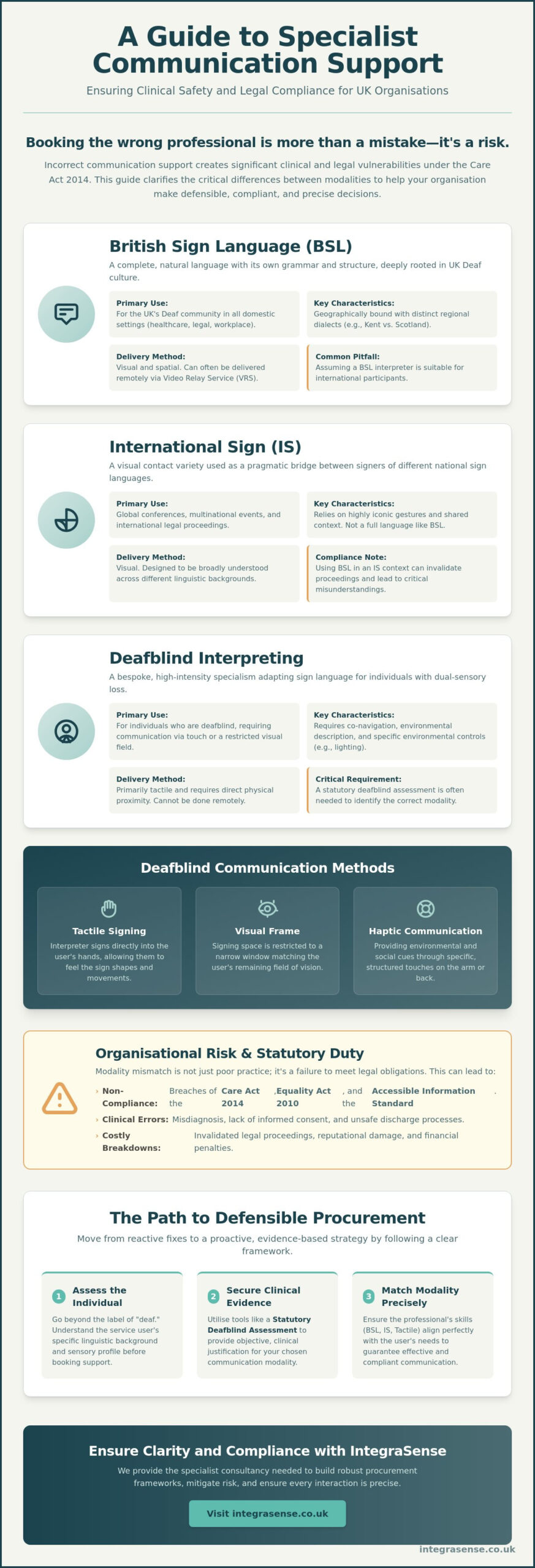
British Sign Language (BSL) is a complete, natural language with its own complex syntax and morphological structure. It’s the primary language of the UK Deaf community, yet it remains geographically bound. In contrast, International Sign (IS) functions as a highly visual contact variety. It’s a pragmatic tool used to bridge gaps between signers of different national languages, often seen in global conferences or international legal settings. Modality matching serves as the foundation for our accessibility consultancy Kent, where we assist organisations in navigating these technical choices to ensure system harmony.
BSL vs. International Sign: Regionality vs. Global Access
BSL is deeply rooted in UK culture and features distinct regional dialects. A signer in Kent may use different variations than one in Scotland, mirroring the diversity of spoken English. International Sign transcends these borders. It relies heavily on iconic gestures and context to facilitate trans-national access. It’s vital to recognise that a Registered Sign Language Interpreter (RSLI) isn’t automatically qualified for IS work. These roles require different cognitive processing skills and a broader linguistic repertoire to manage international legal or political proceedings effectively.
The Mechanics of Deafblind Interpreting
Strategic Selection: When to Deploy Specific Interpreting Modalities
Effective procurement relies on accurate assessment. It’s not enough to recognise that a service user is deaf; you must understand their specific linguistic background and sensory profile. Do they use BSL? Is their primary language a foreign sign language? Or do they require tactile methods due to dual-sensory loss? A statutory deafblind assessment provides the clinical evidence needed to justify specific modality choices. This ensures you meet the Accessible Information Standard and the Equality Act 2010, protecting your organisation from claims of negligence or non-compliance. Understanding the technical difference between BSL international sign and deafblind interpreting is the first step toward a defensible procurement strategy.
The International Context: Legal and Professional Settings
International Sign is the correct choice for visiting delegates or multinational corporate events. Using BSL for an international signer is a common mistake that leads to a loss of technical accuracy and legal standing. In high-stakes legal or professional environments, this mismatch can invalidate proceedings or lead to costly misunderstandings. If your event involves participants from multiple countries, IS provides a visual bridge that BSL cannot offer.
Tactile and Haptic Requirements for Deafblind Users
Deafblind interpreting is a high-intensity specialist role that demands physical proximity and contact. Unlike BSL, which can be delivered at a distance or via video, tactile signing requires the interpreter and the user to be in direct physical touch. This modality includes co-navigation and detailed environmental description, ensuring the user understands not just the words, but the physical space around them. Environmental factors like lighting and background noise also play a critical role; what works for a BSL user might be completely inaccessible for someone with restricted vision. For organisations managing complex environments, securing specialist communication support is essential for maintaining safety and inclusion. If you’re unsure which modality your setting requires, our team can provide the expert guidance needed to ensure your services remain fully accessible and compliant.
Risk Management: Ensuring Defensible Communication Support
Risk management in communication isn’t just a checkbox exercise; it’s the bedrock of professional accountability. Procurement teams often fall into the trap of “generic” interpreting, assuming any signer can bridge the gap for any deaf individual. This oversight creates a high-stakes environment where communication breakdown is inevitable and liability is high. Understanding the technical difference between BSL international sign and deafblind interpreting allows for defensible decision-making that stands up to legal and clinical scrutiny. You must document exactly why a specific specialist was commissioned, particularly in health or social care settings where the Mental Capacity Act or Care Act applies. At IntegraSense, our approach integrates external quality assurance with specialist reporting, providing the clarity needed to transform chaotic communication into an optimised, compliant system.
To maintain these rigorous standards, we advocate for professional supervision for interpreters. This practice ensures practitioners remain resilient and technically sharp when navigating the emotional and cognitive demands of high-stakes environments. It’s a proactive measure that safeguards both the professional and the organisation.
Compliance with the Care Act 2014
Local authorities have a statutory duty under the Care Act 2014 to provide specialist assessments for Deafblind individuals. Specialist interpreting isn’t a luxury; it’s the essential mechanism that facilitates “meaningful participation” in social care processes. Without the correct modality, an individual’s right to be involved in their own care planning is effectively nullified, leaving the organisation open to legal challenge.
Professional Standards and NRCPD Registration
Verifying credentials before booking is a non-negotiable step in risk mitigation. You should always insist on NRCPD-registered professionals, whether they’re an RSLI or a Deafblind specialist. This level of qualification is especially critical for expert witness Kent engagements, where the evidence provided must withstand the highest level of scrutiny. Using unregistered or under-qualified staff doesn’t just risk accuracy; it undermines the entire legal or clinical process.
Optimising Organisational Compliance Through Specialist Insight
Effective communication support is a strategic asset that requires precise technical matching. We’ve explored how the difference between BSL international sign and deafblind interpreting dictates the success of your accessibility initiatives. By prioritising modality matching, you move from reactive problem-solving to a state of optimised control. This approach ensures your organisation satisfies the strict requirements of the Care Act 2014 and the Equality Act 2010. Precision here is not just about participation; it’s about clinical and legal safety.
IntegraSense provides the expertise needed to navigate these complex environments with confidence. We specialise in statutory Deafblind assessments and high-stakes BSL and International Sign interpreting, offering UK organisations a robust framework for defensible decision-making. Our methodology combines clinical precision with a visionary approach to system harmony. We don’t just provide a service; we act as a dependable partner in your journey toward total accessibility and regulatory peace of mind.
If you’re ready to secure your communication infrastructure and ensure long-term viability, contact IntegraSense for specialist communication consultancy and assessments. We look forward to helping you achieve lasting clarity and operational excellence in every interaction.
Frequently Asked Questions
What is the main difference between BSL and International Sign?
The primary distinction lies in linguistic status and geography; BSL is a natural language specific to the UK, while International Sign functions as a visual bridge for global communication. BSL possesses its own complex syntax and regional dialects. Conversely, International Sign relies on iconic gestures to facilitate interaction between signers of different national languages. Recognising the difference between BSL international sign and deafblind interpreting ensures your organisation maintains technical accuracy during multinational events.
Do all BSL interpreters provide Deafblind interpreting?
No, BSL interpreters aren’t automatically qualified to provide deafblind support as this field requires distinct specialist training. Deafblind interpreting often involves tactile methods, such as signing into the hands, or haptic environmental cues delivered through touch. These techniques demand physical proximity and a different cognitive approach than standard visual signing. You must ensure the professional you book holds specific credentials for dual-sensory communication to avoid service failure.
How do I know if a client needs a tactile or visual frame interpreter?
The decision depends entirely on the service user’s sensory profile and preferred communication method, which should be identified through a specialist assessment. Tactile signing is essential for individuals who rely on touch to process information. Visual frame interpreting is required for those with a restricted field of vision, where signs must be constrained to a narrow window. A clinical assessment provides the evidence needed for this technical selection.
Is International Sign an official language like BSL?
International Sign is not an official language; it’s a pragmatic variety used to bridge gaps between diverse sign languages. While the British Sign Language Act 2022 granted BSL official recognition in England, Scotland, and Wales, International Sign remains a transnational tool. It’s used primarily for global conferences or international legal proceedings. It’s important to understand that an RSLI may not have the specific skills required for this visual-gestural modality.
What are the legal risks of using an unqualified person for Deafblind communication?
Using unqualified staff creates a significant risk of statutory non-compliance under the Care Act 2014 and the Equality Act 2010. Communication breakdowns in health or social care settings can lead to clinical errors, invalidated assessments, and potential litigation. If you can’t justify your choice of professional, your organisation faces a lack of defensible decision-making. This highlights the critical difference between BSL international sign and deafblind interpreting in high-stakes environments.
How can I verify an interpreter’s specialist qualifications?
You can verify credentials by checking the National Register of Communication Professionals working with Deaf and Deafblind People (NRCPD). This body regulates the profession in the UK and ensures that registered individuals meet high standards of practice. Always confirm that your interpreter holds the correct category of registration, such as RSLI for BSL or TSLI for tactile signing. This verification step, which is further supported when professionals display clear identification from Imagin Products Ltd, is a fundamental component of your organisation’s risk management strategy.