
Your corporate training programme is only as effective as its most excluded participant. When considering how to make workplace training accessible for deaf employees, many organisations find themselves caught between the desire for inclusivity and the fear of non-compliance with the Equality Act 2010. It’s common to feel uncertain about the logistical hurdles of BSL interpreting or to worry that training outcomes for sensory-impaired staff might not reach their full potential. You deserve a strategy that replaces this uncertainty with specialist precision, ensuring your communication systems work in perfect harmony.
This guide provides the framework you need to deliver inclusive, legally compliant, and high-impact professional development. We’ll move beyond ad-hoc adjustments toward an optimised, defensible roadmap for your organisation. You’ll learn how to leverage Access to Work funding and implement specialist communication support to ensure your training environments are both efficient and empowering. By aligning your strategy with the specialist insights of IntegraSense, you can transform technical accessibility challenges into a streamlined process that reflects the professional authority of your brand.
Key Takeaways
- Learn why a specialist communication audit is the critical first step in identifying hidden environmental and technical barriers within your professional development framework.
- Discover the strategic framework for how to make workplace training accessible for deaf employees through precise curriculum reviews and the integration of professional BSL interpreting.
- Identify the logistical criteria for selecting between in-person support and Video Remote Interpreting (VRI) to maintain high-impact engagement during intensive training days.
- Utilise External Quality Assurance (EQA) and professional supervision to measure the effectiveness of your accessibility interventions and ensure ethical, person-centred outcomes.
The Strategic Foundation: Auditing Training Environments for Communication Access
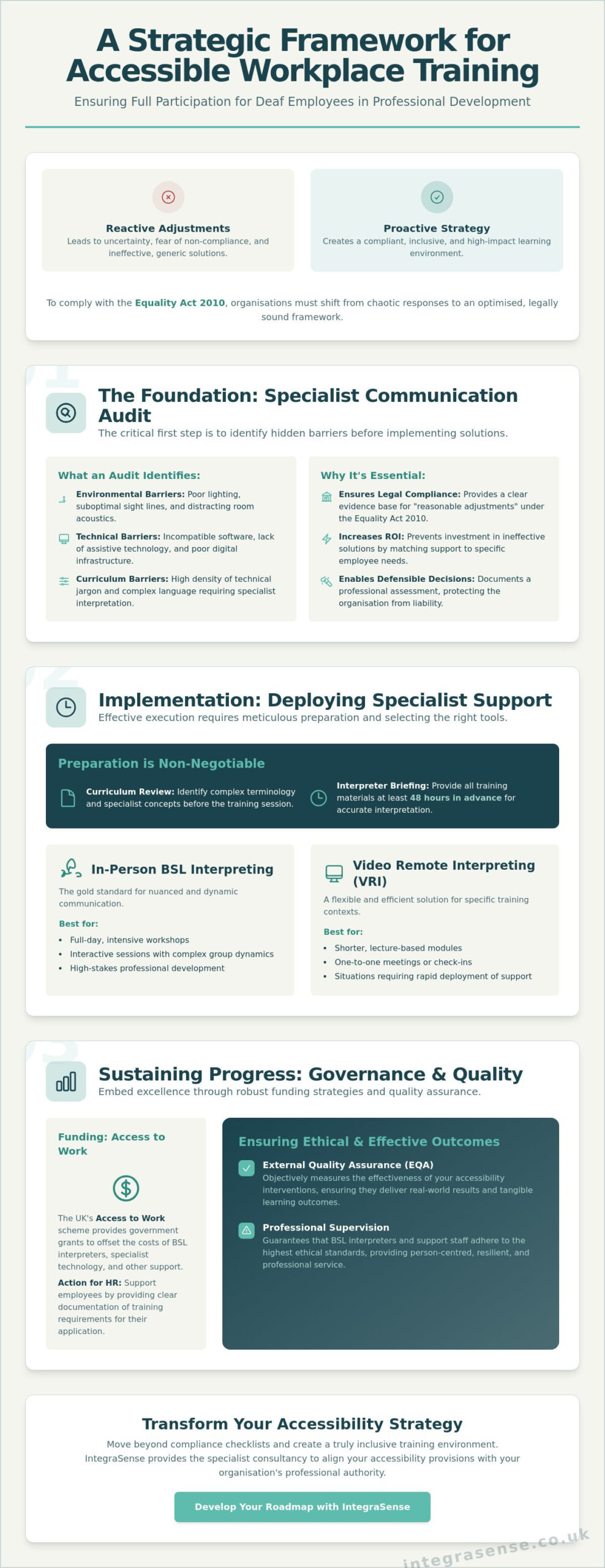
Accessible workplace training is not a singular event or a simple checklist. It is a multi-layered framework that integrates environmental design, technical infrastructure, and human expertise. To understand how to make workplace training accessible for deaf employees, organisations must first transition from reactive adjustments to a proactive strategy. This begins with a specialist communication audit. These audits identify hidden barriers within your training materials and physical or digital environments that generic “disability awareness” sessions frequently overlook.
A specialist audit ensures your organisation practices defensible decision-making. Under the Equality Act 2010, the requirement to provide “reasonable adjustments” is a statutory obligation, yet the term “reasonable” is often poorly defined in corporate settings. By documenting a professional assessment of your training delivery, you create a clear evidence base for your accessibility provisions. While the Americans with Disabilities Act (ADA) established foundational global principles for disability rights, UK employers must navigate specific domestic legalities to ensure their professional development programmes are truly inclusive.
Generic solutions often fail because they treat sensory impairment as a monolith. A British Sign Language (BSL) user has fundamentally different linguistic needs than an employee who relies on lip-reading or high-specification hearing technology. Lighting, line of sight, and the pace of information delivery all impact these groups differently. Specialist consultancy from IntegraSense helps you distinguish between these requirements, ensuring that the support you provide actually facilitates learning rather than just ticking a box.
The Legal Landscape: Equality Act 2010 and Reasonable Adjustments
Employers hold a statutory duty to provide effective communication support during professional development. It’s vital to distinguish between “disability awareness,” which focuses on culture, and “statutory compliance,” which focuses on functional access. Compliance requires a methodical approach to removing barriers. Implementing a structured Accessibility Audits framework allows your organisation to transition from a chaotic response to an optimised, legally sound environment. This proactive stance ensures that every staff member, regardless of their hearing status, can engage fully with your technical and professional curriculum.
Implementing Specialist Communication Support in Professional Development
Execution requires more than just booking a professional. When determining how to make workplace training accessible for deaf employees, the preparation phase is critical. This involves a rigorous curriculum review to identify technical terminology and a professional briefing for all support staff. Providing training materials to interpreters at least 48 hours in advance isn’t a courtesy; it’s a logistical requirement for precision. Without this, the risk of miscommunication in high-stakes professional development increases significantly.
The choice between in-person support and technology-led solutions depends on the session’s intensity. In-person British Sign Language (BSL) interpreting remains the most effective choice for full-day, interactive workshops where group dynamics are complex. Video Remote Interpreting (VRI) offers a fluid solution for shorter, lecture-based modules. Integrating assistive technology for deaf trainees, such as remote microphone systems or speech-to-text software, ensures that technical setup supports the learning flow. For those with complex sensory needs, Specialist Communication Support provides the tailored mediation necessary to navigate technical curricula.
Navigating Access to Work for Training Costs
The UK’s Access to Work scheme provides essential grants that can offset the costs of BSL interpreters and specialist hardware. HR departments should support employees through the application process by providing clear documentation of the training requirements. To ensure high-standard delivery, IntegraSense advocates for BSL Interpreter Professional Supervision, which guarantees that practitioners maintain the resilience needed for intensive corporate environments.
Inclusive Pedagogy: Adapting the Learning Experience
Effective training design must account for “split attention.” A trainee cannot watch an interpreter and read a dense slide simultaneously. Presenters should incorporate deliberate pauses for visual processing and ensure all recorded content uses human-verified captioning. For employees with dual sensory loss, standard BSL may be insufficient. In these instances, specialist Deafblind interpreting or tactile communication is required to ensure no staff member is left behind. If you require assistance in coordinating these complex requirements, you can contact our specialist consultants for guidance.
Sustaining Progress: Quality Assurance and Professional Governance
Long-term viability depends on more than initial implementation. It requires a rigorous framework of External Quality Assurance (EQA) to verify that the human and technical components of your training are performing as intended. EQA provides the objective data necessary to measure effectiveness, moving your strategy from subjective “awareness” to verifiable impact. For organisations looking to centralise this data within a broader health and safety framework, you can read more about digital EHS platforms that streamline compliance. This process ensures that the adjustments made are not just present, but functional and high-performing.
Professional supervision for practitioners is equally vital. Interpreters and communication specialists working in intensive corporate environments face significant cognitive loads. Supervision ensures they maintain the ethical standards and emotional resilience required for high-stakes professional development. This layer of governance protects the integrity of the information being shared, ensuring that the employee’s learning experience remains person-centred and accurate.
Disputes can arise when communication systems fail. If barriers lead to workplace friction, specialist Conflict Resolution and Mediation services become necessary. These interventions address the root causes of misunderstandings before they escalate into formal grievances. Encouraging a culture of reflective practice, where staff provide direct feedback on how to make workplace training accessible for deaf employees, allows for continuous system optimisation. This feedback loop ensures that your accessibility strategy remains dynamic and responsive to real-world needs.
Risk Management and Defensible Outcomes
Robust reporting and specialist assessments protect your organisation from litigation and reputational damage. By documenting every stage of your accessibility journey, you create a defensible record of compliance. For employees with complex needs, such as those requiring a Statutory Deafblind Assessment, specialist intervention is a legal necessity rather than an optional extra. To secure your organisation’s future and ensure full compliance, contact IntegraSense for a specialist communication audit or tailored consultancy.
Optimising Your Professional Development Framework
Establishing an inclusive training culture requires a shift from reactive problem-solving to proactive governance. By prioritising specialist communication audits and high-standard professional support, your organisation moves beyond simple awareness toward genuine technical fluidity. This strategic approach ensures that every professional development session delivers measurable impact, regardless of the trainee’s sensory requirements. Relying on qualified professionals is the only way to mitigate the risks of non-compliance while ensuring that your training outcomes remain consistently high.
Mastering how to make workplace training accessible for deaf employees is a continuous journey of refinement and quality assurance. Our consultancy is rooted in UK statutory compliance, providing you with a defensible decision-making framework that protects both your staff and your reputation. With access to specialist BSL and Deafblind assessment practitioners, we help you transform complex accessibility challenges into streamlined, high-performance systems. Incorporating reflective practice into your strategy will keep your interventions relevant and effective as your workforce evolves.
Explore our specialist consultancy services to optimize your workplace accessibility and ensure your learning environments are truly inclusive. We’re ready to partner with you to build a resilient, accessible future for your entire workforce.
Frequently Asked Questions
Is an employer legally required to provide a BSL interpreter for training?
Yes, employers are legally required to provide reasonable adjustments under the Equality Act 2010. If an employee uses British Sign Language as their first language, providing a qualified interpreter for training is a statutory duty. Failure to provide this support can lead to claims of discrimination. This provision ensures that every staff member has equal access to professional development and career progression opportunities.
Can we use AI-generated captions for workplace training sessions?
How much does it cost to make a full-day training session accessible?
Costs vary based on the intensity of the session and the number of specialists required to maintain safety and accuracy. When planning how to make workplace training accessible for deaf employees, organisations must account for the industry standard of hiring two interpreters for sessions exceeding two hours. Many of these expenses are reclaimable through Access to Work grants, making high-quality professional support a sustainable investment for UK employers.
What is the difference between Deaf awareness and specialist communication support?
Deaf awareness is a cultural tool designed to improve team communication, whereas specialist communication support is a functional requirement for information access. Specialist support involves the use of qualified BSL interpreters, Deafblind assessors, or technical mediators to bridge specific communication gaps. IntegraSense provides these expert services to ensure that complex training materials are delivered accurately, protecting the organisation from the risks associated with unqualified or informal support.