
Relying solely on a standard interpreter during a high-stakes legal or clinical encounter is no longer a sufficient safeguard against procedural appeals. While a qualified professional facilitates the flow of dialogue, they cannot provide the specialist opinion required to validate the integrity of the interaction itself. Determining when do you need an expert witness in communication cases is often the difference between a robust, defensible decision and a costly failure in compliance. You likely understand the pressure of meeting Mental Capacity Act requirements while managing the intricate needs of individuals with complex sensory profiles; for families and providers seeking to maintain high standards of daily care, you can explore Home Care and Skilled Nursing Services to discover specialized support options. It’s a delicate balance where the risk of non-compliance feels constant and the validity of evidence is frequently questioned.
This guide identifies the critical triggers for instructing a communication expert witness to ensure your evidence stands up to the most rigorous scrutiny. We’ll explore why the shift from simple translation to forensic evidential risk is a vital distinction for UK public sector services and healthcare providers in 2026. By the end of this analysis, you’ll have a clear framework for identifying when specialist intervention is necessary to maintain legal governance and operational clarity.
Key Takeaways
- Distinguish between the neutral role of a language interpreter and the evaluative capacity of an expert when the validity of communication is at stake.
- Identify the specific legal and clinical triggers that signal when do you need an expert witness in communication cases to mitigate organizational risk.
- Learn why dual sensory impairment requires a specialist assessment beyond standard models to ensure procedural fairness and accurate evidence.
- Understand how to meet the rigorous communication standards of the Mental Capacity Act 2005 to safeguard your decisions against future appeals.
- Establish robust governance by drafting precise Terms of Reference and integrating professional supervision for practitioners involved in high-stakes litigation.
The Threshold Between Communication Support and Expert Evidence
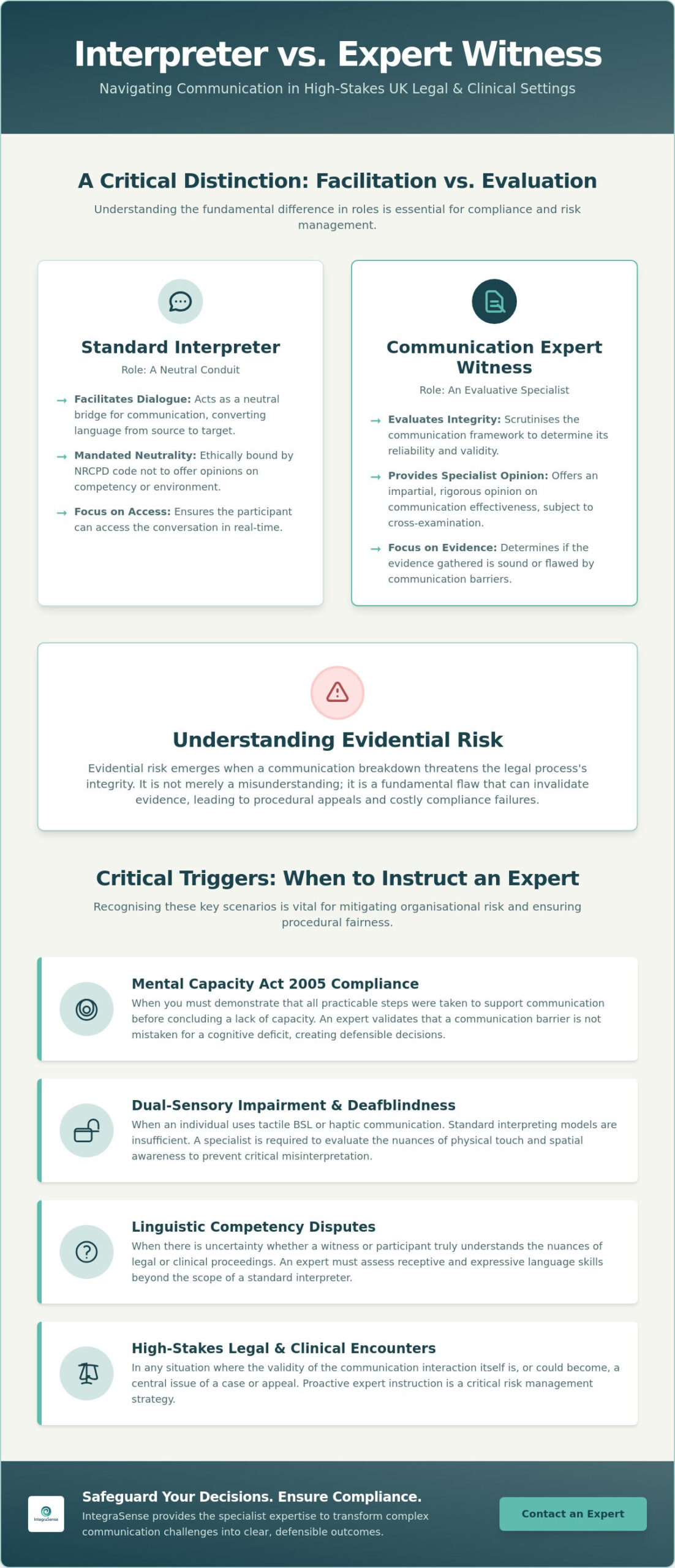
Access is not evidence. A British Sign Language (BSL) interpreter acts as a neutral conduit for dialogue, but an expert witness evaluates the framework of that dialogue to determine its reliability. Understanding when do you need an expert witness in communication cases requires a shift in perspective. You must move from simply facilitating a conversation to scrutinizing the integrity of the information being exchanged.
In the UK legal system, the transition from communication support to expert evidence occurs when the validity of the interaction itself becomes a central issue. Under the Civil Procedure Rules (CPR), an expert’s primary duty lies with the court rather than the instructing party. This ensures that the specialist opinion provided is impartial, rigorous, and capable of withstanding cross-examination. For a foundational Expert witness overview, one must recognize that this role involves interpreting complex data patterns that fall outside the typical experience of a judge or jury.
Why a Standard Interpreter is Not an Expert Witness
Standard interpreters operate under the NRCPD code of conduct, which mandates strict neutrality. This ethical boundary prevents them from commenting on a participant’s linguistic competency or the effectiveness of the communication environment. Attempting to bridge these roles creates a conflict of roles that can compromise the entire case. An active interpreter cannot objectively critique their own facilitated interaction. They lack the mandate to provide the evaluative analysis that a court requires.
Defining Evidential Risk in Communication
Evidential risk emerges when a communication breakdown threatens the legal process’s integrity. It isn’t just about a misunderstanding. It’s about whether the evidence gathered is fundamentally flawed due to systemic barriers. Identifying when do you need an expert witness in communication cases often starts with a communication audit to pinpoint these failures. IntegraSense provides the clarity needed here, transforming chaotic interactions into optimized, defensible workflows that ensure every step taken meets statutory requirements.
Critical Triggers for Instructing a Communication Expert Witness
Identifying the precise moment to escalate from standard support to expert evidence is a matter of strategic risk management. When do you need an expert witness in communication cases? The answer typically lies in the complexity of the individual’s needs and the legal weight of their testimony. While general principles of evidence reliability, such as those outlined in the Federal Rule of Evidence 702, provide a global benchmark for admitting specialist testimony, UK practitioners must focus on specific statutory triggers and clinical nuances.
Linguistic competency disputes often serve as a primary trigger. If there’s uncertainty regarding whether a witness truly understands the nuances of the proceedings, a standard interpreter’s presence isn’t enough. You require an expert to assess the participant’s receptive and expressive language skills. This is particularly vital in safeguarding investigations where non-verbal or idiosyncratic communication methods are used. An expert lens ensures that subtle cues aren’t lost and that the individual’s voice is accurately represented within the judicial framework.
Deafblindness and Dual-Sensory Impairment
Standard interpreting models often fail when a participant experiences dual-sensory loss. In these instances, a statutory deafblind assessment is a fundamental prerequisite for any expert evidence. The transition to tactile BSL or haptic communication requires a specialist who can evaluate the nuances of physical touch and spatial awareness. Without this expert oversight, the risk of misinterpretation increases, which can potentially invalidate the entire legal process. IntegraSense provides the technical depth required to manage these high-stakes environments with precision.
Mental Capacity and Defensible Decisions
Under the Mental Capacity Act 2005, organisations must prove they’ve taken all practicable steps to support communication before concluding a lack of capacity. Experts provide the framework for defensible decision-making, ensuring a person’s communication barrier isn’t mistaken for a cognitive deficit. This specialist validation is essential for maintaining governance in high-risk health and social care settings. If your organisation is managing complex capacity assessments, our specialist communication support offers the expertise needed to ensure legal compliance and procedural integrity.
Instructing an Expert: Ensuring Governance and Risk Management
Governance requires precision. When you instruct a specialist, the clarity of your Terms of Reference determines the defensibility of the final report. This is often the critical juncture where you decide when do you need an expert witness in communication cases to provide an evaluative framework rather than just a narrative summary. A robust instruction ensures the expert addresses the specific legal questions at hand; it prevents scope creep and ensures the evidence remains relevant to the court’s needs.
Integrating these findings into your broader organisational strategy transforms a reactive legal response into a proactive compliance model. This multidisciplinary approach ensures that the insights gained from individual cases inform systemic improvements. IntegraSense provides the technical depth required to bridge the gap between legal requirements and operational excellence, ensuring that your communication systems are both efficient and legally sound.
The Letter of Instruction: Best Practices
Clearly defining the scope is the first step toward a successful instruction. You must determine if the expert is assessing the individual’s unique communication profile or the environmental barriers preventing effective interaction. For local authorities and healthcare providers, this involves ensuring compliance with the Care Act and deafblindness statutory requirements. A well-drafted letter of instruction acts as a blueprint, aligning technical analysis with your organisation’s legal duties.
Mitigating Risk Through Specialist Consultancy
Utilising expert witness services protects organisations from the high costs of litigation and procedural failure. It moves your team from a position of uncertainty to one of proactive governance. By integrating expert findings into broader accessibility audits, you create a sustainable framework for long-term compliance. This process identifies systemic weaknesses before they result in a communication breakdown or a successful appeal.
Professional supervision remains a critical component of risk management. Practitioners involved in high-stakes legal cases need a structured environment to process technical and ethical complexities. Our team provides the specialist oversight necessary to maintain professional standards and emotional resilience. Contact our specialists for professional consultancy to begin optimizing your internal communication governance and safeguarding your organisational reputation.
Advancing Towards Communication Governance
Effective governance in 2026 demands a shift from reactive problem-solving to proactive system optimization. We’ve explored how the distinction between communication support and evaluative evidence is vital for legal integrity. You now have a framework to identify when do you need an expert witness in communication cases, ensuring that every interaction within your organisation is both accessible and defensible. By focusing on statutory triggers like complex sensory loss and Mental Capacity Act compliance, you protect your service from the high costs of procedural appeals.
IntegraSense provides the multidisciplinary consultancy required to navigate these high-stakes environments. Our specialists offer unparalleled expertise in BSL and Deafblind assessments, delivering the clarity needed for health and public sector organisations to meet their legal responsibilities. We don’t just provide a service; we partner with you to establish long-term viability through professional supervision and strategic accessibility audits. It’s time to replace uncertainty with precision.
Instruct a Specialist Expert Witness from IntegraSense to safeguard your decisions and empower the people you serve. Building a compliant, accessible future starts with a single expert insight.
Frequently Asked Questions
What is the difference between a BSL interpreter and a communication expert witness?
A BSL interpreter facilitates dialogue as a neutral conduit for communication. A communication expert witness provides an evaluative opinion on the integrity of the interaction itself. While the interpreter is ethically bound to remain neutral, the expert witness has a primary duty to the court to analyze linguistic competency. They scrutinize the communication framework to ensure that the evidence gathered is both robust and legally defensible.
Can an expert witness be used in Mental Capacity Act assessments?
Yes, an expert witness is vital during Mental Capacity Act 2005 assessments to validate that all practicable steps have been taken to support the individual. This intervention ensures that a communication barrier isn’t mistaken for a lack of cognitive capacity. Identifying when do you need an expert witness in communication cases is essential for healthcare providers who must demonstrate rigorous compliance and defensible decision-making in complex environments.
What qualifications should a communication expert witness hold in the UK?
UK experts should hold advanced qualifications in specialist fields like Deafblindness or BSL, alongside formal training in forensic report writing and the Civil Procedure Rules. They typically maintain professional registration with bodies such as the NRCPD and possess significant experience in clinical or social care settings. IntegraSense utilizes a multidisciplinary approach to ensure that every expert brings both technical depth and legal awareness to the case.
How much does it cost to instruct an expert witness for a communication case?
Fees for specialist instructions are determined by the technical requirements of the case and the time needed for forensic analysis. Most experts utilize hourly rates for file reviews, assessments, and court testimony, often requiring an initial retainer to secure their services. This investment ensures that complex environments are optimized for clarity, empowering organisations to manage their legal responsibilities with precision and professional confidence.