
Arranging a British Sign Language (BSL) interpreter for a university lecture is a critical component of academic accessibility. For Disability Coordinators and university faculty, the process involves more than a simple booking. It requires a strategic approach to legal compliance, quality assurance, and an understanding of the complex communication needs within higher education. Success depends on moving beyond reactive adjustments to a proactive framework that supports academic excellence for every student.
This guide provides a detailed overview for 2026, covering the legal duties, practical steps for sourcing and preparing interpreters, and the importance of professional supervision in maintaining high standards for demanding academic content.
The Strategic Importance of BSL Interpreting in Higher Education
In a fast-paced academic environment, a professional BSL interpreter is essential for providing equal access to lectures, seminars, and tutorials. Their role is to facilitate communication accurately between a D/deaf student and their hearing peers and lecturers. This support is fundamental to ensuring D/deaf students can fully engage with complex subject matter, participate in discussions, and achieve their academic potential.
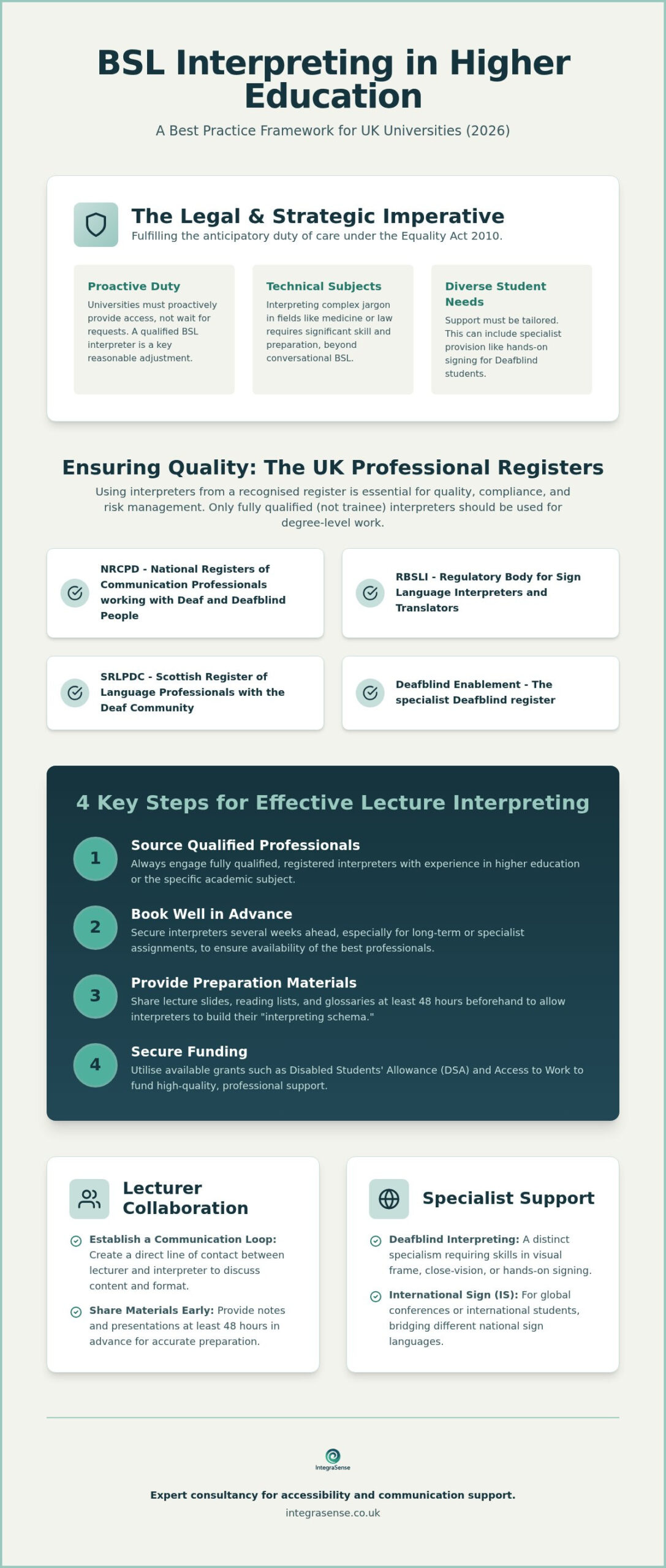
- The Equality Act 2010: Universities have an anticipatory duty to consider the needs of disabled students proactively, rather than waiting for a request for support. Providing a qualified BSL interpreter is a key reasonable adjustment.
- Technical Jargon: Interpreting abstract concepts and specialised terminology in subjects like medicine, law, or engineering requires significant skill and preparation.
- Diverse Needs: Support must be tailored to the individual, which may include specialist provision such as hands-on signing for Deafblind students.
Legal Compliance and Risk Management
Under the Equality Act 2010, higher education providers must make reasonable adjustments to ensure disabled students are not at a substantial disadvantage. A university’s proactive approach to accessibility is central to this duty.
While professional registration for BSL interpreters is not a statutory requirement in the UK, using a fully qualified and registered professional is essential for meeting the demands of higher education. Relying on unqualified individuals or staff with conversational British Sign Language skills is unlikely to provide the quality needed for degree-level study. Using a registered interpreter strengthens the institution’s position if the effectiveness of an adjustment is questioned and demonstrates a commitment to high standards.
Engaging a professional registered with one of the UK’s recognised bodies indicates they work to a professional code of conduct and hold appropriate indemnity insurance. For university-level work, the interpreter should hold a full qualification, not be a trainee. The four key UK registers are:
- National Registers of Communication Professionals working with Deaf and Deafblind People (NRCPD)
- Regulatory Body for Sign Language Interpreters and Translators (RBSLI)
- Scottish Register of Language Professionals with the Deaf Community (SRLPDC)
- The specialist Deafblind register maintained by Deafblind Enablement
Working with a consultancy that understands these nuances helps protect the university from potential disability discrimination claims and ensures that decisions around communication support are robust and well-documented. For a broader perspective on institutional compliance, consider undertaking regular accessibility audits.
Specialist Communication for Diverse Academic Needs
Academic life is diverse, and so are the communication needs of students. A standard approach is not always sufficient. Universities must be prepared to source other forms of specialist communication support, which are distinct specialisms in their own right, not an extension of BSL.
- Deafblind Interpreting: Students who are Deafblind may require a specialist interpreter skilled in visual frame, close-vision, or hands-on signing to access lectures and navigate the university environment.
- International Sign (IS): For global academic conferences, research collaborations, or for international students, an interpreter proficient in International Sign may be required to facilitate communication across different national sign languages.
Practical Steps for Effective Lecture Interpreting
Securing the right support requires careful planning and collaboration between the university’s disability services, academic departments, and the student. A structured approach ensures a seamless experience and optimal learning outcomes.
- Sourcing Professionals: Always source fully qualified BSL interpreters registered with NRCPD, RBSLI, SRLPDC, or the Deafblind Enablement register, ideally with experience in higher education or the specific subject matter.
- Early Booking: It is advisable to book interpreters as far in advance as possible, often several weeks, to secure the most suitable professionals, particularly for long-term or specialist assignments.
- Preparation Materials: Provide interpreters with lecture slides, reading lists, and glossaries of technical terms in advance to help them build the necessary schema for the topic.
- Funding Routes: Utilise grants such as the Disabled Students’ Allowance (DSA) and Access to Work to fund high-quality, professional support.
The Preparation Framework for Lecturers
A collaborative relationship between the academic department and the BSL interpreter is vital for accuracy. The interpreter is not just a passive presence but an active participant in the communication process who needs context to perform effectively.
- Establish a Communication Loop: Create a clear line of communication between the lecturer and the interpreter to discuss course content, terminology, and lecture format.
- Share Materials Early: Provide PowerPoint presentations, lecture notes, and pre-reading materials at least 48 hours beforehand. This allows the interpreter to develop their “interpreting schema”, which is the mental framework needed to understand and accurately convey technical topics.
Logistics and Environment Optimisation
The physical environment of a lecture theatre significantly impacts the effectiveness of interpreting. Small adjustments can make a substantial difference to the student’s ability to access information.
- Lighting and Sightlines: Ensure the room has good lighting and that the student has a clear, unobstructed view of both the interpreter and the lecturer or presentation screen.
- Pacing and Turn-Taking: Lecturers should aim for a clear, manageable pace. During Q&A sessions, it is important to manage turn-taking so the interpreter can keep up and accurately convey each contribution.
Ensuring Quality and Resilience Through Professional Supervision
The cognitive demands of interpreting complex, high-level academic content are immense. The role can also be emotionally taxing, particularly in sensitive subject areas. To maintain quality and prevent burnout, professional supervision is a non-negotiable component of a robust accessibility strategy.
- Managing Cognitive Load: High-stakes university environments place a significant cognitive and emotional burden on interpreters.
- The Need for Supervision: Professional supervision provides a structured space for interpreters to reflect on their practice, manage challenges, and maintain high ethical standards.
- A Strategic Partnership: Universities should move from viewing interpreting providers as vendors to seeing them as strategic partners in accessibility and student success.
The Role of Professional Supervision
Professional supervision is a formal process of reflective practice that helps interpreters maintain the resilience and accuracy required for academic work. It is a key quality assurance mechanism that directly benefits the student.
- Improving Accuracy: Reflective practice allows interpreters to analyse and improve their performance in complex lectures, leading to greater accuracy and consistency.
- Preventing Burnout: Regular supervision helps prevent burnout, ensuring the student receives consistent, high-quality support throughout their course from a familiar professional.
- Learn More: Explore our detailed guide on BSL interpreter professional supervision to understand its strategic importance.
Defensible Decision-Making in Education
By investing in registered interpreters and supporting them with professional supervision, universities create a robust and defensible framework for communication support. This approach not only meets legal obligations but also fosters an inclusive environment where all students can thrive.
- Creating Audit Trails: A professionalised approach provides a clear audit trail for the provision of communication support, demonstrating due diligence.
- Expert Partnerships: Partnering with a specialist agency like IntegraSense provides access to expert consultancy on complex cases and ensures all accessibility decisions are well-informed. Explore our range of specialist services for higher education.
Frequently Asked Questions
Do I need to book two interpreters for a long university lecture?
Yes, for lectures or any academic assignment lasting over two hours, it is standard practice to book a team of two BSL interpreters. This practice, known as co-working, allows them to swap every 20 to 30 minutes. This is essential for managing the significant cognitive load involved in simultaneous interpreting and ensures the accuracy and quality of the support are maintained for the entire duration.
What is the difference between a BSL interpreter and a communication support worker (CSW)?
These are distinct professional roles. A BSL interpreter works between two languages, British Sign Language and English, facilitating communication in real time. A Communication Support Worker (CSW) provides a broader range of support which, in a higher education setting, often includes services like electronic notetaking or lipspeaking. The choice between an interpreter and a CSW depends entirely on the individual student’s communication needs and preferences, which should be established through a needs assessment.
How do I fund a sign language interpreter for a postgraduate student?
The Disabled Students’ Allowance (DSA) is available to eligible postgraduate students, including those on taught and research-based courses, just as it is for undergraduates. It can be used to fund support like BSL interpreters. However, the application process and the administering body for DSA vary across the four nations of the UK: Student Finance England, Student Awards Agency Scotland (SAAS), Student Finance Wales, and Student Finance NI.
The DSA also covers support for various neurodevelopmental differences; to learn more about accessing holistic, personalised educational support, students and coordinators can consult with specialist educational practices.
Can a sign language interpreter work remotely for online lectures?
Yes, this is delivered through Video Remote Interpreting (VRI). It can be a highly effective solution for online or hybrid lectures, provided the technical setup is correct. Key requirements include a stable, high-speed internet connection for all parties and a screen setup that allows the student to see the interpreter, the academic content, and the lecturer simultaneously and clearly.
To implement a robust strategy for academic interpreting that ensures legal compliance and supports student success, contact IntegraSense for specialist interpreting and consultancy.