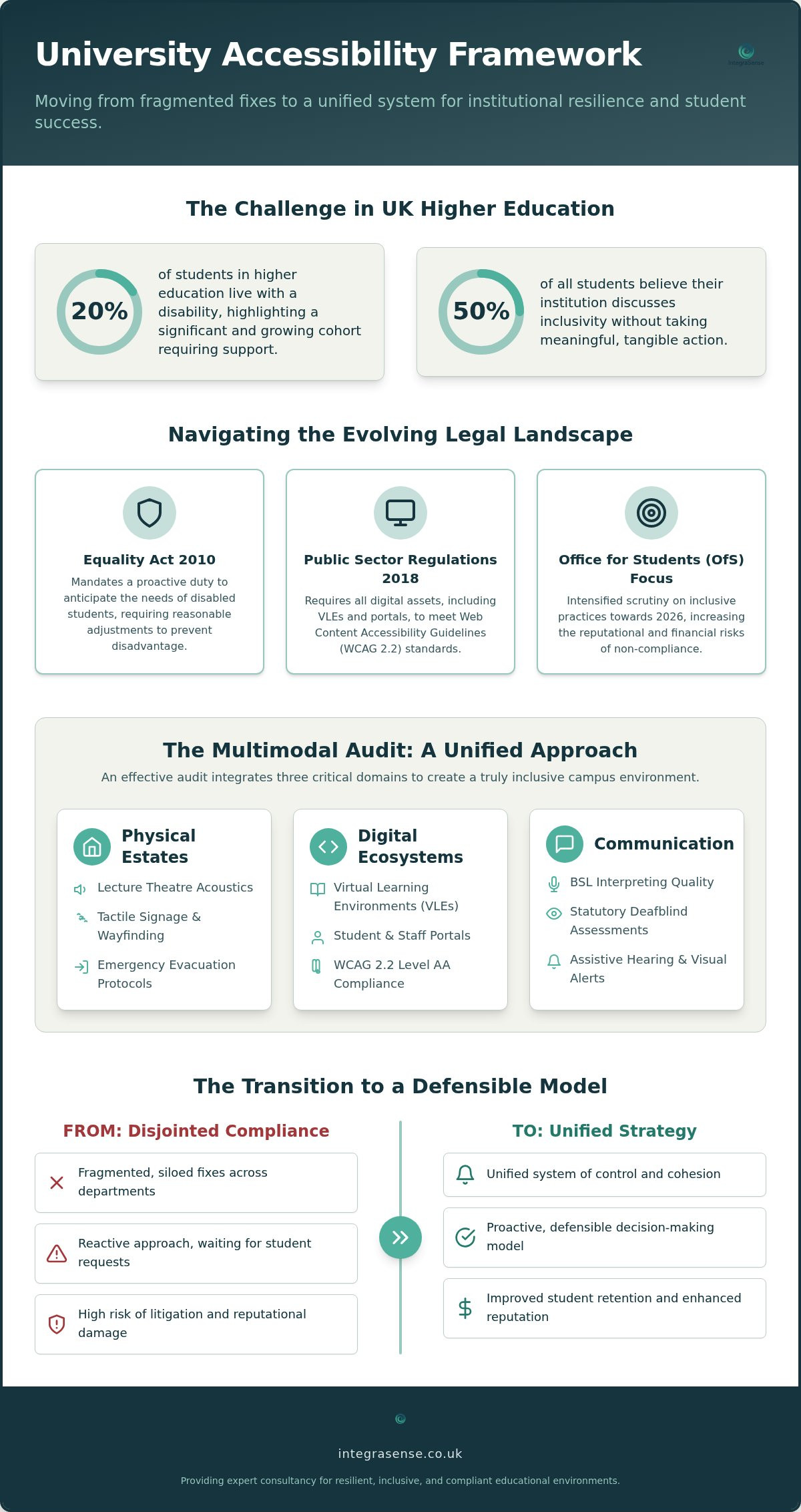
Twenty percent of students in higher education live with a disability, yet half of all students believe their institution discusses inclusivity without taking meaningful action. You likely feel the pressure of this gap while managing a complex, multi-site campus. The fear of litigation under the Equality Act 2010 is real, especially when digital and physical accessibility efforts remain siloed. A comprehensive accessibility audit for universities shouldn’t be a checkbox exercise; it’s a strategic necessity for institutional resilience.
This guide provides a robust framework to master these complexities, moving from fragmented fixes to a unified system of control. You’ll learn how to integrate WCAG 2.2 standards with physical and sensory communication protocols to protect your reputation and improve student retention. We will outline the transition from chaotic compliance to an optimized, defensible decision-making model for 2026.
Key Takeaways
- Navigate the evolving legal landscape by aligning institutional policy with the Equality Act 2010 and the latest public sector digital regulations.
- Execute a robust accessibility audit for universities that bridges the gap between physical estates, digital assets, and sensory communication support.
- Develop a defensible implementation roadmap that prioritises high-risk areas while ensuring long-term financial and operational viability.
- Leverage multidisciplinary expertise to create inclusive environments that enhance student retention and satisfy complex statutory requirements.
Strategic Compliance: Navigating the Legal Landscape for HE Accessibility
An accessibility audit for universities is far more than a simple site walkthrough. It’s a systematic, multi-layered evaluation of physical campus estates, digital learning environments, and the procedural frameworks that govern student life. This process ensures that every touchpoint, from a lecture hall’s acoustics to the university’s virtual learning environment (VLE), is optimized for inclusivity.
The legal framework remains rigorous. The Equality Act 2010 provides the primary foundation, requiring institutions to anticipate the needs of disabled students rather than waiting for a request. This is reinforced by the Public Sector Bodies (Websites and Mobile Applications) Accessibility Regulations 2018, which mandate that all digital assets meet the Web Content Accessibility Guidelines (WCAG) standards. Compliance isn’t just a technical hurdle; it’s a statutory obligation that demands precision.
Within higher education, the concept of “reasonable adjustments” is central to student support and funding. These adjustments aren’t optional extras. They’re essential modifications that prevent students from being at a substantial disadvantage. Institutions must adopt a model of defensible decision-making to manage these requirements. This involves documenting why specific interventions were chosen and how they align with both student needs and institutional capacity.
The Consequences of Non-Compliance in 2026
By 2026, the Office for Students (OfS) has intensified its focus on inclusive practices. The reputational and financial risks of litigation are significant, as students are increasingly aware of their rights. A single high-profile discrimination claim can damage an institution’s brand for years. A robust audit serves as a vital shield against such claims, demonstrating a proactive commitment to equality. Moving from reactive, piecemeal fixes to proactive accessibility audits allows universities to regain control over their environment, ensuring that inclusivity is built into the campus DNA rather than bolted on as an afterthought.
The Multimodal Audit: Integrating Physical, Digital, and Sensory Standards
A modern accessibility audit for universities must transcend the traditional focus on ramps and screen readers. True inclusivity requires a multimodal approach that synchronises physical, digital, and sensory communication pathways. While physical standards often focus on mobility, a comprehensive evaluation prioritises lecture theatre acoustics, tactile signage, and robust emergency evacuation protocols designed for all abilities. These elements form the bedrock of a campus that doesn’t just house students but actively supports their presence. When these systems fail to align, the student experience becomes fragmented and exclusionary.
Digital environments demand equal rigour. Current standards require WCAG 2.2 Level AA compliance across all student portals and Virtual Learning Environments (VLEs). This technical benchmark ensures that educational materials are perceivable and operable for every learner. While institutions often look to DOJ accessibility rules for international best practices, the UK mandate remains focused on removing barriers to information. Integrating these digital checks with physical audits prevents the siloed thinking that often leaves students stranded between a compliant website and an inaccessible laboratory.
Auditing Sensory Communication and BSL Support
The “Communication Audit” is frequently the missing link in higher education strategy. It evaluates the availability and quality of British Sign Language (BSL) interpreting for complex seminars and lab-based learning. Effective support also includes statutory deafblind assessments to ensure those with dual-sensory impairments receive tailored provision. We also assess the technical efficacy of assistive hearing loops and visual alert systems in high-traffic zones to maintain safety and engagement. For institutions seeking to harmonise these disparate systems, our accessibility consultancy provides the multidisciplinary expertise required for total campus cohesion. This ensures that specialist support isn’t just available, but integrated into the university’s operational fabric.
Developing a Defensible Accessibility Roadmap and Implementation Plan
Translating the results of an accessibility audit for universities into a functional roadmap requires a disciplined approach to prioritisation. We recommend a matrix that weights findings based on legal risk, student experience impact, and institutional budget cycles. High-stakes areas, such as non-compliant digital portals or life-safety physical barriers, must take precedence in the first phase of remediation. This structured approach ensures that resources are allocated where they mitigate the most significant institutional risks.
A successful transition from audit to action depends on a multidisciplinary team. You’ll need to bridge the gap between estates, IT departments, and student services. Engaging specialist consultants provides the technical precision required for complex sensory and communication standards. Additionally, providing professional supervision for staff managing these transformations is crucial. It protects the well-being of your internal teams while ensuring they maintain the high standards required for statutory compliance.
Your Accessibility Statement serves as the public face of this roadmap. It shouldn’t be a static document but a living, evidence-based record of progress. By documenting completed works and active projects, you provide a clear narrative of continuous improvement that satisfies both students and regulators.
Evidence-Based Reporting and Continuous Improvement
Maintaining a detailed audit trail for every reasonable adjustment decision is vital to ensure legal defensibility against potential claims. Annual reviews are the gold standard for dynamic university environments because new infrastructure or software updates can inadvertently introduce fresh barriers. For institutions requiring expert oversight on complex communication audits, contact IntegraSense to ensure your framework remains robust and compliant.
Securing the Future of Inclusive Higher Education
Navigating the intersection of digital innovation and statutory requirements requires more than a simple checklist. It demands a holistic strategy that bridges the gap between your physical campus and virtual learning environments. By conducting a comprehensive accessibility audit for universities, you transform compliance from a legal burden into a tool for strategic risk management and student retention. This framework ensures that sensory communication pathways, such as BSL provision and deafblind support, are never overlooked in the pursuit of institutional excellence.
At IntegraSense, we specialise in defensible decision-making and UK-wide public sector compliance. Our multidisciplinary team provides the technical precision needed to interpret complex standards and implement lasting change across your organisation. Contact IntegraSense for an expert accessibility and communication audit to begin your journey toward an optimised, inclusive campus. Together, we can build a learning environment where every student possesses the tools to succeed.
Frequently Asked Questions
Is an accessibility audit a legal requirement for UK universities?
Yes, an accessibility audit for universities is a statutory necessity under the Equality Act 2010 and the Public Sector Bodies Accessibility Regulations 2018. These laws require institutions to proactively remove barriers for disabled students and staff. Failing to maintain compliant digital and physical environments exposes the university to significant legal risk and scrutiny from the Office for Students (OfS).
How often should a university campus undergo a full accessibility audit?
A full accessibility audit for universities should occur annually to account for infrastructure changes, software updates, and evolving statutory standards. While minor reviews can be rolling, a comprehensive yearly evaluation ensures that new digital content or physical renovations haven’t introduced fresh barriers. This frequency allows estates and IT teams to align remediation with annual budget cycles and strategic planning.
What is the difference between a digital accessibility audit and a physical access audit?
Digital audits focus on the technical compliance of virtual learning environments and student portals against WCAG 2.2 standards. In contrast, physical audits evaluate the built environment, including lecture hall acoustics, tactile signage, and emergency exit routes. A truly robust framework integrates both, ensuring students experience a seamless transition between their online studies and their physical presence on campus.
Does the Equality Act 2010 cover communication support like BSL interpreting?
Yes, the Equality Act 2010 mandates communication support as a reasonable adjustment to prevent substantial disadvantage. This includes providing qualified British Sign Language (BSL) interpreters for lectures and ensuring specialist support is available in laboratories. Neglecting these sensory communication pathways is a common compliance gap that can lead to successful discrimination claims and diminished student retention rates.