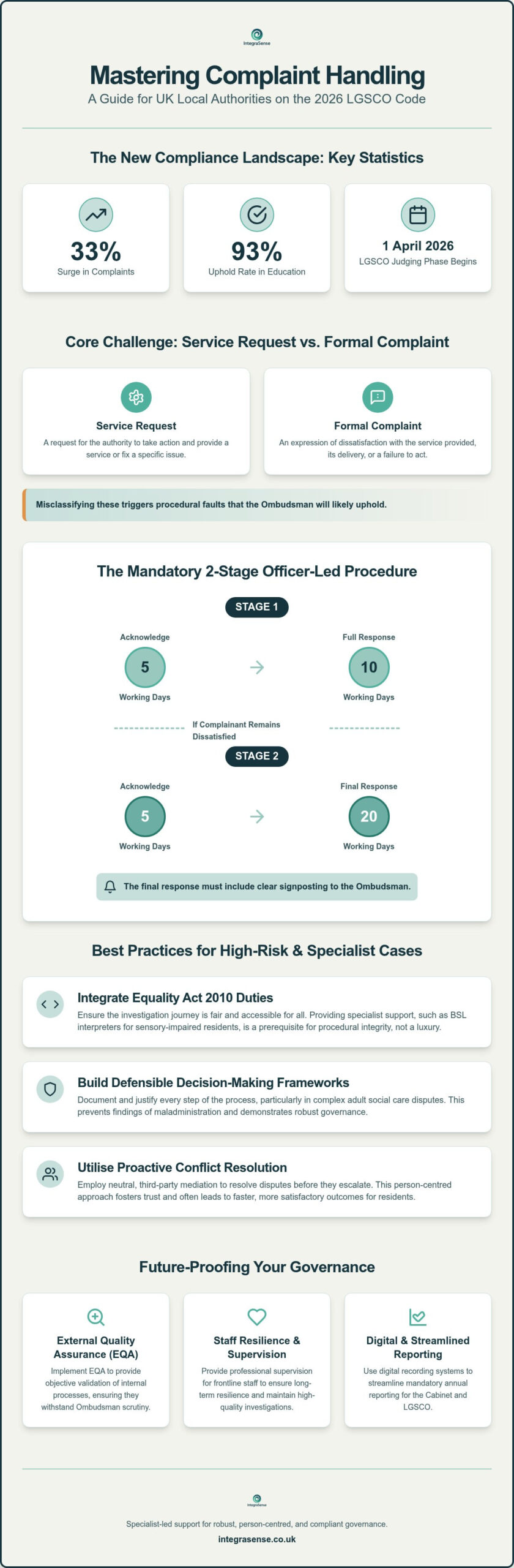
With a 33% surge in complaints and uphold rates hitting 93% in education sectors, the margin for error in local governance has effectively vanished. Mastering Complaint Handling for Local Authorities: Best Practices in 2026 is no longer optional as the 1 April 2026 LGSCO deadline approaches. We recognize that differentiating between simple service requests and formal complaints remains a significant pain point for teams facing increased scrutiny.
This article provides the clarity you need to integrate specialist communication strategies and defensible decision-making frameworks into your daily operations. We’ll explore how to support sensory-impaired complainants with precision, utilizing IntegraSense’s expertise to ensure your annual reporting exceeds regulatory benchmarks. By following this guide, you can reduce Ombudsman escalations and transform your governance into a robust, person-centred system that values both efficiency and accessibility.
Key Takeaways
- Navigate the LGSCO’s new judging phase by mastering the technical distinction between service requests and formal complaints to prevent procedural faults.
- Embed specialist communication support into the investigation journey to ensure your Complaint Handling for Local Authorities: Best Practices in 2026 aligns with Equality Act 2010 duties.
- Adopt External Quality Assurance (EQA) to provide an objective validation of internal processes, fostering a culture of defensible and transparent decision-making.
- Streamline mandatory annual reporting requirements for Cabinet and the LGSCO through the implementation of digital recording systems and structured self-assessments.
The 2026 LGSCO Complaint Handling Code: Strategic Compliance
From 1 April 2026, the Local Government and Social Care Ombudsman (LGSCO) begins its formal judging phase. This shift moves past mere adoption into a rigorous assessment of how councils apply the new standards. A central pillar of Complaint Handling for Local Authorities: Best Practices in 2026 is the precise distinction between a service request and a formal complaint. While a service request asks for action to fix a specific issue, a complaint expresses dissatisfaction with the service provided. Misclassifying these triggers procedural faults that the Ombudsman will likely uphold, particularly considering the 33% increase in complaint volumes recorded in the 2025-2026 period.
Effective corporate governance now requires a proactive stance. Authorities must move away from defensive postures and embrace transparency. Integrating specialist support from providers like IntegraSense, who offer mediation services Kent, during the early stages can resolve disputes before they calcify into formal grievances. This strategic intervention preserves resources and maintains community trust. This transition ensures that Complaint Handling for Local Authorities: Best Practices in 2026 is embedded into the organizational DNA, rather than treated as a peripheral compliance task. It’s about shifting from administrative box-ticking to a specialist-led model of defensible decision-making.
Navigating the 2-Stage Officer-Led Procedure
The new Code mandates a streamlined, two-stage process. For Stage 1, you must acknowledge the complaint within 5 working days and provide a full response within 10. If the complainant remains dissatisfied, Stage 2 requires an acknowledgement within 5 days and a final response within 20 working days. This final response must include clear signposting to the Ombudsman. The 2-stage officer-led procedure serves as the backbone of 2026 procedural fairness, ensuring internal accountability is exhausted before external intervention occurs.
Best Practices for Specialist and High-Risk Complaint Resolution
High-risk complaint resolution requires more than administrative accuracy. It demands a sophisticated understanding of legal duties. Integrating Equality Act 2010 responsibilities into the complaint journey is essential for sensory-impaired residents. This ensures that the investigation remains fair and accessible from the outset. Specialist communication support, such as British Sign Language (BSL) interpreting, isn’t a luxury; it’s a prerequisite for procedural integrity. Failing to provide qualified professionals risks a finding of maladministration and significant distress for the complainant.
When managing adult social care disputes, councils must develop defensible decision-making frameworks. This is particularly critical during a statutory deafblind assessment where the complexity of combined sight and hearing loss can lead to systemic misunderstandings. Adhering to the Complaint Handling Code ensures that every step is documented and justified. This level of precision is the hallmark of Complaint Handling for Local Authorities: Best Practices in 2026, where technical depth meets human-centred design.
Conflict Resolution and Mediation in Local Governance
Neutral third-party mediation offers a proactive route to resolve complex disputes before they reach the Ombudsman. This approach prioritizes person-centred outcomes, which are vital in social care cases involving multiple service areas. By focusing on the individual’s lived experience, mediation fosters a sense of being heard and often resolves the core issue more quickly than formal litigation. However, handling high-conflict cases places significant strain on council employees. Providing professional supervision for frontline staff ensures long-term resilience and maintains the quality of investigations. For councils seeking to optimize their response, IntegraSense provides specialist consultancy and investigation support to navigate these sensitive environments safely.
Future-Proofing Governance: External Quality Assurance and Reporting
Robust governance requires an objective lens. Implementing External Quality Assurance (EQA) provides the cognitive clarity needed to validate internal investigations, ensuring they withstand the scrutiny of the 2026 judging phase. By utilizing digital recording systems, councils can generate automated, 2026-compliant reporting for Cabinet and the LGSCO. This data shouldn’t just sit in a ledger; it must drive a learning culture where complaint trends inform organizational transformation and proactive risk management. Integrating accessibility audits into this process ensures that systemic barriers are identified before they lead to service failure.
Adhering to the LGSCO Complaint Handling Code demands more than just meeting deadlines. It’s about ensuring every resident can access the process with dignity. This is the foundation of Complaint Handling for Local Authorities: Best Practices in 2026.
Specialist Communication and Accessibility in Complaint Portals
Digital complaint portals must be fully accessible to BSL users and those with dual sensory impairment, ensuring system harmony across all touchpoints. A generic web form often fails to meet the specific requirements of sensory-impaired residents, leading to exclusion and potential legal challenges. In complex cases, the strategic value of expert witness services cannot be overstated. These specialists provide the technical depth necessary to defend complaint outcomes in legal settings. To begin this journey, councils should conduct a communication audit of their current escalation routes. This identifies gaps in specialist support and ensures that your Complaint Handling for Local Authorities: Best Practices in 2026 are truly inclusive. For tailored assistance, IntegraSense offers External Quality Assurance and investigation support to refine your governance frameworks and maintain long-term viability.
Advancing Toward a Resilient Governance Framework
The transition to the 2026 judging phase represents a significant opportunity to refine organizational transparency. By prioritizing the technical distinction between service requests and formal complaints, councils can build a foundation of procedural fairness that withstands Ombudsman scrutiny. Integrating specialist communication support and mediation into high-risk investigations ensures that Equality Act duties are met with precision. Adopting Complaint Handling for Local Authorities: Best Practices in 2026 allows your team to move beyond reactive compliance and toward a model of long-term viability.
IntegraSense provides UK-wide consultancy, specializing in defensible decision-making for complex sensory cases and expert conflict resolution. To optimize your governance and secure specialist investigator support, Contact IntegraSense for specialist complaint handling consultancy. Embracing these standards today builds a more accessible and responsive future for every resident.
Frequently Asked Questions
What are the main changes in the 2026 LGSCO Complaint Handling Code?
The main changes center on the mandatory adoption of a streamlined two-stage process and the requirement for annual performance reporting to Cabinet. From 1 April 2026, the LGSCO will assess compliance against these standardized response times and reporting frameworks. This shift ensures a consistent national standard for Complaint Handling for Local Authorities: Best Practices in 2026, replacing fragmented local procedures with a unified approach.
How does the 2026 Code affect statutory adult social care complaints?
The 2026 Code encourages local authorities to align their corporate and statutory social care complaint procedures to reduce complexity for residents. While statutory timelines for adult social care often differ, the Code requires that any investigation remains person-centred and transparent. It emphasizes the need for clear signposting and ensuring that vulnerable complainants receive necessary specialist communication support to participate fully in the process.
What is the definition of a “defensible decision” in local authority complaint handling?
How can local authorities ensure their complaint process is accessible to BSL users?
Ensuring accessibility for BSL users requires the provision of qualified British Sign Language interpreters at every stage of the investigation. Authorities should also offer video-based complaint submission options and ensure all written correspondence is available in accessible formats. This proactive approach is a core element of Complaint Handling for Local Authorities: Best Practices in 2026, preventing the systemic exclusion of sensory-impaired residents from local governance.