
The assignment ends, the debrief is complete, but the work is not over. For many British Sign Language (BSL) and community interpreters, the journey home is filled with reflections on the complex dynamics, ethical choices, and emotional weight of the day. This is particularly true after high-stakes appointments in healthcare, legal, or social care settings. Freelance practice can often feel isolating, leaving little room to unpack these experiences constructively. This is where supervision provides an essential function. It is a formal, confidential, and collaborative process where practitioners can reflect on their work with a trained supervisor. It offers a structured space to analyse professional challenges, manage their impact, and sustain a high-quality, ethical practice over the long term.
What professional supervision is, and what it is not
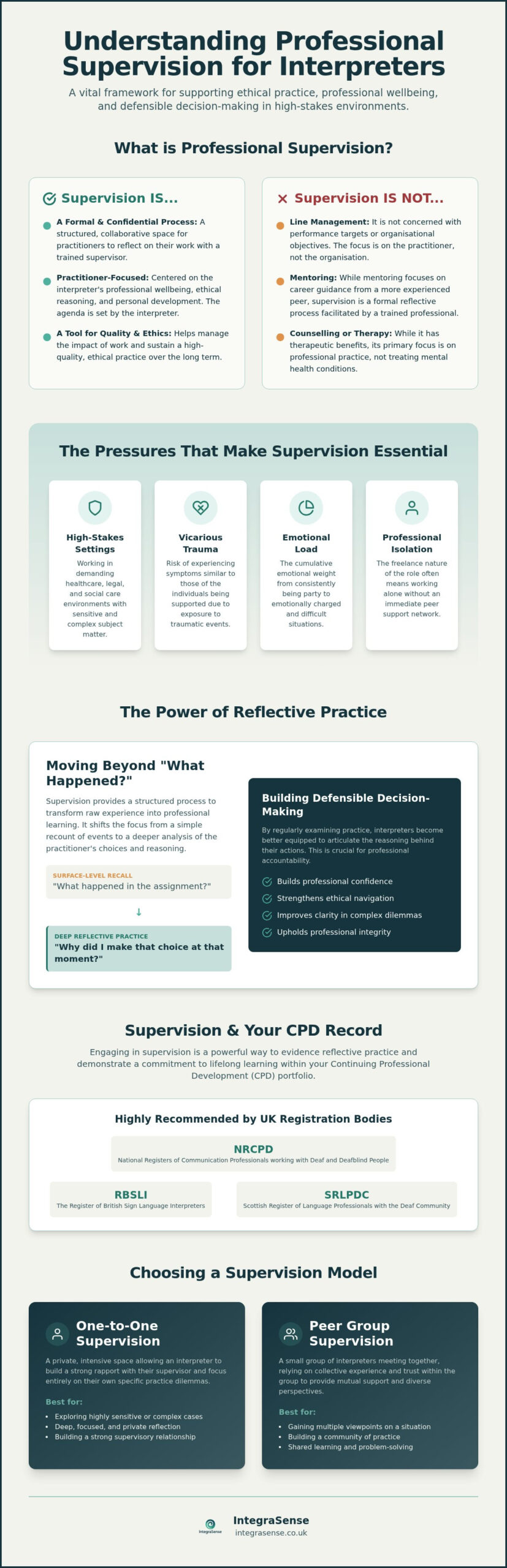
Understanding the distinct role of professional supervision is key to recognising its value. It is a unique professional relationship, separate from other forms of support, and is defined as much by what it is not as by what it is.
Supervision is not line management. A line manager is concerned with performance, targets, and organisational objectives. A supervisor, in contrast, is focused on the practitioner’s professional wellbeing, ethical reasoning, and personal development in relation to their work. The agenda is set by the interpreter, not the organisation.
It is not mentoring. Mentoring is typically a relationship where a more experienced practitioner guides a less experienced one, often focusing on career progression, skill acquisition, and sharing practical wisdom. Supervision is a more formal, structured process of reflective practice, facilitated by a trained supervisor who may not share the same specialism but is skilled in facilitating deep reflection.
Finally, it is not counselling or therapy. While supervision certainly has therapeutic benefits and helps manage work-related stress, its primary focus is on professional practice. It explores the impact of the work on the practitioner, but it does not treat mental health conditions. A supervisor will, however, be able to help an interpreter recognise when they may benefit from seeking therapeutic support elsewhere.
The pressures interpreters face across Medway and Kent
Interpreters working across the diverse public sector landscape of Medway and Kent navigate a unique set of professional pressures. Assignments in acute healthcare settings can involve traumatic events and life-altering news, while legal work in courts or police stations demands immense concentration and procedural precision. In education and social care, interpreters are often party to sensitive family situations and complex safeguarding concerns.
Working consistently in these environments can lead to a cumulative emotional load and increase the risk of vicarious trauma, where the practitioner begins to experience symptoms similar to those of the people they are supporting. The freelance nature of the profession often means working alone, without the immediate peer support network available in a traditional office environment. This isolation can be compounded by the pressure to maintain professional boundaries in emotionally charged situations. Finding effective professional supervision for interpreters in Medway provides a vital outlet to process these challenges and reduce the risk of burnout.
Reflective practice and defensible decision making
Every interpreting assignment involves a constant stream of decisions, many of which are made in a split second. These choices relate not just to language, but to ethics, boundaries, and professional conduct. Professional supervision provides the structure to move beyond a simple recount of events and engage in deep reflective practice.
It is the difference between asking "What happened?" and asking "Why did I make that choice at that moment?". Through skilled facilitation, a supervisor helps an interpreter analyse the factors that influenced their decisions: their personal values, their understanding of professional codes of conduct, the power dynamics in the room, and the emotional impact of the situation. This process transforms raw experience into professional learning.
By regularly examining their practice in this way, interpreters become better equipped to articulate the reasoning behind their actions. This contributes to defensible decision making, which is crucial in a profession where practitioners must be able to account for their conduct. It builds confidence and strengthens an interpreter’s ability to navigate complex ethical dilemmas with clarity and integrity.
Supervision and your CPD record
Maintaining a record of Continuing Professional Development (CPD) is a cornerstone of professional practice for interpreters. It demonstrates a commitment to lifelong learning and to maintaining the high standards expected by clients and service users. Engaging in regular professional supervision is a powerful way to evidence reflective practice within your CPD portfolio.
While supervision is not a mandatory requirement for registration, it is highly recommended as a valuable development activity by the UK’s main registration bodies for language service professionals. These include:
- NRCPD (The National Registers of Communication Professionals working with Deaf and Deafblind People)
- RBSLI (The Register of British Sign Language Interpreters)
- SRLPDC (The Scottish Register of Language Professionals with the Deaf Community)
- The Deafblind Specialist Register maintained by Deafblind Enablement
Choosing a supervision model
There is no single "correct" way to engage in supervision; the most effective approach depends on an individual’s circumstances, experience, and professional goals. There are several models to choose from, each offering distinct benefits.
One-to-one supervision offers a private, intensive space for deep reflection. It allows the interpreter to build a strong rapport with their supervisor and focus entirely on their own specific practice dilemmas without distraction. This model is particularly useful for exploring highly sensitive or complex cases.
Peer group supervision involves a small group of interpreters meeting without a formal supervisor. It relies on the collective experience and trust within the group to provide support and different perspectives. It can be a cost-effective and collaborative way to learn from colleagues facing similar challenges.
Group supervision is facilitated by a qualified supervisor and brings together several practitioners. This model offers the benefit of hearing a wide range of perspectives and experiences, normalising challenges and fostering a sense of shared professional community. It can be especially valuable for interpreters working in a specific specialism, such as legal or mental health settings.
The frequency of sessions should be determined by workload and the intensity of the assignments being undertaken, rather than by a rigid schedule. An interpreter working frequently in high-stress environments may benefit from more regular sessions than one with a different caseload.
Supervision with IntegraSense
IntegraSense is a Kent-based consultancy providing professional supervision for interpreters and other practitioners across the South East. We understand the specific context and challenges of working in the region’s diverse public services. Our approach is grounded in creating a supportive, non-judgmental space for genuine reflective practice.
We offer tailored supervision to individual freelance practitioners and also partner with organisations to provide supervision for their in-house or associate interpreting teams. Sessions can be held in person for those based in Kent or conducted remotely via video call for practitioners across the UK, offering flexibility to fit around busy working schedules.
If you are looking for confidential, structured support to enhance your practice, manage professional challenges, and invest in your long-term career resilience, please get in touch.
Contact IntegraSense to discuss your professional supervision needs.
Frequently Asked Questions
What is the difference between mentoring and professional supervision for interpreters?
Mentoring is primarily a guidance-based relationship where a more experienced interpreter shares their knowledge and advises a colleague on career development or specific skills. It is often focused on "how to do" something. Professional supervision, in contrast, is a formal, reflective process facilitated by a trained supervisor. It focuses less on giving advice and more on helping the interpreter explore their own experiences, ethical decision making, and the emotional impact of their work. It is a space to analyse the "why" behind your practice.
Is professional supervision required for interpreter registration?
No, professional supervision is not a mandatory requirement for registration with UK bodies such as NRCPD, RBSLI, or SRLPDC. However, it is highly recommended as a key component of an interpreter’s Continuing Professional Development (CPD). Engaging in supervision provides strong evidence of reflective practice, a commitment to maintaining ethical standards, and proactive management of your professional wellbeing. It is considered best practice for sustaining a safe and effective career in the long term and supports the principles upheld by the professional registers.
How often should an interpreter attend supervision?
There is no fixed rule for the frequency of supervision sessions. The ideal schedule depends entirely on the individual interpreter’s workload, the nature of their assignments, and their level of experience. An interpreter who frequently works in high-stress environments, such as acute healthcare or child protection, may benefit from monthly sessions. Someone with a less emotionally demanding caseload might find that quarterly or bi-monthly sessions are sufficient. The principle is that supervision should be regular enough to be effective in processing work as it happens.
Can an organisation arrange supervision for a whole interpreting team?
Yes, absolutely. Many organisations, including NHS trusts, local authorities, and third-sector providers, arrange group supervision for their in-house or freelance interpreting teams. This can be a very effective way to ensure consistent quality, support staff wellbeing, and foster a shared culture of reflective practice. Group supervision allows team members to learn from each other’s experiences in a structured, confidential environment, which can improve team cohesion and enhance the overall quality of the service provided to the community.