
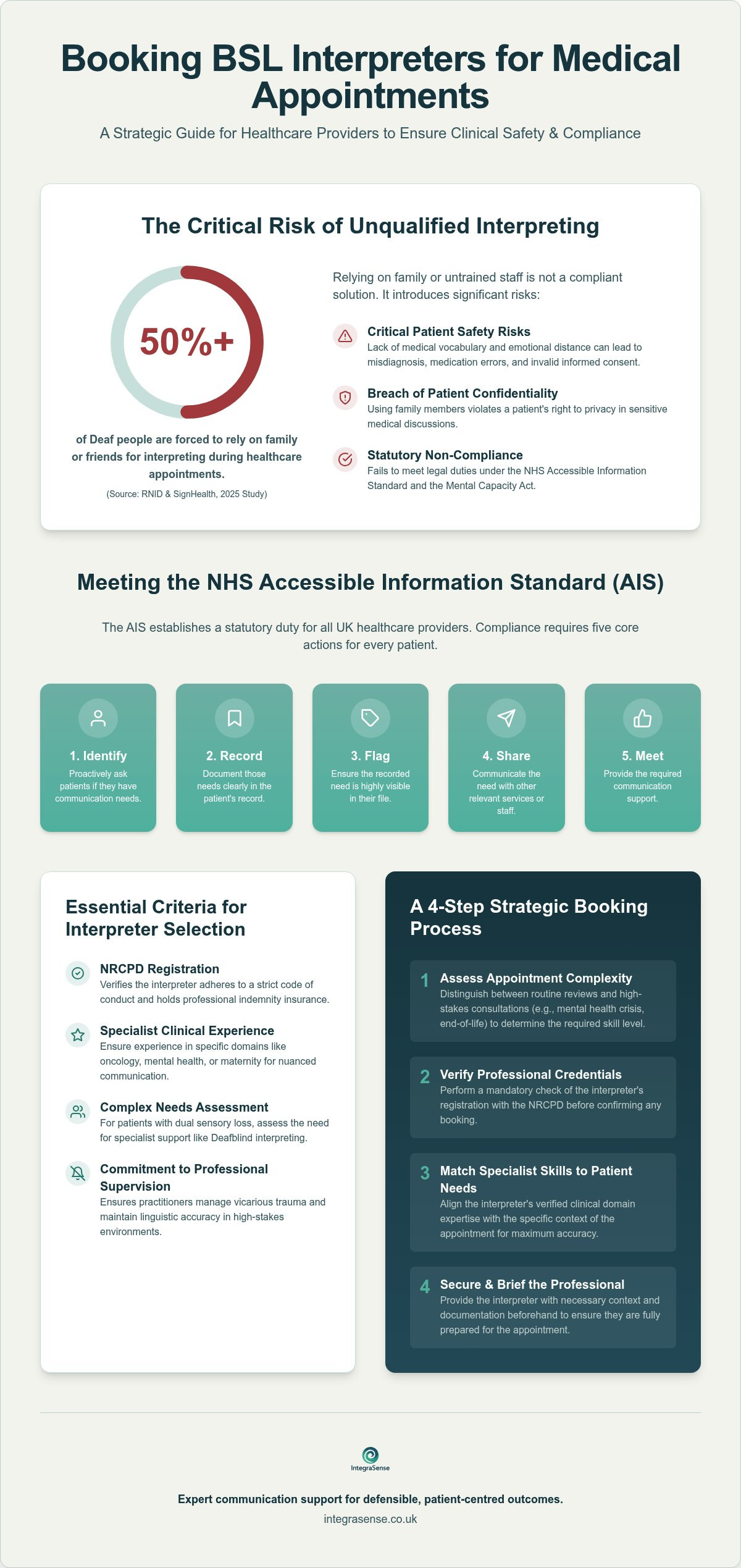
A 2025 study by RNID and SignHealth revealed that over half of Deaf people in the UK are forced to rely on family or friends to interpret during healthcare appointments. In a clinical environment, this isn’t just a breach of privacy; it’s a critical risk to patient safety and statutory compliance. You likely understand that precise communication is the cornerstone of any successful medical outcome, yet identifying BSL Interpreters: How to Book the Right Professional for Medical Appointments can feel like navigating a fragmented system of availability and specialist skill sets. This guide helps you master the procurement process to ensure clinical safety, full alignment with the NHS Accessible Information Standard, and patient-centred results. We’ll provide a structured framework for securing qualified professionals who possess the technical vocabulary required for complex cases. You’ll learn how to move from reactive booking to a proactive, defensible strategy for communication support.
Key Takeaways
- Understand statutory obligations under the NHS Accessible Information Standard to mitigate clinical risk and uphold patient confidentiality during every consultation.
- Master the selection process for BSL Interpreters: How to Book the Right Professional for Medical Appointments by validating NRCPD registration and assessing expertise in specialist clinical domains.
- Implement a strategic request framework that aligns appointment complexity with the specific linguistic competencies required for high-stakes medical environments.
- Enhance clinical safety and patient-centred care through the use of specialist communication professionals who ensure precise, defensible decision-making in complex healthcare scenarios.
The Clinical Necessity of Specialist BSL Interpreting in Healthcare
Clinical safety depends on precise data exchange. The NHS Accessible Information Standard (AIS) establishes a statutory duty for all UK healthcare providers to meet the communication needs of patients. Precision saves lives. Relying on family members or unqualified staff isn’t just inefficient; it’s a breach of clinical safety and patient confidentiality. Family members often lack the emotional distance or specialist medical vocabulary required to facilitate complex diagnoses. For those using British Sign Language, a professional interpreter ensures that the patient’s voice is heard without filtered bias or omission.
Defensible decision-making requires a robust framework. In high-stakes medical outcomes, the choice of communication support must be documented and justified. Without a qualified professional, clinicians can’t guarantee valid informed consent under the Mental Capacity Act. This legal requirement demands that patients understand the risks and benefits of their treatment. Understanding BSL Interpreters: How to Book the Right Professional for Medical Appointments is therefore essential for mitigating litigation risks and ensuring patient-centred outcomes.
Risk Management and the Accessible Information Standard
The AIS mandates five core actions for healthcare providers: identify, record, flag, share, and meet communication needs. Failing at any stage can lead to clinical errors or non-compliance. Specialist BSL interpreting acts as a critical risk management tool. It eliminates the ambiguity that leads to misdiagnosis or medication errors. By integrating specialist communication support, organisations move from a chaotic, reactive approach to an optimised, compliant system that prioritises long-term patient viability.
Criteria for Selecting a Medical Professional
Selecting the right practitioner is a matter of clinical governance. You must verify registration with the NRCPD to ensure the professional adheres to a strict code of conduct and maintains professional indemnity insurance. In complex healthcare settings, generalist skills are often insufficient. You should evaluate experience in specific domains like oncology, mental health, or maternity to ensure the interpreter understands the nuance of the clinical pathway. This level of scrutiny is vital when identifying BSL Interpreters: How to Book the Right Professional for Medical Appointments.
Some cases require more than standard BSL. For patients with dual sensory loss, you must assess the requirement for specialist communication support, such as Deafblind interpreting. This ensures that the Accessible Information Standard is met for every individual, regardless of the complexity of their sensory profile. Validating these credentials isn’t just a tick-box exercise; it’s a prerequisite for patient safety. Effective governance ensures that when searching for BSL Interpreters: How to Book the Right Professional for Medical Appointments, you prioritize those with verified medical expertise.
The Role of Professional Supervision in Clinical Settings
High-stakes environments often lead to vicarious trauma. Engaging in BSL interpreter professional supervision allows practitioners to manage the emotional and cognitive load of medical assignments. This reflective practice ensures linguistic accuracy remains uncompromised by stress or fatigue. Practitioners can process complex ethical dilemmas in a safe, confidential space, which directly translates to better patient outcomes.
IntegraSense prioritises practitioners who engage in this process, fostering a culture of resilience and high professional standards. This commitment to quality assurance protects both the patient and the healthcare provider. For organisations seeking to optimise their communication frameworks, specialist communication support can provide the necessary clinical clarity to ensure every interaction is precise and defensible.
Securing Specialist Communication Support: A Strategic Guide
Procurement in a clinical setting isn’t just about filling a slot; it’s about strategic alignment between patient needs and practitioner expertise. Effective communication is the primary safeguard against clinical error. Not every encounter carries the same weight. A routine review has vastly different linguistic requirements than a mental health crisis or an end-of-life consultation. Identifying BSL Interpreters: How to Book the Right Professional for Medical Appointments involves a methodical, four-step approach to ensure safety and compliance.
- Identify Complexity: Evaluate if the appointment involves high-stakes consent, complex terminology, or sensitive emotional content that demands a specialist.
- Formal Request: Use the NHS provider’s booking system while explicitly citing the Accessible Information Standard. This ensures the request is treated as a statutory requirement.
- Specialist Consultation: For cases involving dual sensory loss or complex mental health, consult a specialist partner for a communication audit to determine the precise level of support required.
- Record and Audit: Log all communication preferences in the patient’s electronic record. This facilitates continuity of care and provides a data trail for future accessibility audits.
Following this framework ensures you’re selecting BSL Interpreters: How to Book the Right Professional for Medical Appointments based on clinical risk rather than mere availability.
When to Consult a Specialist Communications Partner
Standard agency provision often doesn’t have the depth required for highly specialized scenarios. For instance, statutory deafblind assessments demand a level of expertise that goes beyond basic linguistic translation. IntegraSense supports organisations in making defensible decisions by providing expert-led audits and specialist communication support. We help you move away from the chaotic and towards an optimised, compliant framework that prioritises clinical safety and patient-centred outcomes through precise, expert intervention.
Optimising Clinical Outcomes through Strategic Communication
Securing clinical safety isn’t just about a linguistic bridge; it’s about a robust framework of professional accountability and risk management. By aligning your procurement process with the NHS Accessible Information Standard, you ensure that every patient interaction remains precise and defensible. Mastering the selection of BSL Interpreters: How to Book the Right Professional for Medical Appointments transforms communication from a logistical challenge into a high-performance clinical intervention.
As pioneers in professional supervision for BSL practitioners, IntegraSense provides a specialist multidisciplinary consultancy that prioritises statutory compliance and long-term practitioner resilience. We help healthcare providers move away from fragmented support towards a cohesive, expert-led strategy. Contact IntegraSense to discuss specialist communication support for your organisation and ensure your service meets the highest standards of technical and ethical excellence. Precision in communication is the foundation of patient safety; take the first step toward an optimised, compliant healthcare environment today.
Frequently Asked Questions
Who is responsible for paying for a BSL interpreter in a medical appointment?
The healthcare provider is legally responsible for funding the interpreter. Under the Equality Act 2010 and the NHS Accessible Information Standard, providers must ensure patients can communicate effectively without personal cost. This duty applies to GP surgeries, hospitals, and dentists. Financing comes from the provider’s budget or central NHS commissioning, never the patient.
Can I use a family member to interpret my medical results if they know BSL?
What should I do if my GP surgery refuses to book a BSL interpreter?
If a surgery refuses, you should formally remind them of their statutory duties under the Accessible Information Standard. Provide them with the NHS England guidance or contact the practice manager directly. If the refusal persists, you can escalate the matter through the local Integrated Care Board (ICB) or the Parliamentary and Health Service Ombudsman to ensure compliance is met.
How far in advance should I book a BSL interpreter for a hospital appointment?
You should book an interpreter as soon as the appointment is confirmed, ideally at least two to three weeks in advance. With only around 1,500 qualified BSL interpreters in the UK serving 87,000 Deaf users, specialist availability is often limited. Early booking is essential to secure BSL Interpreters: How to Book the Right Professional for Medical Appointments, especially for complex or long-duration clinical sessions.
What is the difference between a standard BSL interpreter and a Deafblind interpreter?
A standard BSL interpreter facilitates visual communication between two languages. In contrast, a Deafblind interpreter uses specialized modalities, such as tactile signing or visual frame adjustments, to support individuals with dual sensory loss. Specialist communication support for Deafblind patients requires specific training to manage the unique environmental and linguistic needs associated with combined sight and hearing impairments.