With 95.9% of homepages failing to meet WCAG 2.2 standards in 2026, the gap between digital intent and inclusive reality has reached a critical point. For local leaders, this challenge isn’t just technical; it’s a matter of governance and professional responsibility. You likely understand that a specialist accessibility audit Tunbridge Wells is the first step toward mitigating legal risk under the Equality Act 2010, yet the distinction between digital compliance and physical communication support often remains blurred. Relying on automated tools alone leaves significant vulnerabilities, especially for users with complex requirements like BSL or deafblindness.
This article provides a specialist framework designed to transform these technical hurdles into a cohesive strategy for professional compliance. You’ll discover how a multidisciplinary approach protects your organization from the repercussions of non-compliance while fostering an environment that welcomes the whole community. We’ll examine the specific steps needed to bridge the gap between physical spaces and digital interfaces, ensuring your decision-making remains defensible and your services remain accessible to the 16.1 million people in the UK living with disabilities. At IntegraSense, we prioritize this harmony between system fluidity and human perception to deliver long-term viability for your organization.
Key Takeaways
- Identify how a specialist accessibility audit Tunbridge Wells integrates physical, digital, and communication assessments to ensure full compliance with the Equality Act 2010.
- Explore the environmental analysis process to evaluate sensory triggers and navigation within your Kent-based premises.
- Assess how information is effectively conveyed to BSL users and those with dual sensory impairment through dedicated communication audits.
- Transition from reactive risk management to a proactive, defensible decision-making framework that optimizes organizational performance.
- Leverage the ROI of inclusive design to attract diverse talent and a wider community base across the South East.
Beyond the Basics: Why Tunbridge Wells Organisations Require Specialist Accessibility Audits
A specialist accessibility audit Tunbridge Wells represents more than a tick-box exercise. It’s a comprehensive evaluation of the physical, digital, and communication barriers that prevent equitable access. While many organizations focus solely on global web accessibility standards, a professional framework must integrate the sensory and interpersonal dimensions of inclusion. In 2026, the legal landscape across Kent has shifted. The Equality Act 2010 now demands a proactive stance rather than reactive adjustments. This evolution requires a focus on defensible decision-making. Documenting the rationale behind your accessibility journey is just as critical as the physical modifications you implement. It provides a robust audit trail that demonstrates due diligence to regulators and stakeholders alike.
Generic checklists often fail to capture the nuances of complex environments like healthcare clinics or educational institutions. These spaces require a multidisciplinary consultancy approach that accounts for varied user journeys. At IntegraSense, we move away from surface-level surveys to interpret how disparate elements, from physical signage to digital portals, function as a cohesive system. This level of precision is essential for organizations that value long-term viability over temporary fixes.
The Hidden Risks of Surface-Level Compliance
Relying on surface-level checks creates significant institutional risk. When audits overlook sensory loss, particularly Deafblindness, they leave organizations vulnerable to legal challenges and profound reputational damage. In the Tunbridge Wells community, expectations for professional standards are high. An inaccessible service doesn’t just exclude individuals; it signals a lack of environmental stewardship. Failing to provide specialist communication support can lead to exclusion that automated tools simply cannot detect.
Accessibility as a Strategic Governance Tool
The IntegraSense Methodology: Conducting a Holistic Accessibility Audit in Kent
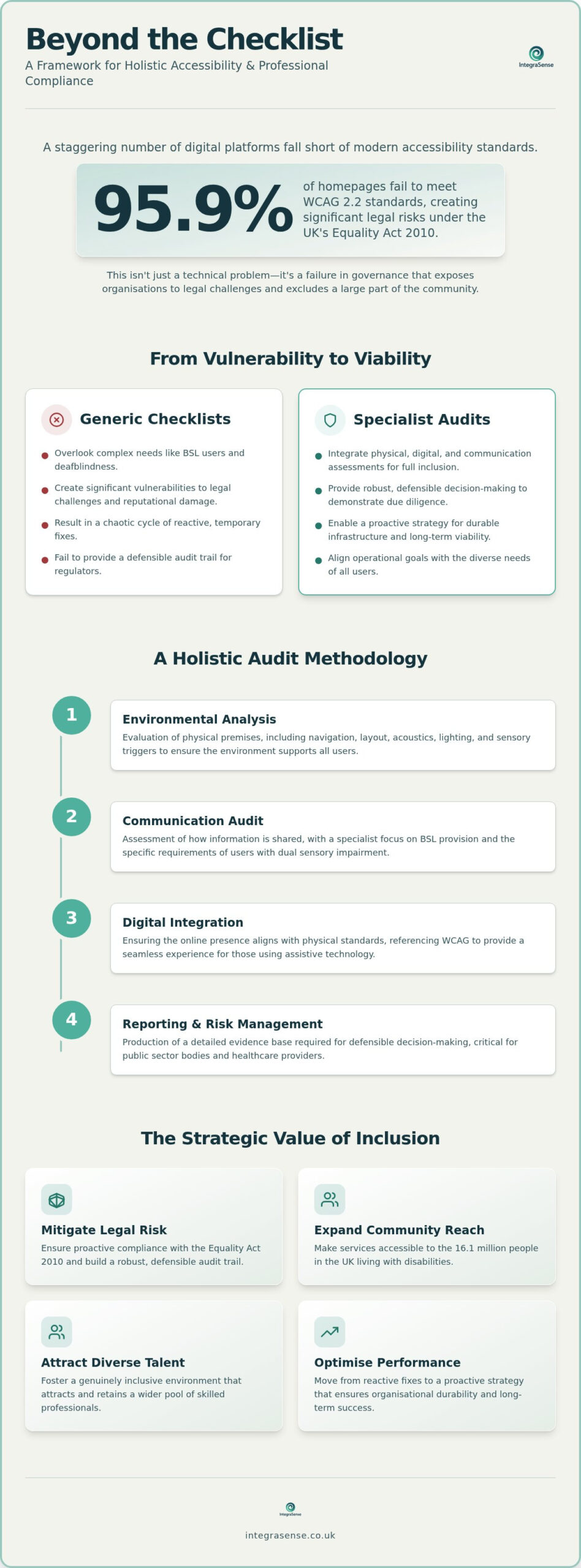
The IntegraSense methodology treats accessibility as a unified system rather than a series of isolated tasks. Our accessibility audit Tunbridge Wells framework follows a four-stage process designed for technical precision and long-term viability. We begin with a strategic vision of your organization’s goals before narrowing down into actionable technical applications.
First, we conduct an Environmental Analysis. This evaluates physical navigation and sensory triggers within your premises, ensuring that layout, acoustics, and lighting support all users. Second, the Communication Audit assesses how information is shared. We look at BSL provision and the specific requirements of those with dual sensory impairment to ensure no user is left behind. Third, we address Digital Integration. Your online presence must align with your physical standards. We reference the Web Content Accessibility Guidelines (WCAG) to ensure your digital elements provide a seamless experience for those using assistive technology. Finally, we provide Reporting and Risk Management. This stage produces the detailed evidence needed for defensible decision-making, particularly for public sector bodies and healthcare providers in Kent.
Specialist Communication Audits for Sensory Loss
Standard audits frequently miss the subtle barriers faced by individuals with dual sensory loss. A generic approach cannot replace the depth of statutory deafblind assessments. By integrating these specialist evaluations into our wider framework, we ensure that communication pathways remain robust and legally compliant. This specialized focus transforms a standard check into a tool for genuine inclusion.
Local Context: Auditing Tunbridge Wells’ Historic and Public Spaces
Tunbridge Wells presents unique challenges due to its historic architectural landscape. Balancing the preservation of heritage sites with modern inclusion requires a nuanced perspective that generic consultants often lack. Our approach ensures that even the most complex public spaces meet contemporary expectations without compromising their character. You can explore our broader methodology in our guide on Accessibility Audits: A Strategic Framework. If you require a tailored evaluation of your current infrastructure, our team can help you identify the most effective specialist consultancy services for your specific environment.
Securing Compliance and Inclusion: The Strategic Value of Specialist Consultancy
Investing in a specialist accessibility audit Tunbridge Wells yields returns that extend far beyond simple regulatory adherence. For organizations across the South East, inclusive design acts as a catalyst for growth. It attracts a wider demographic of users and secures specialist talent who value ethical, high-performing environments. Transitioning from chaotic, reactive fixes to an optimized, proactive strategy ensures that your infrastructure is built for durability rather than just immediate survival. This shift requires more than physical changes; it demands a culture of ongoing professional supervision to ensure staff remain equipped to manage complex sensory environments effectively. When accessibility is woven into the fabric of governance, it ceases to be a burden and becomes a hallmark of professional excellence.
From Audit to Action: Specialist Support Services
Implementation is the bridge between a technical report and a truly inclusive space. Once barriers are identified, organizations must deploy targeted solutions like British Sign Language (BSL) interpreting and specialist communication support to facilitate meaningful interaction. Maintaining the quality of these services is paramount. High-stakes environments benefit significantly from BSL interpreter professional supervision, which ensures that practitioners remain resilient and effective in their roles. This methodical approach ensures that the technical depth of an audit translates into real-world accessibility that stands the test of time.
Managing Disputes and Conflict in Accessibility
Friction can often arise when accessibility barriers impact workplace dynamics or service delivery. If left unaddressed, these issues lead to institutional risk and fractured relationships. Utilizing mediation and conflict resolution allows organizations to address these disputes through a neutral, expert lens. This process prioritizes person-centred outcomes, ensuring that disputes are handled with the precision and empathy required for sensitive environments. IntegraSense positions itself as a visionary partner in this journey, offering a roadmap for organizational transformation rather than just a list of failures. By aligning technical compliance with human perception, we help Tunbridge Wells organizations achieve a level of system harmony that empowers every user.
Advancing Organisational Resilience through Proactive Inclusion
With local expertise and deep specialism in BSL interpreting and deafblind assessments, IntegraSense delivers a multidisciplinary approach to risk management. We act as a dependable partner to ensure your services remain durable and welcoming for every user. It’s time to move away from chaotic reactive fixes and toward an optimized, inclusive environment that reflects your professional standards. Contact our Tunbridge Wells specialists today for a comprehensive accessibility audit to begin your journey toward long-term viability and total sensory inclusion. Empower your team and your community by building a space where communication is never a barrier.
Frequently Asked Questions
What is included in a professional accessibility audit in Tunbridge Wells?
A professional accessibility audit Tunbridge Wells includes a multidisciplinary evaluation of physical premises, digital platforms, and communication protocols. Specialists assess environmental factors such as lighting and acoustics while reviewing digital assets against WCAG 2.2 standards. Crucially, it incorporates an analysis of sensory inclusion, evaluating how information reaches BSL users and those with dual sensory loss. This holistic approach ensures every user interaction is optimized for clarity and safety.
Do small businesses in Kent need to comply with the same accessibility regulations as large organizations?
Yes, the Equality Act 2010 applies to all UK service providers and employers regardless of their size. While the definition of “reasonable adjustments” may vary based on an organisation’s resources, the fundamental duty to prevent discrimination remains absolute. Small businesses in Kent must ensure their premises and services don’t disadvantage disabled individuals. Proactive auditing helps smaller entities identify high-impact, cost-effective changes that mitigate legal risks and open their services to a broader community.
How often should an organisation conduct a communication and accessibility audit?
Organisations should ideally conduct a comprehensive audit every two to three years or whenever significant operational changes occur. Digital environments often require more frequent monitoring due to the rapid evolution of web standards and software updates. Regular reviews ensure that your accessibility strategy remains durable and reflects current best practices. This cyclical approach prevents the accumulation of accessibility debt and maintains system harmony between your infrastructure and its diverse users.
Can an accessibility audit help with Access to Work applications for my employees?
Yes, an audit provides the technical evidence required to support successful Access to Work applications. By identifying specific communication barriers or environmental triggers, the audit report acts as a professional justification for funding specialist support or equipment. IntegraSense can utilize these findings to guide employers through the consultancy process, ensuring that staff with disabilities receive the exact BSL interpreting or specialist communication support they need to thrive in the workplace.