
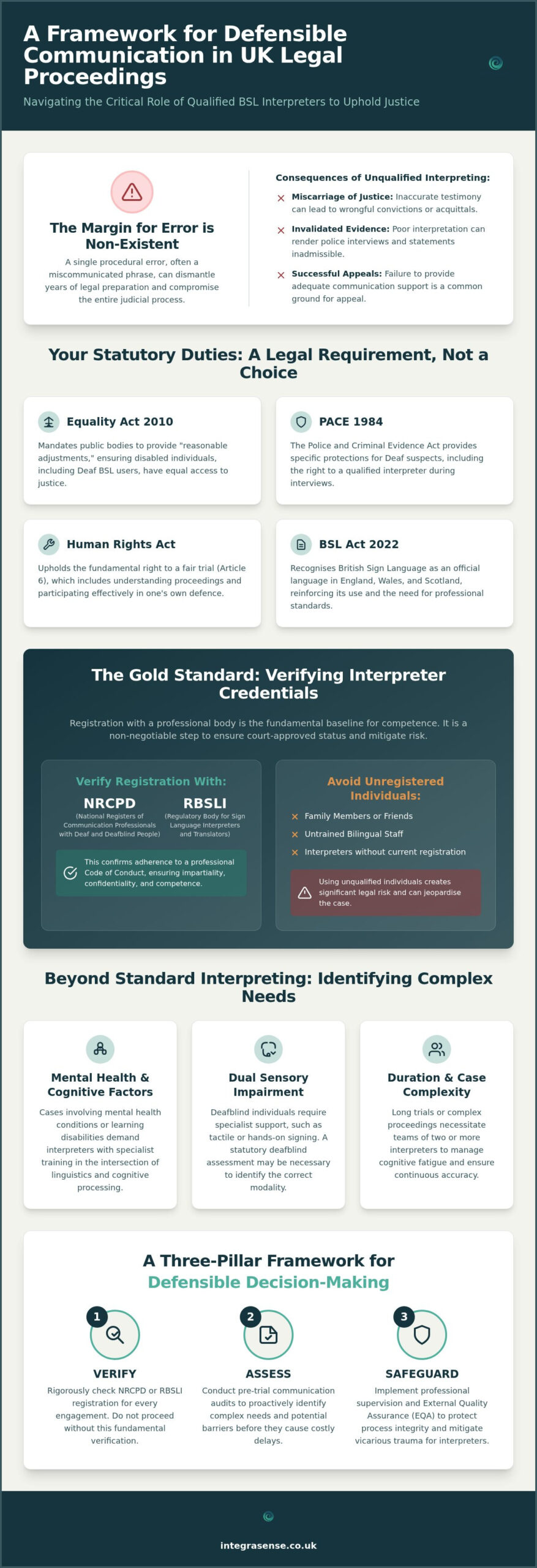
A single procedural error in a courtroom can dismantle years of legal preparation, and often, that error is as simple as a miscommunicated phrase. You understand that in high-stakes environments, the margin for error is non-existent. Sourcing a qualified BSL interpreter for legal proceedings UK isn’t just about finding someone who can sign; it’s about securing the integrity of the entire judicial process. It’s a complex landscape where the choice between an NRCPD registered professional and an unregistered individual can be the difference between a successful trial and a devastating miscarriage of justice.
We’ll provide the strategic clarity you need to manage communication risks effectively, ensuring every interaction meets the rigorous standards set by the BSL Act 2022 and current Legal Aid Agency requirements. You’ll learn how to distinguish between different registration bodies, manage the complexities of deafblindness, and implement professional supervision to protect your team from vicarious trauma. This article outlines a precise framework for navigating statutory duties while positioning IntegraSense as your partner in achieving defensible, high-quality outcomes for every participant in the legal system.
Key Takeaways
- Understand the essential statutory mandates, including the Equality Act 2010 and PACE 1984, that govern the provision of communication support within the justice system.
- Learn why verifying NRCPD or RBSLI registration is a non-negotiable step when selecting a BSL interpreter for legal proceedings UK to ensure court-approved status.
- Identify the specific indicators that signal a need for specialist communication support, particularly in complex cases involving mental health or learning disabilities.
- Discover how integrating professional supervision and External Quality Assurance (EQA) safeguards the integrity of the legal process and mitigates the risk of vicarious trauma.
- Establish a framework for defensible decision-making that prioritizes precision, long-term resilience, and full compliance with evolving UK legal standards.
The Role of BSL Interpreters in the UK Legal System
A BSL interpreter in a legal context isn’t a supporter or an advocate. They’re a neutral professional whose sole purpose is to facilitate clear, unbiased communication between users of British Sign Language (BSL) and the justice system. In high-pressure environments like police interviews or court hearings, this role is critical for maintaining the chain of evidence. Securing a qualified BSL interpreter for legal proceedings UK ensures that every party has equal access to the proceedings, preserving the fundamental right to a fair trial.
Compliance isn’t optional. The Equality Act 2010 mandates reasonable adjustments for disabled individuals, while the Police and Criminal Evidence Act (PACE) 1984 provides specific protections for suspects who are Deaf. Failure to provide a registered professional doesn’t just hinder communication; it creates significant legal risk. Generalist interpreting often falls short because it lacks the technical depth required for complex legal terminology and the procedural rigidity of the courtroom. Precise interpretation is the foundation of what IntegraSense calls “defensible decision-making.” This approach dictates that the selection of a BSL interpreter for legal proceedings UK must be guided by verifiable expertise rather than mere availability.
Legal Frameworks and Access to Justice
Access to justice is a cornerstone of the Human Rights Act. It guarantees that individuals can understand the case against them and participate effectively in their own defense. Relying on well-meaning but unqualified individuals, such as family members or friends, is a dangerous practice that often leads to procedural errors and appeals. These individuals lack the professional distance and technical training necessary to handle sensitive legal disclosures. By late 2026, “legal domain status” signifies that an interpreter is a Registered Sign Language Interpreter (RSLI) who has met the specific competency standards and vetting requirements mandated for Crown Court and police settings. By focusing on specialist communication support, organizations can mitigate the risk of communication breakdown and ensure their processes remain legally robust.
Selecting and Managing Specialist Communication Support
Selecting a BSL interpreter for legal proceedings UK requires more than checking a directory. It demands a rigorous verification of credentials to ensure court-approved status. Registration with the NRCPD or RBSLI serves as the fundamental baseline for professional competence. These bodies ensure that practitioners adhere to the NRCPD Code of Conduct, which outlines the ethical and professional standards required in high-stakes environments. Without this verification, the risk of technical inaccuracy or ethical breaches increases exponentially. It’s about protecting the record as much as the participant.
Complexity often dictates the scale of the support team. While a single professional might suffice for a short hearing, long trials require multi-interpreter teams to manage cognitive fatigue and maintain accuracy. Accuracy relies on sustained concentration. Teams allow for continuous monitoring and instant correction of nuanced legal signs, ensuring that the linguistic integrity of the trial remains intact from the first witness to the final verdict.
Standard interpreting isn’t always enough. Cases involving mental health issues or learning disabilities require specialists who understand the intersection of linguistics and cognitive processing. When dual sensory impairment is present, a statutory deafblind assessment becomes a vital tool for identifying the correct communication modality. This ensures that the justice system adapts to the individual, rather than forcing a standard solution onto a complex need. It’s a proactive step toward true accessibility.
Navigating Complex Communication Needs
Dual sensory impairment presents unique challenges that traditional BSL interpreting cannot always resolve. Specialist deafblind interpreting might involve tactile signing or close-proximity visual support. Integrating communication audits into the pre-trial phase allows legal teams to identify these barriers early. This proactive approach prevents costly delays and ensures that the communication framework is resilient enough for the courtroom environment. You can explore specialist communication support to see how these audits provide a roadmap for complex cases.
Due Diligence for Legal Professionals
Solicitors and court clerks must maintain a strict due diligence checklist. This includes verifying professional indemnity insurance, current Enhanced DBS status, and evidence of specific legal training. It’s not enough to assume competence based on registration alone; the specific demands of the case must match the practitioner’s experience. If you’re unsure about the requirements for a specific case, you can contact IntegraSense for specialist communication audits to ensure your strategy is fully compliant and defensible.
Mitigating Risk through Quality Assurance and Supervision
Securing a BSL interpreter for legal proceedings UK is only the initial step in a robust risk management strategy. The volatility of the legal environment requires ongoing oversight to ensure that communication remains accurate and impartial throughout the life of a case. BSL interpreter professional supervision provides the necessary infrastructure for this oversight. It offers a structured environment where professionals can process the intense linguistic and emotional demands of the courtroom, ensuring their work remains precise under pressure.
Interpreters in legal settings frequently encounter traumatic evidence and high-conflict interactions. Without professional supervision, the risk of vicarious trauma increases, which can lead to cognitive fatigue and unintended errors in interpretation. External Quality Assurance (EQA) acts as a critical safeguard against these risks. By implementing independent oversight, organizations can prevent procedural complaints and potential appeals based on communication failure. This transition from reactive, chaotic booking to an optimized system ensures that every decision is defensible and every interaction is legally sound.
The Impact of Professional Supervision
Reflective practice is essential for maintaining high standards during grueling cross-examinations. Supervision allows interpreters to analyze their performance and refine their linguistic choices in a confidential setting. This process directly correlates to higher accuracy in high-pressure environments where a single sign can alter the perception of testimony. It also provides a framework for navigating complex ethical dilemmas, ensuring that the interpreter remains a neutral facilitator of justice rather than an unintended participant.
Ensuring Long-Term Compliance
A robust record of communication support is your best defense against future audits or appeals. Organizations should maintain detailed documentation regarding the selection criteria for interpreters and the quality assurance measures implemented. This level of transparency demonstrates a commitment to statutory duties and professional excellence. You can explore our specialist services to see how we help legal and public sector partners build communication frameworks that are both resilient and fully compliant with UK standards.
Establishing Defensible Communication Standards
IntegraSense brings specialist expertise in defensible decision-making to every case. We provide professional supervision for all our communication practitioners to maintain the highest standards of resilience and accuracy. Our team also specializes in complex deafblind assessments, ensuring that dual sensory impairments never become a barrier to the legal process. Don’t leave the integrity of your proceedings to chance when specialist oversight is available.
You can secure expert communication support for your legal proceedings today to ensure your case meets every regulatory requirement. With the right framework in place, you can navigate the complexities of the legal system with confidence and clarity.
Frequently Asked Questions
Is a BSL interpreter legally required for all court hearings involving a Deaf person?
Yes, providing a qualified interpreter is a legal obligation under the Equality Act 2010 and the Human Rights Act 1998. These statutes ensure that Deaf individuals can participate effectively in proceedings and understand the case against them. Failing to provide this support constitutes a breach of statutory duty and risks the validity of the entire hearing. Courts must make these reasonable adjustments to uphold the principle of open and accessible justice.
What is the difference between a Registered Sign Language Interpreter (RSLI) and a trainee?
A Registered Sign Language Interpreter (RSLI) has completed all mandatory training and met the professional standards required by regulatory bodies like the NRCPD. In contrast, a trainee (TSLI) is still working toward full qualification and isn’t permitted to work in high-stakes legal environments. For any BSL interpreter for legal proceedings UK, RSLI status is the non-negotiable standard to ensure the linguistic precision and ethical conduct necessary for courtroom integrity.
How much notice is typically required to book a court-approved BSL interpreter?
Ideally, organizations should provide at least three to four weeks of notice to secure a specialist interpreter. The national shortage of qualified professionals means that court-approved practitioners are often booked months in advance for complex trials. While emergency cover is sometimes available for short hearings or police interviews, early booking is the only way to guarantee the specific expertise and registration levels required for defensible decision-making.
Who is responsible for paying for a BSL interpreter in UK legal proceedings?
Responsibility for payment depends on the specific legal setting. For court hearings, His Majesty’s Courts and Tribunals Service (HMCTS) typically covers the costs. In criminal investigations, the police force conducting the interview is responsible. However, solicitors may need to apply to the Legal Aid Agency for funding if the interpreting is required for client conferences or witness statement preparation outside of the courtroom environment.
What happens if a BSL user also has a visual impairment (deafblindness) in court?
If a participant has dual sensory impairment, the court must provide specialist deafblind interpreting. This often involves different communication modalities, such as tactile BSL or close-proximity signing, which standard interpreters might not be trained to deliver. A specialist assessment should be conducted before the trial to identify the exact technical requirements. This ensures that the communication framework is tailored to the individual’s specific perception needs rather than relying on a one-size-fits-all approach.
Can a BSL interpreter be held liable for a mistranslation in a legal setting?
While interpreters are protected when acting in good faith, they can face professional consequences for negligence or breaches of the NRCPD Code of Conduct. Registered professionals carry professional indemnity insurance to manage these risks. If a mistranslation leads to a procedural error, the interpreter may be subject to a formal complaint or investigation. This is why IntegraSense emphasizes the importance of External Quality Assurance and professional supervision to mitigate these risks before they escalate.