
Helen Keller is frequently remembered through a lens of quiet sentimentality, yet her enduring impact lies in the rigorous framework she established for professional sensory loss support. Most practitioners recognize her name, but many fail to connect her journey to the complex statutory requirements of the modern UK landscape. Gaining a true understanding of deafblindness requires moving beyond the “miracle worker” narrative to examine the practical, defensible standards that ensure individuals receive the specialist communication they deserve. It’s about moving from passive charity to a system of professional precision and accountability.
You’ll discover how Keller’s advocacy catalyzed the vital shift from a medical model of disability to the empowered social model that underpins current statutory deafblind assessments. We’ll identify the professional standards required for modern assessments and show how her legacy directly informs the decision-making processes required for legal compliance in 2026. This exploration connects historical milestones to modern specialist services, highlighting why qualified expertise from IntegraSense is essential for organisations seeking to meet their responsibilities. We provide a clear roadmap for navigating these technical requirements while maintaining the human-centric focus Keller pioneered.
Key Takeaways
- Discover how Helen Keller’s transition from a medical to a social model of disability established the foundation for modern, empowerment-led professional practice.
- Develop a more sophisticated understanding deafblindness as a unique, third disability that requires a specific, intersectional approach rather than a combination of sensory supports.
- Identify the strategic importance of specialist communication support and how the Sullivan Model serves as a precursor to modern professional interpreting standards.
- Clarify your statutory responsibilities under the Care Act 2014, specifically regarding the necessity for specialist deafblind assessments to ensure defensible and compliant decision-making.
Redefining Deafblindness: From Helen Keller’s Advocacy to Modern Sensory Intersectionality
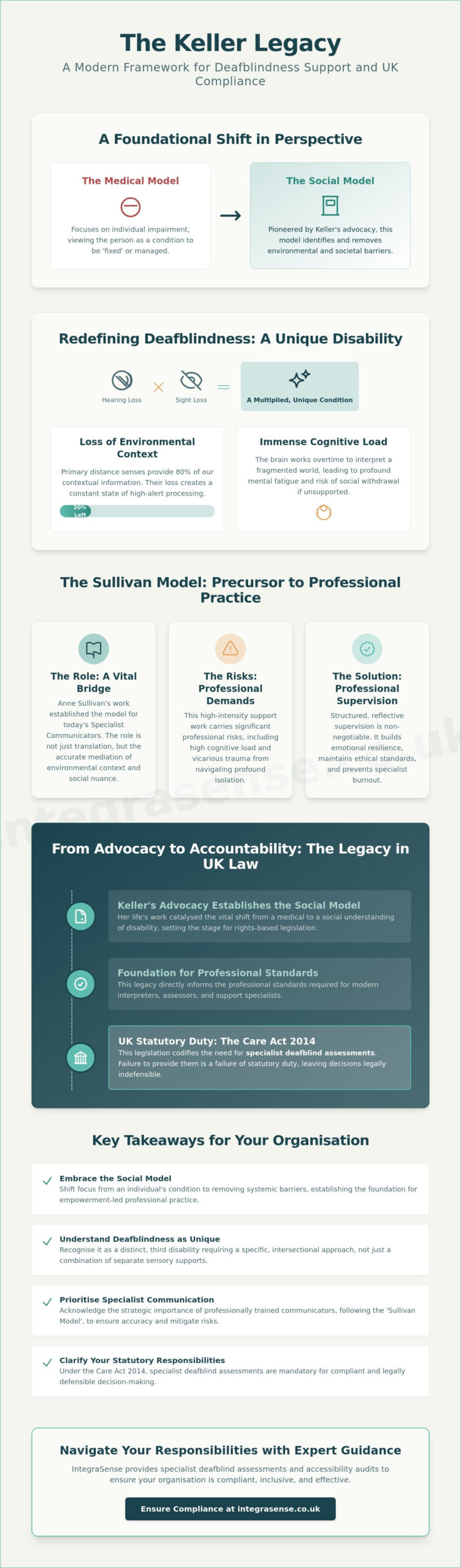
Helen Keller is often relegated to the status of an inspirational historical figure, yet her work represents a fundamental shift in how we approach sensory loss. She was the primary architect of the transition from the medical model, which focuses on individual impairment, to the social model, which highlights environmental barriers. Helen Keller’s Advocacy demonstrated that disability is not a static medical condition but a dynamic interaction between a person and their surroundings. True understanding deafblindness involves recognizing that it is a unique, third disability. It isn’t simply the sum of hearing and sight loss; it’s a distinct condition where the two impairments multiply the challenges of the other.
The cognitive load of this condition is immense. Individuals must process their environment without the benefit of primary distance senses, which typically provide 80% of our contextual information. This constant state of high-alert processing leads to mental fatigue and social withdrawal if not managed by specialists. Gaining a professional understanding deafblindness allows organisations to move beyond generic support and toward targeted solutions. Deafblindness is a distinct sensory intersection that requires bespoke specialist intervention to ensure equitable access.
Tactile Language and the Social Model of Disability
Keller’s mastery of tactile communication and Braille moved the conversation from isolation to professional advocacy. This evolution informs how we conduct modern accessibility audits for UK organisations. We don’t just look for physical ramps; we evaluate the fluidity of communication systems. Ensuring that information is accessible in multiple formats is a direct continuation of Keller’s demand for social inclusion through technical precision and system harmony.
The Intersection of Sight, Hearing, and Cognitive Health
Dual sensory loss rarely exists in a vacuum. It often compounds other conditions, creating complex challenges for healthcare providers and local authorities. For example, the sensory deprivation associated with deafblindness can accelerate or mimic the symptoms of cognitive decline. Practitioners can find deeper insights into these overlaps in our guide on understanding dementia. Managing these intersecting needs requires a holistic view that integrates sensory support with cognitive care strategies to maintain a person’s independence and dignity.
Specialist Intervention and Resilience: The Sullivan Model of Professional Practice
Anne Sullivan is frequently historicised as a dedicated teacher, yet a modern perspective reframes her as a pioneering Specialist Communicator. She acted as a vital bridge between Helen Keller and a world that was otherwise inaccessible, serving as a precursor to the highly skilled BSL and deafblind interpreters we rely on today. Precision in communication is mandatory in these complex sensory environments. Without a clear, consistent method of tactile interpretation, the risk of miscommunication increases, which can lead to significant errors in healthcare, legal, or workplace settings. Achieving a professional understanding deafblindness requires acknowledging that communication isn’t just about the transfer of words; it’s about the accurate mediation of environmental context and nuance.
This level of high-intensity support carries inherent professional risks. Specialists often face significant cognitive load and the threat of vicarious trauma when navigating the profound isolation that dual sensory loss can cause. Modern practitioners must engage in professional supervision to maintain ethical standards and ensure their practice remains robust under the pressures of complex casework. This structured support allows for the emotional resilience needed to deliver long-term, high-quality interventions without succumbing to burnout.
The Necessity of Professional Supervision
The intense dynamic between Sullivan and Keller illustrates why reflective practice is non-negotiable for today’s specialists. It provides a necessary space to process the emotional and technical demands of the role. For those working in the UK, engaging in BSL interpreter professional supervision is a strategic requirement for maintaining professional boundaries and long-term viability. This proactive approach ensures that the specialist remains a reliable partner for the individual they support.
Defensible Decision-Making in Communication Support
Sullivan’s methodical approach to Keller’s education established an early standard for what we now recognise as external quality assurance in sensory services. In 2026, organisations must demonstrate that their communication support is not only effective but also defensible under scrutiny. By implementing rigorous Specialist Intervention and Resilience frameworks, providers can ensure that every interaction meets the highest professional benchmarks. If your organisation requires expert guidance on maintaining these standards, our specialist consultancy services offer the technical depth needed to optimise your accessibility strategy.
The Keller Legacy in 2026: Statutory Compliance and Specialist Assessments
Keller’s lifelong activism wasn’t merely a personal achievement; it was a blueprint for systemic change that eventually informed the UK’s Care Act 2014. This legislation codifies the statutory right to a specialist assessment for anyone with dual sensory loss, moving away from the generic social work models that often fail this demographic. A standard assessment is typically insufficient because it lacks the technical depth required to interpret the intersectional nature of deafblindness. To meet the legal threshold, assessors must demonstrate a specific level of expertise, often called the “Keller Standard,” which involves specialized training at Level 3 or higher. Gaining a professional understanding deafblindness means acknowledging that these assessments are a legal requirement, not a discretionary service.
Local authorities face increasing pressure to ensure their sensory loss provision meets these 2026 professional standards. Actionable steps include auditing current assessment pipelines and ensuring that every case involving dual sensory loss is handled by a qualified specialist. Understanding the full scope of what a statutory deafblind assessment entails is essential for organisations seeking to move from fragmented reporting to defensible, person-centred outcomes. Fostering a deep understanding deafblindness across all public sector touchpoints ensures that no one is left in isolation. It’s about shifting from a “best effort” approach to a defensible, evidence-based practice model that respects the individual’s right to precise communication.
Statutory Deafblind Assessments: Beyond Box-Ticking
A specialist assessor identifies nuanced communication needs and environmental risks that a generalist might miss. This level of precision is vital for creating support plans that actually work. Utilizing Care Act compliant deafblind assessments protects both the individual and the organisation from the risks of inadequate care. The Keller Legacy in 2026 continues through these rigorous standards, ensuring that advocacy is backed by professional accountability.
Securing Professional Outcomes with IntegraSense
Organisations can honour Keller’s journey by implementing robust frameworks for specialist communication and assessment. This ensures that every individual receives the expert intervention they deserve. By choosing to work with specialists who value precision and long-term viability, local authorities can move toward an optimized support environment. If you’re looking to enhance your organisational compliance, Contact IntegraSense for specialist sensory loss guidance and assessments to ensure your services are grounded in expert practice.
Advancing Professional Excellence in Sensory Support
Helen Keller’s journey from isolation to advocacy redefined the landscape of sensory loss; it moved us toward a future where precision and professional accountability are the standard. We’ve transitioned from the miracle worker narrative to a structured, statutory framework that demands specialist expertise and rigorous oversight. Achieving a true understanding deafblindness means recognizing that dual sensory loss requires a bespoke, intersectional approach rather than a generic social care response. It’s about ensuring that every individual has the specialized communication support they need to navigate their environment effectively and independently.
IntegraSense acts as a multidisciplinary consultancy led by qualified sensory experts. We are a trusted partner for UK local authorities and healthcare providers, ensuring your organisation remains fully compliant with the Care Act 2014 through defensible decision-making and specialist insight. Our team handles the technical complexities of sensory loss so you can focus on delivering high-quality, responsible care. Ensure your organisation meets statutory standards with our specialist Deafblind Assessments. Together, we can build a more accessible and inclusive future that honours the legacy of those who paved the way.
Frequently Asked Questions
What is the significance of Helen Keller in modern deafblind practice?
Helen Keller serves as the foundational architect for the social model of disability within modern sensory practice. Her legacy transitioned the field from medical isolation toward a robust system of proactive advocacy and environmental adaptation. This shift ensures that professionals today focus on removing barriers to participation rather than viewing the individual as a medical problem to be solved. Her influence is directly visible in the professional standards governing modern specialist interventions across the UK today.
How did Helen Keller communicate effectively with the world?
Keller communicated through a sophisticated combination of tactile sign language, Braille, and the Tadoma method. By feeling the vibrations and movements of a speaker’s lips and throat, she could interpret spoken language with remarkable precision. This methodical approach to understanding deafblindness through touch laid the groundwork for modern tactile interpreting. It highlights the necessity of using qualified professionals who can facilitate these complex sensory exchanges in technical or high-stakes environments where accuracy is paramount.
What is a statutory deafblind assessment under the Care Act 2014?
A statutory deafblind assessment is a legal requirement under the Care Act 2014 for any individual in the UK with dual sensory loss. Local authorities must ensure these assessments are conducted by a professional with specific training at Level 3 or higher. These evaluations go beyond standard social care reviews by identifying nuanced communication needs and environmental risks. They provide a defensible framework for local authorities to meet their legal obligations while ensuring the individual receives appropriate, specialist support.
Why is specialist communication support necessary for dual sensory loss?
Specialist communication support is essential because dual sensory loss creates a unique cognitive load that standard interpreting services cannot always address. A specialist mediator facilitates understanding deafblindness by providing environmental context and tactile information that distance senses would otherwise capture. Without this precision, individuals face extreme social isolation and a higher risk of mental health challenges. Using qualified specialists from IntegraSense ensures that communication remains fluid, accurate, and optimized for complex sensory environments.