
A procedural error in a high-stakes legal case isn’t just a technicality; it’s a systemic failure that can lead to an immediate miscarriage of justice. You likely recognize that clear communication is the bedrock of a fair trial, yet the specific requirements for securing a court approved BSL interpreter are often overlooked until a case is already at risk. When the nuances of British Sign Language or the complexities of deafblindness are mismanaged, the resulting breach of the Equality Act or the Human Rights Act can jeopardize the entire proceeding.
Securing a professional whose work is beyond reproach requires more than just a booking; it demands a strategic understanding of the rigorous standards and specialist expertise necessary for complex environments. This guide offers the clarity needed to handle these technical challenges with precision. We’ll examine the critical standards for court-approved specialists, the risks associated with inadequate provision, and how IntegraSense supports organizations in achieving equality of access through defensible, specialist-led decision-making. By prioritizing professional supervision and expert oversight, you can move away from the risk of communication failure and towards a more optimized, compliant legal process.
Key Takeaways
- Identify the mandatory registrations and specialist training required to secure a court approved BSL interpreter whose work is legally defensible.
- Understand your statutory obligations under the Equality Act 2010 to ensure “effective participation” for Deaf defendants and witnesses.
- Learn how expert witness services and communication audits provide the necessary evidence for complex cases involving deafblindness.
- Discover why professional supervision is a critical component of risk management for interpreters handling sensitive or traumatic legal material.
- Gain actionable insights into managing organizational liability through proactive, specialist-led communication strategies.
Defining the Standard: What Makes a BSL Interpreter ‘Court Approved’ in 2026?
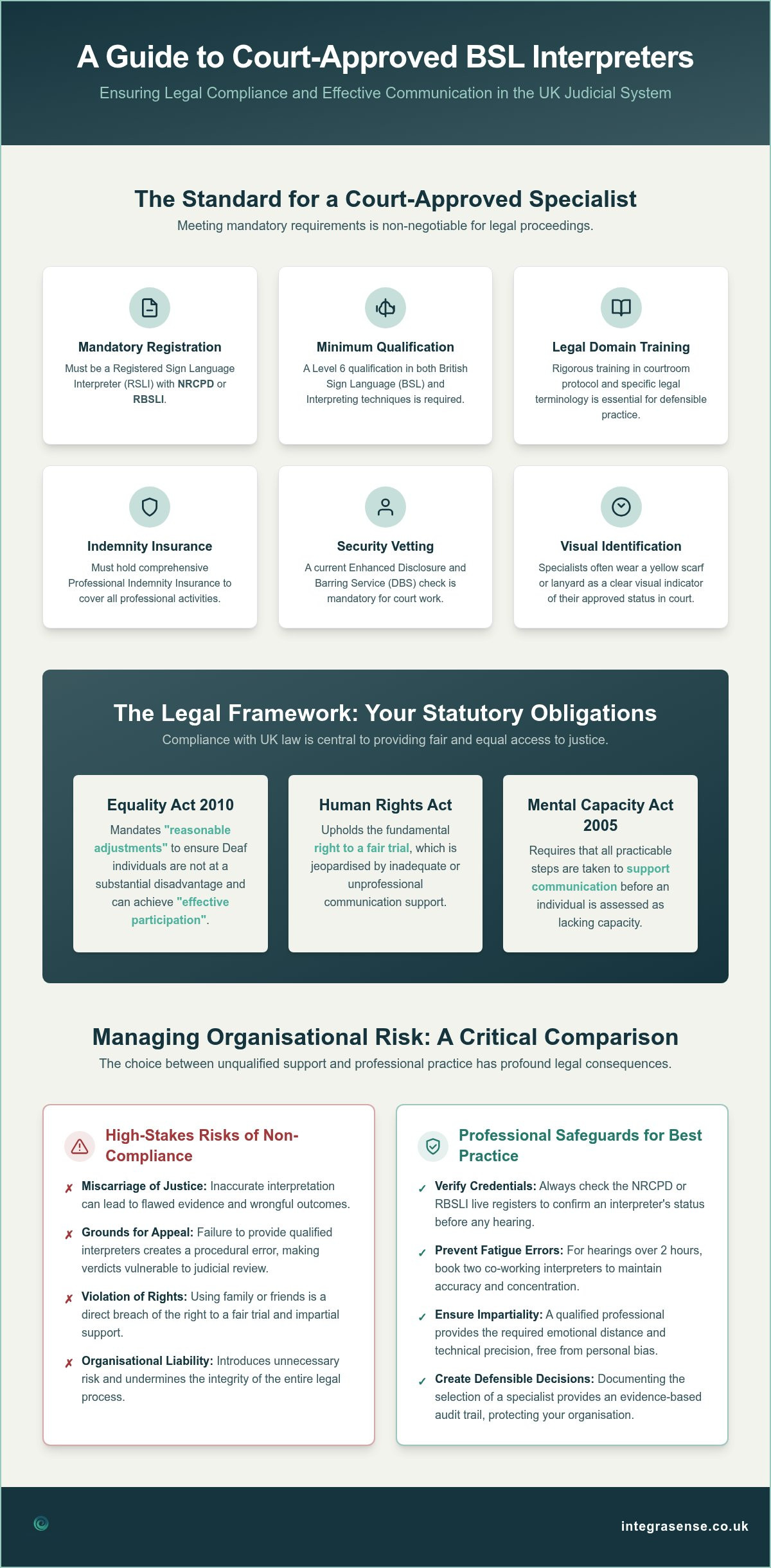
In the judicial system, precision isn’t optional. To function as a court approved BSL interpreter, a professional must hold the status of a Registered Sign Language Interpreter (RSLI) with either the National Registers of Communication Professionals working with Deaf and Deafblind People (NRCPD) or the Regulatory Body for Sign Language Interpreters (RBSLI). These registrations signify that the individual has achieved at least a Level 6 qualification in both BSL and interpreting. Beyond linguistic fluency, a specialist must undergo rigorous training in courtroom protocol and legal terminology to ensure their practice is defensible under cross-examination.
Compliance within the legal domain extends to administrative safeguards. Every interpreter working in court must maintain comprehensive Professional Indemnity Insurance and hold a current Enhanced DBS check to satisfy security and liability protocols. To provide a clear visual indicator of their specialist status and adherence to these high standards, many legal interpreters wear a distinctive yellow scarf or lanyard while working within the courtroom environment.
The Risks of Using Non-Qualified Support
Relying on family members or friends for legal communication is a direct violation of the right to a fair trial. Unqualified individuals lack the emotional distance and technical vocabulary required to remain impartial. Inaccurate interpretation doesn’t just confuse the proceedings; it creates grounds for judicial reviews and can lead to catastrophic legal outcomes. Professional firms like ABBT – Annemarie Bult Business Translations exemplify the standard of expertise needed to prevent such failures. IntegraSense mitigates these vulnerabilities by ensuring every specialist provided meets the exact specifications required for high-stakes litigation, protecting the integrity of the judicial process.
Regulatory Bodies and Compliance in 2026
The NRCPD and RBSLI serve as the gatekeepers of professional integrity. They maintain the National Register, which serves as a live database for verifying an interpreter’s current status and fitness to practice. Legal teams have a mandatory responsibility to check these registers before any hearing. Failing to verify these credentials introduces unnecessary organizational risk and undermines the validity of the evidence presented. A court approved BSL interpreter isn’t just a translator; they’re a verified component of a compliant legal system.
This level of professional scrutiny is a hallmark of risk management in many regulated sectors; for instance, those hiring for financial crime prevention or anti-money laundering roles can visit Decoder to explore their intelligence platform for resume evaluation.
Navigating the Legal Domain: Compliance, Risk, and Defensible Decisions
Legal compliance isn’t a static checkbox. The Equality Act 2010 mandates that public bodies and legal services provide “reasonable adjustments” to prevent Deaf individuals from being placed at a substantial disadvantage. Within the courtroom, this translates to the provision of a court approved BSL interpreter to facilitate “effective participation.” Without this specialist support, a Deaf defendant or witness cannot fully engage with the evidence, instructions, or cross-examinations; this failure potentially renders the entire proceeding procedurally unfair and vulnerable to appeal.
Risk management also requires addressing cognitive load. For any hearing expected to last more than two hours, it’s standard professional practice to book two interpreters. This co-working arrangement prevents fatigue-related errors and ensures the accuracy of the trial record. Overlooking this logistical detail doesn’t just risk the health of the professional. It risks the integrity of the evidence itself. These requirements should be integrated into a comprehensive accessibility audit for legal venues to ensure the environment supports inclusive communication from the outset.
The Mental Capacity Act and Communication
Effective communication is the prerequisite for any capacity assessment. Under the Mental Capacity Act 2005, an individual must be supported to communicate their decision before they’re deemed to lack capacity. Specialist BSL interpreters play a vital role here. They ensure that linguistic barriers aren’t misidentified as cognitive deficits during high-stakes legal assessments.
Defensible Decision-Making in Public Sector Legal Support
Local authorities and public sector bodies must document why specific communication specialists were chosen. A defensible decision is one that is evidence-based and clearly recorded, showing that the organization considered the complexity of the case and the specific needs of the individual. IntegraSense provides the expertise needed to navigate these complex environments, offering specialist communication support that stands up to judicial scrutiny. Documenting this choice is vital for maintaining compliance and managing organizational liability.
Beyond Translation: Specialist Legal Communication and Supervision
Legal proceedings involve complex cognitive processing that extends far beyond simple word-for-sign substitution. In high-profile or sensitive criminal cases, the court may require an Expert Witness report to determine the specific communication needs of a participant. This ensures the court approved BSL interpreter assigned to the case is matched precisely to the individual’s linguistic profile. Professional resilience is equally critical. Interpreters often handle traumatic evidence, making BSL interpreter professional supervision a necessary safeguard against vicarious trauma. This oversight maintains ethical boundaries and ensures the interpreter remains a neutral, high-performing component of the legal team.
Integrating conflict resolution and mediation within these frameworks allows for person-centred outcomes, even in adversarial settings. It moves the focus from mere compliance toward a system where communication is optimized for clarity and control. Specialist communication support differs from standard BSL by addressing the specific barriers found in the legal domain, ensuring that every participant has the tools required to manage their space effectively.
Interpreting for Deafblind Individuals in Court
Legal matters involving sensory loss require a deeper level of technical intervention. A statutory deafblind assessment is often the first step in identifying whether tactile BSL, hands-on signing, or other specialist methods are required. A court approved BSL interpreter with deafblind expertise understands that traditional visual signing may be insufficient, necessitating a bespoke approach to ensure the individual’s right to a fair trial is upheld through precise, tactile communication.
Securing Specialist Legal Support
Organizations can manage risk by embedding specialist communication audits into their long-term legal strategies. Utilizing External Quality Assurance (EQA) provides an additional layer of defensibility, ensuring that the standards of interpretation are beyond reproach. This methodical approach transforms communication from a potential point of failure into a robust, compliant asset. For expert assistance in navigating these technical complexities, contact IntegraSense for specialist legal communication and consultancy services.
Securing Judicial Integrity through Strategic Communication
A fair trial rests upon the bedrock of precise communication. By prioritizing the engagement of a court approved BSL interpreter who adheres to NRCPD or RBSLI standards, your organization moves away from the risk of procedural failure and toward a state of optimized compliance. We’ve examined how specialist oversight, ranging from professional supervision to expert witness reports, ensures that every legal decision is both defensible and inclusive. These aren’t just administrative hurdles; they’re the essential components of a robust, fair, and modern justice system.
IntegraSense operates as a multidisciplinary consultancy with over five years of specialist experience in navigating the technical complexities of the legal domain. Our expertise in statutory deafblind assessments and expert witness services provides the clarity needed to manage organizational risk with quiet confidence. We’re committed to delivering solutions that empower people to manage their spaces effectively while maintaining the highest professional standards. You can ensure your legal proceedings are beyond reproach by partnering with specialists who value long-term viability and technical precision.
Consult with our legal communication specialists today to establish a communication framework that is as resilient as it is compliant.
Frequently Asked Questions
How do I check if a BSL interpreter is court-approved?
To verify a professional’s credentials, you must consult the public registers maintained by the NRCPD or RBSLI. A court approved BSL interpreter will be listed as a Registered Sign Language Interpreter (RSLI), confirming they’ve achieved the necessary Level 6 qualifications. These databases allow you to confirm their current status, insurance validity, and DBS clearance. Verifying these details is a critical step in managing organizational risk and ensuring judicial compliance.
Can a court hearing be postponed if a qualified BSL interpreter is not available?
Courts will typically adjourn or postpone a hearing if a qualified specialist isn’t available. Proceeding without adequate support violates the right to a fair trial and the principle of “effective participation” under the Human Rights Act. While delays are inconvenient, they’re preferable to the procedural errors that arise from poor communication. Securing a qualified professional ensures the trial remains defensible and protects the legal rights of all participants.
Who is responsible for paying for a BSL interpreter in a UK court?
In most UK criminal and family court cases, the cost is met by His Majesty’s Courts and Tribunals Service (HMCTS). For civil matters or employment tribunals, the responsibility for funding often rests with the service provider or the court itself as part of their statutory duty to provide reasonable adjustments. It’s essential to identify the correct funding stream early in the litigation process to ensure that communication support is secured without delay.
What is the difference between a standard BSL interpreter and a legal specialist?
Legal specialists undergo additional training in courtroom etiquette, technical terminology, and the specific rules of evidence. A standard interpreter may lack the familiarity with judicial processes required for high-stakes environments. By contrast, a court approved BSL interpreter possesses the expertise to handle complex cross-examinations and sensitive material with precision. Their practice is often supported by professional supervision, which maintains the high levels of ethical resilience needed for legal work.