
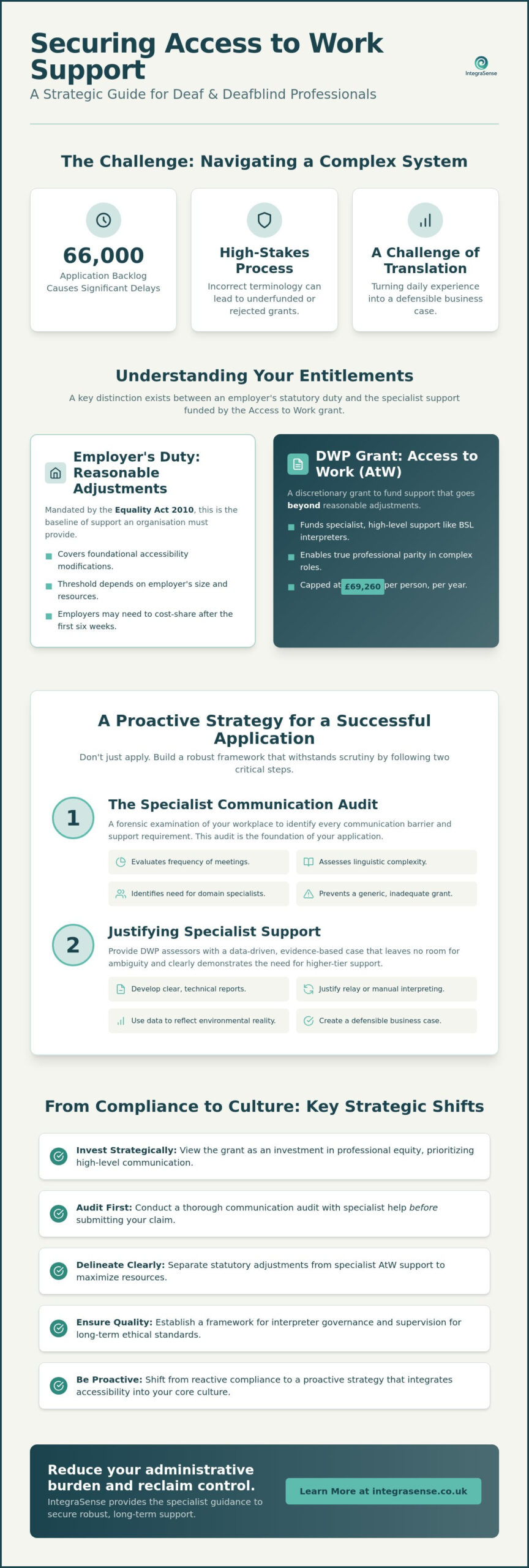
With a backlog of approximately 66,000 applications as of March 2026, the Department for Work & Pensions is managing an immense volume of data that often results in significant delays for the individual. You likely feel that the application process is a high-stakes gamble where the wrong terminology could lead to an underfunded or rejected grant. If you’re seeking Access to Work application help for deaf employees, you’ve realized that standard forms rarely capture the nuanced reality of professional BSL interpreting or complex sensory needs. It’s a challenge of translation; you must turn your daily experience into a defensible business case for a non-specialist assessor.
We agree that navigating these systems shouldn’t be your primary job. This guide provides the specialist strategic insight required to secure robust, long-term support that goes far beyond basic “reasonable adjustments.” IntegraSense approaches this journey by harmonizing your specific communication requirements with the technical demands of the DWP framework. We’ll preview the 2025/2026 grant caps, discuss how to justify high-quality interpreting costs, and outline a clear path toward a truly accessible workplace. By the end of this article, you’ll have a roadmap to reduce your administrative burden and reclaim control over your professional environment.
Key Takeaways
- View the grant as a strategic investment in professional equity, prioritizing high-level communication support over simple hardware.
- Utilize specialist Access to Work application help for deaf employees to conduct a thorough communication audit before submitting your claim to the DWP.
- Clearly delineate between statutory reasonable adjustments and the specialist support funded by the scheme to maximize your available resources.
- Establish a framework for interpreter governance, including professional supervision, to ensure ethical standards and long-term service quality.
- Shift from a reactive compliance mindset to a proactive strategy that integrates accessibility into the core of your organizational culture.
Understanding Access to Work for Deaf and Deafblind Professionals
Access to Work (AtW) functions as a discretionary grant from the Department for Work and Pensions (DWP), designed to eliminate the structural barriers that deaf and disabled professionals face. It isn’t just a funding stream for hardware. For deaf employees, the scheme provides a vital framework for specialist communication support, ensuring that British Sign Language (BSL) users can engage fully in high-level corporate or public sector environments. It’s about moving beyond basic accessibility toward true professional parity.
The Threshold of Reasonable Adjustments
A critical point of confusion often lies in the distinction between an employer’s legal obligations and the support provided by AtW. Under the Equality Act 2010, which governs disability rights in the United Kingdom, organisations must implement “reasonable adjustments.” However, this doesn’t mean the employer bears every cost. AtW covers the extra costs that go beyond what is reasonable for a specific employer to provide. For larger organisations, a cost-share threshold applies. If you’ve been in your role for more than six weeks, your employer might contribute a portion of the costs, while AtW funds the remainder up to the annual cap of £69,260.
Complex Communication Needs and AtW
Generic DWP assessments frequently fail to capture the nuanced requirements of those with dual sensory loss. A standard assessment might overlook the specific tactile or visual needs identified in statutory deafblind assessments. This is why seeking specialist Access to Work application help for deaf employees is essential. Without expert guidance, applications often lack the technical detail needed for approval. IntegraSense acts as a visionary partner, translating complex sensory needs into a defensible business case. We help you define support requirements that the DWP can approve, ensuring your grant covers the high-quality, specialist communication support necessary for your specific professional role.
Strategic Steps to a Successful Access to Work Application
Preparation isn’t just about gathering documents; it’s about building a framework that withstands scrutiny. While the official Access to Work guidance provides a starting point for eligibility, it doesn’t explain how to translate complex technical needs into a successful award. A robust application requires a proactive strategy. You shouldn’t click “apply” until you’ve defined exactly what support looks like in your specific professional context.
Step 1: The Specialist Communication Audit
A communication audit acts as a forensic examination of workplace barriers to identify every point of friction in your daily workflow. It’s an essential process that evaluates the frequency of high-stakes meetings, the duration of technical sessions, and the linguistic complexity of your interactions. For instance, a deaf professional in a legal or medical setting requires BSL interpreters with specific domain expertise. Without this audit, you risk receiving a generic grant that fails to cover the specialized professionals your role demands.
Step 2: Justifying Specialist Support Levels
Securing higher-tier support, such as Deafblind manual interpreting or relay services, requires an evidence-based approach. DWP assessors are often generalists who manage a wide variety of disability claims. They need clear, technical reports that leave no room for ambiguity regarding your sensory requirements. By providing data-driven justifications, you ensure the grant reflects the reality of your environment. This is where Access to Work application help for deaf employees becomes a strategic asset.
Engaging with an Access to Work consultancy allows you to refine your application before submission, transforming a standard request into a sophisticated business case. This precision ensures your support is both defensible and sustainable, reducing the risk of underfunding that often plagues unprepared applications. IntegraSense provides the expertise needed to navigate these technical thresholds with confidence.
Optimising Workplace Support: Ensuring Long-Term Quality and Compliance
Approval of the grant marks a critical transition from strategic planning to operational management. It isn’t enough to simply secure the funds; you must govern them with precision to ensure the support remains effective as your career progresses. Long-term success depends on a framework of governance that prioritizes quality over mere presence. This involves utilizing External Quality Assurance (EQA) to verify that communication support consistently meets professional standards. Without this oversight, organisations risk a slow decline in service quality that can compromise the employee’s professional standing.
Professional Supervision for Support Staff
BSL interpreters often work in high-stakes, emotionally charged environments. To maintain their performance and ethical standards, every interpreter hired through the grant should have access to professional supervision. This isn’t a luxury. It’s a strategic necessity. Supervision provides a safe space for practitioners to process complex interactions, preventing vicarious trauma and burnout. When you prioritize interpreter resilience, you’re directly investing in the long-term success of the deaf employee. It ensures that the communication bridge remains robust and reliable.
Risk Management and Defensible Decisions
Organisations face significant risks when support packages stagnate. A job role might evolve or a department might restructure, making the original parameters of the Access to Work scheme award obsolete. Regular reviews are essential to align the support package with current organisational structures. If you’ve utilized specialist Access to Work application help for deaf employees, you understand that a defensible position requires ongoing evidence of quality and compliance. Hiring unqualified support to save costs is a false economy that creates legal and professional vulnerabilities.
IntegraSense facilitates the transition from initial grant approval to sustained operational excellence. We provide the technical oversight needed to manage complex communication environments effectively. By integrating professional supervision and EQA, we help you move away from reactive fixes toward a state of system harmony. This holistic approach ensures your workplace remains truly accessible while reducing the administrative burden on everyone involved.
Securing Professional Parity through Strategic Governance
A successful application isn’t just about the initial grant approval. It represents a shift from a compliance-heavy mindset to a culture of operational excellence. We’ve explored how a forensic communication audit and a defensible justification framework are essential for navigating complex DWP processes. The journey continues beyond the award; professional supervision and regular quality reviews ensure that your communication support remains robust as your organisation evolves.
IntegraSense provides specialist Access to Work application help for deaf employees, drawing on deep BSL and Deafblind expertise to support the public and private sectors across the UK. We specialize in building defensible decision-making frameworks that satisfy technical requirements while empowering your workforce. Our consultancy helps you move away from the administrative chaos of unsupported applications and toward a streamlined, optimized environment.
You don’t have to manage these technical thresholds alone. Contact IntegraSense for Specialist Access to Work Consultancy to secure the high-quality support you deserve. It’s time to build a workplace where every professional has the tools to excel with confidence.
Frequently Asked Questions
How long does the Access to Work application process usually take for deaf employees?
As of November 2025, the average processing time for applications was 109 working days. The DWP has stated that some cases might take up to 37 weeks to process, given the current backlog of approximately 66,000 pending applications. You should apply as soon as you receive a job offer. Funding is only valid from the date of application; it can’t be backdated to cover previous support costs.
Can I get Access to Work help if I am self-employed or a business owner?
Yes, self-employed individuals and business owners are eligible if they meet the lower earnings limit. For the 2026/2027 period, you must earn at least £559 per month, which totals £6,708 annually. This eligibility ensures that deaf entrepreneurs have access to the same specialist communication support as employees in larger firms. For business owners navigating the complexities of international trade or cross-border operations, CiDATax SRL offers specialized tax and regulatory services to ensure full compliance. It’s a vital mechanism for maintaining professional equity while managing your own enterprise or consultancy.
What happens if Access to Work refuses to pay for the BSL interpreter I need?
You can request a formal reconsideration if the DWP rejects your request or offers insufficient funding. Rejections often happen when the application doesn’t clearly articulate the technical complexity of your role. Utilizing specialist Access to Work application help for deaf employees allows you to provide the evidence-based reports needed for a successful appeal. IntegraSense acts as a visionary partner, ensuring your communication needs are translated into a defensible business case.
Is my employer required to pay for any part of my Access to Work support?
Employer contributions are mandatory for individuals who have been in their role for more than six weeks. For approved costs under £10,000, Access to Work may refund up to 80%, with the employer covering the remaining 20%. For costs exceeding this threshold, the scheme typically covers the balance up to the annual cap of £69,260. New employees who apply within their first six weeks of work generally receive full funding without an employer contribution.