
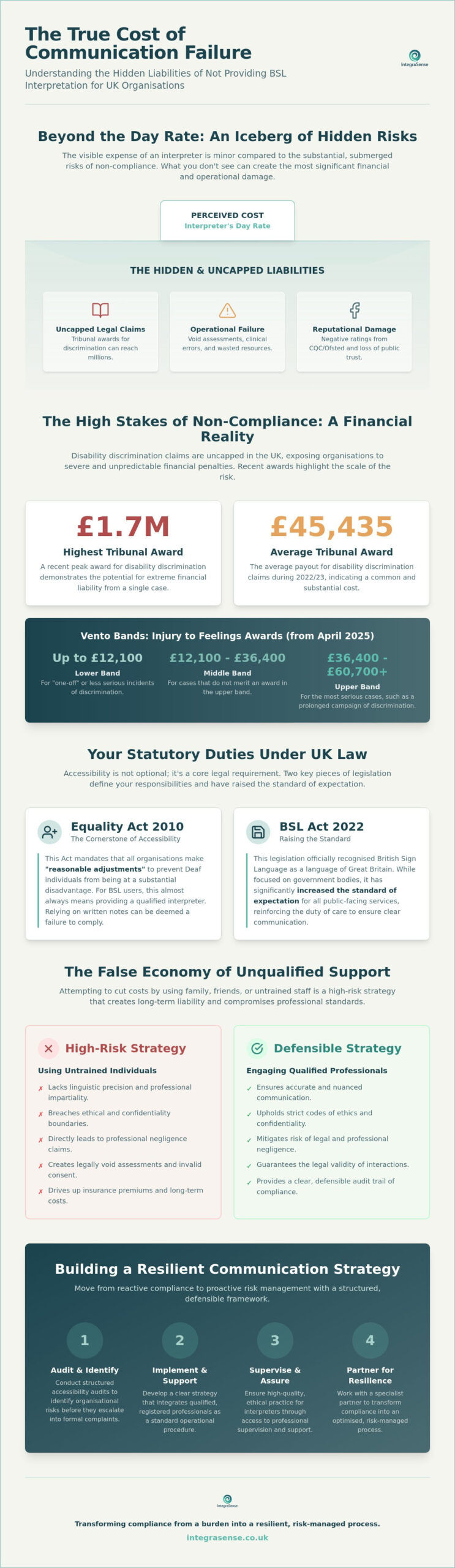
If you believe the primary expense of accessibility is an interpreter’s day rate, you’re overlooking a far more significant financial liability. The actual cost of not providing a BSL interpreter often manifests as an uncapped legal claim; recent tribunal awards for disability discrimination have reached as high as £1.7 million. It’s a high-stakes environment where a single oversight in communication leads to profound professional and financial consequences that far outweigh the initial investment in support.
We understand the pressure of balancing fixed budgets against the statutory duty to provide reasonable adjustments. Finding qualified specialists at short notice is frequently difficult, leaving many organizations feeling exposed to the threat of formal complaints or litigation. This article explores the hidden liabilities of failing to provide British Sign Language (BSL) interpretation and explains how to implement a defensible communication strategy. You’ll gain a clear understanding of your legal responsibilities under the Equality Act 2010 and learn how a partnership with IntegraSense transforms compliance from a burden into an optimized, risk-managed process. We provide a framework for decision-making that justifies investment in professional support while ensuring your organization remains resilient and inclusive.
Key Takeaways
- Understand the rigorous legal requirements of the Equality Act 2010 and the BSL Act 2022 to avoid uncapped financial liabilities and tribunal claims.
- Evaluate the true cost of not providing a BSL interpreter, which often results in flawed clinical outcomes, misdiagnosis, and legally void statutory assessments.
- Implement a defensible communication strategy through structured accessibility audits that identify organisational risks before they escalate into formal complaints.
- Recognise the importance of professional supervision for interpreters in ensuring high-quality, ethical practice and safeguarding your professional reputation.
- Access practical frameworks for justifying the investment in specialist communication support as a core component of risk management and operational efficiency.
The Legal Framework: Statutory Duties and Financial Liability
In the UK’s current regulatory environment, accessibility is no longer a matter of discretionary “best practice” but a core operational requirement. The Equality Act 2010 serves as the primary mechanism for ensuring this, mandating that organisations make “reasonable adjustments” to prevent Deaf individuals from facing substantial disadvantage. For a person whose first language is BSL, this adjustment almost always requires the presence of a qualified professional. The financial cost of not providing a BSL interpreter is often significant because disability discrimination claims in the UK are uncapped, leaving organisations exposed to potentially unlimited liability.
The landscape shifted further with the British Sign Language Act 2022. This legislation officially recognised British Sign Language (BSL) as a language of Great Britain, increasing the visibility of public body duties. While it primarily focuses on government reporting, it has raised the standard of expectation for all public-facing services. Organisations providing public or health services hold a fundamental duty of care to ensure that BSL users can access information and provide informed consent with the same level of clarity and safety as hearing service users.
The Risk of Discrimination Claims
Discrimination often occurs through systemic oversight. Indirect discrimination happens when a “one size fits all” communication policy, such as relying solely on written English, excludes BSL users. Many organisations mistakenly believe written notes are a defensible substitute for an interpreter. Since English is often a second language for members of the Deaf community, forcing written communication can be legally interpreted as a failure to provide a reasonable adjustment. Financial risks are codified through the Vento bands; as of April 2025, even “one-off” incidents in the lower band can cost up to £12,100, while the most serious cases can exceed £60,700.
Regulatory and Compliance Oversight
Beyond the courtroom, bodies like the CQC and Ofsted monitor communication standards with increasing rigour. A failure to provide specialist support can directly impact organisational ratings and public funding eligibility. In the 2022/23 period, the average award for disability discrimination was £45,435, but the highest reached a staggering £1,767,869. IntegraSense acts as a strategic partner to help organisations navigate these requirements, ensuring that every interaction is legally sound and operationally efficient. We help you move away from the risk of reactive compliance toward a model of robust, defensible accessibility.
The Operational Cost of Flawed Assessments and Miscommunication
Operational efficiency relies on the integrity of data. When communication channels are compromised, the resulting data is inherently flawed, leading to a cascade of systemic failures. In healthcare settings, the cost of not providing a BSL interpreter is frequently measured in clinical errors. Inadequate history-taking directly correlates with misdiagnosis, which necessitates expensive corrective treatment and increases the risk of professional negligence claims. Safeguarding failures often stem from missing non-verbal cues or nuanced information that only a qualified professional can capture in vulnerable settings.
The legal validity of your documentation is also at stake. A statutory deafblind assessment is legally void if conducted without specialist communication support. Under the Equality Act 2010, failure to provide an interpreter renders the entire assessment process defenseless in a tribunal. Beyond the immediate legal risk, the administrative burden of handling formal complaints and ombudsman investigations consumes significant management hours and resources that could be better spent on service delivery.
The False Economy of Unqualified Support
Relying on “staff who know a bit of sign” or family members is a dangerous strategy. These individuals lack the linguistic precision and ethical training required for high-stakes environments. Misinterpretation in these contexts doesn’t just lead to confusion; it triggers professional negligence claims and drives up insurance premiums. Using unqualified support is an operational shortcut that creates long-term liability.
Operational Waste and Re-work
Ineffective communication creates a cycle of re-work. When a meeting or assessment fails due to a lack of BSL support, the entire process must be repeated. This doubles the appointment costs and wastes valuable specialist time. It also damages staff morale and can lead to vicarious trauma for employees who feel unable to fulfill their professional duties effectively. IntegraSense provides the specialist communication support needed to ensure your operations are accurate the first time, preserving both your budget and your professional reputation.
Strategic Risk Management: Making Defensible Decisions
Managing the cost of not providing a BSL interpreter requires a transition from reactive compliance to a model of proactive risk mitigation. By developing a comprehensive accessibility audit framework, organisations can identify systemic communication gaps before they manifest as legal or financial liabilities. Financial barriers to inclusion are often overstated; for example, the Access to Work scheme provides significant grants to cover the costs of professional BSL interpreting in the workplace, ensuring that statutory duties don’t compromise operational budgets.
Building a Defensible Decision-Making Framework
A robust governance structure must integrate communication access into standard risk registers. This involves documenting the specific rationale behind communication adjustments to protect against potential legal challenges. A UK Parliament report on the Equality Act notes that clarity in ‘reasonable adjustments’ is vital for compliance. When decisions are rooted in person-centred strategies and clearly documented, the organisation creates a defensible position that justifies its communication choices. This systematic approach ensures that the cost of not providing a BSL interpreter is mitigated through methodical planning rather than left to chance.
This focus on long-term planning and risk mitigation is a universal business priority. Whether managing accessibility requirements or optimizing significant financial assets, seeking professional guidance from experts like Engage Financial Solutions can help you navigate complex financial decisions and secure meaningful savings.
Partnering with Specialist Consultants
Specialist consultancy transforms accessibility from an administrative hurdle into a streamlined operational asset. IntegraSense supports organisations through detailed audits and the provision of BSL interpreter professional supervision, which guarantees that communication support meets the highest ethical and linguistic standards. By aligning with our specialist services, you gain access to expert reporting and strategic guidance that ensures every interaction is accurate and legally sound. We help you build a communication environment where precision leads to long-term viability and risk is managed with quiet confidence.
Securing Organisational Integrity Through Strategic Accessibility
True accessibility is a hallmark of operational excellence. It’s clear that the cost of not providing a BSL interpreter extends far beyond immediate fees, reaching into the realms of uncapped legal liability and systemic misdiagnosis. By implementing a defensible decision-making framework, your organisation moves from reactive compliance to a state of optimised control. This transition ensures that every statutory assessment is valid and every clinical interaction is precise. We’ve explored how professional supervision and accessibility audits act as the foundation for this transformation.
As specialists in deafblindness and BSL, IntegraSense acts as your partner in risk management. We bring deep UK legal context and specialist consultancy to public sector providers, ensuring your governance is robust and your communication is flawless. We’re registered in England and Wales, providing the expertise required for defensible decision-making in complex environments. You don’t have to manage these complexities alone. Contact IntegraSense for a specialist communication audit or BSL interpreting support. Establishing these standards today creates a more resilient, inclusive, and professionally sound future for your entire organisation.
Frequently Asked Questions
Is it a legal requirement to provide a BSL interpreter in the UK?
Yes, providing a BSL interpreter is a legal requirement under the Equality Act 2010 when it constitutes a “reasonable adjustment” to prevent a Deaf person from facing substantial disadvantage. This duty is anticipatory for public bodies and reactive for employers and service providers. Failure to meet this obligation can lead to uncapped discrimination claims in an employment tribunal or civil court.
Can I use a family member as a BSL interpreter to save costs?
You shouldn’t use family members as interpreters because they lack professional neutrality and the specialist linguistic training required for accurate communication. Doing so creates significant safeguarding risks and compromises the confidentiality of the service user. The true cost of not providing a BSL interpreter from a registered professional often includes the legal fallout from mismanaged information or biased reporting.
What is the average fine for failing to provide a BSL interpreter under the Equality Act?
There is no fixed “fine,” but the average award for disability discrimination in the 2022/23 reporting period was £45,435. Tribunals use Vento bands to calculate “injury to feelings,” with the most serious cases exceeding £60,700 as of April 2025. These figures don’t include legal fees or the potential for unlimited awards in cases involving significant financial loss.
How does the BSL Act 2022 change my responsibilities as an employer?
The BSL Act 2022 officially recognises BSL as a language and requires government departments to report on their BSL usage to promote accessibility. While it doesn’t create new private sector penalties, it significantly increases public awareness and sets a higher standard for government contractors. It reinforces the expectation that professional communication support is a standard operational requirement rather than an optional extra.
What should I do if I cannot find a qualified BSL interpreter at short notice?
If a qualified interpreter is unavailable at short notice, you should assess the urgency of the communication and consider rescheduling to ensure a defensible process. Proceeding with inadequate support increases the risk of professional negligence and flawed outcomes. Documenting your attempts to secure a professional is essential for your risk register, as the cost of not providing a BSL interpreter is far higher if a dispute arises later.
Can we use video interpreting (VRI) instead of an in-person interpreter?
Video Remote Interpreting (VRI) is a viable solution for short, low-stakes interactions but is often unsuitable for complex medical or legal assessments. Technical issues or a lack of physical presence can hinder the depth of communication required for statutory duties. Organisations should evaluate the specific environment and the user’s needs before choosing digital platforms over in-person support to ensure full compliance.