What if the most effective safeguard against professional risk isn’t a new software suite or a revised policy, but a structured, reflective conversation? In high-pressure sectors like healthcare, social work, and specialist communication support, the burden of high-stakes decision-making often leads to profound compassion fatigue and professional isolation. You likely recognize that standard line management, while necessary for administrative oversight, frequently fails to address the complex psychological and ethical demands of your daily practice.
This guide clarifies what is professional supervision and who needs it within the modern UK landscape. It’s a formal process designed to enhance your competence, ensure public protection, and provide a framework for defensible decision-making in unpredictable environments. With new standards for health and social care regulators coming into effect on July 1, 2026, the need for formalised support has never been more critical. We’ll explore how professional supervision serves as a vital governance tool, offering you the evidence required to justify this investment to your employer while building the resilience needed for long-term career viability.
Key Takeaways
- Gain clarity on what is professional supervision and who needs it by differentiating between administrative oversight and reflective professional practice.
- Pinpoint specific high-risk roles, including BSL interpreters and deafblind assessors, that require structured support to manage the weight of complex communication.
- Implement supervision as a proactive risk management framework to ensure defensible decision-making and the early detection of practice-based errors.
- Strengthen organisational resilience by leveraging professional supervision to prevent burnout and retain highly skilled specialist practitioners.
Defining Professional Supervision: Beyond Line Management
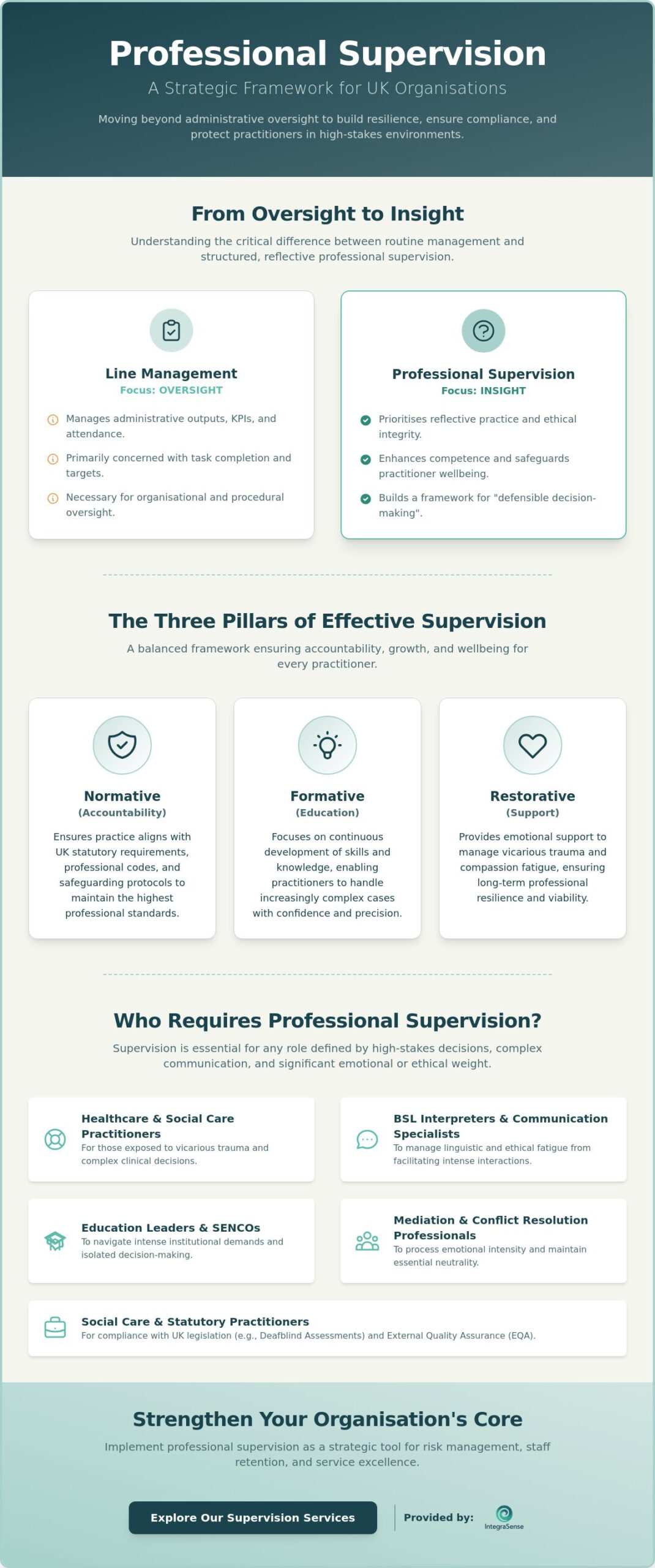
Professional supervision is a sophisticated, collaborative framework that extends far beyond the basic oversight of tasks and targets. While line management focuses on administrative outputs, such as KPIs and attendance, professional supervision prioritises reflective practice and ethical integrity. It’s a structured space where practitioners examine their interactions, challenge their assumptions, and refine their clinical or technical judgment. Defining what is professional supervision and who needs it begins with a shift in perspective from oversight to insight.
This process, often referred to as Clinical Supervision in healthcare and social care contexts, provides a rigorous method for maintaining high standards of care while safeguarding the practitioner’s wellbeing. A primary output of this relationship is “defensible decision-making.” In complex professional environments, decisions are rarely black and white. Supervision provides the documented, evidence-based trail that proves a practitioner acted with due diligence, even when outcomes are challenging. Without this, organisations face significant governance risks and practitioners are left vulnerable to professional scrutiny.
IntegraSense provides Professional Supervision as a core service, ensuring that practitioners aren’t just meeting quotas, but are operating at the peak of their professional capacity. This distinction is vital for maintaining system harmony and avoiding the chaotic fallout of unexamined practice.
The Three Pillars of Effective Supervision
- Normative: This pillar focuses on accountability. It ensures that every action aligns with UK statutory requirements, professional codes of conduct, and safeguarding protocols. It’s the mechanism that maintains professional standards.
- Formative: This is the educational component. It focuses on the continuous development of skills and theoretical knowledge, allowing practitioners to handle increasingly complex cases with confidence and precision.
- Restorative: This pillar provides the emotional support necessary to manage vicarious trauma and compassion fatigue. It ensures long-term professional viability by acknowledging the human impact of high-stakes work.
Who Needs Professional Supervision? Identifying High-Risk Roles
Determining what is professional supervision and who needs it requires an analysis of the psychological and ethical weight carried within a specific role. While some view it as a remedial tool for new starters, global health standards emphasize that professional development and supervision are essential for all practitioners, regardless of their years of experience. It’s particularly critical for those exposed to vicarious trauma, such as mental health practitioners and frontline social care staff, where the risk of burnout can compromise service delivery and safety.
Supervision for Interpreters and Communication Specialists
BSL interpreters and communication specialists operate within a complex triadic relationship. They often absorb the emotional intensity of the interactions they facilitate. This unique position leads to a specific form of linguistic and ethical fatigue that standard management cannot address. Without a dedicated BSL interpreter professional supervision pillar, these specialists risk losing the clarity required for their work. Supervision allows them to unpack these dynamics, ensuring their practice remains fluid and their professional boundaries intact.
Social Care and Statutory Practitioners
In the context of statutory deafblind assessments, supervision ensures that practitioners remain compliant with complex UK legislation. It provides a vital layer of External Quality Assurance (EQA), helping local authorities maintain high standards of service. When practitioners are tasked with making life-altering assessments, the lack of a reflective framework increases the risk of procedural errors. Exploring professional supervision services can help organisations identify which roles within their structure are most vulnerable to these risks, ensuring long-term viability for both the staff and the service users they support.
The Strategic Value of Professional Supervision for UK Organisations
Effective governance requires more than just policy. For UK organisations, professional supervision acts as a proactive risk management tool that identifies practice errors before they escalate into systemic failures. By providing a structured space for reflection, organisations can ensure that their specialists are operating within the highest ethical and professional boundaries. This level of oversight is essential for maintaining system harmony and protecting the integrity of service delivery.
Compliance is another critical driver. Organisations must meet their responsibilities under the Care Act 2005 and various safeguarding mandates. These legal frameworks require that staff are competent and appropriately supported in their roles. Professional supervision provides the evidence of this support, ensuring that organisations can demonstrate adherence to statutory requirements during inspections or audits. IntegraSense acts as a specialist partner in this journey, offering external professional supervision and consultancy that aligns with current UK regulatory standards.
Mitigating Risk through Defensible Decisions
A defensible decision is one that is logical, evidence-based, and professionally supervised. In complex environments, outcomes cannot always be guaranteed, but the process of reaching a decision must be robust. Documented supervision sessions create a clear audit trail for local authorities and healthcare providers. This record proves that the practitioner considered all relevant factors and consulted with a supervisor to mitigate potential biases or errors in judgment.
Implementing a Supervision Framework
Integrating an external framework into your governance structure involves several practical steps. First, identify the roles within your organisation that carry the highest risk or emotional weight. Second, establish a consistent schedule for sessions that remains separate from administrative line management. Finally, ensure the supervisor has the specific expertise required for the practitioner’s field. To begin this transition, organisations are encouraged to explore IntegraSense services for tailored consultancy that ensures your supervision framework is both effective and compliant. Understanding what is professional supervision and who needs it is the first step toward building a resilient, high-performing workforce.
Optimising Professional Practice for Long-term Viability
Professional supervision is far more than a restorative luxury; it’s a critical infrastructure for any organisation managing complex communication or high-stakes social care. By integrating the normative, formative, and restorative pillars, you move away from reactive crisis management toward a model of system harmony and precision. Understanding what is professional supervision and who needs it is essential for leaders who value both their practitioners’ wellbeing and their organisation’s statutory compliance.
IntegraSense brings multidisciplinary expertise in sensory loss and communication to every supervisory relationship. Our team, founded by specialists in defensible decision-making, offers extensive expert witness and EQA experience to help you navigate the nuances of professional risk. We provide the clarity needed to transform chaotic environments into optimised, resilient spaces where specialists can thrive. Contact IntegraSense to discuss your professional supervision needs and ensure your team has the support required to deliver exceptional service. Investing in your people today secures the integrity of your practice for the future.
Frequently Asked Questions
What is the difference between clinical supervision and professional supervision?
Clinical supervision primarily targets the patient-clinician dynamic in healthcare, whereas professional supervision encompasses a wider range of specialist roles, including communication support and social care. Both frameworks prioritise reflective practice and the mitigation of risk. While the terminology varies by sector, the objective remains the same: ensuring that practitioners maintain high standards of ethical and technical competence through structured, external dialogue.
How often should professional supervision sessions take place?
The frequency of sessions typically ranges from once every four weeks to once every quarter, depending on the practitioner’s caseload and the level of risk involved. High-intensity roles, such as those in child protection or mental health, often require monthly engagement to ensure professional resilience. Establishing a consistent cadence is vital for maintaining an effective audit trail and ensuring that what is professional supervision and who needs it remains a central part of your organisational governance.
Is professional supervision mandatory for BSL interpreters in the UK?
While not a universal legal requirement for all BSL interpreters in the UK, professional supervision is increasingly mandated by specific frameworks and professional bodies like ASLI. It’s often a prerequisite for those working in high-risk environments such as mental health or the legal system. Organisations often find that providing supervision is a practical step toward meeting their accessibility and safeguarding responsibilities under the Equality Act 2010.
What should I bring to a professional supervision session?
You should bring specific case examples, ethical dilemmas, or reflections on challenging interactions that occurred since your last session. Preparation is key to a productive conversation. Focusing on “near misses” or moments of uncertainty allows the supervisor to help you build a more robust framework for defensible decision-making. This proactive approach ensures your practice remains aligned with current UK standards and organisational expectations.