
What if the integrity of your organisation’s assessment outcomes isn’t actually determined by your assessors, but by the specialist overseeing them? You likely recognise the persistent anxiety that stems from inconsistent results or the looming threat of a failed external audit. When asking what does an IQA assessor do, it’s best to view them as the architect of professional integrity. They move your operations away from subjective guesswork and toward a system of optimized, defensible precision that ensures long term viability.
This guide explores the critical responsibilities of an IQA assessor and how they safeguard professional standards within specialist communication and healthcare settings. You’ll gain a clear framework for improving organisational compliance while ensuring your decision-making remains robust under regulatory scrutiny. We will examine the essential duties of the role, the current 2026 Ofqual requirements, and the practical steps needed to implement a high-performance quality assurance strategy that brings harmony to complex assessment environments.
Key Takeaways
- Professional evolution. Understand the transition from assessment to internal oversight and how this progression elevates your organisation’s standard of practice.
- Systemic consistency. Discover exactly what does an IQA assessor do to maintain the absolute validity of assessment processes within your specialist teams.
- Optimized oversight. Learn how to implement risk-based sampling strategies that monitor performance effectively while providing assessors with high-quality formative feedback.
- Defensible decisions. Explore why internal quality assurance acts as a primary line of defence against professional negligence and regulatory challenges.
Understanding the Role of an Internal Quality Assurer (IQA)
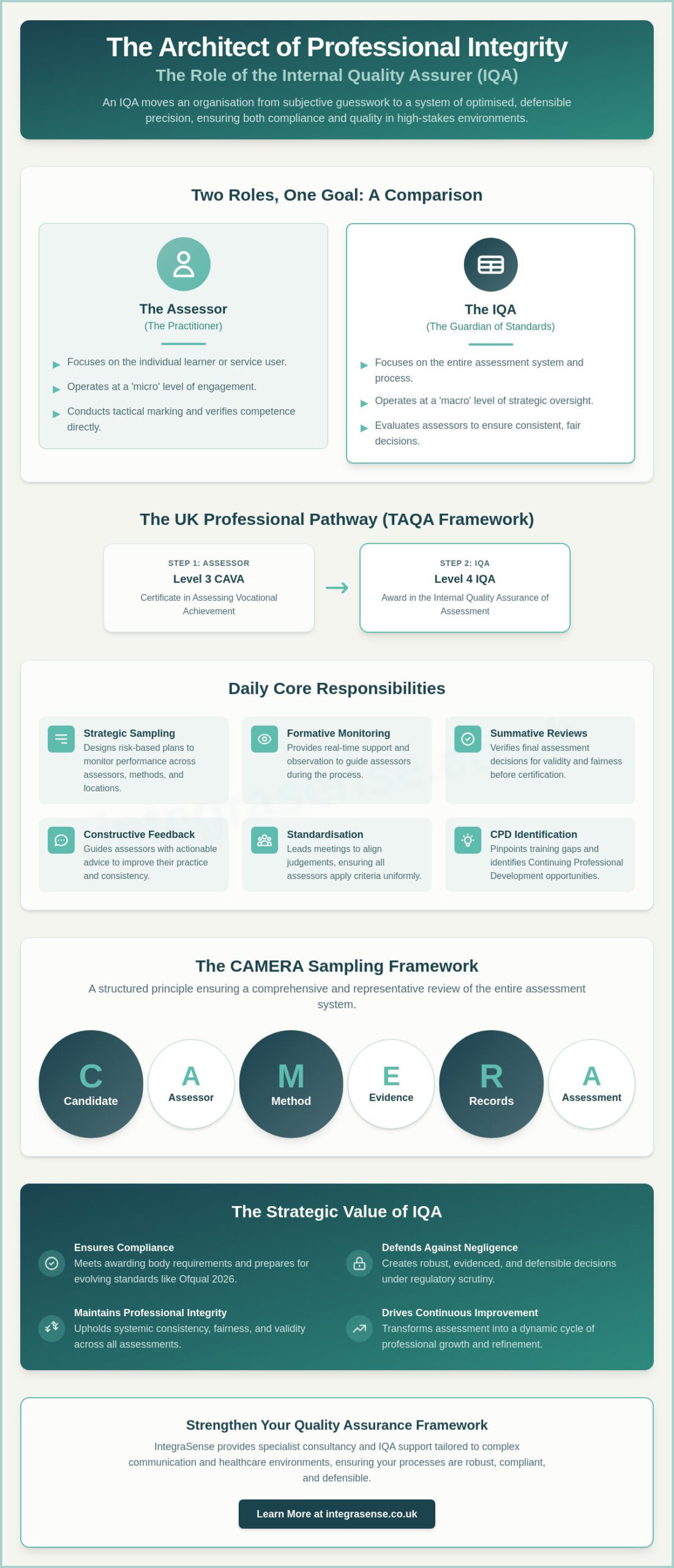
The Internal Quality Assurer (IQA) serves as the strategic pivot point within any regulated assessment framework. While an assessor focuses on the individual learner, the IQA maintains systematic efforts to ensure quality across the entire department. They don’t mark the student’s work; they evaluate the assessor’s ability to reach valid, fair, and consistent decisions. This distinction is vital. Organisations operating in high-stakes environments like healthcare or specialist communication services cannot afford misaligned judgments that lead to professional negligence.
So, what does an IQA assessor do in practice? They act as the final check on professional standards. By transitioning from a Level 3 Certificate in Assessing Vocational Achievement (CAVA) to a Level 4 IQA qualification, a practitioner shifts their focus from tactical marking to systemic oversight. This evolution ensures that awarding body requirements and statutory mandates are met with absolute precision. Understanding what does an IQA assessor do is central to maintaining the integrity of your professional services, especially as Ofqual regulations evolve in 2026. It’s about moving from doing the task to verifying the process.
IQA vs. Assessor: Key Differences in Scope
Assessors operate at the ‘micro’ level, engaging directly with service users or learners to verify competence. In contrast, the IQA maintains a ‘macro’ perspective. They oversee the assessors to ensure criteria are applied uniformly across the board. This oversight is what makes organisational decisions defensible. Without it, two different assessors might reach conflicting conclusions on identical evidence, creating a liability risk that IntegraSense helps organisations mitigate through robust internal frameworks.
The TAQA Framework in the UK Context
The Training, Assessment, and Quality Assurance (TAQA) suite represents the gold standard for UK practitioners. It provides a structured pathway for professional development, ensuring that every link in the quality chain is verified and regulated. The Level 4 Award in the Internal Quality Assurance of Assessment Processes and Practice is the specific RQF qualification required to lead these internal audits effectively.
Core Responsibilities: What an IQA Assessor Does Daily
The daily workflow of an IQA involves far more than administrative verification; it’s a proactive exercise in system harmony. While an assessor focuses on the individual learner, an IQA meticulously constructs a sampling strategy that accounts for the experience of the assessor, the complexity of the criteria, and the inherent risks of the specific vocational area. When asking what does an IQA assessor do, it’s best to view them as the guardian of professional consistency. They spend their time conducting formative monitoring to support assessors in real-time, alongside summative reviews that verify final decisions before they’re certified. For organisations looking to improve the sensory environment of their training and assessment spaces, check out sonicsense for tailored background and course music.
Precision matters in every interaction. Adhering to the City & Guilds IQA Guidance ensures that these sampling plans remain compliant with national standards. By providing constructive feedback and identifying CPD opportunities, the IQA transforms a static assessment process into a cycle of continuous improvement. For organisations seeking to refine these processes, IntegraSense offers specialist consultancy and IQA support tailored to complex communication environments.
Sampling and Monitoring Strategies
Effective IQAs rely on the CAMERA principle to maintain oversight. This framework ensures they review the Candidate, Assessor, Method, Evidence, Records, and Assessment process in a structured manner. Instead of checking every file, the IQA selects a representative cross-section of practice. This includes focusing on new assessors, sampling across different geographical locations, and scrutinising diverse assessment methods to ensure the entire system remains robust and defensible.
Standardisation and Professional Development
Standardisation meetings are the cornerstone of professional consensus. They are critical in subjective fields like BSL interpreting professional supervision, where practitioners must align their judgements to ensure fairness. The IQA leads these sessions to iron out inconsistencies and identify training gaps. This role is equally vital in mentoring staff to meet modern safeguarding standards, ensuring every team member is equipped to protect service users effectively.
Strategic Value: Why IQA is Essential for Compliance
Internal quality assurance functions as an organisation’s first line of defence against litigation. It provides a structured mechanism for identifying risks before they escalate into professional negligence claims. When evaluating what does an IQA assessor do, it’s essential to look beyond the paperwork; they are the architects of a defensible audit trail. This oversight ensures that every decision made by your specialist staff is grounded in evidence and aligned with statutory requirements. By validating the accuracy of assessments, the IQA protects the reputation and legal standing of the entire organisation.
Preparation for an External Quality Assurance (EQA) audit begins with the rigour of your internal processes. A robust IQA framework doesn’t just satisfy awarding bodies; it serves as a tool for organisational transformation. By maintaining high professional standards, you demonstrate a commitment to the environmental stewardship of the sector’s integrity. It’s about moving from reactive crisis management to proactive system optimization. While the day-to-day focuses on sampling, the broader question of what does an IQA assessor do is ultimately answered by their ability to protect the organisation from systemic risk.
Risk Management and Defensible Decisions
Inconsistent assessment outcomes represent a significant liability for local authorities and healthcare providers. If two practitioners evaluate the same service user but reach different conclusions, the resulting decisions become legally fragile and difficult to justify. This is particularly critical when conducting statutory deafblind assessments. The IQA provides the necessary oversight to ensure that these complex evaluations remain compliant with the Care Act and other relevant UK legislation, providing the evidence trail necessary to withstand scrutiny.
Integration with Professional Supervision
The data captured during quality assurance activities shouldn’t exist in a vacuum. It acts as a vital input for professional supervision for interpreters and other communication specialists. By linking IQA findings to reflective practice, organisations can resolve ethical dilemmas and improve practitioner resilience. This synergy ensures that quality assurance isn’t just a tick-box exercise, but a holistic journey toward excellence. IntegraSense facilitates this harmony by aligning quality metrics with the practical realities of specialist service delivery.
Securing Future Standards Through Internal Quality Assurance
Establishing a robust quality assurance framework is no longer an optional extra; it’s a strategic necessity for organisations prioritising professional integrity. By shifting focus from individual marking to systemic oversight, you ensure that every outcome is fair, valid, and consistent across your multidisciplinary team. We’ve explored how a clear understanding of what does an IQA assessor do allows your organisation to build a defensible audit trail, protecting you from the risks of inconsistent decision-making and professional negligence in high-stakes environments.
IntegraSense has been a trusted partner in the UK consultancy landscape since 2019. Our expert team brings specialist knowledge to the Deafblind and BSL communication sectors, focusing on risk management and the optimization of professional standards. We help you move away from the chaotic and towards a state of controlled precision where technical challenges are handled by specialists who value long-term viability—a standard of excellence also upheld by BioKem Oil Services in the industrial maintenance sector.
Contact IntegraSense today to discuss our IQA and consultancy services and discover how we can empower your team to manage complex assessment environments with quiet confidence. Your commitment to quality today secures your organisation’s resilience for the future.
Frequently Asked Questions
Can an IQA also be an assessor for the same candidate?
No, an IQA cannot assess and quality assure the same candidate’s work. This separation of duties is fundamental to maintaining an objective and defensible assessment process. If one person held both roles for the same individual, it would create a clear conflict of interest. Such a breach would compromise the integrity of the internal audit trail and likely result in a non-compliance finding during an external audit.
How many assessments should an IQA sample?
There is no fixed percentage; sampling must be based on a robust risk assessment of the assessors and the specific qualification. When asking what does an IQA assessor do regarding sampling, they typically evaluate factors like assessor experience and historical accuracy. New or inexperienced assessors often require 100% sampling. Conversely, established practitioners with a proven track record might only require a 10% to 20% sample across a representative cross-section of their work.
What is the difference between IQA and EQA?
Internal Quality Assurance (IQA) happens within the organisation to monitor assessor performance, while External Quality Assurance (EQA) is conducted by the awarding body to verify the centre’s entire system. The IQA ensures day-to-day consistency and professional standards. The EQA provides an additional layer of independent oversight to confirm that the organisation is meeting national standards and that the IQA’s own decisions remain valid and robust.
Is an IQA qualification mandatory for all training providers?
Yes, an IQA qualification is mandatory for any organisation delivering regulated qualifications on the Regulated Qualifications Framework (RQF). This requirement ensures that those overseeing the assessment process hold the necessary pedagogical and technical expertise. Specifically, practitioners must hold the Level 4 Award in the Internal Quality Assurance of Assessment Processes and Practice to legally and professionally sign off on assessment decisions within a regulated environment.