
A single non-compliant report can dismantle months of rigorous social work, leaving a vulnerable individual without a voice and a local authority facing a costly legal rebuke. You likely recognize that securing a qualified expert witness in social care proceedings is no longer just a matter of checking credentials; it’s about ensuring every assessment survives the heightened scrutiny of a 2026 courtroom. With the Family Procedure Rules undergoing significant amendments this year, including the June 2026 update to Rule 29.1, precision is your only safeguard.
This guide provides the strategic framework you need to master the complexities of instructing specialists, particularly when managing the intersection of sensory impairment and mental capacity. We’ll show you how to move beyond the chaos of rejected reports toward a model of systemic precision. You’ll gain clarity on the latest Legal Aid Agency rates, such as the £35 hourly cap for Independent Social Workers, and discover how IntegraSense integrates specialist communication support to deliver defensible, court-admissible outcomes that protect the rights of those with complex needs.
Key Takeaways
- Align your legal strategy with the Part 25 mandates of the Family Procedure Rules to ensure every report meets the court’s rigorous standards for independence and precision.
- Recognize the critical necessity of specialist communication support when instructing an expert witness in social care proceedings to avoid the procedural risks of generalist assessments.
- Protect the integrity of your evidence by understanding how cognitive processing and language deprivation impact the quality of testimony in complex sensory cases.
- Construct a robust Letter of Instruction that prioritizes defensible decision-making and precise sensory analysis to secure reliable, court-admissible outcomes.
- Streamline your procedural timelines by effectively coordinating specialist expert reporting within the 2026 family court framework to reduce delays and optimize resource allocation.
Understanding the Expert Witness Mandate in UK Social Care
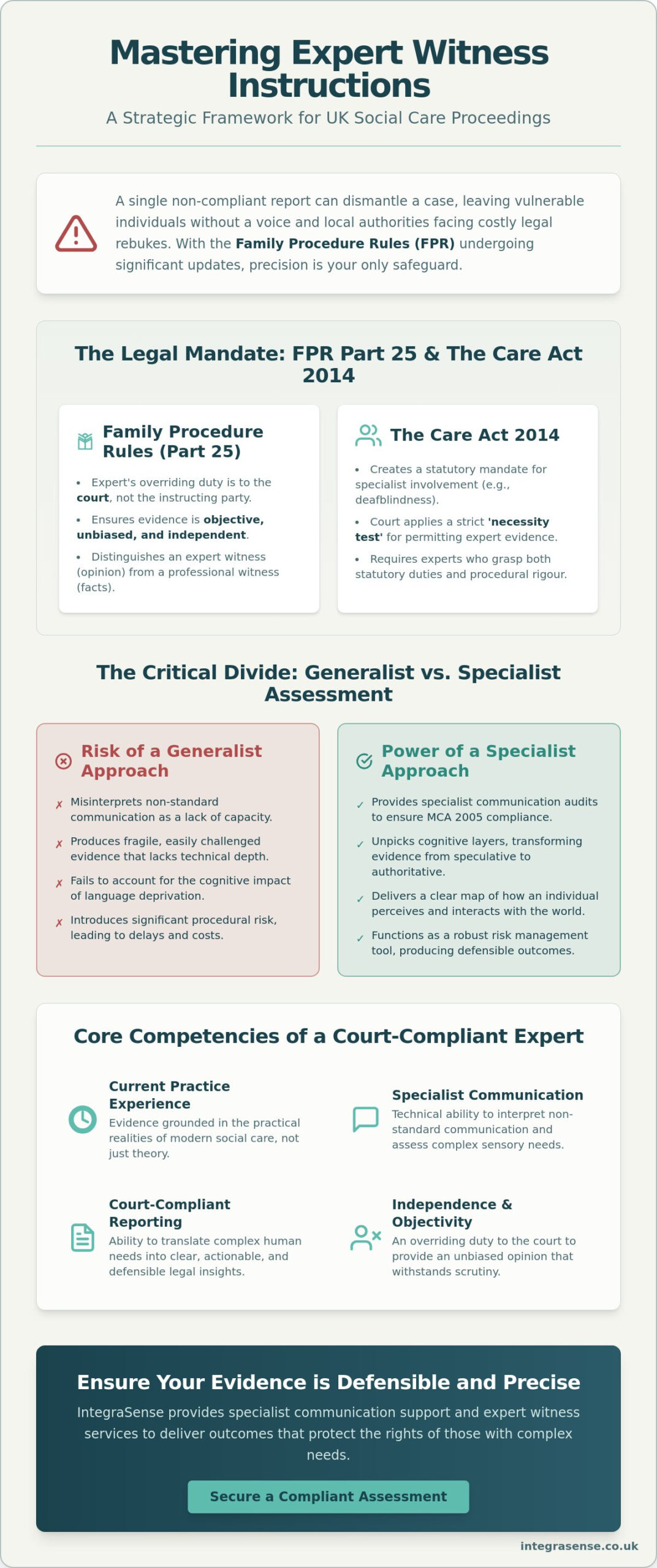
The role of an expert witness in social care proceedings is defined by a singular, overriding loyalty: the duty to the court. While a solicitor or local authority might facilitate the instruction, Part 25 of the Family Procedure Rules (FPR) makes it clear that the expert’s primary obligation is to provide objective, unbiased opinion to the judiciary. This role is distinct from a professional witness, such as a local authority social worker, who provides factual evidence based on their direct involvement in a case. An expert, by contrast, applies specialist knowledge to interpret those facts and offer an independent opinion on the best interests of the individual.
In high-stakes litigation, defensible decision-making isn’t just a preference; it’s a legal requirement. When a court’s decision can permanently alter a family’s structure or an individual’s liberty, the evidence must be robust enough to withstand intense cross-examination. This standard is fundamental to the role of expert witnesses in English law, ensuring that complex human needs are translated into clear, actionable legal insights. Without this level of precision, reports risk being dismissed as speculative rather than authoritative.
The Legal Framework: FPR Part 25 and the Care Act 2014
The Care Act 2014 creates a statutory mandate for specialist involvement when dealing with specific impairments like deafblindness. To grant permission for such evidence, the court applies a ‘necessity test.’ It must be satisfied that the expert’s input is truly required to resolve the proceedings justly, rather than merely being helpful. This high threshold reinforces why organisations must select experts who understand both the statutory requirements and the procedural rigour of the family court.
Core Competencies of a Social Care Expert
A credible expert needs more than just a degree. They require a sophisticated blend of current practice experience and the technical ability to produce court-compliant reports. IntegraSense prioritises practitioners who maintain active involvement in statutory deafblind assessment. This ensures that the evidence provided isn’t just theoretical but is grounded in the practical realities of modern social care, providing the court with the precision it demands for fair outcomes.
The Critical Role of Specialist Communication in Legal Evidence
Generalist reports in cases involving dual-sensory impairment frequently fail because they lack the technical depth to interpret non-standard communication. When an expert witness in social care proceedings overlooks the nuances of deafblindness, the resulting evidence is often fragile and easily challenged. Relying on a generalist expert in these scenarios introduces significant procedural risk, as they may misinterpret a lack of response as a lack of capacity or cognitive ability.
Language deprivation isn’t just a lack of vocabulary; it’s a fundamental shift in how an individual processes their environment and legal concepts. Without a specialist to unpick these cognitive layers, the court receives a distorted view of the individual’s intent. This vulnerability is often highlighted in expert witness written evidence, where the quality of communication support directly dictates the reliability of the findings. Specialist communication audits transform this evidence from speculative to authoritative, providing a clear map of how an individual perceives and interacts with the world.
For local authorities and legal teams, specialist input functions as a robust risk management tool. It ensures that assessments are not just compliant on paper, but resilient under the pressure of cross-examination. If your case involves complex sensory needs, our team at IntegraSense provides specialist communication support to ensure your evidence base remains defensible and precise.
Deafblindness and the Mental Capacity Act 2005
The Mental Capacity Act 2005 requires that all practicable steps be taken to support communication before a person is treated as lacking capacity. This is a high bar in sensory loss cases, where traditional methods often fail. An expert witness ensures MCA compliance by implementing specialist communication support that bridges the gap between sensory impairment and legal understanding.
BSL Interpreting and Cultural Nuance in the Witness Box
Standard interpreting often lacks the clinical or social care depth required for complex litigation. High-stakes cases demand more than literal translation; they require an understanding of cultural nuance and linguistic variance that only a specialist can provide. This is why BSL interpreter professional supervision is essential, as it provides a framework for interpreters to maintain the rigorous objectivity and resilience needed in the witness box.
Strategic Framework for Instructing an Expert Witness in Social Care
Precision in instruction dictates the utility of the final report. A vague Letter of Instruction (LOI) often results in a generic assessment that fails to address the specific legal thresholds at the heart of the case. When instructing an expert witness in social care proceedings, your queries must be targeted. To achieve this level of strategic precision, elite firms often rely on LexQuest AI to refine their legal research and instruction frameworks. You should focus on the interplay between sensory loss and cognitive processing, asking the expert to delineate exactly how a dual-sensory impairment affects the individual’s ability to retain or weigh information during the decision-making process.
Timelines require proactive management. With the family court system moving toward streamlined digital processes and more investigative approaches in 2026, integrating expert reporting into the court’s timetable is a matter of logistical harmony. Delays are often the result of late instructions or inadequate communication support during the assessment phase. A robust, defensible report should be:
- Evidentiary: Every opinion must be anchored in observed data, clinical findings, or specific social care practice.
- Compliant: It must adhere strictly to the updated Part 25 FPR standards and reflect a clear understanding of the overriding duty to the court.
- Actionable: The recommendations should provide a clear path for the court to reach a final determination without ambiguity.
Preparation for oral evidence is the final stage of this journey. A specialist expert must be able to translate complex technical findings into clear testimony during cross-examination, maintaining objectivity under intense scrutiny. This transition from written report to oral evidence is where the depth of an expert’s practice truly stabilizes the case, ensuring that the individual’s needs are correctly interpreted and understood by the judge.
Key Considerations for Local Authorities
Strategic budgeting is essential. While the Legal Aid Agency (LAA) has maintained specific caps, such as the £35 per hour rate for Independent Social Workers amended in March 2024, the cost of a failed appeal or a judicial review far outweighs the investment in specialist insight. Implementing accessibility audits as a precursor to litigation can identify communication barriers early, often preventing the need for protracted legal disputes altogether.
How IntegraSense Supports Legal Teams
We provide a multidisciplinary gateway to specialist expertise. Our approach combines technical precision with a deep understanding of the UK social care landscape, ensuring that your evidence base is both comprehensive and defensible. For initial case consultations or to request fee estimates that align with current LAA guidance, you can begin the process by contacting IntegraSense directly.
Securing Procedural Integrity through Specialist Insight
The transition toward a more investigative and digitally optimized family court system in 2026 leaves no room for speculative evidence. Success in high-stakes litigation now depends on your ability to harmonize statutory requirements with the lived realities of those with complex sensory needs. By prioritizing a compliance-led approach to FPR Part 25 and recognizing the non-negotiable role of specialist communication, you ensure system harmony and protect the rights of the individual; for organizations looking to extend these values of transparency and accountability into their broader culture, discover Core Integrity.
IntegraSense stands as a visionary partner in this process, offering a multidisciplinary gateway to BSL and Deafblindness expertise. Our focus on defensible decision-making empowers Local Authorities to navigate complex cases with quiet confidence and technical rigor. If you’re ready to move away from procedural uncertainty and optimize your evidence base, you can instruct an IntegraSense expert witness for your social care proceedings today. Together, we can ensure that even the most technical challenges lead to fair and sustainable outcomes.
Frequently Asked Questions
What is the difference between a professional witness and an expert witness in social care?
A professional witness provides evidence of fact based on their direct involvement in a case, while an expert witness offers an independent opinion to assist the court in areas outside its own knowledge. In social care, the professional witness is typically the assigned social worker. By contrast, the expert witness in social care proceedings is an external specialist who interprets complex data to provide a neutral, authoritative perspective on the individual’s needs.
When is a specialist deafblind expert witness required by law?
A specialist is required by law whenever an assessment involves an individual who is deafblind, as mandated by the Care Act 2014 statutory guidance. This requirement ensures that the assessor possesses the technical skills to communicate effectively and understand the unique impact of dual-sensory loss. Failure to involve a specialist at this stage creates a significant legal risk, potentially rendering the resulting assessment non-compliant and inadmissible in court.
How do courts assess the credibility of a social care expert witness report?
Courts assess credibility by examining the report’s adherence to Part 25 Family Procedure Rules and the depth of the expert’s evidence-based reasoning. A robust report must demonstrate a clear methodology and cite specific observations while maintaining an objective tone. If a report lacks technical precision or appears to advocate for one party, the judge will likely afford it less weight during the final determination.
Can a BSL interpreter also act as an expert witness in the same case?
No, a BSL interpreter cannot act as an expert witness in the same case because it creates a fundamental conflict of interest. The interpreter’s role is to provide a neutral linguistic bridge; the expert’s role is to provide an evaluative opinion. Maintaining these as separate roles is essential to ensure the integrity of the legal process and the objectivity of the evidence presented to the court.