The most significant barrier to workplace inclusion isn’t a lack of intent; it’s the financial friction of unmanaged support costs. Many leaders struggle to define what is access to work and how can employers use it without falling into the trap of confusing government grants with their own legal obligations. While reasonable adjustments are an employer’s mandate, the Access to Work scheme provides a strategic bridge. It offers a maximum grant of £69,260 per year to fund specialist equipment and communication support, ensuring that talent isn’t sidelined by preventable logistical hurdles.
You’re likely aware that inclusive teams outperform their peers, but the administrative complexity of DWP claims and the cost of specialist BSL interpreters often create hesitation. This guide promises to replace that uncertainty with a refined operational strategy. We’ll explore the 2026 eligibility criteria, provide a framework for successful grant applications, and demonstrate how IntegraSense helps you interpret complex requirements to create a more harmonious, high-performance environment.
Key Takeaways
- Distinguish between mandatory reasonable adjustments and discretionary grant funding to ensure your organisation remains compliant while maximizing available support.
- Understand what is access to work and how can employers use it to fund specialist equipment, BSL interpreting, and travel adaptations that drive workforce productivity.
- Identify the specific cost-sharing tiers for small, medium, and large organisations to accurately forecast and reduce the financial impact of specialist workplace support.
- Establish a defensible decision-making framework that leverages professional consultancy to mitigate the risks of administrative delays and non-compliant adjustments.
Understanding the Access to Work Framework: Beyond Reasonable Adjustments
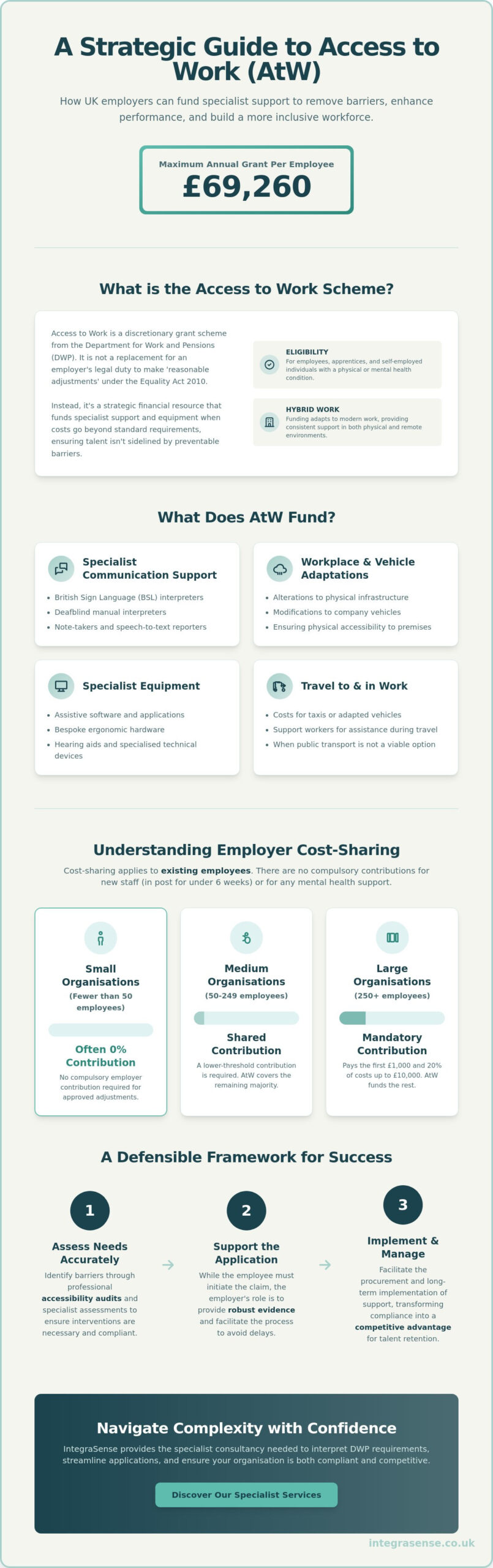
Efficiency in the modern workplace requires more than just goodwill; it demands a technical understanding of the support structures available to your staff. Access to Work (AtW) is a discretionary grant scheme managed by the Department for Work and Pensions (DWP) that provides financial assistance to remove barriers for disabled employees. It’s not a replacement for your legal duties. Instead, it’s a strategic resource for costs that exceed standard workplace requirements. Defining what is access to work and how can employers use it starts with recognizing it as a tool for high-level inclusion that protects your bottom line.
The scheme typically covers several critical areas of intervention:
- Specialist communication support, such as British Sign Language (BSL) interpreters or deafblind manual interpreters.
- Adaptations to vehicle or workplace infrastructure to ensure physical accessibility; for instance, you can discover Safe & Sound Mobile for nationwide vehicle security and audio installations.
- Specialist equipment, including assistive software and bespoke ergonomic hardware.
- Travel-to-work costs where public transport isn’t a viable option for the individual.
An employer’s legal duty under the Equality Act 2010 typically concludes at the point where an adjustment becomes an “undue burden” or moves beyond standard office modifications, at which point AtW funding intervenes to cover specialist costs. By 2026, the framework has adapted to the fluid nature of hybrid work, allowing for funded support that transitions seamlessly between physical offices and remote environments. This ensures that employees with sensory or physical impairments have consistent access to the tools they need, regardless of their location, often facilitated by bespoke technology solutions from Cornerstone Business Solutions.
Eligibility and the 2026 Statutory Landscape
The scheme is open to employees, apprentices, and self-employed individuals with physical or mental health conditions. For those working for themselves, eligibility in the 2026/2027 tax year requires earnings above the Lower Earnings Limit of £559 per month. With the current annual funding cap set at £69,260, organisations can implement comprehensive support packages without shouldering the entire financial weight. Proactive teams often identify these needs through accessibility audits, ensuring that interventions are both necessary and compliant from the first day of employment.
How Employers Can Use Access to Work to Optimise Performance
Employers often misunderstand their role in the initial application phase. While the individual must legally initiate the claim for the Access to Work scheme, the organisation acts as the critical facilitator for procurement and long-term implementation. Understanding what is access to work and how can employers use it effectively requires a clear grasp of cost-sharing thresholds. For existing staff in large organisations with over 250 employees, the employer typically pays the first £1,000 plus 20% of costs up to £10,000. Medium-sized firms share a lower threshold; meanwhile, smaller enterprises with fewer than 50 staff often face zero contribution for approved adjustments.
Integrating these grants into your retention strategy transforms simple compliance into a distinct competitive advantage. When you facilitate high-quality support like BSL interpreting or specialist mentoring, you’re investing in the durability of your workforce. It’s a proactive method to ensure that talent isn’t lost to administrative friction or inadequate workplace tools. For organisations seeking to refine these internal processes, our specialist consultancy services provide the technical precision needed to navigate the DWP landscape with confidence.
Specialist Communication and Sensory Support
Generic workplace assessments frequently fail employees with dual sensory loss because they lack the depth to identify complex communication barriers. A standard review might suggest a larger monitor but overlook the systemic requirements of a deafblind professional. Commissioning a statutory deafblind assessment ensures that your AtW application is grounded in expert evidence. This precision reduces the risk of funding rejection and ensures that support services meet the highest standards through External Quality Assurance (EQA), protecting both the employee’s performance and the organisation’s investment.
Implementing Access to Work: A Defensible Decision-Making Approach
Effective implementation hinges on a robust governance framework. Organisations often treat these grants as isolated administrative tasks rather than core risk management components. To truly understand what is access to work and how can employers use it as a strategic asset, you must establish clear internal protocols for managing funded support. This includes defining exactly where the grant-funded intervention ends and the employer’s ongoing responsibility for supervision begins. Without this clarity, you risk non-compliant adjustments that may fail to meet statutory standards or leave the organisation vulnerable to performance disputes.
Support workers, including BSL interpreters or specialist communication assistants, require professional supervision to maintain high standards of practice and resilience. This isn’t just a quality control measure; it’s a safeguard for your staff. In complex cases where support needs are disputed or communication barriers lead to friction, conflict resolution and mediation become essential. These specialist interventions prevent the escalation of grievances and ensure the workplace remains productive and harmonious. Managing these risks requires a technical depth that standard HR processes often lack.
Partnering with Specialist Consultants
Transitioning from reactive problem-solving to a proactive accessibility strategy requires specialist insight. IntegraSense provides the technical reporting and Access to Work consultancy necessary for complex applications, ensuring every adjustment is evidence-based and defensible. We help you move beyond mere compliance toward a system where technical depth supports human potential. By establishing a clear audit trail and utilizing expert witness services when necessary, you protect the organisation’s long-term viability. To refine your approach and mitigate organisational risk, contact our consultancy team for a strategic review of your accessibility needs.
Advancing Your Workplace Accessibility Strategy
Integrating the Access to Work scheme into your organisational structure isn’t just about financial recovery; it’s about building a framework where specialist support is managed with technical precision. You’ve seen that understanding what is access to work and how can employers use it involves more than a simple application. It requires a defensible decision-making approach that protects both the individual and the organisation from the risks of non-compliant adjustments. By establishing clear governance and professional supervision, you ensure that high-level inclusion becomes a sustainable part of your operations.
Relying on generic assessments often leads to administrative friction and inadequate support. As specialists in Deafblind and BSL communication based in South East England, we provide the expert reporting needed for complex UK-wide cases. We help you transform government-funded grants into a high-performance strategy that empowers your workforce and mitigates organisational risk. Explore our Specialist Consultancy and Advisory Services to refine your 2026 inclusion roadmap. Your journey toward a truly optimized, inclusive environment is well within reach.
Frequently Asked Questions
Does an employer have to pay for an Access to Work assessment?
The DWP typically funds the workplace assessment itself, so there’s no direct charge to the employer for the evaluation. While the assessment is free, organisations often choose to supplement this with specialist consultancy to ensure the resulting recommendations are technically sound and compliant. You may still be responsible for cost-sharing on the actual equipment or services recommended, depending on your company size and the employee’s length of service.
Can Access to Work be used for an employee who is working from home?
Access to Work provides a flexible package of support that enables disabled employees to work effectively from both home and the office. This adaptability is a cornerstone of the 2026 framework, ensuring that specialist equipment or communication support remains fluid across different environments. It’s essential to specify all working locations during the application process to ensure the grant covers the necessary hardware or software for a remote setup.
What happens if the cost of the support exceeds the Access to Work cap?
If the total cost of support exceeds the annual grant cap, currently set at £69,260, the employer is usually responsible for the balance. This scenario often arises with high-intensity specialist communication needs or complex sensory support. To manage this risk, we recommend a strategic review of your support structures to ensure resources are used efficiently. Professional consultancy helps you navigate these high-cost applications while maintaining a defensible audit trail.
How long does an Access to Work grant last before it needs to be renewed?
An Access to Work grant typically lasts for up to three years before it requires a formal review. However, if an employee’s role or health condition changes significantly during this period, you should trigger an earlier reassessment. Understanding what is access to work and how can employers use it includes staying ahead of these renewal timelines to prevent a lapse in support, which could disrupt productivity and organisational compliance.