Booking the wrong interpreter isn’t just a minor logistical error; it’s a profound risk to your organisation’s legal and operational integrity. You likely understand the moral and legal weight of providing accessible services, yet the technical nuances of the BSL Act 2022 often create more confusion than clarity. If you’re unsure how to book a qualified BSL interpreter who can navigate complex jargon or high-stakes environments, you’re facing a challenge shared by many UK procurement leads.
This guide will empower you to master the strategic process of securing registered professionals, ensuring your communication is both accurate and fully compliant with current UK regulations. We’ll explore the essential differences between trainee and registered designations, the logistical necessity of the two-interpreter requirement for demanding sessions, and how IntegraSense leverages professional supervision to maintain the highest standards. By the end, you’ll have a streamlined framework that transforms accessibility from a perceived burden into an optimised, professional asset.
Key Takeaways
- Prioritise NRCPD or SASLI registration to ensure your interpreters adhere to a strict code of professional ethics and regulatory standards.
- Master a repeatable framework for how to book a qualified BSL interpreter by assessing session complexity, technical requirements, and participant numbers.
- Implement the “30-minute rule” to determine when co-working is necessary to maintain cognitive accuracy and prevent interpreter fatigue during demanding assignments.
- Integrate specialist communication support into your broader organisational strategy to mitigate legal risks and ensure seamless compliance with the BSL Act 2022.
- Recognise the value of professional supervision as a strategic tool for maintaining high performance and resilience in complex interpreting environments.
Navigating Regulatory Standards: Why Professional Registration is Non-Negotiable
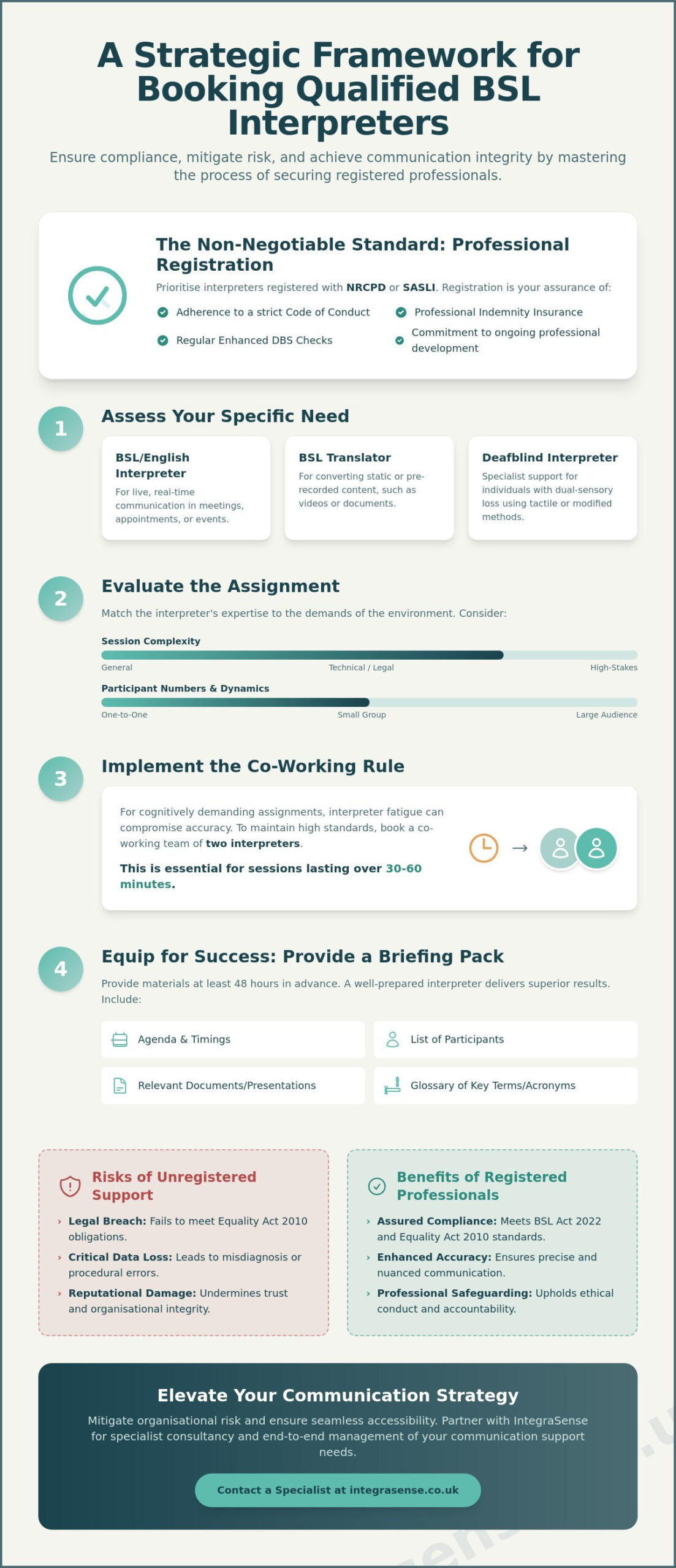
Understanding how to book a qualified BSL interpreter begins with recognising that language proficiency and professional interpreting are distinct skill sets. While many people possess a basic or even advanced knowledge of British Sign Language (BSL), a qualified professional must be registered with the National Registers of Communication Professionals working with Deaf and Deafblind People (NRCPD) or the Scottish Register (SASLI). These bodies ensure that practitioners adhere to a strict code of ethics, maintain professional indemnity insurance, and undergo regular enhanced Disclosure and Barring Service (DBS) checks.
Registration isn’t a mere formality. It’s a safeguarding mechanism for your organisation. The NRCPD acts as a regulatory shield, providing a transparent framework for accountability and professional conduct. At IntegraSense, we advocate for the use of practitioners who engage in regular professional supervision. This practice is a hallmark of high-tier practitioners. It ensures they possess the ethical clarity and mental resilience required to handle high-stakes environments, such as legal proceedings or complex corporate negotiations, without compromising accuracy or neutrality.
The Risks of Using Unregistered Communication Support
The clinical and legal implications of miscommunication are severe, particularly in healthcare or social care settings. Relying on “signing” staff or unregistered individuals often results in critical data loss, leading to misdiagnosis or procedural errors. Failing to secure a registered professional can also constitute a breach of your Equality Act 2010 obligations, leaving your organisation vulnerable to litigation and reputational damage. True compliance requires a defensible decision-making process that prioritises verified expertise.
Interpreting vs. Translation: Identifying Your Specific Need
Clarity in procurement requires distinguishing between live interaction and static content. You’ll need a BSL/English interpreter for real-time meetings or consultations, while a translator is better suited for pre-recorded media or website content. For individuals with dual-sensory loss, general support isn’t enough. In these instances, specialist deafblind interpreting is essential to ensure the nuances of tactile or modified communication are accurately conveyed. Identifying these needs early prevents the friction of ill-fitted support during critical moments.
A Step-by-Step Framework for Booking and Managing BSL Interpreters
Securing the right support requires more than a simple phone call. It demands a structured assessment of the communication environment. When researching how to book a qualified BSL interpreter, you must first evaluate the complexity of the discourse and the number of active participants. Highly technical or emotionally charged sessions require specific expertise that goes beyond general fluency. Identifying these variables early allows for a more precise match between the interpreter’s skill set and your organisation’s specific requirements.
This demand for specialist skill sets is mirrored in other professional sectors; for instance, those seeking a high-end aesthetic transformation can visit Khan Dental to see how expert precision applies to cosmetic dentistry.
Accuracy in interpreting is a cognitively demanding process that degrades over time. For assignments exceeding 30 to 60 minutes, you’ll need to engage at least two interpreters to work in tandem. This co-working model allows for regular switching, ensuring that the message remains precise and the risk of cognitive fatigue is eliminated. Modern approaches, such as the Scottish Government initiative for BSL, highlight how digital integration can assist in managing these logistics, but the human element of co-working remains vital for high-stakes accuracy.
You can source professionals directly through the NRCPD register or partner with a specialist consultancy to manage the end-to-end procurement. A managed service often provides an additional layer of quality assurance, matching the specific linguistic profile of the interpreter to the unique needs of your organisation. Preparation is performance; just as technical firms visit BCM Public Relations for specialist B2B communications, the quality of interpretation is linked to the depth of information provided beforehand, ensuring the practitioner can navigate your specific industry context with ease.
The Briefing Pack: What Your Interpreter Needs to Know
Provide your interpreter with a comprehensive briefing pack at least 48 hours before the event. This should include participant names, a list of industry-specific acronyms, and the core objectives of the meeting. Don’t overlook environmental factors; ensure the room has adequate lighting and that the interpreter is positioned where they can clearly see the Deaf participant and hear all speakers. For remote sessions, high-quality audio and stable internet connections are non-negotiable for success.
Funding and Support: Access to Work and Healthcare Obligations
UK organisations have several avenues for financial and regulatory support. Employers can often utilise Access to Work grants to cover the costs of communication support for Deaf employees, reducing the direct financial impact on the business. Healthcare providers must adhere to the NHS Accessible Information Standard, which mandates the provision of professional support to ensure patient safety. If you’re navigating these requirements for the first time, exploring our specialist communication services can help clarify your specific obligations.
Mitigating Organisational Risk through Specialist Communication Consultancy
Treating communication support as a simple logistical task is a strategic oversight. It’s a vital element of your organisation’s risk management profile. When you understand how to book a qualified BSL interpreter through a consultancy framework, you’re doing more than meeting a requirement. You’re establishing a defensible decision-making process that protects both the individual and the organisation from the fallout of miscommunication.
A key differentiator in high-quality provision is BSL interpreter professional supervision. This practice provides interpreters with the reflective space needed to navigate complex ethical dilemmas and maintain professional boundaries. For organisations, this translates to higher accuracy and long-term service stability. Moving beyond basic compliance allows you to create truly inclusive environments where Deaf and Deafblind individuals can participate with full autonomy and confidence.
Complex Environments: Legal, Medical, and Mental Health Settings
Generalist support often falls short in technical settings where specific terminology and high levels of precision are required. In legal contexts, an expert witness approach ensures that every nuance is captured for the record. Simultaneously, robust safeguarding protocols must be integrated into the interpreting process to protect vulnerable participants in mental health or social care environments.
Partnering for Long-Term Accessibility Success
Consistency is the foundation of effective communication. Partnering with a specialist consultancy allows for a deeper understanding of your organisation’s recurring needs and cultural context. Start by auditing your current communication provision to identify gaps in compliance or efficiency. For organisations seeking to optimise their approach, IntegraSense provides bespoke specialist services designed to handle the most complex communication challenges with precision and authority.
Optimising Your Communication Strategy for Long-Term Compliance
Mastering the nuances of professional registration and logistical management transforms accessibility from a regulatory obligation into a core organisational strength. By prioritising NRCPD-registered practitioners and implementing structured briefing protocols, you eliminate the risks of miscommunication in high-stakes environments. This strategic approach ensures that every interaction is accurate, ethical, and fully compliant with the BSL Act 2022.
Understanding how to book a qualified BSL interpreter is the first step toward building a truly inclusive and legally defensible organisation. IntegraSense acts as a specialist partner in this journey, offering expertise in complex health and social care settings where precision is non-negotiable. Our focus on professional supervision and specialist communication support ensures your organisation remains at the forefront of accessibility innovation.
Secure expert communication support for your organisation today and benefit from our team of NRCPD-registered professionals who specialise in defensible decision-making. Establishing a robust framework for accessibility doesn’t just manage risk; it empowers your team and the people you serve to communicate with total clarity and confidence. We’re ready to help you move from a reactive booking process to an optimised, visionary communication strategy.
Frequently Asked Questions
How much does it cost to book a BSL interpreter in the UK?
Understanding how to book a qualified BSL interpreter involves budgeting for regional variations and specific qualification levels. Fees are typically determined by the interpreter’s location, the duration of the assignment, and the complexity of the subject matter. You’ll find that rates in London or the South East often differ from regional averages. Additional costs for travel and cancellation policies are standard, reflecting the professional nature of these specialist services.
Why do I need to book two interpreters for a two-hour meeting?
Co-working is a vital requirement for any assignment exceeding 30 to 60 minutes to maintain linguistic integrity. Interpreting is an intense cognitive process that leads to mental fatigue, which increases the risk of errors or omissions over time. By engaging two professionals, they can rotate every 20 minutes, ensuring the communication remains precise and your organisation meets its duty of care toward all participants.
What is the difference between a Trainee Sign Language Interpreter (TSLI) and a Registered Sign Language Interpreter (RSLI)?
A Registered Sign Language Interpreter (RSLI) has completed all necessary training and is qualified to work in any environment, including high-risk legal or medical settings. A Trainee Sign Language Interpreter (TSLI) is still qualifying and is restricted from certain complex assignments. When researching how to book a qualified BSL interpreter, always check the NRCPD register to ensure the practitioner’s status is appropriate for your specific meeting.
Can I use a family member to interpret in a medical or legal setting?
Using a family member is a significant risk to patient safety and organisational compliance. Family members lack the professional neutrality and specialist vocabulary required to interpret technical concepts accurately. This practice often leads to filtered information and potential safeguarding breaches. Professional, registered interpreters are mandatory to ensure objective, confidential, and legally defensible communication in these sensitive and high-stakes contexts.
How far in advance should I book a BSL interpreter?
You should aim to book at least two to three weeks in advance to secure a practitioner with the right expertise. Demand for registered professionals is high across the UK, particularly for specialist health or social care assignments. Early planning also allows you to provide essential briefing materials, which directly improves the quality and accuracy of the interpretation provided on the day of the event.
What should I do if I cannot find a local interpreter for an in-person meeting?
If a local practitioner is unavailable, you should consider Video Remote Interpreting (VRI) or covering travel expenses for a specialist from another region. VRI is an effective solution for many business meetings, provided the technology and sound quality are robust. However, for complex or sensitive sessions, it’s often more effective to partner with a consultancy that can source the right specialist from a wider national network.