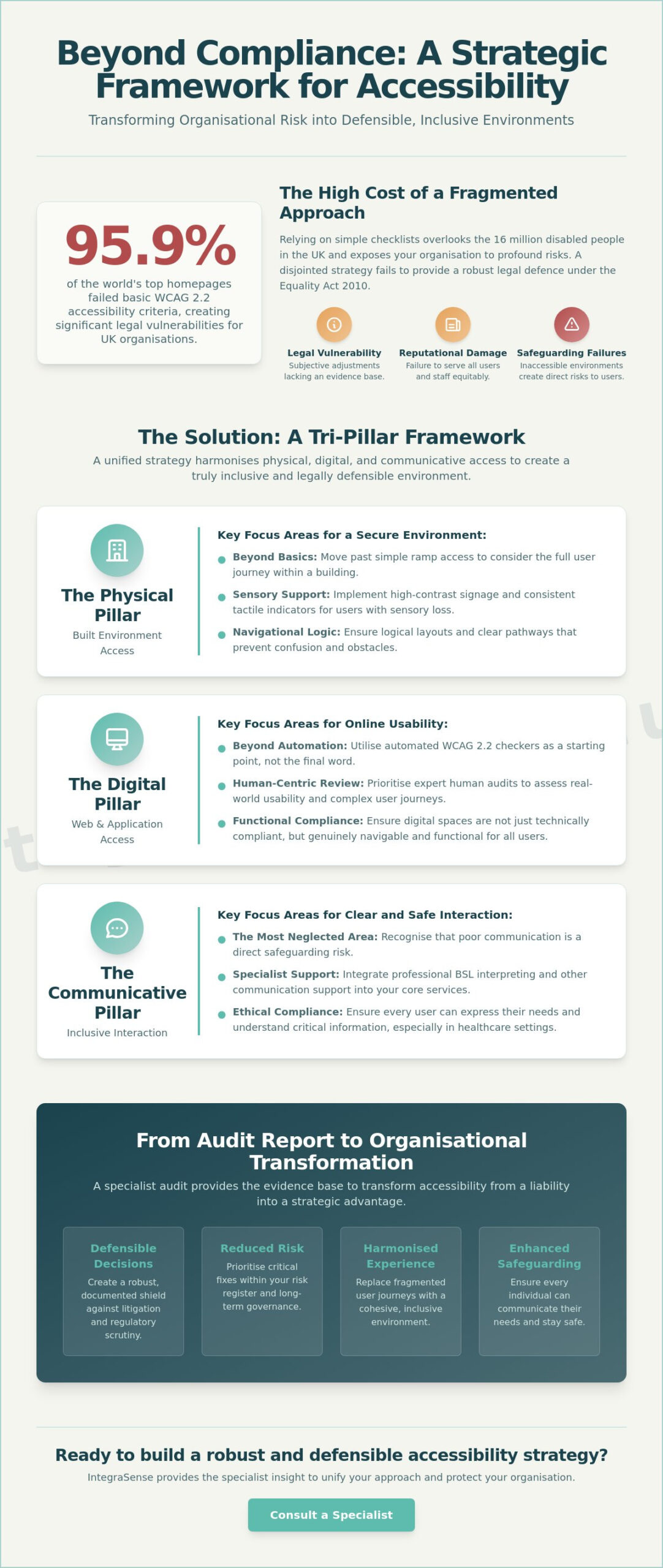
Did you know that 95.9% of the world’s top one million homepages failed basic WCAG 2.2 criteria in 2026? For UK organisations, this statistic represents more than a technical oversight; it’s a significant legal vulnerability that underscores the need for rigorous accessibility audits under the Equality Act 2010. You likely recognize that accessibility is a mandatory requirement, yet the distinction between digital standards and physical adjustments often remains unclear. Many leaders worry that a simple checklist won’t protect them from litigation or, more importantly, won’t actually serve the 16 million disabled people currently living in the UK.
Compliance is not a static destination. It is a continuous state of operational readiness that requires precision, foresight, and expert interpretation. This article demonstrates how specialist audits move beyond a tick-box exercise to become a strategic framework for defensible decision-making. You’ll discover how to replace fragmented communication support with a cohesive, inclusive environment for all staff and service users. IntegraSense views this process as a vital evolution toward a more optimized and responsible professional environment, providing you with a clear roadmap for reducing organisational risk through specialist insight and methodical execution.
Key Takeaways
- Establish a robust evidence base for reasonable adjustments by using professional accessibility audits as a proactive risk management tool.
- Avoid fragmented user experiences by adopting a tri-pillar framework that harmonises physical, digital, and communicative access.
- Gain clarity on specialist requirements for the built environment, including the tactile indicators and navigational aids essential for those with dual-sensory loss.
- Implement a strategic methodology to categorise audit findings, ensuring critical fixes are prioritised within your organisational risk register and long-term governance.
The Strategic Role of Accessibility Audits in Risk Management
An accessibility audit is far more than a technical survey or a digital scan. It represents a comprehensive evaluation of the barriers existing within an organisation’s physical, digital, and communicative environments. By identifying these obstacles, leaders can move from reactive troubleshooting to a state of strategic readiness. This process ensures that every touchpoint, from an office entrance to a mobile application, aligns with the fundamental rights of every user. For individuals looking to enhance the physical quality of their own residential or home-office spaces, you can discover Windows in Cheshire for premium glazing solutions.
Central to this framework is the concept of defensible decision-making. Under the Equality Act 2010, organisations must make reasonable adjustments to prevent disadvantage. However, without the objective evidence provided by accessibility audits, the rationale for these adjustments remains subjective and legally fragile. A specialist audit provides the documented evidence base required to justify why certain actions were taken and others were prioritised; it creates a robust shield against litigation and regulatory scrutiny.
The risks of neglecting this duty extend well beyond financial penalties. Failure to ensure accessibility often leads to significant reputational damage and, more critically, a failure in safeguarding duties. When environments are inaccessible, vulnerable individuals are effectively silenced. IntegraSense acts as the specialist partner that bridges this gap, translating complex technical compliance into person-centred outcomes that protect both the organisation and the individuals it serves.
Beyond the Equality Act 2010
While the Equality Act is the cornerstone of UK disability rights, professional audits also ensure compliance with the Care Act 2014 and specific public sector equality duties. Relying solely on automated digital checkers is a high-risk strategy. While these tools identify surface-level issues, they lack the nuance required for legal defensibility. True compliance requires expert human oversight to interpret the Web Content Accessibility Guidelines (WCAG) 2.2 within the context of real-world user journeys.
Safeguarding and Inclusive Communication
Accessibility is inextricably linked to safeguarding. Poor communication doesn’t just create inconvenience; it creates risk. If a service user cannot express their needs or understand safety instructions, the organisation’s protective measures have failed. Integrating specialist communication support into your accessibility strategy ensures that every interaction is secure. This methodical approach transforms a chaotic environment into one that is controlled, inclusive, and fundamentally safe. Organisations operating in high-pressure environments should also consider how unresolved workplace tensions can compound these risks; a structured approach to conflict resolution Kent organisations can rely on helps maintain the stable, inclusive culture that effective safeguarding demands.
The Tri-Pillar Framework: Physical, Digital, and Communicative Access
A siloed approach to compliance is a liability. When organisations treat digital, physical, and communicative access as disconnected workstreams, they inadvertently create “blind spots” that compromise the entire user journey. True inclusion requires a unified framework where every touchpoint is equally robust. This integrated perspective ensures that a user who can navigate your website can also safely access your physical premises and communicate effectively with your staff. Without this harmony, your accessibility strategy remains fragmented and vulnerable to legal challenge.
The Physical Pillar extends beyond basic ramp access to include the nuanced requirements of the built environment. For individuals with dual-sensory loss, navigating a space requires high-contrast signage, consistent tactile indicators, and logical layouts. If these aren’t present, a building remains a series of obstacles rather than a functional workspace. Similarly, the Digital Pillar must move beyond technical checkboxes. While website accessibility is often measured against WCAG 2.2, the focus should remain on functional usability. You might utilise W3C’s accessibility evaluation tools for initial scans, but expert human review is necessary to ensure these spaces are truly navigable. Finally, the Communication Pillar addresses the vital need for BSL interpreting and specialist support. This is often the most neglected area, yet it is critical for ensuring legal and ethical compliance in healthcare and professional settings. If you need to unify these elements, our accessibility consultancy provides the specialist insight required for a cohesive strategy.
Auditing for Sensory and Cognitive Impairments
Standard accessibility audits frequently fail to account for the complex needs of Deafblind individuals or those requiring alternative communication methods. A truly inclusive audit evaluates the implementation of PECS and tactile communication systems. It moves beyond the “average” user to consider how those with sensory or cognitive impairments process information and interact with their environment, ensuring no one is left behind in the communication chain. Organisations seeking to address these gaps comprehensively should explore a specialist communication access audit UK providers offer, which delivers the defensible framework needed to meet the nuanced requirements of BSL users and deafblind individuals under the Equality Act 2010.
Developing an Accessibility Audit Brief
To extract maximum value from the process, organisations must prepare for an accessibility audit with precision. Auditors require specific data points to be effective. This includes detailed user journey maps, current communication policies, and a clear understanding of your workplace responsibilities. Providing this context ensures the final report is actionable and provides a defensible roadmap for organisational change.
From Audit Report to Organisational Transformation
The completion of accessibility audits marks the transition from theoretical assessment to tangible organisational transformation. A comprehensive report acts as a strategic blueprint, yet its value depends entirely on how an organisation interprets and executes its findings. Distinguishing between “critical” barriers that impede safety and “desirable” enhancements that improve experience—such as the premium ambient scenting solutions from ISCENT—is essential for effective resource allocation. By integrating these insights into strategic risk registers, leaders ensure that accessibility becomes a permanent pillar of corporate governance rather than a temporary project.
Maintaining this momentum requires more than just physical or digital fixes; it demands a cultural shift. Professional supervision and mentoring play a pivotal role here, ensuring that staff remain equipped to uphold inclusive standards long after the initial audit. Organisations should also recognise that workplace disputes and interpersonal tensions can undermine even the most carefully implemented accessibility strategies; proactive conflict resolution and mediation risk management ensures that the human environment remains as inclusive as the physical and digital one. For organisations seeking a long-term partner to navigate these complexities, IntegraSense provides specialist accessibility consultancy in Kent and across the UK. We bridge the gap between high-level strategy and operational reality, ensuring your environment remains both compliant and welcoming.
Managing the Implementation Phase
Execution must be methodical to be effective. Organisations should follow a structured three-step process to ensure long-term viability:
- Step 1: Categorise findings. Prioritise issues based on legal risk and their direct impact on user safety and autonomy.
- Step 2: Assign ownership. Distribute responsibilities across specific departments such as IT, Facilities, and HR to ensure accountability at every organisational level.
- Step 3: Establish review cycles. Implement recurring checks to prevent “compliance drift,” ensuring that digital updates or physical modifications don’t introduce fresh barriers.
The Role of External Quality Assurance (EQA)
External validation is vital for maintaining a defensible position. Relying on internal assessments alone can lead to an insular “tick-box” mentality that overlooks subtle systemic failures. Engaging in External Quality Assurance (EQA) provides an objective lens, verifying that improvements align with the Web Content Accessibility Guidelines (WCAG) and broader statutory duties. This ongoing consultancy fosters genuine system harmony. It transforms accessibility from a reactive obligation into a proactive organisational strength that empowers every user.
Achieving System Harmony and Legal Resilience
True inclusion requires a shift from reactive compliance to proactive governance. By adopting a tri-pillar framework that addresses physical, digital, and communicative barriers, your organisation moves from a state of vulnerability to one of optimized control. Professional accessibility audits provide the essential evidence base for defensible decision-making, ensuring that every adjustment is rooted in specialist insight and statutory compliance. This methodical approach doesn’t just satisfy a checklist; it transforms your operational environment into a space where every user journey is safe and navigable.
IntegraSense was founded by industry-leading consultants to bridge the gap between technical regulations and person-centred outcomes. Our specialist expertise in Deafblindness and BSL interpreting ensures that even the most nuanced communication needs are met with precision. We prioritise robust risk management and long-term viability, positioning your organisation as a leader in inclusive practice. We help you move away from the chaotic and towards a state of clarity and control.
Protect your organisation and empower your users. Contact IntegraSense for a specialist accessibility consultancy quote. Embracing these standards today builds a more resilient, inclusive, and efficient future for everyone.
Frequently Asked Questions
Is an accessibility audit a legal requirement for UK businesses?
Yes, accessibility audits are a practical necessity for meeting statutory obligations under the Equality Act 2010. The Act requires organisations to take proactive steps to remove barriers for disabled people through reasonable adjustments. For public sector bodies, the Public Sector Bodies Accessibility Regulations 2018 mandate specific compliance with technical standards. Failing to document these efforts leaves your organisation exposed to litigation and regulatory intervention.
How much does a professional accessibility audit cost in 2026?
Audit costs depend on the scale of your infrastructure and the depth of the evaluation required. A comprehensive assessment for a large organisation with multiple physical sites and complex digital assets requires a different level of investment than a targeted review for a small service provider. You should seek a bespoke quote that reflects your specific operational risks and compliance needs rather than relying on generic estimates.
Can we conduct an accessibility audit in-house?
In-house teams can perform basic checks, but they often lack the specialist tools and technical distance required for a robust audit. Professional auditors bring deep expertise in areas like dual-sensory loss and complex communication support that internal staff might overlook. An external assessment provides an objective, defensible evidence base that is far more resilient under legal or regulatory scrutiny.
How often should our organisation commission an accessibility audit?
Your organisation should commission accessibility audits every one to two years to maintain high standards. Regular reviews are essential because digital platforms and physical environments change over time. New software updates or office renovations can easily introduce fresh barriers that weren’t present during the initial assessment. Establishing a recurring cycle ensures that your inclusion strategy remains effective and reflects current best practices.
What is the difference between a disability audit and an accessibility audit?
A disability audit focuses on internal culture and HR policies, while an accessibility audit targets the functional environment. Accessibility assessments evaluate the physical, digital, and communicative touchpoints that users interact with daily. While policy reviews are important for recruitment and retention, accessibility audits provide the technical blueprints needed to remove the actual barriers that prevent people from accessing your services or workspace.
How do accessibility audits support Access to Work requirements?
These audits identify the specific adjustments and specialist support needed for individual employees to thrive. This documentation is vital when applying for Access to Work funding, as it provides the Department for Work and Pensions with a clear rationale for the requested support. By highlighting precise barriers, the audit ensures that any government-funded adjustments are both necessary and effective for the specific workplace context. Organisations navigating these requirements alongside evolving statutory duties should also review the latest safeguarding compliance standards for 2026 to ensure their governance frameworks remain aligned with current professional protection obligations.