
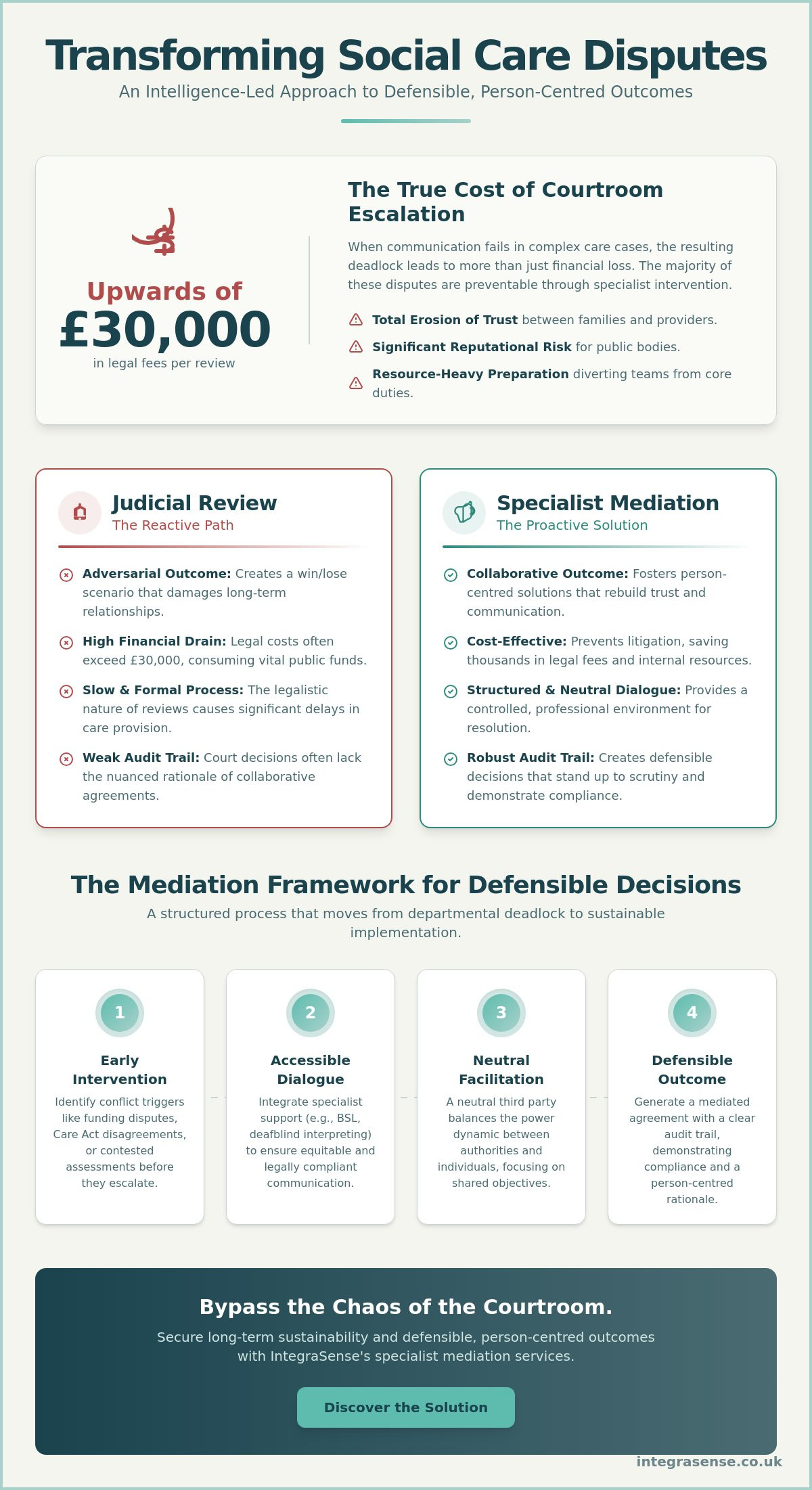
A single judicial review in the UK can cost a local authority upwards of £30,000 in legal fees alone, yet the majority of these disputes are entirely preventable through early, specialist intervention. It’s a reality many social care leads face; when communication breaks down in complex sensory loss cases, the resulting deadlock feels both inevitable and exhausting. You likely understand that the true cost of litigation isn’t just financial; it’s the total erosion of trust between families and the providers meant to support them.
This guide demonstrates how specialist mediation in social care transforms these volatile disputes into defensible, person-centred outcomes. By choosing an intelligence-led approach, you can bypass the chaos of the courtroom and secure long-term sustainability for your service. We’ll explore a clear framework for defensible decision-making that restores communication, reduces litigation risk, and ensures your organisation meets its statutory responsibilities with precision. IntegraSense provides the clarity needed to manage these complex environments, offering a seamless journey from initial conflict to final, sustainable implementation.
Key Takeaways
- Master the application of mediation in social care to transform high-stakes funding and assessment disputes into defensible, person-centred outcomes that mitigate the risk of judicial review.
- Identify the critical triggers for conflict under the Care Act 2014 and learn how a structured, neutral dialogue can resolve complex disagreements before they escalate into costly legal battles.
- Explore the necessity of specialist communication support, including BSL and deafblind interpreting, in ensuring that dispute resolution remains inclusive, equitable, and legally compliant.
- Examine how IntegraSense leverages deep expertise in sensory loss to navigate multi-disciplinary challenges, providing a seamless path from departmental deadlock to sustainable implementation.
The Role of Mediation in Social Care Disputes
Conflict in social care often stems from high-stakes decisions regarding personal autonomy and resource allocation. At its core, mediation functions as a neutral, structured dialogue designed to resolve these disputes outside of the courtroom. Understanding What is Mediation? allows providers to view it as a precision instrument for clarity. It moves parties away from friction and toward optimized outcomes. When mediation in social care is applied effectively, it replaces the chaotic nature of legal battles with a sense of methodical resolution.
Common triggers for conflict include funding disputes, disagreements over Care Act 2014 compliance, and contested assessments. These issues frequently arise when communication breaks down between local authorities and service users. Early intervention is critical. Resolving a dispute at the assessment stage prevents the erosion of long-term trust, which is vital for sustainable care delivery. It’s about maintaining the resilience of the relationship between the provider and the individual, ensuring that the care journey remains focused on the person rather than the problem.
Mediation vs. Judicial Review: Risk and Resource Management
Judicial reviews present significant financial and reputational risks for public bodies. Legal costs for a full High Court challenge often exceed £30,000, even before considering the resource-heavy preparation required by legal teams. Mediation offers a collaborative alternative that prioritizes person-centred planning. This approach ensures that decisions are not just legally sound, but also defensible. A mediated agreement documents the rationale behind a decision, creating a robust audit trail that courts respect and value for its evidence of proactive engagement.
The Legal Framework: Care Act 2014 and Mental Capacity
The Care Act 2014 places a statutory duty on local authorities to involve individuals in decisions about their own care. Mediation directly supports this mandate by giving the individual a voice in a controlled, professional environment. It also aligns with the Mental Capacity Act 2005. By providing specialized communication support, mediation in social care ensures that those with fluctuating capacity participate meaningfully in the resolution process. This ensures compliance while maintaining the dignity and autonomy of the service user, reflecting a modern, tech-humanist approach to social care management.
Implementing a Specialist Mediation Framework
Effective mediation in social care requires more than a simple meeting; it demands a structured framework that acknowledges the friction between local authorities and service users. Neutral third-party intervention is vital in multi-disciplinary settings. It creates a controlled space where teams can align objectives without institutional bias. Mediators act as a fulcrum, balancing the inherent power imbalance between resource-constrained authorities and families advocating for individual needs. Quick fixes often collapse under the weight of future service demands. We focus on sustainable outcomes that integrate long-term care goals into every resolution.
Ensuring Accessibility in the Resolution Process
Standard mediation often fails those with sensory impairments because communication barriers lead to exclusion. Integrating specialist support, such as BSL or deafblind interpreting, ensures equity. Practitioners must utilize Care Act compliant deafblind assessment data to tailor the mediation environment accurately. One essential actionable step is to conduct a communication audit before the first session. This audit identifies specific requirements, ensuring every participant has the necessary tools to engage fully and fairly.
Building Defensible Decisions Through Dialogue
A defensible decision is evidence-based, logical, and follows a transparent process. It’s a decision that stands up to scrutiny because it documents the reasoning behind every conclusion. The mediation record serves as a primary piece of evidence. It provides a clear trail of reasonable adjustments and meaningful consultation. This record demonstrates that the organisation has met its statutory duties under the Equality Act 2010 while seeking a pragmatic resolution. Organisations looking to refine these processes can review our specialist consultancy services to ensure their frameworks remain robust and compliant.
Case Study: Resolving a Complex Dual Sensory Loss Dispute
A 2023 dispute between a London-based Local Authority and the family of a service user with dual sensory loss highlights the transformative power of specialist intervention. The disagreement centered on the provision of 1:1 specialist communication support; the family requested 35 hours per week while the authority cited a budget cap. IntegraSense introduced a mediator with professional expertise in deafblindness to bridge this gap. This specialist insight ensured that the service user’s statutory communication rights remained the focal point of the negotiation.
The mediator facilitated a structured dialogue that moved both parties beyond adversarial positions. They focused on “meaningful access” rather than arbitrary hours. This approach led to a signed agreement within two six-hour sessions. The resolution avoided a potential £50,000 Court of Protection bill and established a sustainable support plan. Subsequent clinical reviews showed a 40% improvement in the service user’s daily engagement levels.
Analysis of Success Factors
The success of this intervention relied on applying workplace mediation principles to a multi-agency setting. By treating the professional-to-professional dialogue with the same rigour as a corporate dispute, the mediator neutralized emotional volatility. Expertise in sensory impairment allowed the mediator to identify subtle communication barriers that a generalist would miss. This deep technical understanding builds immediate trust with clinicians and families, ensuring that mediation in social care remains both practical and defensible.
Strategic Integration for Local Authorities
Local Authorities achieve greater resilience by embedding mediation into standard complaint handling and Stage 2 investigations. Commissioners should treat mediation in social care as a proactive investment in governance rather than a last resort. This shift reduces the risk of protracted legal battles and ensures resources are allocated based on evidence-based outcomes. It’s an essential move from reactive crisis management to optimized service delivery. Organisations operating across the south east can also benefit from dedicated conflict resolution Kent frameworks that address the specific legislative and operational pressures facing regional public sector providers.
- Integrate mediation triggers into early-stage dispute protocols.
- Utilize specialists who understand the specific legislative frameworks of sensory loss.
- View mediation costs as a risk-mitigation strategy against future litigation.
Contact IntegraSense to discuss specialist mediation for your organisation and secure a more sustainable path for complex case management.
Securing Resilience Through Strategic Conflict Resolution
Navigating the intricate intersections of health, education, and public sector governance requires more than standard dispute resolution. It demands a framework that stands up to legal scrutiny while upholding the dignity of the individual. Effective mediation in social care transforms volatile disputes into sustainable, documented outcomes. By integrating specialist expertise in Deafblindness and BSL communication, your organisation ensures that every voice is heard and every decision is defensible. IntegraSense has provided these robust frameworks for over 5 years. We help providers move from reactive crisis management toward proactive, intelligent oversight.
This strategic approach mitigates the risk of judicial review. It strengthens trust between families and local authorities. Precision in communication isn’t just a preference; it’s a necessity for compliance. You can secure better outcomes through specialist insight that prioritises clarity and long-term stability. Our methodology focuses on the end-to-end journey. We ensure no detail is overlooked in complex sensory loss cases.
Explore our specialist mediation and conflict resolution services to ensure your organisation’s decisions remain resilient and compliant. We’re ready to help you transform complex challenges into clear, actionable paths forward.
Frequently Asked Questions
Is mediation in social care legally binding?
Mediation agreements aren’t legally binding by default, but they become enforceable once they’re documented as a formal contract or a court-sanctioned consent order. This process transforms a mutual understanding into a defensible legal framework that protects all stakeholders. According to the CEDR Tenth Mediation Audit, 72% of cases settle on the day, providing immediate clarity for providers and families alike.
What happens if one party refuses to participate in mediation?
Participation remains voluntary, so you can’t compel an unwilling party to attend a session. However, the UK courts view an unreasonable refusal to engage in alternative dispute resolution as a significant breach of conduct, often resulting in heavy cost penalties under the Civil Procedure Rules. Choosing to bypass mediation in social care increases the risk of a 12 month delay in resolution, making early engagement a strategic necessity for risk management.
How much does specialist mediation in social care cost?
Fees for specialist mediation typically scale with the complexity of the case and the mediator’s expertise. The Civil Justice Council indicates that daily rates for professional mediators often fall between £1,000 and £3,000. These figures represent a controlled investment when compared to the £50,000 or more that complex social care disputes can accrue in legal fees during a traditional tribunal process.
Who should attend a social care mediation session?
Success depends on the presence of key decision makers and those with a direct interest in the care plan. You’ll need the service user or their advocate, relevant family members, and a representative from the commissioning body who has the authority to sign off on financial or service changes. IntegraSense facilitates this connectivity, ensuring that the right expertise is in the room to reach a sustainable and intelligent resolution.