What if your commitment to the Equality Act 2010 is being undermined by a single overlooked sensory barrier? You likely recognise that “reasonable adjustments” are a legal necessity, yet the complexity of balancing physical access with digital requirements often feels like a moving target. In 2023, UK tribunals recorded over 12,000 disability discrimination claims. This data highlights why obtaining a precise accessibility audit quote Kent organisations can rely on is the first step toward mitigating litigation risk and fostering true inclusivity.
We promise to provide you with a defensible decision-making framework, ensuring you receive a clear, costed plan that transforms compliance from a legal burden into a seamless operational standard. This guide explores the essential components of a holistic audit, from physical infrastructure to the nuanced sensory needs of the deafblind community. You will discover how to integrate these disparate requirements into a cohesive strategy that provides total confidence in your service inclusivity and long-term environmental resilience.
Key Takeaways
- Master the legal nuances of the Equality Act 2010. Learn why true compliance requires a holistic view that extends far beyond physical modifications to encompass sensory and digital access.
- Evaluate the three pillars of environmental intelligence. Understand how the integration of physical, digital, and sensory audits creates a seamless and inclusive experience for all stakeholders.
- Optimise your budget with precision. Discover the specific factors that determine an accessibility audit quote Kent, ensuring your investment reflects the unique complexity and scale of your local facilities.
- Select the right expertise for long-term resilience. Recognise the critical difference between standard building surveys and the specialised, technical insights provided by NRAC-registered consultants.
- Transition from insight to implementation. Explore an end-to-end journey that leverages sensing technology and human-centric design to achieve total environmental optimisation.
Why Accessibility Audits are Essential for Kent Organisations
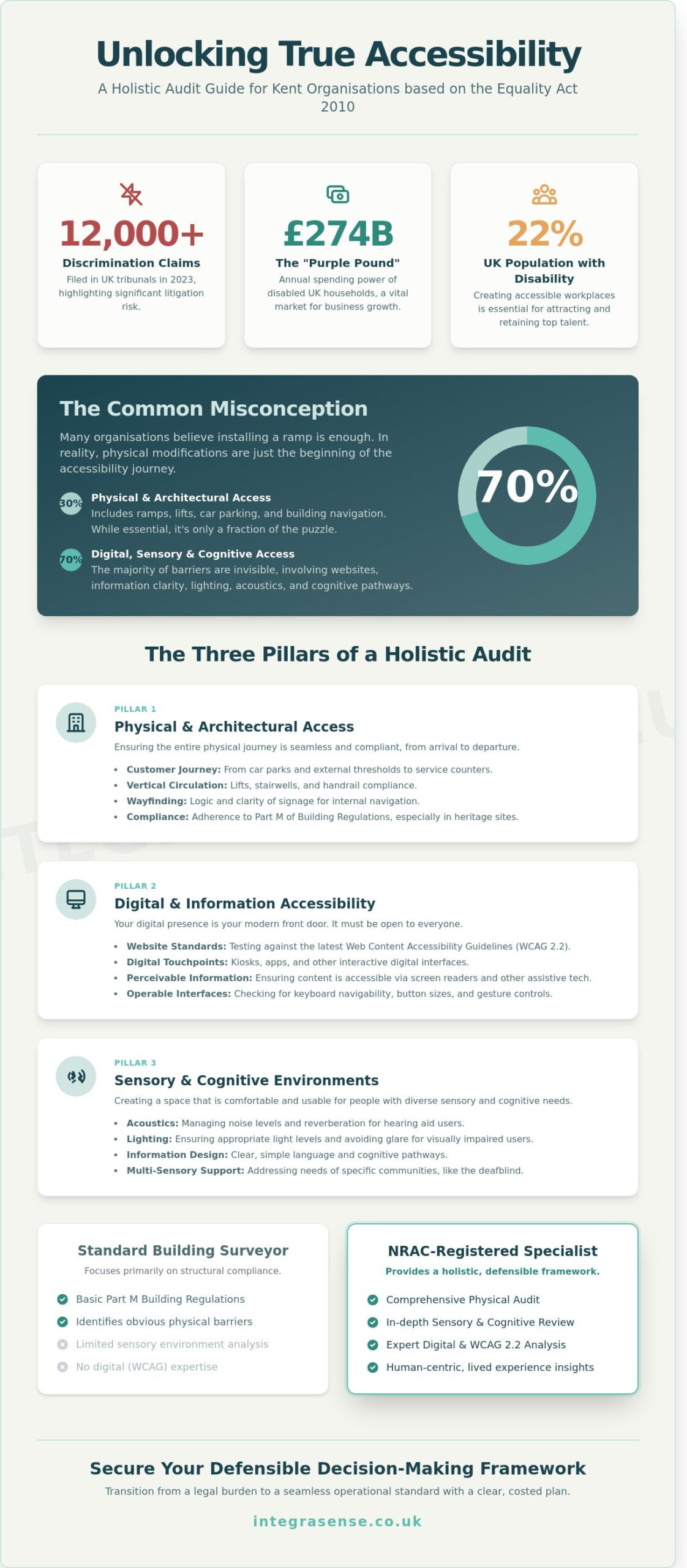
The modern business landscape in Kent demands more than just basic compliance; it requires a commitment to inclusive intelligence. Many organisations mistakenly believe that installing a ramp solves their accessibility obligations. In reality, physical modifications account for only 30% of the total accessibility puzzle. The remaining 70% involves digital interfaces, sensory environments, and cognitive pathways that often remain invisible to the untrained eye. For a business seeking an accessibility audit quote Kent, understanding this holistic requirement is the first step toward true environmental optimization.
Legal risks in the South East are tangible. Non-compliance with statutory obligations leads to more than just financial penalties; it erodes brand equity and damages public trust. A professional audit transforms vague intentions into a defensible strategy for local authorities and charities. It provides the empirical data needed to justify expenditure and prioritise interventions. By sensing the barriers within your space, you gain the clarity required to manage your environment effectively and responsibly.
The Equality Act 2010 and “Reasonable Adjustments”
The Equality Act 2010 requires all service providers to make reasonable adjustments for disabled people. What counts as “reasonable” is not a fixed standard. It scales with your organisation’s size and annual turnover. A small boutique in Canterbury faces different expectations than a large public building in Maidstone. Proactive inclusive design has replaced the era of reactive fixes. Central to this shift is the adherence to international standards like the Web Content Accessibility Guidelines (WCAG), which ensure that digital touchpoints are as accessible as physical entrances. These guidelines provide a framework for making information perceivable and operable for everyone.
The Business Case for Accessibility in Kent
Investing in accessibility is a high-yield strategic move. The “Purple Pound” represents the spending power of disabled households, valued at £274 billion per year across the United Kingdom. Kentish organisations that ignore this demographic leave significant revenue on the table. Beyond the consumer market, inclusive environments improve staff retention rates. Data from the Office for National Statistics shows that roughly 22% of the UK population reported a disability in 2023. Creating a seamless workplace ensures you don’t lose top-tier talent to more accessible competitors. When you request an accessibility audit quote Kent, you’re not just buying a report; you’re investing in a more resilient and socially responsible brand identity that resonates with a wider audience.
The Three Pillars of a Holistic Accessibility Audit
A holistic accessibility audit functions as a strategic deep-dive into the technical and human layers of your organisation. It moves beyond simple compliance, offering an end-to-end evaluation of how diverse users interact with your physical, digital, and sensory environments. By identifying friction points before they become legal or reputational liabilities, we transform your space into a high-performance environment. Requesting an accessibility audit quote Kent businesses can rely on ensures your facilities meet the needs of the 17.6% of the local population who identify as having a disability according to 2021 Census data.
Physical and Architectural Access
Physical barriers often prevent engagement before a customer even reaches your service counter. Our auditors scrutinise the entire customer journey, starting from car parking and external thresholds through to vertical circulation like lifts and stairwells. This is particularly vital for the heritage buildings found in historic Kentish towns like Canterbury or Rochester, where 18th-century architecture must be sensitively adapted to modern standards. We evaluate the logic of your signage and the efficiency of internal navigation to ensure that your physical assets are both welcoming and compliant with Part M of the Building Regulations.
Digital and Information Accessibility
Digital touchpoints represent the front door of your business in a connected economy. We test your website against the WCAG 2.2 standards, which were updated in October 2023 to include new criteria for pointer gestures and button sizes. Our process ensures that your documents, PDFs, and emails are fully readable by screen readers and assistive technologies. There is a compelling business case for accessibility that links digital inclusion to improved search engine rankings and expanded market reach. We also assess the availability of “Easy Read” versions and alternative formats, ensuring your information is accessible to those with cognitive impairments or learning difficulties. For organisations seeking to implement comprehensive digital inclusion strategies, our website accessibility checklist provides a strategic framework for inclusive digital spaces that aligns with current WCAG 2.2 requirements.
Sensory and Communication Intelligence
Sensory intelligence completes the holistic picture by addressing the needs of those with hearing loss, visual impairments, or neurodivergent conditions. The IntegraSense approach provides a distinct edge by auditing for British Sign Language (BSL) support and the specific requirements of those with dual sensory loss. We measure acoustic environments to reduce background noise interference and evaluate lighting levels to support those with sensory processing needs. Our staff training audits determine if your front-line teams in Kent are truly communication-ready. A business that understands how to manage its sensory environment creates a more stable, productive space for both employees and visitors. Securing an accessibility audit quote Kent specialists provide is the most direct route to achieving this level of environmental optimisation.
Choosing the Right Auditor: Surveyors vs. Sensory Specialists
Securing an accurate accessibility audit quote Kent requires a clear understanding of the distinction between structural compliance and functional inclusivity. A standard Chartered Building Surveyor typically evaluates a property against Approved Document M of the Building Regulations. While this ensures physical dimensions meet minimum legal standards, it often neglects the nuanced requirements of the Equality Act 2010. True accessibility transcends ramp gradients; it encompasses how a person perceives and interacts with a space. Since 70% of disabilities are non-visible, a checklist approach often fails to address the sensory and cognitive barriers that prevent true engagement.
Professional credibility in this field rests on registration with the National Register of Access Consultants (NRAC). This body ensures auditors possess the specific competencies required to advise on complex barrier removal beyond simple masonry. Relying solely on “off-the-shelf” automated digital tools or generalist surveyors poses a significant risk to your business. Research indicates that automated tests might only identify 40% of potential barriers. According to UK government guidelines on accessibility audits, a manual review by an expert is essential for legal protection and genuine usability. Without the human element and lived experience of disability, Kent businesses leave themselves vulnerable to litigation and lost revenue.
The Limitations of Traditional Property Surveys
Standard surveys focus on the “bricks and mortar” aspect of a facility. They often overlook sensory barriers that are just as exclusionary as a flight of stairs. For example, poor acoustics in a commercial setting can reduce speech intelligibility by 30% for individuals with hearing impairments. High-gloss flooring that creates glare can disorient visitors with visual sensitivities or neurodivergent conditions. A person-centred approach identifies these “invisible” obstacles that a Part M checklist misses, ensuring your space is optimized for every visitor.
The Value of Multidisciplinary Consultancy
IntegraSense advocates for a holistic model that integrates British Sign Language (BSL) expertise with robust governance and risk management. This ensures that communication support isn’t a secondary thought but a core component of the audit outcome. Effective consultancy provides professional supervision for implementation, ensuring that technical solutions align with long-term resilience goals. When you request an accessibility audit quote Kent, prioritise consultants who demonstrate this multidisciplinary intelligence. It’s about shifting from reactive fixes to creating a seamless, inclusive environment that reflects your brand’s commitment to excellence.
Calculating Costs and Preparing for Your Audit Quote
Precision is the cornerstone of a meaningful accessibility strategy. When you request an accessibility audit quote Kent, the final investment reflects the technical complexity and the scale of your specific environment. We don’t apply a one-size-fits-all figure. Instead, we calculate costs based on the architectural intricacy of your site and the depth of your digital infrastructure. A 400-square-metre retail space in Ashford, which experiences high public footfall, requires a different analytical framework than a private 1,200-square-metre office complex in Dover.
The scope of digital analysis also influences the quote. We distinguish between a standard five-page marketing site and a complex, multi-layered CRM system used by 150 employees. Our methodology involves detailed user-journey simulations. These simulations test your premises against 25 distinct accessibility benchmarks, covering everything from physical navigation to sensory communication. You can typically expect the process to take 14 working days from the initial site visit to the delivery of a defensible, high-resolution report.
What to Include in Your Quote Request
Efficiency begins with high-quality data. To ensure your quote is as accurate as possible, please provide updated building floor plans and any access statements authored since the 2010 Equality Act. We also require a comprehensive list of digital assets, including internal staff portals and customer-facing mobile applications. Sharing your current staff training records is equally vital. In the 2023 reporting cycle, 68% of identified barriers in Kent businesses were attributed to a lack of staff confidence in sensory loss protocols and BSL basics. Understanding how to prepare for an accessibility audit with a structured governance framework ensures that the documentation and evidence you gather in advance leads to a more accurate and actionable final report.
Understanding the ROI of a Precise Audit
An intelligent audit identifies the most efficient path to compliance. It prevents the common pitfall of “gold-plating” adjustments, where businesses overspend on architectural changes that exceed what is legally reasonable or technically necessary. We categorise our findings into a logical sequence. This allows you to prioritise high-impact, low-cost modifications before committing to long-term capital projects. This structured approach is essential for securing local authority contracts; currently, 82% of public sector tenders in the South East require evidence of a proactive inclusion strategy. Furthermore, a detailed audit report serves as the primary evidence needed to unlock government funding, such as the Access to Work grants which can provide up to £66,000 per employee for workplace adaptations.
Optimise your business environment with a data-driven strategy that balances compliance with commercial reality. Request your bespoke accessibility consultation to begin the transformation of your Kent premises.
Securing Your Audit with IntegraSense: A Person-Centred Approach
Choosing an expert consultant requires absolute confidence in their technical depth and their commitment to your long-term success. At IntegraSense, we’ve refined a process that bridges the gap between static regulatory requirements and the dynamic reality of human interaction within a space. We don’t just check boxes; we apply intelligence. Our team utilises advanced sensing techniques to understand how people move through your Kent premises, ensuring that every recommendation is rooted in real-world utility. This approach transforms raw data into a clear, strategic roadmap for inclusion.
The journey with us is holistic and intentional. It begins with initial insight and extends through to final implementation support. We recognise that accessibility isn’t a one-time fix but a continuous commitment to excellence. By focusing on resilient, long-term solutions, we help your organisation stay ahead of evolving standards like the BS 8300:2018. Our focus on sustainability ensures that the modifications you make today will remain effective for years to come, providing a stable foundation for your business growth and social responsibility goals.
The IntegraSense Methodology
Our methodology relies on sense-making. We transform complex environmental data into actionable intelligence that satisfies both users and regulators. By applying Expert Witness and External Quality Assurance (EQA) standards to every project, we provide a level of precision that is rare in the industry. We focus on person-centred outcomes that directly benefit the 16 million disabled people currently living in the UK. Every audit we conduct is a deep technical dive, assessing how physical and digital barriers impact different demographics. We provide clarity where there is often confusion, ensuring your site is optimised for every visitor.
Our consultants bring a wealth of experience to the table, including:
- Strategic Insight: Aligning your accessibility goals with the 2010 Equality Act requirements.
- Technical Precision: Using smart technology to identify friction points in the user journey.
- Future-Proofing: Recommending materials and systems that offer 10-year resilience.
- Expert Oversight: Ensuring all consultancy projects meet the highest EQA benchmarks.
Next Steps: Contacting Our Kent Consultants
Your path to a more inclusive environment begins with a focused 20-minute discovery call. During this session, we’ll define the specific scope of your audit, whether you manage a single heritage site or a portfolio of modern office spaces. Following this consultation, you’ll receive a transparent, fixed-fee accessibility audit quote Kent organisations can use for precise budgetary planning. We believe in total clarity from the outset, removing the guesswork from compliance and allowing you to focus on your core operations.
Don’t leave your accessibility obligations to chance. Our methodical approach ensures that your technical challenges are handled by specialists who value precision and human-centric design. You can Get your bespoke accessibility audit quote from IntegraSense today and take the first step towards a more resilient and inclusive future for your Kent-based business.
Future-Proof Your Organisation’s Inclusive Compliance
True accessibility goes beyond meeting statutory minimums; it’s about creating environments where every individual navigates with dignity. By prioritising sensory specialists over general surveyors, your organisation ensures that its audit addresses the actual lived experience of those with sensory loss. IntegraSense has pioneered this person-centred approach since 2019, leveraging a multidisciplinary team skilled in British Sign Language (BSL), mediation, and complex governance.
Our focus on defensible decision-making provides public sector leaders with the confidence they need to manage complex environments effectively. Securing a detailed accessibility audit quote Kent organisations can trust is the primary step towards a more resilient and optimised future. We don’t just find faults; we provide the intelligence and connectivity needed to transform your space into a truly inclusive hub.
Your journey towards seamless compliance starts with a specialist partnership. Request your bespoke accessibility audit quote today and see how our expertise can empower your team. We’re ready to help you build a world that makes sense for everyone.
Frequently Asked Questions
How much does an accessibility audit cost for a business in Kent?
Professional accessibility audit fees in Kent typically range from £750 for small retail units to over £4,500 for complex industrial sites or multi-storey office blocks. Your specific accessibility audit quote Kent will depend on the total square footage of your premises and the complexity of your digital infrastructure. We provide a transparent breakdown of costs to ensure your investment drives measurable improvements in site efficiency and inclusivity.
Is a digital accessibility audit different from a physical one?
Digital audits focus on software and web compliance with WCAG 2.2 standards, while physical audits evaluate the built environment. A physical assessment examines tangible elements like 900mm wide door clearances and 1:12 gradient ramps to ensure safe movement. We integrate these two disciplines to create a unified experience, ensuring your Kent business remains accessible whether a client visits your physical office or your online service portal.
How often should our Kent organisation update its accessibility audit?
Organisations should refresh their accessibility audits every 24 months to account for physical wear and evolving legislative standards. Regular reviews are essential if you’ve recently completed a refurbishment or migrated your digital platforms to a new host. This biennial cycle ensures your business maintains its commitment to long-term sustainability and avoids the risks associated with outdated access features.
Does the Equality Act 2010 apply to small businesses in the South East?
The Equality Act 2010 mandates that all businesses in the South East, regardless of their size, must provide equal access to services and employment. This legislation protects the 16 million disabled people in the UK by requiring service providers to anticipate needs and remove barriers. Small businesses that ignore these obligations face potential legal challenges and miss out on the significant spending power of disabled consumers.
What is a “reasonable adjustment” for a heritage building in Kent?
A reasonable adjustment for Kent’s 17,000 listed buildings involves finding a balance between modern access requirements and historical preservation. This might include installing high-contrast signage that respects the original aesthetic or using portable ramps where permanent alterations aren’t permitted. Our specialist consultants focus on intelligent, non-invasive solutions that enhance building intelligence without compromising the architectural integrity of protected sites.
Can IntegraSense help with BSL interpreting as part of an audit?
IntegraSense incorporates British Sign Language (BSL) interpreting into our comprehensive audit packages to ensure your communication strategy is truly inclusive. We help you engage with the 151,000 BSL users across the UK by identifying gaps in your current service delivery. Our team provides the technical and human insights needed to foster a seamless environment for the Deaf community in Kent.
What qualifications should an accessibility auditor have?
A reputable auditor should hold accreditation from the National Register of Access Consultants (NRAC) or possess equivalent professional engineering qualifications. Our auditors bring a minimum of 10 years of experience in inclusive design and smart building technology to every project. This high level of expertise ensures that the advice you receive is both legally sound and technically viable for your specific industry.
How long does it take to receive a full accessibility report?
You’ll receive your detailed accessibility report within 14 working days of our on-site assessment. This document provides a structured roadmap, featuring prioritised recommendations and clear photographic evidence of required adjustments. We focus on delivering a swift turnaround so you can begin the journey from initial sensing to final implementation without unnecessary delays.